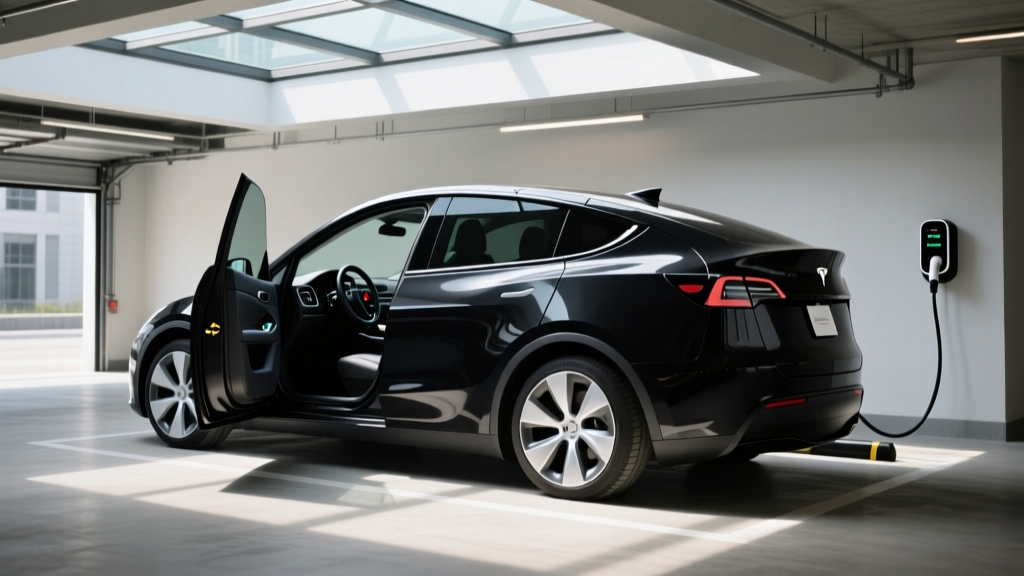
The Tesla Model Y remains one of the best-selling electric vehicles in the United States, and for good reason: strong range, fast charging, and access to the Supercharger network. But as ownership scales into the millions, practical safety questions surface — including how to exit the vehicle if the primary electronic door buttons fail. Understanding the Model Y emergency door release is essential knowledge for every owner and passenger, and it ties into a broader conversation about the vehicle's design, tech, and everyday usability.
This guide covers exactly where the emergency releases are located, how they function, and pairs that critical safety information with a comprehensive 2026 Tesla Model Y review — range, charging, pricing, tax credits, and real-world ownership insights.
Where Is the Tesla Model Y Emergency Door Release?
The Tesla Model Y uses electronic push-button door releases for both front and rear doors. Under normal operation, you press a button at the top of the interior door handle and push the door open. But if the 12V auxiliary system loses power — whether from a dead 12V battery, a collision, or an electrical fault — those electronic buttons stop working.
That's where the mechanical emergency releases come in:
Front Doors
Each front door has a mechanical release cable hidden behind a small removable panel on the door's interior trim, near the window switch area. Pulling this cable manually disengages the door latch. Tesla documents this in the owner's manual, but many owners never locate it until they need it.
Rear Doors
Rear-door emergency releases are less intuitive. On Model Y vehicles, a mechanical release is accessible by removing the bottom portion of the rear door panel or, on some model years, via a pull-tab concealed under the door pocket lining. This is a known pain point: rear passengers — especially children in car seats — may not be able to access it without assistance.
2026 Tesla Model Y: Full Spec Overview
Before diving deeper into safety specifics, here's the complete spec sheet for the current-generation Model Y lineup. Tesla refreshed the Model Y significantly for the 2025 model year (internally called "Juniper"), and those updates carry into 2026 with minor software and pricing adjustments.
| Specification | Long Range RWD | Long Range AWD | Performance |
|---|---|---|---|
| EPA Range | 320 mi | 310 mi | 295 mi |
| Battery (usable) | ~75 kWh, NMC | ~75 kWh, NMC | ~75 kWh, NMC |
| Drivetrain | Rear-Wheel Drive | Dual-Motor AWD | Dual-Motor AWD |
| Horsepower | ~295 hp | ~384 hp | ~456 hp |
| 0-60 mph | 6.5 sec | 4.8 sec | 3.5 sec |
| MPGe (combined) | 123 MPGe | 119 MPGe | 111 MPGe |
| Efficiency | 27 kWh/100mi | 28 kWh/100mi | 30 kWh/100mi |
| Max DC Fast Charge | 250 kW | 250 kW | 250 kW |
| 10-80% DC Time | ~25 min | ~25 min | ~25 min |
| Level 2 Home Charging | 11.5 kW (~44 mi/hr) | 11.5 kW (~44 mi/hr) | 11.5 kW (~44 mi/hr) |
| Cargo Volume | 72 cu ft (rear seats folded) | 72 cu ft (rear seats folded) | 72 cu ft (rear seats folded) |
| Rear Legroom | 40.5 in | 40.5 in | 40.5 in |
| Base MSRP | $46,630 | $49,630 | $53,630 |
Sources: EPA Fueleconomy.gov, Tesla.com Model Y. Prices exclude destination fee. Specs reflect 2026 model year as of publication.
Real-World Range: What the EPA Number Doesn't Tell You
• City/suburban mixed driving (65-75°F): ~300-315 mi — regen braking helps recover energy
• Sustained highway (75 mph, 70°F): ~260-280 mi — aerodynamic drag dominates at speed
• Cold weather (below 32°F, highway): ~210-240 mi — battery heating and cabin HVAC cut range 25-35%
• Cold + highway + headwind: Can dip below 200 mi on a full charge
The Model Y's NMC (nickel manganese cobalt) battery pack delivers strong energy density, which is why Tesla achieves 320 miles from a ~75 kWh usable pack. However, NMC chemistry is more temperature-sensitive than LFP (lithium iron phosphate). In sub-freezing conditions, the battery management system diverts energy to warm the pack — protecting longevity but reducing available range.
Practical tip: Use the Tesla app to precondition the battery and cabin while still plugged in at home. This pulls heating energy from the grid rather than the battery, preserving range for your drive. On road trips, navigating to a Supercharger via the car's built-in navigation triggers automatic battery preconditioning, warming the pack for faster DC charging on arrival.
Charging Speed: DC Fast, Level 2, and the Charge Curve Reality
The 2026 Model Y supports a peak DC fast-charge rate of 250 kW on V3 and V4 Tesla Superchargers, as well as on CCS-compatible third-party networks (with the Tesla CCS adapter, included with newer vehicles). Here's what that looks like in practice:
| Charging Level | Power (kW) | Miles Added per Hour | Notes |
|---|---|---|---|
| Level 1 (120V outlet) | ~1.4 kW | ~4-5 mi/hr | Emergency/trickle only |
| Level 2 (240V, 48A) | 11.5 kW | ~44 mi/hr | Full overnight charge in ~7 hr |
| DC Fast (peak) | 250 kW | ~1,000+ mi/hr (initial) | 10-80% in ~25 min |
| DC Fast (sustained avg) | ~120-140 kW avg | ~500 mi/hr avg | Curve tapers significantly above 60% SoC |
Understanding the charge curve: The 250 kW peak only holds between roughly 10-30% state of charge (SoC). From 30-60%, the rate steps down to around 150-170 kW. Above 60%, it tapers further, dropping below 60 kW past 80%. This is why Tesla and most EV experts recommend charging to 80% on road trips — the final 20% can take as long as the first 60%. For daily use, Tesla recommends setting the charge limit to 80% for NMC batteries to preserve long-term health.
With the Juniper refresh, the Model Y adopted the NACS (North American Charging Standard) connector natively, meaning it plugs directly into Tesla Superchargers without an adapter. For non-Tesla CCS networks like Electrify America or EVgo, a NACS-to-CCS adapter may be required depending on the station — though more networks are adding NACS cables through 2025-2026.
Pricing, Trims, and Federal Tax Credit Eligibility
The 2026 Tesla Model Y is offered in three trims. Here's the pricing breakdown with current federal incentive context:
| Trim | Base MSRP | Est. w/ Destination | §30D Credit Eligible? | Est. After Credit |
|---|---|---|---|---|
| Long Range RWD | $46,630 | ~$48,120 | Yes (if sourcing rules met) | ~$40,620* |
| Long Range AWD | $49,630 | ~$51,120 | Yes (if sourcing rules met) | ~$43,620* |
| Performance | $53,630 | ~$55,120 | Yes (under $80K SUV cap) | ~$47,620* |
*After-credit prices assume full $7,500 §30D eligibility. Actual credit depends on battery sourcing, buyer income, and point-of-sale transfer election. See IRS rules below.
- MSRP Cap: Vehicle must be under $80,000 for SUVs/vans — all Model Y trims qualify.
- Buyer Income Cap: Modified AGI must not exceed $150,000 (single), $225,000 (head of household), or $300,000 (joint). Source: IRS.gov §30D.
- Battery Sourcing: The $7,500 credit splits into two $3,750 halves — one for critical minerals sourcing, one for battery component manufacturing. Tesla's Fremont and Austin-built Model Y batteries have increasingly met domestic sourcing requirements, but the specific breakdown changes quarterly. Verify current eligibility on fueleconomy.gov before purchasing.
- Point-of-Sale Transfer: As of 2024+, buyers can elect to transfer the credit to the dealer at purchase, reducing the upfront price rather than waiting for a tax refund. Tesla supports this at checkout.
Tech, Safety, and Driver Assistance
The Juniper-refreshed Model Y brought notable interior and tech improvements: a ventilated front seat upgrade, ambient lighting, a rear-seat touchscreen, improved sound insulation, and a redesigned center console. The 15.4-inch center touchscreen runs Tesla's latest software with navigation, streaming, and vehicle controls.
Autopilot and FSD (Supervised): Every Model Y ships with basic Autopilot (traffic-aware cruise control + autosteer). Full Self-Driving (Supervised) remains a $8,000 add-on or $99/month subscription.
On the safety front, the Model Y continues to earn top marks from NHTSA (5-star overall) and the IIHS (Top Safety Pick+ when equipped with acceptable headlights). Standard active safety includes automatic emergency braking, lane departure warning, blind-spot monitoring, and rear cross-traffic alert.
Notable Drawbacks
- No physical stalks: The Juniper refresh moved turn signals to steering-wheel buttons and gear selection to the touchscreen — a learning curve some drivers find frustrating.
- Rear emergency release accessibility: As detailed above, the mechanical rear-door release is not immediately obvious, which is a concern for families with young children.
- Panel gaps and build consistency: While improved since early Fremont production, some owners still report minor panel-gap variation. Tesla's Austin-built units tend to be more consistent.
- No Apple CarPlay/Android Auto: Tesla's closed infotainment ecosystem remains a dealbreaker for some buyers accustomed to phone projection.
Pros and Cons at a Glance
✅ Pros
- 320-mile EPA range (Long Range RWD) — among the best in class
- 250 kW peak DC charging with extensive Supercharger network access
- Spacious 72 cu ft cargo area with flat load floor
- Strong performance across all trims (3.5s 0-60 on Performance)
- Over-the-air updates continuously add features
- NACS native connector — no adapter needed at Superchargers
- Top safety ratings from NHTSA and IIHS
❌ Cons
- Rear emergency door release is difficult to locate and operate
- Turn signals on steering wheel buttons take adjustment
- No Apple CarPlay or Android Auto support
- NMC battery requires 80% daily charge limit for longevity
- FSD (Supervised) is expensive and still requires full driver attention
- Insurance costs tend to run 15-25% higher than comparable ICE SUVs
- Cold-weather range loss is significant without preconditioning
Warranty and Battery Longevity
Tesla provides the following warranty coverage for the 2026 Model Y:
- Basic Vehicle: 4 years / 50,000 miles
- Battery & Drive Unit: 8 years / 120,000 miles (Long Range RWD/AWD); 8 years / 120,000 miles (Performance)
- Battery Capacity Retention: Tesla warrants that the battery will retain at least 70% of original capacity during the warranty period
Real-world degradation data from fleet operators and owner surveys suggests NMC Model Y packs typically lose 8-12% capacity over the first 100,000 miles, with the steepest drop occurring in the first 15,000-20,000 miles before leveling off. Best practices for longevity: avoid frequent 100% charges, minimize DC fast-charging when Level 2 is available, and always precondition in extreme temperatures.
Who Should Buy the 2026 Tesla Model Y?
- You want the longest real-world range in a compact electric SUV under $55K
- Road trips are regular — the Supercharger network remains the most reliable DC fast-charging ecosystem in the US
- You need cargo versatility (72 cu ft with seats folded rivals midsize gas SUVs)
- You value OTA software updates that genuinely improve the car over time
- Rear-seat emergency egress is a primary concern — the Hyundai Ioniq 5 and Ford Mustang Mach-E have more intuitive mechanical releases
- You want Apple CarPlay — virtually every competitor offers it
- You prefer a traditional dealership experience with in-person service — Tesla's service model is entirely direct-to-consumer
- You need LFP battery chemistry for daily 100% charging tolerance — look at the base RWD trims of competitors like the Chevy Equinox EV
Frequently Asked Questions
How do I use the Tesla Model Y emergency door release?
For front doors, locate the small removable panel on the interior door trim near the window switches. Remove it and pull the mechanical cable to release the latch. For rear doors, the release is concealed behind the lower door panel or under the door pocket lining — consult your owner's manual for the exact location on your model year. Practice locating these before you need them.
What happens if the Tesla Model Y 12V battery dies?
If the 12V battery fails, the electronic door buttons, touchscreen, and most vehicle systems will not function. The mechanical emergency door releases still work because they are cable-operated and independent of electrical power. Tesla's 2024+ Model Y vehicles use a lithium-ion 12V auxiliary battery, which has a longer lifespan and lower failure rate than the lead-acid units in earlier models.
Does the 2026 Tesla Model Y qualify for the $7,500 federal tax credit?
All Model Y trims fall under the $80,000 SUV MSRP cap. However, the full $7,500 credit depends on (1) your modified adjusted gross income being under IRS thresholds ($150K single / $300K joint), and (2) the battery meeting critical-mineral and component-manufacturing sourcing requirements under §30D. These sourcing rules tighten annually. Verify the current month's eligibility at fueleconomy.gov or consult a tax professional before relying on the credit.
What is the real-world range of the Model Y in winter?
In sustained sub-freezing temperatures with highway driving, expect 210-240 miles from the Long Range AWD (vs. its 310-mile EPA rating). Preconditioning while plugged in, using seat heaters instead of cabin air heating, and reducing speed to 65 mph can recover 20-30 miles of that loss.
How does the Model Y compare to the Hyundai Ioniq 5 or Ford Mustang Mach-E?
The Model Y leads in range (320 vs. ~305 mi for Ioniq 5 Long Range), charging network access (Supercharger exclusivity), and cargo space. The Ioniq 5 charges faster on 800V architecture (~18 min 10-80% vs. ~25 min for the Model Y) and offers a more intuitive interior with physical controls and CarPlay. The Mach-E offers a more traditional driving feel and dealer service network. All three are strong — test-drive each.
Is the Tesla Model Y safe for families with children?
The Model Y earns top crash-test ratings and includes robust active safety features. However, the rear-door emergency release mechanism is a legitimate concern for parents. If your children ride in rear-facing car seats or are too young to follow emergency instructions, familiarize yourself with the rear mechanical release and consider whether competitors with more accessible releases better fit your family's needs.
Always verify specifications, pricing, and tax credit eligibility directly with Tesla.com, IRS.gov, and fueleconomy.gov before purchasing. Rules and vehicle configurations change frequently.