Quick Verdict: The Tesla Model Y in 2026 — Still the Benchmark, But Watch the Door Handles
The Tesla Model Y remains the best-selling electric vehicle in the United States for good reason: class-leading Supercharger access, strong efficiency, and a practical crossover form factor. But if you've been searching for "Tesla Model Y door handles fail" online, you're not alone. A recurring thread on owner forums and NHTSA complaint databases points to intermittent issues with the electronic door-release mechanism — specifically, the interior electronic push-button release failing to actuate the latch, occasionally trapping occupants inside or preventing exterior entry when the 12V auxiliary battery dips.
This review covers the full 2026 Tesla Model Y lineup — its range, charging, performance, pricing, and tax-credit eligibility — while directly addressing the door-handle concern and what it means for buyers and current owners.
| Spec | Long Range AWD | Performance | Standard Range RWD |
|---|---|---|---|
| EPA Range | 320 miles | 295 miles | 260 miles |
| Battery (usable) | ~75 kWh (NMC) | ~75 kWh (NMC) | ~60 kWh (LFP) |
| Peak DC Fast Charge | 250 kW | 250 kW | 175 kW |
| 10–80% DC Time | ~22 min | ~22 min | ~28 min |
| Level 2 (11.5 kW) | ~44 mi/hr | ~44 mi/hr | ~35 mi/hr |
| 0–60 mph | 4.8 sec | 3.5 sec | 6.6 sec |
| Horsepower | 384 hp | 456 hp | 295 hp |
| Drivetrain | Dual-Motor AWD | Dual-Motor AWD | Single-Motor RWD |
| MPGe (combined) | 122 MPGe | 115 MPGe | 128 MPGe |
| Efficiency | 28 kWh/100 mi | 29 kWh/100 mi | 26 kWh/100 mi |
| Base MSRP | $44,990 | $48,990 | $39,990 |
Tesla Model Y Door Handle Failures: What's Actually Happening
The Tesla Model Y uses an electronic push-button door release rather than a traditional mechanical pull handle. A small button on the interior door panel electronically actuates the latch. On the exterior, a flush-mounted pull handle triggers the same electronic latch system.
The complaint pattern: Owners have reported the interior electronic release becoming unresponsive, most commonly when:
- The 12V auxiliary battery (a lithium-ion unit in 2023+ models) is depleted or failing
- The vehicle's body controller module experiences a software glitch
- Moisture ingress into the door latch assembly causes corrosion over time (more common in coastal or road-salt climates)
Mechanical override exists but isn't obvious. Tesla includes a manual release cable located near the door speaker grille (front) or under a small access panel (rear). However, most owners are unaware of it until they're stuck. The rear doors are the more common complaint site, particularly concerning for parents with children in rear car seats.
NHTSA context: As of early 2026, the National Highway Traffic Safety Administration has logged dozens of complaints related to Model Y door latches across model years 2020–2025. No formal recall specifically for the latch mechanism has been issued for the Model Y as of publication, though Tesla has issued service bulletins addressing latch replacement under warranty. You can search complaints directly at NHTSA's complaint database.
Real-World Range: EPA Sticker vs. What You'll Actually Get
EPA Estimated: 320 miles
Real-World Highway (70 mph, mild weather): ~270–290 miles
Real-World Highway (30°F or below): ~220–250 miles
City / Stop-and-Go (regen active): ~300–320 miles
The 2026 Model Y Long Range AWD carries an EPA-estimated 320 miles of range, per fueleconomy.gov. That figure is measured on a mixed cycle with moderate temperatures and climate control active.
In practice, the Model Y's range is heavily influenced by three factors:
- Speed: At sustained 75–80 mph highway driving, aerodynamic drag cuts range by roughly 10–15%. Expect 270–290 miles from a full charge in 60–75°F conditions.
- Temperature: Cold weather is the biggest range killer. At 30°F, expect a 20–30% reduction due to battery internal resistance and cabin heating demands. With the heat pump (standard on 2021+ Model Y), losses are less severe than older EVs, but 220–250 miles is realistic for winter highway driving.
- Terrain and payload: Mountain passes and a fully loaded cabin (5 passengers + cargo) will reduce range further. Regenerative braking recovers energy on descents, partially offsetting uphill losses.
The Standard Range RWD trim uses an LFP (lithium iron phosphate) battery, which is heavier and less energy-dense than the NMC chemistry in Long Range/Performance trims. The trade-off: LFP batteries tolerate daily 100% charging without degradation concerns, have longer cycle life, and are less expensive. NMC batteries offer more range per kilogram but Tesla recommends charging to 80% for daily use to preserve longevity.
Charging Speed: DC Fast Charge and Home Level 2
Charging speed is where the Model Y's Supercharger network advantage shines. Tesla's V3 and V4 Superchargers deliver up to 250 kW to Long Range and Performance trims.
| Charging Method | Power | Miles Added Per Hour | Notes |
|---|---|---|---|
| Level 1 (120V outlet) | ~1.4 kW | ~4–5 mi/hr | Emergency/trickle only |
| Level 2 (240V, 48A) | 11.5 kW | ~35–44 mi/hr | Home overnight standard |
| DC Fast (Supercharger V3) | Peak 250 kW | ~1,000 mi/hr (peak) | Tapers above 60% SoC |
| DC Fast (CCS adapter, EA/others) | Up to 250 kW | Varies by station | CCS adapter included 2024+ |
Charging curve reality: The 250 kW peak rate is only sustained between roughly 10–40% State of Charge. Above 60%, the rate tapers significantly to protect the battery. A 10–80% session takes approximately 22 minutes on a V3 Supercharger for Long Range/Performance trims. Expect the final 80–100% to add another 25–30 minutes — plan accordingly on road trips and charge to 80% unless you need the full battery for the next leg.
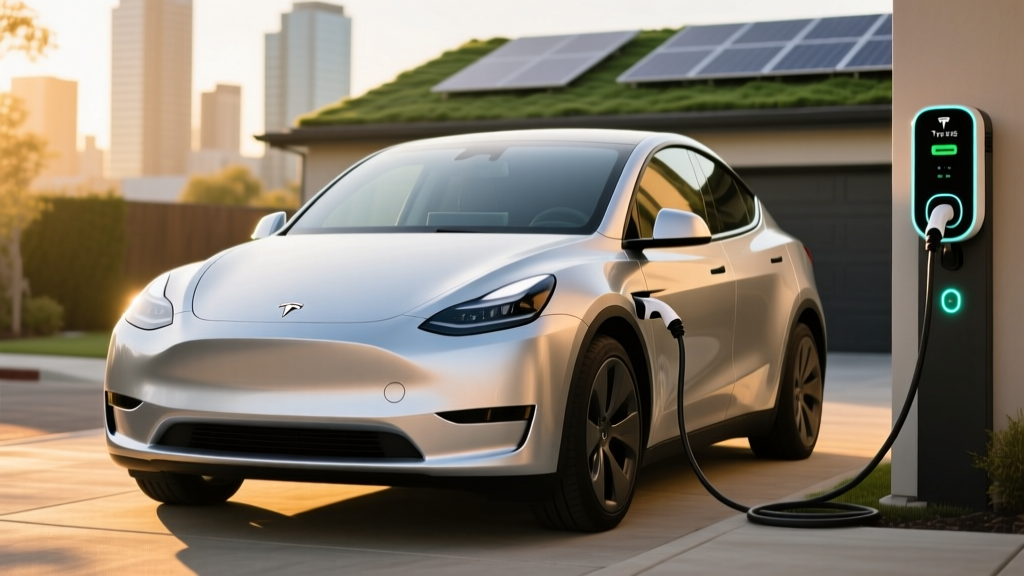
Home charging: Tesla's Wall Connector at 48 amps (11.5 kW) adds roughly 44 miles of range per hour on the Long Range AWD. A full overnight charge from 20% to 80% takes about 5 hours. Installation costs for a 240V/60A circuit typically range from $500–$2,000 depending on panel proximity and local permit requirements. If your home's electrical panel is at capacity (common in older homes with 100A service), a panel upgrade to 200A can add $1,500–$3,000.
Performance, Interior Space, and Daily Practicality
The Model Y Performance trim hits 0–60 mph in 3.5 seconds with 456 hp from its dual-motor setup — supercar territory in a family crossover. The Long Range AWD is hardly slow at 4.8 seconds. Even the Standard Range RWD manages 6.6 seconds, quicker than most gas-powered compact SUVs.
Cargo and passenger space:
- Behind second row: 30.2 cu ft
- With second row folded: 72.1 cu ft
- Front trunk (frunk): 4.1 cu ft
- Rear legroom: 41.6 inches
- Front headroom: 41.0 inches
These numbers make the Model Y one of the most practical EVs in its price class. The flat floor and lack of transmission tunnel create genuinely usable space. Two adults and two children with a double stroller and groceries fit comfortably; a week-long family road trip requires strategic packing but is doable.
Tech and driver assistance: The 15.4-inch center touchscreen controls everything — there are no physical buttons for climate, mirrors, or glovebox. The interface is fast and responsive but demands familiarity. Autopilot is standard (lane-keeping + adaptive cruise). Full Self-Driving (Supervised) is an $8,000 add-on that adds automated lane changes, traffic-light recognition, and city-street navigation.
Both Autopilot and FSD (Supervised) are SAE Level 2 driver-assistance systems. The driver must remain fully engaged, hands on or near the wheel, and eyes on the road at all times. These are NOT self-driving systems. Tesla's camera-based vision system is capable but has documented limitations in construction zones, faded lane markings, and heavy rain.
Pricing, Tax Credits, and Total Cost of Ownership
| Trim | Base MSRP | Destination | §30D Credit Eligible? | Effective Price (if eligible) |
|---|---|---|---|---|
| Standard Range RWD | $39,990 | $1,390 | Yes (up to $7,500) | ~$33,880 |
| Long Range AWD | $44,990 | $1,390 | Yes (up to $7,500) | ~$38,880 |
| Performance | $48,990 | $1,390 | Yes (up to $7,500) | ~$42,880 |
Federal tax credit eligibility (§30D): The 2026 Model Y qualifies for up to $7,500 under the Inflation Reduction Act, but eligibility is not automatic. Per IRS guidelines, you must meet all of the following:
- MSRP cap: Vehicle MSRP must be ≤ $80,000 for SUVs (all Model Y trims qualify)
- Buyer income cap: Modified AGI ≤ $300,000 (married filing jointly), $225,000 (head of household), $150,000 (single)
- Battery sourcing: At least 80% of critical minerals and 100% of battery components must be sourced from the U.S. or FTA-partner countries (as of 2026 requirements — Tesla's U.S.-built batteries generally satisfy this, but verify at purchase)
- Point-of-sale transfer: You can transfer the credit to the dealer at purchase for an immediate price reduction, or claim it on your tax return
- Tax liability: The credit is non-refundable — you must owe at least $7,500 in federal income tax to claim the full amount
Warranty: Tesla covers the Model Y with a 4-year/50,000-mile basic warranty and an 8-year/120,000-mile battery and drive unit warranty (Long Range/Performance) or 8-year/100,000-mile (Standard Range). The battery warranty guarantees retention of at least 70% of original capacity during the warranty period. Door handle and latch assemblies fall under the basic 4-year/50,000-mile coverage — if you're experiencing issues outside that window, repair costs for the electronic latch assembly typically run $300–$600 per door at a Tesla service center.
Pros and Cons: The Honest Scorecard
- Class-leading Supercharger network reliability
- Strong real-world efficiency (26–29 kWh/100 mi)
- Excellent cargo space for the footprint
- Over-the-air updates continuously add features
- Fast DC charging (250 kW peak, ~22 min 10–80%)
- Qualifies for full $7,500 federal tax credit (if eligible)
- Strong resale value relative to other EVs
- Electronic door-release failures reported across model years
- No physical buttons — everything via touchscreen
- Ride quality firm, especially with 21" wheels
- FSD (Supervised) is expensive ($8,000) and still Level 2
- No Apple CarPlay or Android Auto
- Rear visibility limited; relies heavily on cameras
- Insurance premiums 15–25% higher than comparable gas SUVs
Is the 2026 Model Y Worth It vs. Key Competitors?
The Model Y competes directly with the Hyundai Ioniq 5, Ford Mustang Mach-E, and Chevrolet Equinox EV. Here's how it stacks up on the metrics that matter most:
| Metric | Tesla Model Y LR | Hyundai Ioniq 5 LR | Ford Mach-E ER |
|---|---|---|---|
| EPA Range | 320 mi | 305 mi | 312 mi |
| Peak DC Charge | 250 kW | 350 kW | 150 kW |
| 10–80% Time | ~22 min | ~18 min | ~36 min |
| Cargo (rear seats up) | 30.2 cu ft | 27.2 cu ft | 29.7 cu ft |
| Base MSRP (AWD) | $44,990 | $49,500 | $48,995 |
| Charging Network | Supercharger (native) | NACS adapter required | NACS adapter required |
The Ioniq 5 charges faster on paper (350 kW on 800V architecture), but real-world Supercharger reliability still gives Tesla the road-trip edge. The Mach-E offers a more traditional interior with physical buttons but lags in charging speed. If door-handle reliability is a dealbreaker, the Ioniq 5's conventional mechanical handles may sway you.
Choose the Hyundai Ioniq 5 if: You want the fastest DC charging, prefer physical buttons and a more conventional cabin, and don't mind using a NACS adapter for Supercharger access.
Look elsewhere if: Electronic door latches concern you and you want a proven mechanical-release system, or if you need Apple CarPlay/Android Auto integration.
Frequently Asked Questions
What is the real-world range of the 2026 Tesla Model Y?
The EPA rates the Long Range AWD at 320 miles. In real-world highway driving at 70 mph in mild weather, expect 270–290 miles. In cold weather (below 30°F), expect 220–250 miles. City driving with regenerative braking can approach the EPA figure.
How fast does the Model Y charge at home and on the road?
At a Tesla Supercharger, the Long Range and Performance trims peak at 250 kW, achieving a 10–80% charge in approximately 22 minutes. At home on a 240V/48A Level 2 charger (11.5 kW), you'll add roughly 44 miles of range per hour — enough for a full overnight top-up.
How much does the 2026 Model Y cost after tax credits?
The Standard Range RWD starts at $39,990 + $1,390 destination. If you qualify for the full $7,500 federal §30D credit, the effective price drops to approximately $33,880. The Long Range AWD drops to ~$38,880. Eligibility depends on income caps, battery sourcing requirements, and your tax liability — consult a tax professional and verify at IRS.gov.
Do Tesla Model Y door handles actually fail?
Yes — there are documented reports of the electronic interior door-release button failing to actuate the latch, most commonly linked to 12V battery issues or latch assembly moisture corrosion. Tesla includes a manual override cable in each door, but many owners are unaware of it. If you experience intermittent release issues, schedule a service appointment. Under the 4-year/50,000-mile basic warranty, latch replacement is covered.
Is the Model Y worth buying over the Hyundai Ioniq 5 or Ford Mach-E?
For road-trip-heavy owners who value Supercharger network reliability and maximum cargo space, the Model Y still leads. The Ioniq 5 charges faster (350 kW peak) and has a more conventional interior. The Mach-E suits buyers who want physical buttons and a more traditional driving experience. All three qualify for the federal tax credit (verify eligibility for your specific situation).
Does the 2026 Model Y qualify for the $7,500 federal EV tax credit?
Yes, all Model Y trims fall under the $80,000 SUV MSRP cap. However, you must also meet IRS income limits ($150K single / $300K joint), the vehicle's battery must satisfy critical-mineral and component-sourcing thresholds, and you must have sufficient federal tax liability. The credit can be transferred to the dealer at point of sale for an immediate price reduction. Rules are subject to change — always verify current requirements at IRS.gov before purchasing.