Finding Dog Mode in the 2026 Tesla Model Y
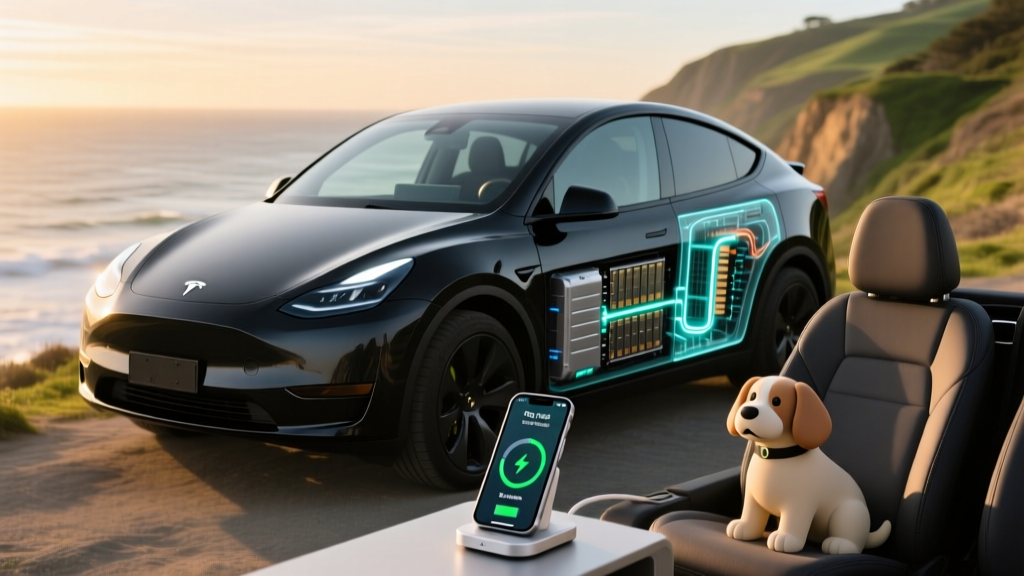
If you've just picked up your Tesla or are shopping for one and wondering where is Dog Mode Tesla, you'll find it inside the climate controls on the touchscreen. Swipe up from the bottom of the screen to open the climate panel, tap the fan icon, and scroll through the climate-keep options at the bottom: you'll see Dog, Camp, and Keep modes. Select Dog, and the cabin maintains your set temperature while the center display shows a large message assuring passersby that your pet is safe and the climate system is running.
Dog Mode is one of those signature Tesla features that turns heads at the grocery store parking lot, but it's also a practical illustration of how the Model Y's thermal management system — complete with a standard heat pump — can sustain cabin comfort for extended periods with minimal energy draw. In this review, we cover the full 2026 Tesla Model Y: range, charging, pricing, tax credit eligibility, and whether it still holds its ground against a rapidly closing competitive field.
Range, Efficiency, and Real-World Expectations
The 2026 Tesla Model Y Long Range AWD carries an EPA-estimated range of 320 miles on its updated battery pack. The base Rear-Wheel Drive variant is rated at 302 miles. These numbers place the Model Y near the top of the compact electric SUV segment, though real-world results depend heavily on how and where you drive.
- EPA sticker: 320 mi (Long Range AWD) / 302 mi (RWD)
- Highway cruising (70-75 mph): Expect ~265-285 mi on a full charge
- City / mixed driving: Closer to EPA, ~295-315 mi thanks to regenerative braking
- Cold weather (below 32°F): Range drops 20-30% — plan for ~220-255 mi without preconditioning; the heat pump mitigates but doesn't eliminate this loss
The Model Y's heat pump (standard across all trims) is a meaningful advantage over competitors still using resistive PTC heaters, reducing winter HVAC energy draw significantly.
Efficiency on the Long Range AWD comes in at approximately 122 MPGe combined, translating to roughly 28 kWh per 100 miles. That's competitive with the Hyundai Ioniq 5 and slightly behind the most efficient configurations of the Ford Mustang Mach-E, but the gap is narrow enough that charging cost differences are measured in pennies per mile.
Battery Chemistry, Capacity, and Warranty
The 2026 Model Y Long Range uses an NMC (nickel manganese cobalt) battery pack with approximately 75 kWh usable capacity (roughly 78.1 kWh gross). Tesla sources cells from multiple suppliers including Panasonic and LG Energy Solution, and exact chemistry can vary by production batch — but NMC is the consistent chemistry for Long Range and Performance trims.
The Rear-Wheel Drive trim has transitioned in recent model years to LFP (lithium iron phosphate) chemistry in many markets. LFP offers a longer cycle life and can be charged to 100% daily without degradation concerns, though it sacrifices some energy density (hence the slightly lower range) and performs worse in extreme cold without preconditioning.
| Attribute | Long Range / Performance (NMC) | RWD (LFP) |
|---|---|---|
| Usable capacity | ~75 kWh | ~60 kWh |
| Daily charge recommendation | 80% for longevity | 100% OK daily |
| Cold-weather performance | Better energy density retention | Needs preconditioning; greater cold loss |
| Cycle life | ~1,000-1,500 cycles to 80% SoH | ~2,500-3,000+ cycles to 80% SoH |
| EPA range | 320 mi (AWD) | 302 mi (RWD) |
Tesla's battery and drive unit warranty covers 8 years or 120,000 miles (Long Range/Performance) and 8 years or 100,000 miles (RWD), with a capacity retention threshold of 70%. This is industry-standard and matches most competitors, though some brands now offer 10-year battery coverage.
Charging Speed: DC Fast and Home Level 2
Charging speed remains one of the Model Y's strongest competitive advantages, particularly given access to the Tesla Supercharger network — which continues to lead the industry in reliability and geographic coverage.
| Charging Level | Power / Rate | Speed |
|---|---|---|
| DC Fast Charge (peak) | 250 kW (Supercharger V3/V4) | 10-80% in ~25 minutes |
| DC sustained (average 10-80%) | ~170-190 kW | Peak tapers above 50% SoC |
| Level 2 home (Tesla Wall Connector) | 11.5 kW (48A) | ~44 miles of range per hour |
| Level 2 home (standard 40A circuit) | 9.6 kW | ~37 miles of range per hour |
| Level 1 (120V outlet) | ~1.4 kW | ~3-5 miles of range per hour |
The 250 kW peak charge rate is impressive on paper, but as with all EVs, the sustained rate matters more. The Model Y's charge curve peaks early (around 10-30% SoC) and progressively tapers. From 10-80%, you'll average roughly 170-190 kW, which is why the 10-80% time is about 25 minutes rather than the theoretical minimum. Preconditioning the battery — which happens automatically when you navigate to a Supercharger — is essential to hitting these numbers. Without it, expect significantly slower charging, especially in cold weather.
Performance and Drivetrain
The 2026 Model Y Long Range AWD uses a dual-motor setup with a permanent-magnet rear motor and an induction front motor (which can freewheel for efficiency when AWD traction isn't needed). Output is approximately 384 horsepower and 376 lb-ft of torque, delivering a 0-60 mph time of 4.8 seconds.
| Spec | Long Range AWD | RWD |
|---|---|---|
| EPA range | 320 mi | 302 mi |
| Battery (usable) | ~75 kWh NMC | ~60 kWh LFP |
| Drivetrain | Dual-motor AWD | Single-motor RWD |
| Horsepower | 384 hp | 295 hp |
| 0-60 mph | 4.8 sec | 6.6 sec |
| Top speed | 135 mph | 135 mph |
| Max DC charge rate | 250 kW | 170 kW |
| 10-80% DC time | ~25 min | ~30 min |
| Efficiency | 122 MPGe / 28 kWh/100mi | 128 MPGe / 26 kWh/100mi |
The RWD model is no slouch at 6.6 seconds to 60 mph — quicker than many gas-powered compact SUVs — but the dual-motor AWD variant provides both the performance edge and the all-weather confidence that justifies its price premium for buyers in snow-belt states.
Interior, Cargo, and Tech Features
The refreshed Model Y interior (introduced with the "Juniper" update) brought meaningful improvements: ventilated front seats, ambient lighting, a rear-seat touchscreen for climate and media control, improved sound insulation, and updated materials. The minimalist aesthetic remains — there are still no physical buttons on the dash, and all climate, mirror, and glove-box controls live on the 15.4-inch center touchscreen.
Cargo volume: 30.2 cubic feet behind the second row, expanding to 72.1 cubic feet with the rear seats folded. The front trunk (frunk) adds approximately 4.1 cubic feet of secure, weatherproof storage — ideal for charging cables or groceries you want separated from the cabin.
Passenger space: Rear legroom measures 41.6 inches, which is generous for the segment and accommodates rear-facing child seats without pushing the front passenger into the dashboard. Headroom is ample thanks to the full glass roof, though that same glass roof can make the cabin noticeably warm in direct summer sun — the included tint helps, but many owners add an aftermarket shade.
Standout tech features:
- Dog Mode, Camp Mode, Keep Mode: Climate-maintenance features accessible from the climate panel — Dog Mode keeps pets safe with a visible message on screen, Camp Mode maintains climate and USB power overnight, and Keep Mode holds temperature without fanfare
- Autopilot (standard): SAE Level 2 driver assistance including Traffic-Aware Cruise Control and Autosteer lane centering
- Full Self-Driving Supervised (optional, ~$8,000): Adds automatic lane changes, Navigate on Autopilot, Smart Summon, and traffic light/stop sign recognition — but remains Level 2 requiring full driver attention
- 15.4-inch touchscreen with navigation, streaming, gaming, and Sentry Mode dashcam recording
- Over-the-air updates: Continuous feature additions and refinements without dealer visits
Tesla's Autopilot and Full Self-Driving (Supervised) are SAE Level 2 driver-assistance systems. You must keep your hands on the wheel and eyes on the road at all times. These systems do not make the vehicle autonomous. Only Level 4 services like Waymo operate without a driver.
Notable drawbacks: The all-touchscreen interface frustrates some buyers who prefer physical knobs for volume or temperature. Panel gap quality, while improved, still draws occasional criticism. The ride on the Performance trim's larger wheels can feel firm on rough pavement. And while the Supercharger network is best-in-class, non-Tesla charging (via the included CCS adapter or NACS-native stations opening to other brands) can be slower and less reliable.
Pricing, Trims, and Federal Tax Credit Eligibility
The 2026 Tesla Model Y lineup is structured across three main trims. Pricing reflects Tesla's most recent adjustments:
| Trim | Base MSRP | Federal Credit (§30D) | Effective Price* |
|---|---|---|---|
| Rear-Wheel Drive | $44,990 | Up to $7,500 (if eligible) | ~$37,490 |
| Long Range AWD | $48,990 | Up to $7,500 (if eligible) | ~$41,490 |
| Performance AWD | $52,490 | Up to $7,500 (if eligible) | ~$44,990 |
*Effective price assumes full §30D credit eligibility. Destination charges, paint/wheel upgrades, and FSD purchase add to final cost.
The federal EV tax credit under IRS §30D can reduce your cost by up to $7,500, and as of 2024, this credit can be transferred to the dealer at the point of sale — meaning you get the discount upfront rather than waiting to claim it on your tax return. However, eligibility is not automatic. You must meet all of the following criteria:
- MSRP cap: The vehicle's MSRP must not exceed $80,000 for SUVs — all Model Y trims qualify
- Buyer income limits: Adjusted gross income must not exceed $150,000 (single), $225,000 (head of household), or $300,000 (joint filers)
- Battery sourcing: The battery's critical minerals and components must meet phased-in domestic sourcing thresholds — Tesla's US-built packs have largely met these requirements, but verify at fueleconomy.gov before purchasing, as eligibility can shift by production date
- Point-of-sale transfer: You can elect to transfer the credit to Tesla at purchase, reducing your out-of-pocket cost immediately
Always confirm current eligibility on IRS.gov and consult a tax professional, as rules are subject to legislative changes.
Model Y vs. Key Competitors: Is It Worth Buying?
The compact electric SUV segment is more competitive than ever. Here's how the Model Y stacks up against its most direct rivals:
| Spec | Tesla Model Y LR | Hyundai Ioniq 5 LR AWD | Ford Mach-E ER AWD |
|---|---|---|---|
| EPA range | 320 mi | 290 mi | 300 mi |
| Battery | ~75 kWh NMC | 84 kWh NMC | 91 kWh NMC |
| Peak DC charge | 250 kW | 350 kW (800V) | 150 kW |
| 10-80% time | ~25 min | ~18 min | ~38 min |
| 0-60 mph | 4.8 sec | 5.1 sec | 5.6 sec |
| Cargo (behind 2nd row) | 30.2 cu ft | 27.2 cu ft | 29.7 cu ft |
| Base MSRP (AWD) | $48,990 | $50,200 | $48,995 |
The Ioniq 5's 800V architecture gives it a clear DC fast-charging advantage — 18 minutes from 10-80% is meaningfully faster on road trips. The Mach-E offers a more traditional SUV feel with physical buttons and a conventional dealership experience. But the Model Y's combination of Supercharger network access, cargo space, efficiency, and software ecosystem (including Dog Mode, Sentry Mode, and OTA updates) keeps it at or near the top of buyer consideration lists.
- Supercharger network access is a priority for road trips
- You value over-the-air updates and software features like Dog Mode and Sentry Mode
- Maximum cargo space and efficiency matter more than peak charging speed
- You're comfortable with a touchscreen-only interface
- Faster DC charging is critical (Ioniq 5 / EV6 with 800V)
- You want physical buttons and a traditional dealership service experience (Mach-E)
- You prefer a more conventional interior layout or need a larger battery for towing (Mach-E GT)
Who the 2026 Model Y Suits Best
The Model Y is a strong fit for daily commuters who can charge at home and want minimal running costs, small families who need car-seat-friendly rear space and cargo flexibility, and frequent road-trippers who benefit from the Supercharger network's reliability. It's less ideal for buyers who tow regularly (3,500 lb max towing is modest), those without home charging access in areas with sparse public infrastructure, or drivers who strongly prefer physical controls and traditional dealer service.
- Best-in-class Supercharger network for road trips
- Class-leading cargo volume (30.2 / 72.1 cu ft)
- Heat pump standard — strong cold-weather efficiency
- Dog Mode, Camp Mode, Sentry Mode add daily utility
- Strong efficiency (122-128 MPGe) keeps charging costs low
- OTA updates continuously add features
- 250 kW peak DC charging trails 800V competitors (Ioniq 5 at 350 kW)
- All-touchscreen interface lacks physical controls
- FSD purchase ($8,000) adds significant cost for Level 2 capability
- Glass roof can cause cabin heat in summer
- Ride quality firm on Performance trim
Frequently Asked Questions
Where is Dog Mode on a Tesla?
Open the climate controls by swiping up from the bottom of the touchscreen or tapping the temperature display. Tap the fan speed icon, and at the bottom of the panel you'll see three mode options: Keep, Dog, and Camp. Tap Dog to activate it. The screen will display a large message reading "My owner will be back soon. Don't worry! The A/C is on and it's [temperature] inside." You can also activate Dog Mode via the Tesla mobile app remotely.
How long can Dog Mode run on a Tesla Model Y?
Dog Mode can run for many hours — limited only by your battery's state of charge. On a warm day, the heat pump and A/C compressor draw roughly 1-3 kW to maintain cabin temperature, meaning a Model Y Long Range at 50% SoC (~37 kWh available) could sustain Dog Mode for 12+ hours. In extreme heat or cold, consumption rises. Tesla sends a notification to your phone if the battery drops below 20% while Dog Mode is active.
Does the 2026 Model Y qualify for the $7,500 federal tax credit?
The Model Y qualifies for the full $7,500 §30D federal tax credit for eligible buyers, provided you meet IRS income limits ($150K single / $300K joint), the vehicle's MSRP is under $80,000 (all trims qualify), and the battery meets critical-mineral and component sourcing requirements. Tesla's US-assembled packs have generally met these thresholds, but always verify current eligibility at fueleconomy.gov before purchase. The credit can be transferred at point of sale for an immediate price reduction.
What is the real-world range of the 2026 Model Y?
The EPA rates the Long Range AWD at 320 miles. In real-world highway driving at 70-75 mph, expect approximately 265-285 miles. In cold weather below freezing, range can drop to 220-255 miles without preconditioning. City driving with regenerative braking gets closest to the EPA figure. For official EPA data, check fueleconomy.gov.
Is Tesla Autopilot or FSD self-driving?
No. Both Autopilot (standard) and Full Self-Driving Supervised (optional) are SAE Level 2 driver-assistance systems. They require continuous driver supervision — hands on the wheel and eyes on the road. They can handle lane centering, adaptive cruise, and (with FSD) automatic lane changes, but they cannot navigate all scenarios safely without human intervention.
How does the Model Y's charging speed compare to competitors?
The Model Y's 250 kW peak is competitive but trails the Hyundai Ioniq 5 and Kia EV6, which use 800V architecture supporting up to 350 kW (10-80% in ~18 minutes). However, Tesla's Supercharger network delivers more consistent real-world charging reliability than third-party networks, which partially offsets the raw speed disadvantage.