Quick Verdict: The Benchmark Compact Electric SUV
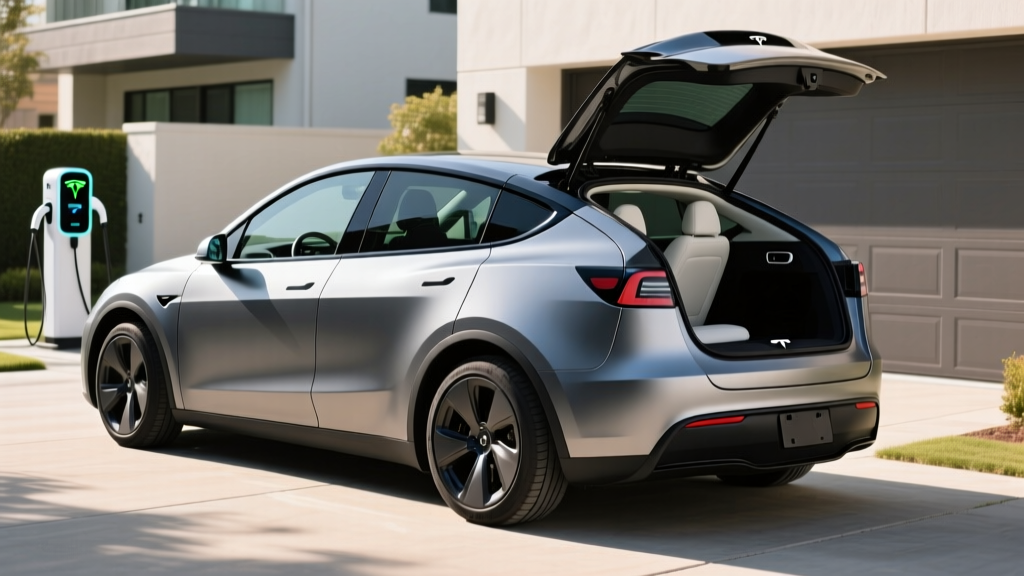
The Tesla Model Y remains the default choice in the compact electric SUV segment for buyers who prioritize charging infrastructure, cargo versatility, and software integration. For 2026, the refreshed "Juniper" Model Y brings a redesigned interior, a full-width light bar, ventilated front seats, and a rear touchscreen — but the core value proposition is unchanged: class-leading efficiency, access to Tesla's 20,000+ Supercharger network, and a starting price that undercuts most rivals after the federal tax credit.
This guide breaks down every dimension, spec, and ownership number you need before signing a purchase agreement.
Tesla Model Y Dimensions & Exterior Specs
The 2026 Model Y sits on the same platform as the Model 3 sedan but rides higher and stretches longer to accommodate SUV cargo needs. Here is the complete dimensional breakdown for the current-generation Juniper refresh:
| Dimension | Measurement |
|---|---|
| Overall Length | 188.0 in (4,775 mm) |
| Overall Width (mirrors folded) | 75.6 in (1,921 mm) |
| Overall Width (mirrors extended) | 83.8 in (2,129 mm) |
| Overall Height | 63.9 in (1,624 mm) |
| Wheelbase | 113.8 in (2,890 mm) |
| Ground Clearance | 6.6 in (167 mm) |
| Curb Weight (Long Range RWD) | 4,331 lbs (1,964 kg) |
| Curb Weight (Long Range AWD) | 4,416 lbs (2,003 kg) |
| Drag Coefficient (Cd) | 0.22 |
| Wheel Options | 19" Gemini / 20" Helix |
Garage-fit note: At 75.6 inches wide with mirrors folded, the Model Y fits most standard US garage bays (typically 8–9 feet wide). However, the 188-inch length means you'll want at least a 20-foot-deep bay to close the door comfortably behind it. Measure before you buy.
Interior Space: Passenger Room & Cargo Volume
The Model Y's sloping roofline gives it a coupe-like silhouette, but interior volume remains competitive with boxier rivals like the Hyundai Ioniq 5 and Ford Mustang Mach-E.
| Interior Metric | Measurement |
|---|---|
| Front Headroom | 41.0 in |
| Rear Headroom | 37.7 in |
| Front Legroom | 41.8 in |
| Rear Legroom | 37.0 in |
| Front Shoulder Room | 56.5 in |
| Rear Shoulder Room | 54.0 in |
| Cargo Volume (rear seats up) | 30.2 cu ft |
| Cargo Volume (rear seats folded) | 72.0 cu ft |
| Front Trunk (Frunk) | 4.1 cu ft |
| Total Cargo Capacity | 76.1 cu ft |
For context, 30.2 cubic feet behind the second row swallows roughly four full-size suitcases or a double stroller with room to spare. The 72 cu ft maximum with seats folded rivals some midsize SUVs and makes the Model Y a practical choice for IKEA runs or camping gear.
Seating for seven: Tesla offers an optional third-row seat ($3,000) that brings total capacity to seven passengers. However, the third row is best suited for children under about 5'4" — legroom is tight at roughly 26.5 inches, and cargo space drops significantly when it's deployed. For regular seven-passenger needs, the Model X or Kia EV9 is a better fit.
Range, Battery & Efficiency
Real-World Expectation: Expect 260–285 miles on highway road trips at 70–75 mph. In sub-freezing winter conditions (below 32°F), plan for 200–230 miles of usable range — a roughly 30–35% reduction due to cabin heating demand and increased battery resistance. City driving with regenerative braking recovers energy and can push real-world results closer to or slightly above the EPA sticker.
The 2026 Model Y Long Range uses a ~75 kWh usable lithium iron phosphate (LFP) battery pack. Tesla has shifted its standard and long-range packs toward LFP chemistry in recent years. LFP offers key advantages: longer cycle life (less degradation over time), the ability to charge to 100% daily without accelerating wear, and lower reliance on cobalt and nickel. The trade-off is slightly lower energy density than NMC chemistry, which is why the pack is physically larger than earlier NMC packs for similar range.
| Efficiency Metric | Long Range RWD | Long Range AWD |
|---|---|---|
| EPA Combined MPGe | 122 MPGe | 111 MPGe |
| Energy Consumption | 28 kWh/100 mi | 30 kWh/100 mi |
| Usable Battery Capacity | ~75 kWh (LFP) | ~75 kWh (LFP) |
| EPA Range | 320 mi | 295 mi |
Source: EPA Fuel Economy
Charging Speed: DC Fast Charge & Home Level 2
Charging speed is where the Model Y's integration with the Tesla Supercharger network pays dividends. Here is the full charging profile:
| Charging Method | Rate | Speed / Notes |
|---|---|---|
| DC Fast Charge (Supercharger V4) | Up to 250 kW peak | 10–80% in ~25 minutes; tapers significantly above 80% |
| DC Fast Charge (CCS adapter) | Up to 250 kW peak | Same curve; compatible with Electrify America, EVgo, etc. |
| Level 2 Home (Tesla Wall Connector) | 11.5 kW (48A) | ~44 miles of range per hour; full charge in ~7 hours |
| Level 2 Public (J1772 adapter) | Up to 11.5 kW | Varies by station; ChargePoint, EVgo L2, etc. |
| Level 1 (120V household outlet) | ~1.4 kW | ~4–5 miles per hour; emergency/trickle only |
Charging-curve reality: The 250 kW peak rate holds only between roughly 10–30% state of charge. From 30–60%, expect sustained rates around 150–170 kW. Above 80%, the rate drops to under 50 kW to protect the LFP cells. This is why Tesla (and every other automaker) advertises 10–80% times rather than 0–100%. For road trips, plan your stops around the 10–80% window — charging from 80–100% at a DC fast charger adds 20+ minutes for only ~60 miles of range.
The Model Y uses the NACS (North American Charging Standard) connector natively. A CCS adapter is included or available for use with non-Tesla DC fast-charging networks. By 2026, most major networks have added NACS cables, reducing adapter dependency.
Performance & Drivetrain
| Performance Spec | Long Range RWD | Long Range AWD |
|---|---|---|
| Drivetrain | Rear-Wheel Drive (single motor) | Dual-Motor All-Wheel Drive |
| Horsepower | ~346 hp | ~384 hp |
| Torque | ~346 lb-ft | ~376 lb-ft |
| 0–60 mph | 5.6 seconds | 4.6 seconds |
| Top Speed | 125 mph | 125 mph |
| Towing Capacity | 3,500 lbs | 3,500 lbs |
The dual-motor AWD variant is the stronger pick for buyers in snow-belt states. The independent front and rear motors provide torque vectoring that improves traction without the mechanical complexity of a traditional AWD system. The 4.6-second 0–60 time is brisk enough to merge confidently onto any highway, though it trails the discontinued Performance variant (3.5 seconds).
Towing note: The 3,500-pound tow rating handles a small boat trailer or light utility trailer. Towing reduces range by roughly 40–50%, so plan for 150–180 miles of real-world range when hauling. Always use the Tesla tow hitch accessory and enable Tow Mode in the vehicle settings.
Pricing, Trims & Federal Tax Credit
| Trim | Base MSRP | After §30D Credit | Destination |
|---|---|---|---|
| Long Range RWD | $44,990 | $37,490* | +$1,390 |
| Long Range AWD | $47,990 | $40,490* | +$1,390 |
*Effective price after $7,500 point-of-sale transfer, assuming full eligibility.
- MSRP Cap: SUVs/vans/pickups must be ≤$80,000 MSRP. The Model Y qualifies at all trims.
- Buyer Income Cap: AGI must not exceed $150,000 (single), $225,000 (head of household), or $300,000 (joint). Check your prior-year or current-year AGI, whichever is lower.
- Battery Sourcing: Critical minerals and battery components must meet phased-in percentages from US or free-trade-agreement partners. Tesla has largely localized its supply chain, but verify current-year compliance on the IRS Clean Vehicle Credits page before purchasing.
- Point-of-Sale Transfer: You can transfer the credit to the dealer at purchase, reducing your out-of-pocket cost by $7,500 on the spot — you don't need to wait until tax filing.
- One credit per taxpayer per year: You cannot claim the credit on more than one new EV in the same tax year.
Source: IRS §30D Clean Vehicle Credit
Technology, Driver Assistance & Notable Drawbacks
Infotainment: The Juniper refresh adds a 15.4-inch center touchscreen (slightly larger than the outgoing 15-inch) plus an 8-inch rear-seat touchscreen for climate and media control. The system runs Tesla's proprietary software with built-in navigation, streaming (Netflix, YouTube, Spotify while parked), and over-the-air updates. There is no Apple CarPlay or Android Auto — a dealbreaker for some buyers who prefer phone-mirroring interfaces.
Driver Assistance (Autopilot / FSD Supervised):
Tesla Autopilot (standard) and Full Self-Driving Supervised ($8,000 option or $99/month) are SAE Level 2 driver-assist systems. The driver must keep hands on the wheel (or demonstrate attentiveness via the cabin camera) and remain prepared to take over at any moment. These systems are NOT self-driving. Only Level 4 services like Waymo operate without a human driver.
Autopilot includes adaptive cruise control, lane-centering, and automatic emergency braking. FSD Supervised adds automated lane changes, navigation-guided on/off-ramp handling, and traffic-light/stop-sign recognition. Real-world performance varies: it excels on well-marked highways but can be hesitant in construction zones and complex urban intersections.
- Does not eliminate the need for an attentive driver
- Does not handle all weather conditions (heavy rain, fog, snow can disable sensors)
- Does not guarantee safe navigation through construction zones or unmapped areas
- Is not a substitute for a licensed, sober, alert driver
Notable Drawbacks:
- No Apple CarPlay / Android Auto — Tesla's walled garden won't suit everyone
- Firm ride quality — the sport-tuned suspension transmits more road imperfections than the Ioniq 5 or Mach-E, though the Juniper refresh improved damping
- Panel-gap variability — build quality has improved but still varies unit-to-unit; inspect before delivery
- Insurance costs — Model Y premiums average 15–25% higher than comparable gas SUVs due to repair costs and claim frequency
- Minimal physical controls — nearly all functions (glove box, mirror adjustment, vent direction) are screen-driven, which frustrates some drivers
Who the Model Y Suits Best
- You road-trip frequently and want the most reliable DC fast-charging network (Superchargers)
- You need versatile cargo space (72 cu ft max) without stepping up to a 3-row SUV
- You can charge at home with a Level 2 wall connector
- You value OTA software updates and tech-forward features
- You require Apple CarPlay or Android Auto (consider Ioniq 5, Mach-E, or EV6)
- You need genuine 7-passenger seating with usable third-row space (consider the Kia EV9 or Model X)
- You prioritize a plush, quiet ride over sporty handling (consider the Genesis GV70 Electrified)
- You lack home charging access and your area has limited public infrastructure
Warranty & Long-Term Ownership
| Coverage | Term |
|---|---|
| Basic Vehicle Limited Warranty | 4 years / 50,000 miles |
| Battery & Drive Unit Warranty | 8 years / 120,000 miles (whichever comes first) |
| Battery Capacity Retention Guarantee | Minimum 70% capacity over warranty period |
The 8-year/120,000-mile battery warranty is competitive with the industry standard. Tesla guarantees the pack will retain at least 70% of its original capacity during the warranty window. In practice, LFP packs have shown strong longevity — Tesla's own fleet data suggests average degradation of roughly 10–12% over 100,000 miles for LFP-equipped vehicles, though individual results vary based on charging habits and climate.
Battery care tips for LFP: Unlike NMC chemistry, Tesla recommends charging LFP packs to 100% at least once per week to allow the battery management system to recalibrate cell balance. There is no need to baby an LFP pack with an 80% daily limit as you would with NMC.
Pros & Cons at a Glance
- Access to 20,000+ Tesla Superchargers — most reliable DC fast-charging network
- Class-leading cargo volume (72 cu ft max) in the compact EV SUV segment
- Low energy consumption (28 kWh/100 mi RWD) keeps charging costs down
- LFP battery can be charged to 100% daily without degradation concerns
- Strong over-the-air update pipeline keeps the vehicle current
- $7,500 federal tax credit eligibility reduces effective price significantly
- No Apple CarPlay or Android Auto
- Firm ride quality compared to Hyundai Ioniq 5 and Kia EV6
- Insurance premiums run 15–25% above segment average
- Third-row option is cramped — children only
- Panel gap and paint quality still inconsistent unit-to-unit
- FSD Supervised is expensive ($8,000) and remains Level 2 — not autonomous
Frequently Asked Questions
What is the real-world range of the 2026 Tesla Model Y?
The EPA rates the Long Range RWD at 320 miles and the AWD at 295 miles. In real-world highway driving at 70–75 mph, expect 260–285 miles. In freezing winter conditions, plan for 200–230 miles due to heating load and reduced battery efficiency. City driving with frequent regenerative braking can push results closer to the EPA sticker or slightly above.
How fast does the Model Y charge at home and on the road?
On a Tesla Supercharger (V3/V4), the Model Y peaks at 250 kW and charges from 10–80% in approximately 25 minutes. At home with a Tesla Wall Connector (11.5 kW / 48A Level 2), you'll add about 44 miles of range per hour, with a full charge taking roughly 7 hours. A standard 120V outlet delivers only 4–5 miles per hour and is suitable only for overnight trickle charging.
How much does the Model Y cost after the federal tax credit?
The Long Range RWD starts at $44,990 MSRP and drops to approximately $37,490 after the $7,500 §30D point-of-sale credit — assuming your income falls below the AGI caps ($150K single / $300K joint) and the vehicle meets current-year battery-sourcing requirements. The AWD version starts at $47,990 and drops to ~$40,490. Always verify eligibility on the IRS Clean Vehicle Credit page before purchasing.
Is the Model Y worth buying vs. the Ioniq 5, Mach-E, or EV6?
The Model Y wins on Supercharger network access, cargo volume (72 cu ft vs. ~53–60 for rivals), and software integration. The Hyundai Ioniq 5 and Kia EV6 offer faster 10–80% charging (~18 minutes on 350 kW chargers), Apple CarPlay/Android Auto, and a more comfortable ride. The Ford Mustang Mach-E provides a more traditional SUV feel and CarPlay support. If public charging reliability is your top priority, the Model Y's Supercharger advantage is hard to beat. If you want a plusher ride and phone-mirroring, test-drive the Ioniq 5 or EV6.
Does the Tesla Model Y qualify for the $7,500 federal EV tax credit?
Yes — as of 2026, the Model Y qualifies for the full $7,500 §30D credit at all trims (all are under the $80,000 SUV MSRP cap). Buyer eligibility depends on adjusted gross income limits ($150K single, $225K head of household, $300K joint filers) and the vehicle meeting critical-mineral and battery-component sourcing thresholds for the current tax year. The credit can be transferred to the dealer at the point of sale, reducing your purchase price on the spot.
What are the biggest pros and cons of the 2026 Model Y?
Top pros: Supercharger network reliability, 72 cu ft cargo space, 28 kWh/100 mi efficiency, LFP battery longevity, OTA updates, and post-credit pricing. Top cons: no CarPlay/Android Auto, firm ride, above-average insurance costs, cramped optional third row, and variable panel-gap quality.
How does the LFP battery affect ownership?
LFP (lithium iron phosphate) chemistry trades a small amount of energy density for longer cycle life, thermal stability, and the ability to charge to 100% regularly without accelerated degradation. Tesla recommends a weekly 100% charge for LFP packs to maintain cell-balance calibration. Long-term degradation data suggests roughly 10–12% capacity loss over 100,000 miles — among the best in the industry.