2026 Tesla Model Y: The Compact Electric SUV That Defined a Segment
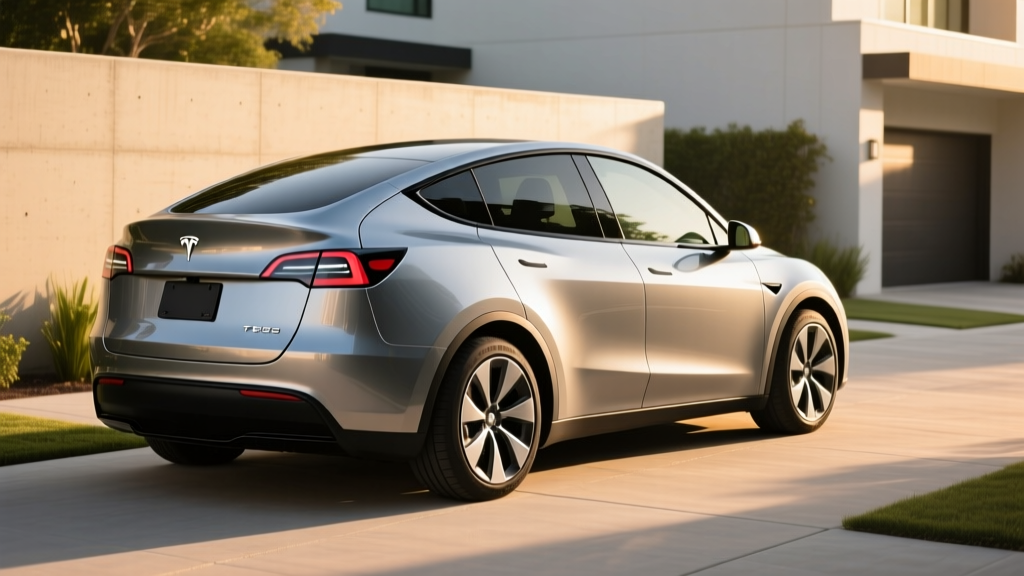
If you've ever searched for "Tesla Model Y dimensions in feet" before visiting a showroom or measuring your garage, you're not alone. The Model Y's footprint is one of the most scrutinized specs in the EV world, because this crossover has to fit into real lives — tight urban garages, family road trips, and daily commutes alike. For 2026, the refreshed Model Y (internally dubbed "Juniper") carries over the proportions buyers know but adds meaningful updates to range, interior materials, and ride refinement.
This review covers every number that matters: exterior and interior dimensions, real-world range versus the EPA sticker, DC fast-charging behavior, pricing after federal tax credits, and how the Model Y stacks up against a growing field of rivals.
Tesla Model Y Dimensions in Feet and Inches: Exterior and Cargo
Let's address the headline question directly. The 2026 Tesla Model Y measures approximately 15.6 feet long (187.0 inches), 6.3 feet wide (75.6 inches without mirrors), and 5.3 feet tall (63.9 inches). Wheelbase stretches 9.7 feet (113.8 inches). These figures place it firmly in the compact-to-midsize crossover segment, roughly the same footprint as a Toyota RAV4 but with a lower roofline and longer wheelbase for better interior packaging.
| Measurement | Feet | Inches | Millimeters |
|---|---|---|---|
| Overall Length | 15.6 ft | 187.0 in | 4,750 mm |
| Width (no mirrors) | 6.3 ft | 75.6 in | 1,921 mm |
| Width (mirrors folded) | 6.8 ft | 81.5 in | 2,070 mm |
| Height | 5.3 ft | 63.9 in | 1,624 mm |
| Wheelbase | 9.7 ft | 113.8 in | 2,890 mm |
| Ground Clearance | 0.56 ft | 6.7 in | 170 mm |
Cargo volume is where the Model Y earns its family-SUV credentials. Behind the second row, you get 30.2 cubic feet of space. Fold the rear seats and that expands to 72.1 cubic feet. The front trunk (frunk) adds another 4.1 cubic feet, useful for charging cables or a small bag. Compared to the Hyundai Ioniq 5 (27.2 cu ft rear / 59.3 cu ft max), the Model Y holds a practical edge for bulkier loads.
Interior Space: Passenger Room by the Numbers
Inside, the Model Y's 9.7-foot wheelbase translates to generous legroom. Front-seat occupants enjoy 41.8 inches of legroom and 40.0 inches of headroom. Rear passengers get 37.0 inches of legroom and 37.7 inches of headroom — enough for adults on longer trips, though the sloping roofline cuts into headroom for passengers over six feet tall.
The 2026 Juniper refresh improved seat cushion density and added ventilated front seats across all trims, addressing one of the longest-standing complaints about the pre-refresh Model Y. Rear-seat recline adjustment is now standard, and the addition of a rear touchscreen (borrowed from the refreshed Model 3) lets back-seat passengers control climate and media independently.
Range, Efficiency, and Battery Specs
EPA Estimated: 320 miles (Long Range AWD, 19" wheels)
Real-World Highway (70 mph): ~265–285 miles
Real-World Cold Weather (below 32°F): ~220–250 miles
Highway driving, cold temperatures, and aggressive acceleration all reduce range from the EPA sticker. Plan charging stops using ~85% of the EPA figure for conservative trip planning.
The 2026 Model Y Long Range AWD pairs an 82 kWh usable battery (NMC chemistry — nickel manganese cobalt) with dual motors producing a combined 384 horsepower and 376 lb-ft of torque. Efficiency lands at 122 MPGe combined, or roughly 28 kWh per 100 miles, according to fueleconomy.gov. That's among the most efficient figures in the compact electric SUV class.
The base Rear-Wheel Drive (RWD) trim uses a smaller 60 kWh LFP (lithium iron phosphate) battery rated for 260 miles EPA. LFP chemistry trades energy density for longevity — Tesla recommends charging LFP packs to 100% regularly, which simplifies daily use and reduces degradation anxiety over hundreds of thousands of miles.
| Trim | Battery (usable kWh) | Chemistry | EPA Range | MPGe (Combined) |
|---|---|---|---|---|
| RWD (Base) | 60 kWh | LFP | 260 mi | 118 MPGe |
| Long Range AWD | 82 kWh | NMC | 320 mi | 122 MPGe |
| Performance AWD | 82 kWh | NMC | 295 mi | 111 MPGe |
Charging Speed: DC Fast Charging and Home Level 2
Charging speed remains a Tesla stronghold, though the gap has narrowed as competitors adopt 800V architectures. The 2026 Model Y Long Range peaks at 250 kW on DC fast chargers via the native NACS connector, which now provides access to Tesla's Supercharger network and, increasingly, third-party stations equipped with NACS cables.
On a V3 or V4 Supercharger, the Long Range model charges from 10% to 80% in approximately 22 minutes. However, the charge curve tapers sharply above 80% — expect 80–100% to add another 15–20 minutes. For road trips, plan stops at 15–20% SoC and charge to 80% for the best time-to-miles ratio.
| Charging Method | Power (kW) | Speed | Notes |
|---|---|---|---|
| Level 1 (120V household) | ~1.4 kW | ~3–4 mi/hr | Emergency/trickle only |
| Level 2 (240V, 48A home) | 11.5 kW | ~37 mi/hr | Full charge overnight (~8 hrs) |
| DC Fast (NACS Supercharger) | Peak 250 kW | 10–80% in ~22 min | Tapers above 80% |
For home charging, the Model Y's onboard charger accepts up to 11.5 kW (48 amps) on a 240V Level 2 circuit. A full charge from 10% takes about 7–8 hours. Installation of a Tesla Wall Connector or equivalent NACS-compatible Level 2 unit typically costs $500–$1,500 for equipment and electrician labor, assuming your panel has capacity. Homes with older 100-amp service may need a $1,500–$3,000 panel upgrade — factor this into your first-year budget.
Performance: Acceleration and Drivetrain
The Long Range AWD hits 0–60 mph in 4.8 seconds with its dual-motor setup. The Performance trim drops that to 3.5 seconds thanks to revised motor mapping and a track-tuned suspension. The base RWD model is no slouch at 6.6 seconds to 60 — adequate for highway merging and confident passing.
All trims feature regenerative braking with one-pedal driving capability. The Juniper refresh brought a slightly softer brake-pedal feel and revised damper tuning that reduces the crashiness over sharp bumps — a welcome change from the firm ride of pre-2025 models. Towing capacity maxes out at 3,500 lbs for AWD trims, sufficient for a small utility trailer or a pair of dirt bikes but not a full-size camper.
Pricing, Trims, and Federal Tax Credit Eligibility
| Trim | Base MSRP | Est. After §30D Credit* | Drivetrain |
|---|---|---|---|
| RWD (Base) | $44,990 | $37,490 | Rear-Wheel Drive |
| Long Range AWD | $48,990 | $41,490 | Dual-Motor AWD |
| Performance AWD | $53,490 | $45,990 | Dual-Motor AWD |
*Federal tax credit amount shown assumes full eligibility. Actual credit depends on IRS §30D rules.
The federal EV tax credit under IRS §30D can reduce your effective purchase price by up to $7,500, and as of 2024 it can be transferred to the dealer at the point of sale — meaning you don't have to wait until tax filing to benefit. However, eligibility is not automatic. Here's what you need to verify:
- MSRP Cap: The Model Y qualifies as an SUV under IRS rules, so the cap is $80,000. All trims clear this easily.
- Buyer Income Limits: Modified adjusted gross income must not exceed $300,000 (joint filers), $225,000 (head of household), or $150,000 (single filers).
- Battery Sourcing: A portion of the credit depends on critical minerals and battery components sourced from the U.S. or FTA-partner countries. Tesla's supply chain has progressively shifted to comply, but verify the exact credit amount on the IRS qualified vehicle list before purchasing.
As an as-tested example, a Long Range AWD with $1,500 Ultra Red paint and $1,000 20" wheels lands at roughly $51,490 MSRP, dropping to about $43,990 after the full $7,500 credit — competitive with a well-equipped Hyundai Ioniq 5 or Ford Mustang Mach-E when similarly optioned.
Technology, Driver Assists, and Notable Drawbacks
The Model Y's 15.4-inch center touchscreen runs Tesla's latest software, which in 2026 includes a more responsive navigation system, improved voice commands, and native integration with the Tesla Supercharger network for automatic route preconditioning. The Juniper refresh added ambient lighting, acoustic glass on all four doors, and power-folding second-row seats — quality-of-life upgrades that close the gap with more traditionally luxurious competitors.
Tesla's Autopilot and Full Self-Driving (Supervised) are Level 2 driver-assist systems. The driver must remain attentive, keep hands on the wheel, and be prepared to take over at any moment. This is not autonomous driving. Only Level 4 services like Waymo operate without a human driver in defined areas.
Standard Autopilot includes adaptive cruise control and lane centering. The $8,000 FSD (Supervised) package adds automatic lane changes, traffic light and stop sign recognition, and city-street navigation — though its real-world behavior still requires active supervision and occasional intervention. For most buyers, the included Autopilot is sufficient for highway commuting.
Pros
- Class-leading cargo volume (72.1 cu ft max)
- Access to Tesla Supercharger network (17,000+ U.S. stalls)
- Strong efficiency (122 MPGe combined)
- Over-the-air updates add features post-purchase
- Point-of-sale tax credit reduces upfront cost
Cons
- No physical instrument cluster or stalks (all screen-based)
- Rear visibility limited by sloping roofline
- FSD package expensive and still requires supervision
- Insurance premiums above segment average
- Ride quality improved but still firm on rough pavement
Who the 2026 Tesla Model Y Suits Best
Daily commuters benefit from the Model Y's efficiency and one-pedal driving in stop-and-go traffic. A Long Range owner with home charging will spend roughly $500–$700 per year on electricity (at $0.14/kWh national average), compared to $1,800+ for a gas equivalent averaging 25 MPG.
Young families will appreciate the cargo space, standard AWD traction (on Long Range and Performance), and strong NHTSA 5-star safety ratings. The rear touchscreen keeps kids entertained on road trips, and the frunk stores strollers or sports gear out of sight.
Road trippers gain the most from Tesla's Supercharger network — still the most reliable and widespread DC fast-charging ecosystem in the U.S., even as Electrify America and others expand. With 250 kW peak charging and route preconditioning, a 500-mile trip requires one 20-minute stop and minimal range guesswork.
The Model Y is less ideal for buyers who prioritize traditional luxury materials, want physical buttons and knobs, or need more than 3,500 lbs of towing capacity. If those matter, consider the Rivian R1S (more rugged, higher tow rating) or the Genesis Electrified GV70 (more opulent interior, lower range).
Is the 2026 Model Y Still Worth Buying vs. Competitors?
The compact electric SUV segment has matured. The Hyundai Ioniq 5 offers 800V ultra-fast charging (10–80% in 18 minutes on a 350 kW charger) and a more distinctive design. The Ford Mustang Mach-E delivers engaging driving dynamics. The upcoming Chevrolet Equinox EV undercuts on price.
Yet the Model Y holds its position through a combination that's hard to replicate: best-in-class cargo space, Supercharger network access, strong efficiency, and aggressive post-credit pricing. For buyers who value practicality and charging infrastructure above styling novelty, the 2026 Model Y remains the default recommendation — and the dimensions in feet (15.6 × 6.3 × 5.3) still fit most American garages with room to spare.
Frequently Asked Questions
What is the real-world range of the Tesla Model Y?
The EPA rates the Long Range AWD at 320 miles, but real-world highway driving at 70 mph typically yields 265–285 miles. In cold weather (below 32°F), expect 220–250 miles due to battery resistance and cabin heating demands. The RWD trim's 260-mile EPA rating drops to roughly 210–230 miles on the highway.
How fast does the Model Y charge at home and on the road?
At home on a 240V Level 2 charger (48A), the Model Y adds about 37 miles of range per hour, fully charging overnight in 7–8 hours. On a DC fast charger, it peaks at 250 kW and reaches 10–80% in roughly 22 minutes. Charging slows significantly above 80% to protect battery health.
How much does the Tesla Model Y cost after tax credits?
The base RWD starts at $44,990 and drops to approximately $37,490 after the full $7,500 federal credit. The Long Range AWD starts at $48,990 ($41,490 after credit). Eligibility depends on your income, the vehicle's battery sourcing compliance, and MSRP limits per IRS §30D guidelines.
Does the Tesla Model Y qualify for the federal EV tax credit?
Yes, all Model Y trims fall under the $80,000 SUV MSRP cap. However, the buyer must also meet income limits ($150K single / $300K joint), and the vehicle must satisfy critical-mineral and battery-component sourcing requirements. Check the IRS qualified vehicle list for the most current credit amount before purchasing.
What are the Tesla Model Y's biggest advantages over competitors?
Supercharger network access, class-leading cargo space (72.1 cu ft), strong efficiency (122 MPGe), and competitive post-credit pricing. The native NACS connector also future-proofs charging compatibility as the industry standardizes on Tesla's plug.
What are the biggest drawbacks?
The turn-signal buttons on the steering wheel (replacing traditional stalks) take getting used to. The minimalist interior isn't for everyone, FSD remains a costly add-on that still requires full driver attention, and insurance costs tend to run 15–25% higher than comparable gas-powered crossovers.