The 2026 Tesla Model Y: Your Complete Delivery-Day Briefing
If you're tracking a Tesla car delivery for the refreshed Model Y (internally dubbed "Juniper"), you already know the basics: it's a compact electric crossover with strong range, access to the Supercharger network, and minimal dealership friction. What most pre-delivery guides miss is the data that actually matters once you drive off the lot — real-world range versus the EPA sticker, how the charging curve behaves at a Supercharger, and whether your specific configuration qualifies for the federal EV tax credit under current IRS §30D rules.
This profile breaks down the 2026 Model Y lineup with the exact numbers you need before signing the delivery paperwork, plus a checklist of what to inspect when your VIN finally gets assigned.
Range, Battery, and Efficiency: Beyond the EPA Sticker
Real-World Expectation: Plan for ~260–285 miles on highway road trips at 70–75 mph. In freezing temperatures (below 32°F), expect a 20–30% reduction, dropping effective range to ~190–230 miles depending on cabin heating use and whether you precondition. City driving with regenerative braking recovers more energy, often exceeding the EPA combined figure.
The 2026 Model Y Long Range AWD uses a 78.1 kWh (usable) battery pack with NMC (nickel manganese cobalt) chemistry, which offers higher energy density and stronger cold-weather performance than LFP. The Standard Range RWD model uses a ~60 kWh LFP (lithium iron phosphate) pack — heavier per kWh but rated for more charge cycles and safer to hold at 100% state of charge daily.
| Specification | Model Y Standard RWD | Model Y Long Range AWD | Model Y Performance AWD |
|---|---|---|---|
| EPA Range | 277 mi | 320 mi | 295 mi |
| Battery (usable) | ~60 kWh (LFP) | 78.1 kWh (NMC) | 78.1 kWh (NMC) |
| Efficiency | 28 kWh/100mi (120 MPGe) | 26 kWh/100mi (130 MPGe) | 28 kWh/100mi (120 MPGe) |
| 0–60 mph | 6.5 sec | 4.8 sec | 3.5 sec |
| Horsepower | 295 hp | 384 hp | 456 hp |
| Drivetrain | RWD (single motor) | AWD (dual motor) | AWD (dual motor) |
Efficiency is where Tesla continues to lead the segment. The Long Range AWD's 26 kWh per 100 miles translates to roughly 3.8 miles per kWh — meaning even a modest 40 kWh top-up at a Supercharger adds about 150 miles. For context, the Ford Mustang Mach-E Extended Range AWD achieves around 2.7 mi/kWh, and the Hyundai Ioniq 5 AWD lands near 3.1 mi/kWh. (Source: EPA / fueleconomy.gov)
Charging Speed: Supercharger and Home Level 2
Charging speed is the number one concern for EV buyers, and Tesla's advantage here is twofold: the peak charge rate and the density of the Supercharger network. The 2026 Model Y Long Range AWD accepts up to 250 kW on a V3 or V4 Supercharger (CCS1 via the built-in NACS port, now the North American standard). Here's what that means in practice:
| Charging Level | Power | Speed (approx.) | Use Case |
|---|---|---|---|
| Level 1 (120V outlet) | ~1.4 kW | ~4–5 mi/hr | Emergency/trickle |
| Level 2 (240V, 48A Wall Connector) | 11.5 kW | ~44 mi/hr | Daily home charging |
| DC Fast (Supercharger V3/V4) | Peak 250 kW | 10–80% in ~22 min | Road trips |
| DC Fast (3rd-party CCS) | Up to 250 kW (site-dependent) | 10–80% in ~22–28 min | Non-Tesla networks |
Charging curve reality check: The 250 kW peak is not sustained. The Model Y's charge curve ramps quickly to ~250 kW between 10–20% state of charge, then tapers progressively. By 50% SoC, you'll see roughly 150 kW; by 80%, it drops below 60 kW. This is why Tesla (and every other manufacturer) quotes 10–80% times rather than 0–100%. Charging from 80–100% on DC fast charge is painfully slow and unnecessary for road trips — plan your stops around the 10–80% window for the fastest throughput.
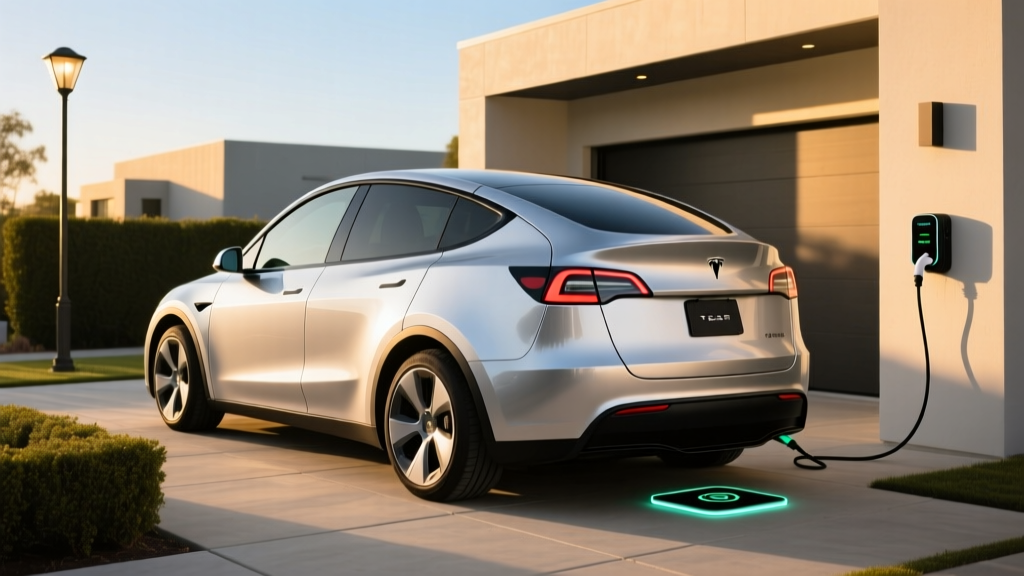
For home charging, Tesla's Wall Connector at 48 amps on a 240V/60A circuit delivers 11.5 kW, adding roughly 44 miles per hour of charging. A full overnight charge (10 hours) restores about 440 miles — more than enough to replenish any single day's driving. Installation costs typically run $500–$1,500 depending on panel proximity and whether your electrical panel needs an upgrade to 200A service.
Pricing, Trims, and Federal Tax Credit Eligibility
The 2026 Model Y lineup starts at $44,990 for the Standard Range RWD and climbs to $52,490 for the Long Range AWD (prices before destination and options). The Performance variant sits at approximately $54,990.
| Trim | Base MSRP | Est. After §30D Credit | Qualifies? |
|---|---|---|---|
| Standard Range RWD | $44,990 | ~$37,490 | Yes (if sourcing rules met) |
| Long Range AWD | $52,490 | ~$44,990 | Yes (if sourcing rules met) |
| Performance AWD | $54,990 | ~$47,490 | Yes (if sourcing rules met) |
Federal tax credit (IRS §30D) rules for 2026: The Model Y qualifies for up to $7,500, which can now be transferred at the point of sale as a price reduction — you don't need to wait until tax filing. However, eligibility depends on several conditions that change periodically:
- MSRP cap: SUVs/crossovers must be priced at or below $80,000 (all Model Y trims qualify).
- Buyer income cap: Modified AGI must not exceed $150,000 (single), $225,000 (head of household), or $300,000 (joint).
- Battery sourcing: A percentage of critical minerals and battery components must be sourced from the US or FTA partners — Tesla has progressively shifted supply chains, but confirm your specific VIN's eligibility at the point of sale or via the IRS qualified vehicles list.
- Point-of-sale transfer: You can elect to transfer the credit to Tesla at delivery, reducing your out-of-pocket cost immediately.
Important: Battery sourcing requirements tighten annually. Always verify your delivery vehicle's eligibility on the IRS qualified manufacturer list before finalizing the purchase. A tax professional can confirm income eligibility specifics.
Interior, Cargo, and Technology
The refreshed Model Y interior received meaningful improvements over the pre-2025 model. The cabin now features ventilated front seats, ambient lighting, a rear-seat touchscreen, and improved sound insulation that noticeably reduces wind and road noise at highway speeds.
Cargo space: 30.2 cubic feet behind the second row, expanding to 72.1 cubic feet with the rear seats folded. The front trunk (frunk) adds approximately 4.1 cubic feet — useful for charging cables and a small bag. Rear legroom measures 41.6 inches, which comfortably fits adults on longer trips.
Infotainment and tech: The 15.4-inch center touchscreen runs Tesla's proprietary OS with built-in navigation, streaming apps, and over-the-air updates. There is no Apple CarPlay or Android Auto — Tesla's native interface is the only option, which is either a pro or a con depending on your ecosystem preferences. The navigation system integrates real-time Supercharger availability and routes through waypoints automatically on longer trips.
Driver assistance: Basic Autopilot (Traffic-Aware Cruise Control + Autosteer) is standard. Full Self-Driving (Supervised) remains an $8,000 add-on or $99/month subscription.
Delivery Day: What to Inspect Before Signing
Tesla's delivery process is streamlined — often completed in 15–30 minutes at a service center or via contactless drop-off. That speed is convenient but means you need to be proactive about inspection. Here's what to check before you accept the vehicle:
- Panel gaps and paint: Walk the entire vehicle in good lighting. Check the hood-to-fender alignment, rear hatch seams, and bumper-to-quarter-panel gaps. Tesla's build quality has improved significantly, but cosmetic issues still surface.
- Wheel and tire condition: Inspect all four wheels for curb rash (from transport) and verify tire brand/date codes match.
- Screen and electronics: Boot up the touchscreen, test the rear screen, verify all cameras display correctly, and confirm Bluetooth pairs with your phone.
- Charging port: Plug in a Supercharger or Level 2 cable on-site if possible. Verify the port door opens/closes and the latch engages.
- VIN and documentation: Confirm the VIN on the dash plate matches your paperwork. Verify the title, registration, and insurance are in order before driving off.
- Tax credit confirmation: If you're applying the §30D credit at point of sale, confirm the dealer report (IRS Form 15407) reflects the correct credit amount and that Tesla has processed the price reduction.
Pros, Cons, and the Competition
- Class-leading efficiency (3.8 mi/kWh on Long Range)
- Access to 6,000+ Tesla Superchargers in North America — still the most reliable DC network
- Strong real-world range (260–285 mi highway) with 22-min 10–80% charging
- Over-the-air updates continuously add features
- Point-of-sale $7,500 tax credit reduces effective price to ~$37,490 (Standard Range)
- Minimal maintenance — no oil, filters, or emissions checks
- No Apple CarPlay or Android Auto
- FSD (Supervised) is expensive ($8,000) and still requires full driver attention
- Ride quality is firm — sportier than some competitors (Mach-E, Ioniq 5)
- Service center wait times can stretch weeks in high-population areas
- Lack of physical buttons for climate/media frustrates some drivers
- Insurance premiums run 15–30% higher than comparable gas crossovers
Is it worth buying vs. competitors? The Model Y Long Range AWD at ~$44,990 (after credit) competes directly with the Hyundai Ioniq 5 Long Range AWD (~$52,000 before credit), Ford Mustang Mach-E Extended Range AWD (~$48,000 before credit), and Volkswagen ID.4 Pro S AWD (~$49,000 before credit). The Model Y wins on efficiency, Supercharger access, and cargo volume. The Ioniq 5 wins on ride comfort and 800V charging architecture (slightly faster peak rates at compatible stations). The Mach-E offers a more traditional cockpit layout with physical controls. If you road-trip frequently, the Supercharger network remains a decisive advantage — other networks (Electrify America, EVgo) have improved but still trail Tesla in uptime and plug-and-charge reliability.
Warranty and Long-Term Ownership
Tesla's warranty coverage is straightforward:
- Basic vehicle: 4 years / 50,000 miles
- Battery and drive unit: 8 years / 120,000 miles (Long Range/Performance) or 8 years / 100,000 miles (Standard Range), with a minimum 70% capacity retention threshold
The 70% retention threshold is standard across the industry. In practice, Tesla's NMC packs have shown approximately 10–12% degradation over 100,000 miles based on fleet data, meaning most owners will retain 88–90% capacity well within the warranty period. LFP packs (Standard Range) degrade even more slowly but start with less total capacity.
Long-term ownership costs favor the Model Y if you charge at home. At the US average electricity rate of $0.17/kWh, charging a Long Range from empty to full costs roughly $13.30 — versus $50–$65 for a tank of gas in a comparable crossover. Over 5 years and 75,000 miles, the fuel savings alone can exceed $6,000, partially offsetting higher insurance costs. (Source: IRS §30D Credit Guidelines)
Frequently Asked Questions
What is the real-world range of the 2026 Tesla Model Y?
The EPA rates the Long Range AWD at 320 miles and the Standard Range RWD at 277 miles. In real-world highway driving at 70–75 mph, expect 260–285 miles (Long Range) and 220–245 miles (Standard Range). Cold weather below freezing reduces these figures by 20–30%. City driving with regenerative braking often yields results at or slightly above the EPA combined estimate.
How fast does the Model Y charge at home and on the road?
On a Tesla Wall Connector (Level 2, 11.5 kW), the Model Y adds about 44 miles per hour, fully charging overnight. At a V3/V4 Supercharger, it peaks at 250 kW and charges from 10–80% in approximately 22 minutes. The charge curve tapers significantly above 80%, so plan road-trip stops around the 10–80% window.
How much does the Model Y cost after the federal tax credit?
The Standard Range RWD starts at $44,990 and drops to approximately $37,490 with the full $7,500 §30D credit applied at point of sale. The Long Range AWD falls from $52,490 to ~$44,990. Eligibility depends on your income, the vehicle's battery sourcing compliance, and MSRP caps — confirm your specific VIN's qualification before delivery.
Does the 2026 Model Y qualify for the $7,500 federal EV tax credit?
Yes, all Model Y trims fall under the $80,000 SUV MSRP cap. However, you must meet the income limits ($150K single / $300K joint) and the vehicle must satisfy critical-mineral and battery-component sourcing thresholds that tighten annually. Tesla has shifted significant sourcing to US and FTA-partner supply chains, but always verify on the IRS qualified vehicles list for your delivery date.
Is the Model Y worth buying over the Ioniq 5 or Mach-E?
The Model Y wins on efficiency (3.8 mi/kWh), Supercharger network access, and cargo space (72.1 cu ft max). The Ioniq 5 offers a smoother ride and faster 800V charging at compatible stations. The Mach-E provides a more conventional interior with physical buttons. If you frequently road-trip and value charging reliability, the Model Y's ecosystem advantage is significant. If ride comfort or CarPlay are priorities, test-drive the Ioniq 5 before committing.
What should I check on delivery day?
Inspect panel gaps and paint in good lighting, test all screens and cameras, verify the charging port functions, confirm your VIN matches paperwork, and ensure the §30D point-of-sale credit is reflected on your final invoice. Document any cosmetic issues with photos before signing — Tesla can address them at a service center, but it's far easier to note them at delivery.
Sources: EPA / fueleconomy.gov, IRS §30D Electric Vehicle Credits, Tesla Model Y Specifications.