The Dallas-Fort Worth EV Benchmark: 2026 Tesla Model Y at a Glance
Search for "Tesla Motors Dallas" and you'll find the Model Y remains the default crossover EV for North Texas buyers — and for good reason. The 2026 Model Y Long Range AWD delivers 320 miles of EPA-estimated range, access to the Supercharger network (now open to other brands), and a starting MSRP of $44,990 before incentives. But Dallas drivers face specific conditions — triple-digit summer heat, sprawling highway commutes on I-35 and the DNT, and occasional winter ice storms — that affect real-world range and charging behavior in ways the EPA sticker doesn't capture.
This review breaks down exactly what a 2026 Model Y delivers in the DFW metroplex: actual highway range at 80 mph, DC fast-charge taper above 80%, LFP battery longevity in Texas heat, and whether the §30D federal tax credit applies to your purchase.
| Spec | Value |
|---|---|
| EPA Range | 320 miles |
| Battery (usable) | ~75 kWh, LFP (prismatic) |
| Max DC Fast Charge | 250 kW peak |
| 10–80% DC Time | ~25 minutes |
| Level 2 Home Charge | 11.5 kW (~44 mi/hr) |
| 0–60 mph | 4.8 seconds |
| Horsepower | 384 hp (dual motor) |
| Drivetrain | AWD, dual motor |
| Efficiency | 122 MPGe / 28 kWh/100mi |
| Cargo (rear seats up) | 30.2 cu ft |
| Cargo (rear seats folded) | 72.1 cu ft |
| Base MSRP | $44,990 |
| Battery Warranty | 8 years / 120,000 miles |
Real-World Range: What Dallas Heat and Highway Driving Actually Cost You
EPA Sticker: 320 miles
Expected Highway (75–80 mph, I-35/DNT): ~265–285 miles
Expected City/Suburban (Dallas stop-and-go): ~295–310 miles
Cold Weather (below 35°F, rare DFW ice events): ~240–260 miles
Summer A/C Load (100°F+ North Texas): ~280–300 miles
The 2026 Model Y Long Range uses a lithium iron phosphate (LFP) battery pack with approximately 75 kWh of usable capacity. LFP chemistry sacrifices some energy density versus NMC (nickel manganese cobalt) but gains significantly in cycle life and thermal stability — a meaningful advantage in Dallas summers where ambient temperatures regularly exceed 100°F and battery thermal management is critical.
According to fueleconomy.gov, the Model Y Long Range AWD achieves 122 MPGe combined. In practice, efficiency on Dallas highways hovers around 3.5–3.8 miles per kWh at 75 mph, which translates to roughly 265–285 miles before you need to plug in. The LFP pack's thermal stability means less aggressive cooling draw in extreme heat compared to NMC packs, partially offsetting the A/C energy penalty during July and August.
For the typical DFW commuter covering 40–60 miles round trip (Plano to downtown, Arlington to Las Colinas), a single home charge provides 4–5 days of driving. Road trips to Austin (195 miles) or Houston (240 miles) are feasible on a single charge, but a 10-minute Supercharger stop in Waco or College Station provides a comfortable buffer.
Charging Speed: Supercharger Network and Home Level 2 Setup
Charging infrastructure is where Tesla still holds a structural advantage, though the gap is narrowing as other networks expand. The 2026 Model Y charges via the NACS (North American Charging Standard) connector natively — no adapter required at Superchargers.
| Level | Power | Speed | Use Case |
|---|---|---|---|
| Level 1 (120V) | ~1.4 kW | ~5 mi/hr | Emergency/trickle only |
| Level 2 (240V, 48A) | 11.5 kW | ~44 mi/hr | Home daily charging |
| DC Fast (Supercharger V3/V4) | 250 kW peak | 10–80% in ~25 min | Road trips |
| DC Fast (non-Tesla, NACS) | Up to 250 kW | Varies by station | Expanding network |
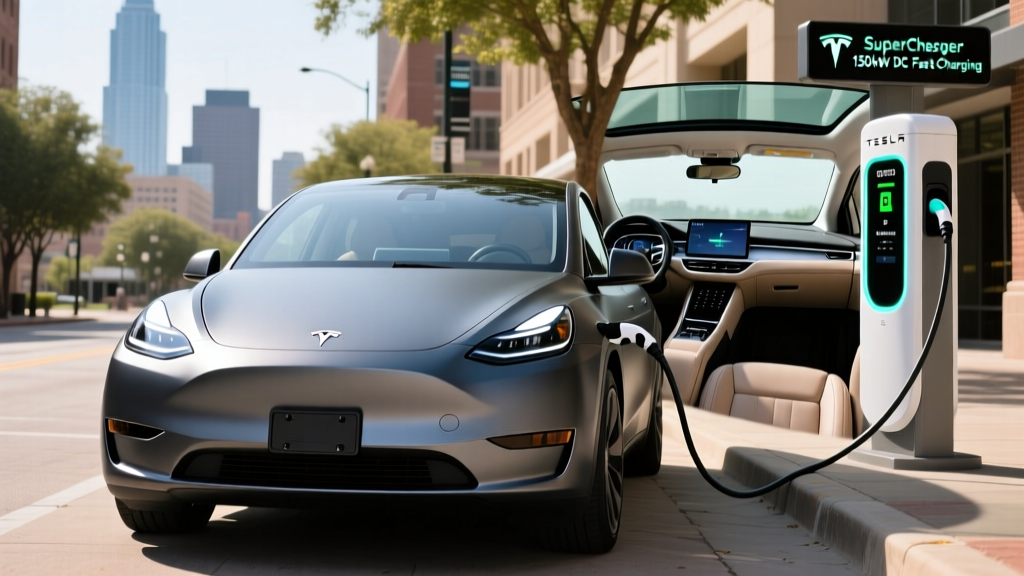
Charging curve reality: The 250 kW peak rate applies between approximately 10–45% state of charge. Above 60%, the curve tapers significantly — expect ~100 kW by 70% and ~50 kW above 85%. A 10–80% session takes roughly 25 minutes at a V3 or V4 Supercharger, but a 10–95% session stretches past 40 minutes due to taper. Dallas-Fort Worth has over 40 Supercharger stations as of early 2026, including high-traffic locations at NorthPark Center, the Galleria, and multiple DNT/I-35E corridor stops.
For home charging, the onboard 11.5 kW AC charger requires a 60-amp circuit (48A continuous). Most DFW homes with 200-amp electrical panels can accommodate this without a panel upgrade, but older homes in neighborhoods like Lakewood or M Streets may need an electrician to verify capacity. Expect $500–$1,500 for a standard Tesla Wall Connector installation if your panel is adjacent to the garage; add $1,500–$3,000 if a subpanel upgrade or long conduit run is required.
Performance and Drivetrain: Dual-Motor AWD in North Texas
The 2026 Model Y Long Range AWD produces 384 horsepower from its dual-motor setup, achieving 0–60 mph in 4.8 seconds. The Performance trim (if available for 2026) drops that to approximately 3.5 seconds with 510 hp, but at a $5,000+ premium and reduced range.
For Dallas drivers, the dual-motor AWD system matters less for snow (DFW averages 1–2 ice events per year) and more for wet-road traction during spring thunderstorms and the occasional flash-flood scenario on low-water crossings. The regenerative braking system offers one-pedal driving that reduces brake wear substantially — expect original brake pads to last 80,000+ miles in typical DFW driving.
Ride quality on the 2026 Model Y has improved over earlier model years with revised damper tuning, but the firm suspension still transmits expansion joints on I-635 and SH-121 more than competitors like the Hyundai Ioniq 5 or Ford Mustang Mach-E. Road noise at highway speed is noticeable but acceptable for the segment.
Pricing, Trim Levels, and Federal Tax Credit Eligibility
The 2026 Tesla Model Y lineup starts at $44,990 for the Long Range RWD (if offered) and $46,990 for the Long Range AWD. The Performance trim sits around $52,490. All trims fall below the IRS §30D MSRP cap of $80,000 for SUVs/CUVs, making them potentially eligible for the full $7,500 federal tax credit — but eligibility depends on multiple buyer and vehicle criteria.
| Trim | MSRP | §30D Credit (if eligible) | Effective Price |
|---|---|---|---|
| Long Range RWD | $44,990 | Up to $7,500 | ~$37,490 |
| Long Range AWD | $46,990 | Up to $7,500 | ~$39,490 |
| Performance AWD | $52,490 | Up to $7,500 | ~$44,990 |
- Income caps: AGI ≤ $150,000 (single), $225,000 (HOH), $300,000 (MFJ)
- MSRP cap: ≤ $80,000 for SUVs/CUVs (all Model Y trims qualify)
- Battery sourcing: Critical minerals and battery components must meet phased percentage thresholds from US/FTA partners — verify current-year compliance on IRS.gov
- Point-of-sale transfer: Eligible buyers can transfer the credit to the dealer at purchase, reducing the transaction price directly
Always confirm eligibility with a tax professional and check the IRS's current eligible-vehicle list before purchasing.
Interior, Cargo, and Daily Practicality for DFW Families
The Model Y's cargo capacity remains a class strength: 30.2 cubic feet behind the second row and 72.1 cubic feet with seats folded. The rear trunk well (sub-floor storage) adds usable volume for groceries or gym bags. The front trunk (frunk) provides an additional ~4.1 cubic feet — useful for charging cables or a soft cooler for HEB runs.
Rear legroom measures 40.5 inches, sufficient for adult passengers on longer drives to Hill Country or weekend trips to South Padre. The panoramic glass roof creates an airy cabin but contributes to solar heat gain in summer — Tesla's 2025+ glass has improved IR rejection, but many DFW owners still apply aftermarket ceramic tint (check Texas tint laws: front side windows must allow 25%+ VLT).
The minimalist interior means no physical buttons for climate or media — everything routes through the 15.4-inch center touchscreen. This is polarizing: some buyers love the clean aesthetic, others find it distracting while navigating Dallas's complex highway interchanges (the High Five, the Mixmaster). Wireless phone charging, ventilated front seats, and a HEPA cabin air filter (useful for DFW pollen season) are standard.
Tech, Autopilot, and Driver Assistance
Every 2026 Model Y ships with Tesla's Basic Autopilot, which includes adaptive cruise control and lane-centering on marked highways. This is an SAE Level 2 system — the driver must remain engaged, hands on the wheel, and eyes on the road at all times.
Tesla Autopilot and FSD (Supervised) are SAE Level 2 systems. They do NOT make the vehicle self-driving. The driver is legally and practically responsible for all vehicle operation. FSD (Supervised) costs $8,000 as a one-time purchase or $99/month and adds features like city-street navigation and traffic-light recognition, but still requires full driver attention. Only Level 4 robotaxi services (Waymo, Zoox in limited geofenced areas) operate without a human driver.
The infotainment system runs on Tesla's proprietary OS with built-in navigation, streaming (Spotify, Apple Music, YouTube when parked), and over-the-air updates that periodically add features. There is no Apple CarPlay or Android Auto — a dealbreaker for some buyers accustomed to phone projection. Navigation routes through Superchargers automatically and preconditions the battery for optimal charge speed on arrival, a genuine advantage for road-trip efficiency.
Warranty, Ownership Costs, and Long-Term Battery Outlook
Tesla covers the 2026 Model Y's battery and drive unit for 8 years or 120,000 miles (whichever comes first), with a minimum 70% capacity retention guarantee. LFP chemistry historically degrades more slowly than NMC, with real-world data from high-mileage Model 3/Y fleets showing 85–90% capacity retention at 100,000 miles. For a DFW driver averaging 15,000 miles per year, this translates to meaningful battery health well past the warranty period.
According to IIHS, the Model Y continues to earn top safety ratings, which helps moderate insurance costs — though EV insurance premiums in Texas remain 15–25% higher than comparable gas crossovers due to repair-cost data. Expect annual insurance of $1,800–$2,400 in the DFW metroplex depending on zip code and driving history.
Maintenance costs are minimal: no oil changes, no transmission fluid, cabin air filter replacement every 2 years (~$60), tire rotation every 6,250 miles, and wiper fluid. The regenerative braking system means brake pads and rotors rarely need replacement before 100,000 miles. Total 5-year maintenance cost typically runs $800–$1,200, versus $3,000–$4,500 for a gas-powered compact SUV.
Pros, Cons, and Who Should Buy the 2026 Model Y in Dallas
- 320-mi EPA range; real-world 265–310 mi depending on conditions
- Supercharger network access (most reliable DC network in TX)
- LFP battery excels in Texas heat; slow degradation
- Class-leading cargo volume (72.1 cu ft)
- Strong §30D credit eligibility (MSRP under cap)
- OTA updates add features post-purchase
- No Apple CarPlay/Android Auto
- Firm ride on DFW highway expansion joints
- Touchscreen-only controls distract in complex interchanges
- FSD costs $8,000 extra and is still Level 2
- Insurance premiums 15–25% above gas crossover average
- Panel upgrade may be needed for older DFW homes
Best for: DFW commuters with home-charging access, small families needing cargo flexibility, road-trippers who value Supercharger coverage across Texas and beyond, and buyers who prioritize low operating costs over plush ride quality.
Consider alternatives if: You require Apple CarPlay, prefer a softer ride (Hyundai Ioniq 5, Kia EV6), need three rows (Kia EV9), or want a traditional dealership service experience.
Frequently Asked Questions
What is the real-world range of the 2026 Tesla Model Y in Dallas?
Expect 265–285 miles on DFW highways at 75–80 mph, 295–310 miles in city/suburban driving, and 240–260 miles during rare cold snaps. Summer A/C load at 100°F+ reduces range by roughly 7–10% versus EPA.
How fast does the Model Y charge at home and on the road?
At home on a 240V/48A Level 2 charger: ~44 miles of range per hour, or a full 10–80% charge in about 7 hours. At a 250 kW Supercharger: 10–80% in approximately 25 minutes, with significant taper above 80%.
Does the 2026 Model Y qualify for the $7,500 federal EV tax credit?
All Model Y trims are under the $80,000 MSRP cap. Eligibility depends on your AGI (≤ $150K single / $300K joint), and the vehicle's battery-sourcing compliance with current-year §30D critical-mineral and component thresholds. Check the IRS eligible vehicle list and consult a tax professional before purchasing.
Is the Model Y worth buying versus the Ioniq 5 or Mach-E in 2026?
The Model Y wins on Supercharger network access, cargo space, and LFP battery longevity in heat. The Ioniq 5 offers a more comfortable ride and 800V architecture for faster peak charging. The Mach-E provides a more traditional crossover feel. If Supercharger reliability and cargo volume are priorities, the Model Y remains the strongest DFW choice.
How does Texas heat affect the LFP battery long-term?
LFP chemistry is inherently more thermally stable than NMC, making it well-suited to North Texas summers. Tesla's active liquid cooling manages pack temperature during charging and driving. High-mileage fleet data suggests 85–90% capacity retention at 100,000 miles — among the best in the segment.
Can I install a Level 2 charger in my Dallas home?
Most DFW homes with a 200-amp panel and garage-proximity panel can support a 60A circuit for the Tesla Wall Connector ($500–$1,500 installed). Older homes or those with distant panels may need a subpanel upgrade ($1,500–$3,000 additional). Always get a licensed electrician's assessment before purchasing equipment.