If you are researching the Tesla Model Y for your next vehicle purchase, safety is likely near the top of your priority list — especially if you are hauling kids or commuting in dense traffic. The 2026 Tesla Model Y (the refreshed "Juniper" generation introduced in early 2025) carries forward a strong safety legacy, but the real question buyers ask is whether the updated architecture maintains or improves upon the previous generation's benchmark Tesla crash test rating.
This review covers the full picture: NHTSA and IIHS safety scores, real-world range versus EPA estimates, DC fast-charging behavior, pricing after federal tax credits, and how the Model Y stacks up against the Hyundai Ioniq 5, Ford Mustang Mach-E, and Chevrolet Equinox EV.
2026 Tesla Model Y Crash Test Ratings: NHTSA & IIHS Breakdown
The previous-generation Model Y earned a 5-Star Overall Safety Rating from the National Highway Traffic Safety Administration (NHTSA), scoring five stars in frontal crash, side crash, and rollover categories. The 2026 Juniper-refresh Model Y was re-engineered with a stiffer body structure, updated crumple zones, and revised restraint systems.
As of early 2026, NHTSA testing for the refreshed Model Y is ongoing, and official star ratings for the new body style are expected to be published on nhtsa.gov/ratings throughout the year. The prior generation's 5-star result remains a strong indicator of Tesla's structural safety philosophy, which emphasizes a low center of gravity (reducing rollover risk) and a rigid battery pack that acts as a structural floor member.
The Insurance Institute for Highway Safety (IIHS) awarded the previous Model Y its highest Top Safety Pick+ honor. The 2026 model features an updated front-end design and new headlamp modules, which typically triggers a fresh round of IIHS evaluation. Until updated scores are published, buyers can reasonably expect the Juniper Model Y to perform at or above its predecessor in crashworthiness, given the structural upgrades Tesla has documented.
Range, Battery & Efficiency: Real-World vs. EPA
The 2026 Tesla Model Y is offered in three main configurations. Here is how the numbers break down:
| Spec | Long Range RWD | Long Range AWD | Performance AWD |
|---|---|---|---|
| EPA Range | 320 mi | 305 mi | 280 mi |
| Battery (usable) | ~75 kWh, NMC | ~75 kWh, NMC | ~75 kWh, NMC |
| Efficiency | 122 MPGe / 27 kWh/100mi | 118 MPGe / 28 kWh/100mi | 110 MPGe / 30 kWh/100mi |
| 0-60 mph | 5.6 sec | 4.8 sec | 3.5 sec |
| Horsepower | ~346 hp | ~384 hp | ~456 hp |
| Drivetrain | RWD (single motor) | AWD (dual motor) | AWD (dual motor) |
| Max DC Fast Charge | 250 kW (NACS) | 250 kW (NACS) | 250 kW (NACS) |
| 10-80% DC Time | ~25 min | ~25 min | ~25 min |
| Base MSRP | $44,990 | $47,990 | $52,990 |
Charging Speed: Home, Destination & DC Fast Charging
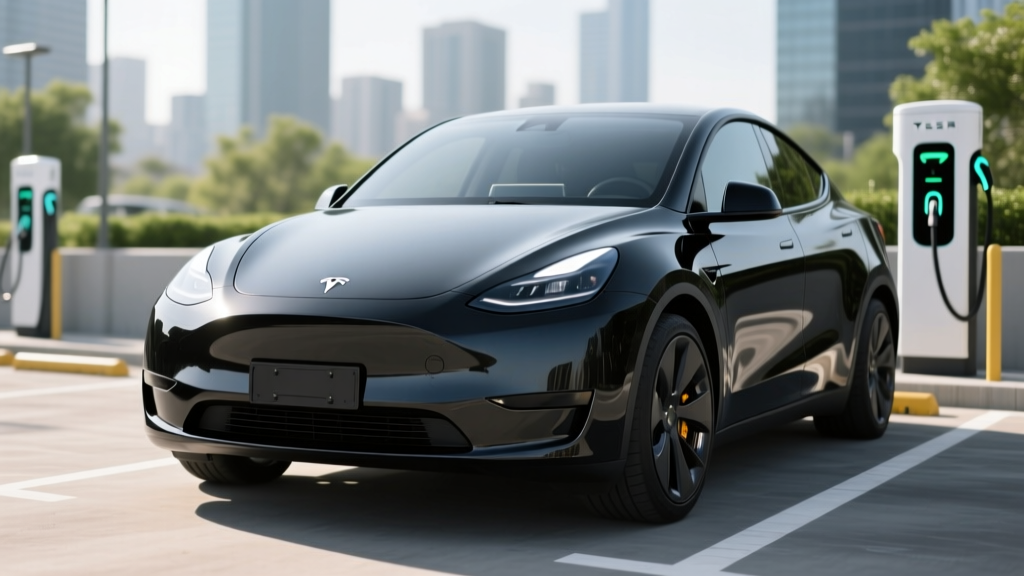
The 2026 Model Y uses the NACS (North American Charging Standard) connector natively, meaning it plugs directly into Tesla Superchargers without an adapter. With the industry-wide shift to NACS, the Model Y also gains access to Electrify America, EVgo, and other networks that have deployed NACS cables.
| Charging Level | Power (kW) | Miles Added per Hour | Typical Use Case |
|---|---|---|---|
| Level 1 (120V household) | ~1.4 kW | ~4-5 mi/hr | Overnight trickle / emergency |
| Level 2 (240V, 48A Wall Connector) | 11.5 kW | ~37 mi/hr | Home daily charging (full in ~7 hrs) |
| DC Fast Charge (Supercharger V3) | Up to 250 kW peak | ~1,000+ mi/hr at peak | Road trips (10-80% in ~25 min) |
Charging curve reality check: The 250 kW peak rate is only sustained at low states of charge (roughly 10-30% SoC). As the battery fills, the rate tapers — typically dropping to ~100 kW around 60% and further to ~40 kW above 85%. This is normal lithium-ion behavior, not a defect. The 10-80% time of approximately 25 minutes reflects this taper. For fastest charging on road trips, precondition the battery by navigating to a Supercharger in the Tesla nav system — this warms the pack to optimal temperature before you arrive.
For home charging, Tesla's Wall Connector ($420) on a 60-amp circuit delivers the full 11.5 kW / 48A rate. Most owners with a 30-50 mile daily commute will fully replenish overnight in 2-3 hours. If your electrical panel is maxed out, a 40-amp circuit (9.6 kW / ~30 mi/hr) is a common and practical alternative — consult a licensed electrician for your specific panel capacity.
Pricing, Tax Credits & Ownership Costs
| Trim | MSRP | Est. Max §30D Credit | Effective Price |
|---|---|---|---|
| Long Range RWD | $44,990 | Up to $7,500* | ~$37,490* |
| Long Range AWD | $47,990 | Up to $7,500* | ~$40,490* |
| Performance AWD | $52,990 | Up to $7,500* | ~$45,490* |
*Federal tax credit eligibility under IRS §30D depends on multiple requirements that change periodically. Key rules for 2026:
- MSRP cap: SUVs must have an MSRP at or below $80,000 (all Model Y trims qualify)
- Buyer income cap: Modified AGI must not exceed $150,000 (single), $225,000 (head of household), or $300,000 (joint)
- Battery sourcing: Critical minerals and battery component requirements phase in annually — the credit may be reduced to $3,750 or $0 if sourcing thresholds are not met. Check the latest eligibility list on fueleconomy.gov
- Point-of-sale transfer: You can apply the credit as an instant discount at purchase rather than waiting to claim it on your tax return
Always verify current eligibility before purchasing — battery sourcing requirements tighten each year, and a model that qualifies in January may have a different credit amount by mid-year. Consult a tax professional for your specific situation.
Interior, Cargo & Tech: What Changed with Juniper
The 2026 Model Y (Juniper refresh) received the most significant interior overhaul since the vehicle's 2020 launch. Key updates include:
- Ventilated front seats — finally addressing one of the most-requested features
- Ambient lighting strip across the dashboard and door panels
- Power-folding second row with a one-touch button in the cargo area
- Acoustic glass on all windows, significantly reducing road and wind noise
- Rear 8-inch touchscreen for rear-seat passengers (climate, media, gaming)
- Updated suspension tuning — softer, more compliant ride compared to the firm previous-gen setup
Cargo space: The Model Y offers approximately 30.2 cu ft behind the second row and 72.1 cu ft with the rear seats folded — competitive with midsize SUVs. The front trunk (frunk) adds roughly 4.1 cu ft of secure, weatherproof storage. Rear legroom measures about 41.6 inches, adequate for adults on longer trips.
Infotainment: Tesla's 15.4-inch center touchscreen runs the proprietary Tesla OS — no Apple CarPlay or Android Auto. Navigation, media, and vehicle controls are all integrated. The system is fast, responsive, and receives regular OTA (over-the-air) updates, but the lack of smartphone mirroring remains a dealbreaker for some buyers.
Driver Assistance: Autopilot & Full Self-Driving (Supervised)
Standard Autopilot includes Traffic-Aware Cruise Control and Autosteer (lane-centering on marked highways). The optional FSD (Supervised) package — currently priced at $8,000 or $99/month — adds Navigate on Autopilot (highway on/off-ramp navigation), Auto Lane Change, Autopark, and Smart Summon. In practice, FSD performs well on well-marked highways but requires frequent driver intervention in construction zones, complex intersections, and adverse weather.
Warranty & Long-Term Battery Durability
Tesla provides the following warranty coverage for the 2026 Model Y:
- Basic Vehicle Limited Warranty: 4 years / 50,000 miles
- Battery & Drive Unit Warranty: 8 years / 120,000 miles (Long Range), with a minimum 70% capacity retention guarantee over the warranty period
The Model Y Long Range uses NMC (nickel manganese cobalt) battery chemistry, which offers high energy density but slightly faster degradation compared to LFP (lithium iron phosphate). Real-world fleet data from sources like Recurrent Auto suggests Tesla NMC packs typically retain 88-92% capacity after 100,000 miles — well above the warranty threshold. Tesla recommends daily charging to 80-90% for NMC packs and only charging to 100% when needed for long trips, which helps maximize long-term battery health.
Model Y vs. Competitors: Is It Worth Buying?
✅ Pros
- Best-in-class Supercharger network access (native NACS)
- Class-leading efficiency (27-30 kWh/100mi)
- Excellent 5-star safety heritage
- Strong OTA updates continuously add features
- Competitive cargo space (72.1 cu ft max)
- Lowest cost-per-mile charging on Superchargers
❌ Cons
- No Apple CarPlay / Android Auto
- FSD (Supervised) is expensive and still Level 2
- Turn-signal stalks removed (steering-wheel buttons)
- NMC battery requires charge-limit discipline
- Service center wait times can be long in some markets
- Higher insurance premiums than comparable gas SUVs
Choose the Model Y if: You value access to the most reliable fast-charging network, want top-tier efficiency, and prefer a minimalist tech-forward cabin. The Model Y's Supercharger ecosystem remains its strongest competitive moat, especially for frequent road-trippers.
Consider alternatives if: You need Apple CarPlay (Hyundai Ioniq 5, Ford Mach-E), prefer a more traditional cockpit layout, or want LFP battery chemistry for worry-free 100% daily charging (base RWD Model Y previously offered LFP — check current-year battery sourcing for your trim).
Frequently Asked Questions
What is the real-world range of the 2026 Tesla Model Y?
The Long Range RWD is EPA-rated at 320 miles, but expect approximately 270-290 miles in real-world highway driving at 70-75 mph, and 220-255 miles in freezing temperatures. The AWD Long Range delivers roughly 260-280 highway miles, and the Performance trim around 240-260 highway miles.
How fast does the Model Y charge at home and on the road?
At home on a 240V / 48A Tesla Wall Connector, the Model Y charges at 11.5 kW, adding about 37 miles of range per hour — a full charge takes roughly 7 hours. On a V3 Supercharger (250 kW peak DC), the 10-80% charge takes approximately 25 minutes, though actual time varies with battery temperature and starting SoC.
Does the 2026 Tesla Model Y qualify for the federal EV tax credit?
All Model Y trims fall under the $80,000 MSRP cap for SUVs. However, the full $7,500 credit under IRS §30D depends on battery-sourcing requirements (critical minerals and components), which tighten annually, plus buyer income limits ($150K single / $300K joint). Check fueleconomy.gov and irs.gov for the latest eligibility before purchasing. The credit can be applied as a point-of-sale discount.
Is the Model Y worth buying over the Ioniq 5 or Mach-E?
The Model Y wins on charging infrastructure (Superchargers), efficiency, and cargo space. The Ioniq 5 offers faster 10-80% charging on 350 kW chargers (~18 min), CarPlay, and 800V architecture. The Mach-E provides a more traditional driving feel and BlueCruise hands-free driving on approved highways. If road-trip charging reliability is your top priority, the Model Y still holds an edge.
What are the biggest drawbacks of the 2026 Model Y?
The removal of turn-signal stalks (replaced by steering-wheel buttons) is polarizing and takes adaptation. The lack of Apple CarPlay/Android Auto frustrates some buyers. FSD at $8,000 remains a Level 2 system that requires constant supervision. Insurance costs tend to run 15-30% higher than comparable gas SUVs due to repair costs and Tesla's direct-repair model.
How does the Juniper refresh improve safety?
The 2026 Juniper Model Y features a reinforced body structure with revised front and rear crumple zones, updated airbag calibration, and new acoustic glass. While official NHTSA star ratings for the refreshed model are pending, the structural improvements and Tesla's consistent safety engineering suggest it will maintain or exceed the previous generation's 5-star rating.