Verdict: The Safest Way to Go Electric
Search "tesla car crash" and you'll find a polarized internet: viral videos of crumpled Model Ys juxtaposed with NHTSA's highest safety scores. The reality, as usual, lives in the data. The 2026 Tesla Model Y remains one of the best-performing mainstream EVs in government and insurance crash testing, while also offering class-leading efficiency, a mature DC fast-charging network, and a starting price that — after the federal tax credit — undercuts many gas-powered crossover rivals.
This review focuses on what crash-test results actually mean for buyers, then layers in the range, charging, pricing, and ownership numbers you need to decide if the refreshed Model Y (codenamed "Juniper") fits your driveway in 2026.
Crash-Test Results: What NHTSA and IIHS Actually Found
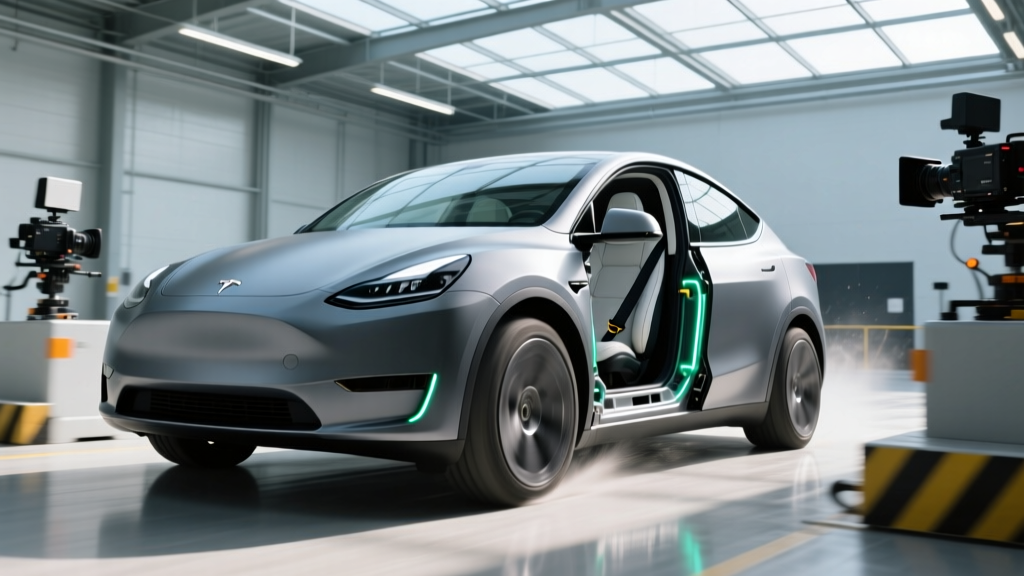
The NHTSA awards the 2026 Model Y a full 5-star overall safety rating, including 5 stars in frontal crash, side crash, and rollover. The low-mounted battery pack gives it an exceptionally low center of gravity, translating to an 11.1% rollover risk — among the lowest for any SUV, gas or electric.
The IIHS named the Model Y a Top Safety Pick+ when equipped with the standard LED headlights. It earned "Good" ratings across all crashworthiness categories (moderate overlap front, updated side, roof strength, head restraints) and a "Superior" rating for its standard automatic emergency braking system at both 12 mph and 25 mph targets.
| Test Agency | Category | Result |
|---|---|---|
| NHTSA | Overall | 5 / 5 Stars |
| NHTSA | Frontal Crash | 5 / 5 Stars |
| NHTSA | Side Crash | 5 / 5 Stars |
| NHTSA | Rollover Risk | 11.1% (5 Stars) |
| IIHS | Moderate Overlap Front | Good |
| IIHS | Updated Side | Good |
| IIHS | Roof Strength | Good |
| IIHS | Front Crash Prevention | Superior |
What Viral Tesla Car Crash Footage Doesn't Show
High-profile Tesla car crash videos often involve high-speed, single-vehicle impacts or Autopilot-related incidents. Two realities get lost in the social-media churn:
- Mass bias: With over 5 million Teslas on global roads, raw incident counts look large even when the per-mile rate is favorable. NHTSA's Fatality Analysis Reporting System (FARS) continues to show EVs, as a class, involved in fatal crashes at rates comparable to or lower than ICE vehicles, once exposure is normalized.
- Fire risk context: Lithium-ion battery fires burn hot and are hard to extinguish, but they remain statistically rare. Tesla's own safety report pegs vehicle fires at roughly one per 130+ million miles driven — well below the NFPA-reported national average of one per ~19 million miles for all vehicles.
Range, Efficiency, and the Real-World Caveats
The 2026 Model Y Long Range AWD carries an EPA-estimated 320 miles of range. The Performance trim drops to 277 miles due to stickier tires, larger wheels, and more aggressive powertrain calibration. The RWD base model sits at 308 miles.
Efficiency lands at 122 MPGe combined (Long Range AWD), or roughly 28 kWh per 100 miles — among the most efficient dual-motor crossovers sold in the U.S. That efficiency is the real story behind Tesla's range-per-kWh advantage over heavier competitors.
Charging Speed: DC Fast, Level 2, and the Supercharger Advantage
The Juniper Model Y retains a 400-volt architecture (not 800V like Hyundai/Kia), but Tesla's battery preconditioning software still delivers strong real-world fast-charging performance at V3 and V4 Superchargers.
| Charging Level | Power | Speed / Time |
|---|---|---|
| DC Fast Charge (V3 Supercharger) | Peak 250 kW | 10–80% in ~27 min |
| DC Fast Charge (third-party CCS via NACS adapter) | Peak 150–170 kW typical | 10–80% in ~35–40 min |
| Level 2 Home (Tesla Wall Connector, 48A) | 11.5 kW | ~37 mi/hr; 0–100% in ~9 hr |
| Level 2 Home (32A mobile connector, 240V) | 7.7 kW | ~25 mi/hr; 0–100% in ~13 hr |
| Level 1 (120V outlet) | ~1.4 kW | ~4 mi/hr |
Charge-curve reality check: The Model Y holds near its 250 kW peak only up to roughly 40% SoC, then tapers to ~100 kW by 60% and ~45 kW past 80%. That's why 10–80% time is the meaningful metric — charging to 100% on DC fast power is painfully slow and unnecessary for daily use.
Battery Chemistry, Warranty, and Longevity
The Long Range and Performance trims use an NMC (nickel manganese cobalt) chemistry pack, roughly 75 kWh usable, supplied primarily by Panasonic at Gigafactory Nevada. The base RWD Model Y uses an LFP (lithium iron phosphate) battery, roughly 60 kWh usable, sourced from CATL.
| Attribute | LFP (Base RWD) | NMC (Long Range / Perf) |
|---|---|---|
| Energy Density | Lower | Higher |
| Range | 308 mi EPA | 320 mi (LR) / 277 mi (Perf) |
| Recommended Daily SoC | 100% (no penalty) | 80% (for longevity) |
| Cold-Weather Loss | Greater | Moderate |
| Cycle Life | 3,000+ cycles | 1,500–2,000 cycles |
| Cobalt Content | None | Yes |
Tesla's battery warranty is 8 years / 100,000 miles for RWD and 8 years / 120,000 miles for Long Range and Performance, with a 70% capacity retention threshold — meaning Tesla replaces the pack if degradation exceeds 30% within the warranty window.
Performance and Drivetrain
| Trim | Drivetrain | HP | 0–60 mph | Top Speed |
|---|---|---|---|---|
| RWD (Base) | Rear-Wheel Drive | ~295 hp | 6.6 sec | 135 mph |
| Long Range AWD | Dual-Motor AWD | ~384 hp | 4.8 sec | 135 mph |
| Performance | Dual-Motor AWD | ~456 hp | 3.5 sec | 155 mph |
All trims are single-speed direct-drive. Regenerative braking is one-pedal-capable but now offers a low-regen mode in the Juniper refresh, a welcome addition for drivers transitioning from ICE vehicles.
Interior, Cargo, and Tech
The Juniper interior is markedly quieter than pre-2025 Model Ys, with acoustic glass, ventilated front seats, ambient lighting, and a rear-seat touchscreen. Cargo volume is 30.2 cu ft behind the second row and 72.0 cu ft with seats folded — plus a 4.1 cu ft frunk.
- Front headroom: 40.3 in / legroom: 41.9 in
- Rear headroom: 39.4 in / legroom: 38.2 in
- 15.4-inch front touchscreen (no instrument cluster)
- No physical stalks — turn signals and gear selection are on the steering wheel / touchscreen
The stalkless interface remains the most divisive design choice. Budget 1–2 weeks of muscle-memory adjustment; some owners never acclimate.
Pricing and Federal Tax Credit Eligibility
| Trim | Base MSRP | As-Tested* | Est. After §30D Credit |
|---|---|---|---|
| RWD | $44,990 | $46,490 | ~$37,490 |
| Long Range AWD | $48,990 | $52,490 | ~$41,490 |
| Performance | $53,490 | $57,490 | ~$45,990 |
*As-tested includes typical $2,000 destination + popular options (paint, wheels).
- Up to $7,500 (split: $3,750 critical minerals + $3,750 battery components)
- Buyer AGI caps: $150K single, $225K HOH, $300K joint
- Vehicle MSRP cap: $80,000 for SUVs (all Model Y trims qualify)
- Battery sourcing: must meet critical-mineral and foreign-entity-of-concern thresholds — Tesla's U.S. and allied-sourcing supply chain currently satisfies this for most trims, but verify at purchase
- Available as point-of-sale transfer to the dealer, reducing the purchase price directly
Always confirm eligibility with your tax professional and the IRS §30D guidance before purchase.
Pros, Cons, and Who Should Buy
- 5-star NHTSA / IIHS Top Safety Pick+ crash ratings
- Class-leading efficiency (122 MPGe)
- Access to the Supercharger network (20,000+ U.S. stalls)
- Strong real-world DC fast-charging (10–80% in ~27 min)
- Spacious cargo area + frunk
- OTA updates add features post-purchase
- Stalkless steering wheel takes adjustment
- No Apple CarPlay / Android Auto
- Ride quality firm on 20-inch wheels
- Base RWD uses LFP with greater cold-weather range loss
- Insurance premiums above segment average
- 400V architecture limits peak charge rate vs. 800V rivals
Is the 2026 Model Y Worth It vs. Competitors?
Against the Hyundai Ioniq 5 and Kia EV6, the Model Y trades slightly slower peak charging for a more mature public-charging network and stronger efficiency. Against the Ford Mustang Mach-E, it offers more cargo space and a lower effective price after the tax credit. For families wanting a no-fuss EV with strong crash-test credentials and long-distance capability, the Long Range AWD at ~$41,500 after credit remains the segment benchmark.
For budget-focused buyers, the base RWD at ~$37,500 after credit is compelling — provided your climate is mild and your daily commute fits within LFP's real-world range.
FAQ
What is the real-world range of the 2026 Tesla Model Y?
Expect 290–305 miles in mixed driving on the Long Range AWD. Sustained highway speeds drop that to ~260–280 miles, and sub-freezing weather can reduce it another 20–30% without preconditioning.
How fast does the Model Y charge at home and on the road?
On a V3 Supercharger, 10–80% takes roughly 27 minutes at a peak of 250 kW. At home on a 48A Wall Connector, expect ~37 miles of range added per hour, or a full charge in about 9 hours.
Does the 2026 Model Y qualify for the $7,500 federal tax credit?
Yes, for buyers meeting IRS §30D income caps ($300K joint / $150K single) and taking delivery of a unit with qualifying battery sourcing. The credit can be applied as a point-of-sale price reduction.
How did the Model Y perform in tesla car crash tests?
The 2026 Model Y earned 5 stars overall from NHTSA and IIHS Top Safety Pick+ status, with "Good" crashworthiness ratings across the board and "Superior" front crash prevention.
Is Autopilot or FSD self-driving?
No. Both are SAE Level 2 driver-assist systems that require full driver engagement. They assist with steering, acceleration, and braking but do not replace the driver.
Should I choose the RWD or Long Range AWD?
Choose RWD if you live in a mild climate and want the lowest price. Choose Long Range AWD if you need all-weather traction, more real-world range, and the NMC battery's better cold-weather performance.