Quick Verdict: The Model Y's Active Safety Is Elite, But Read the Fine Print
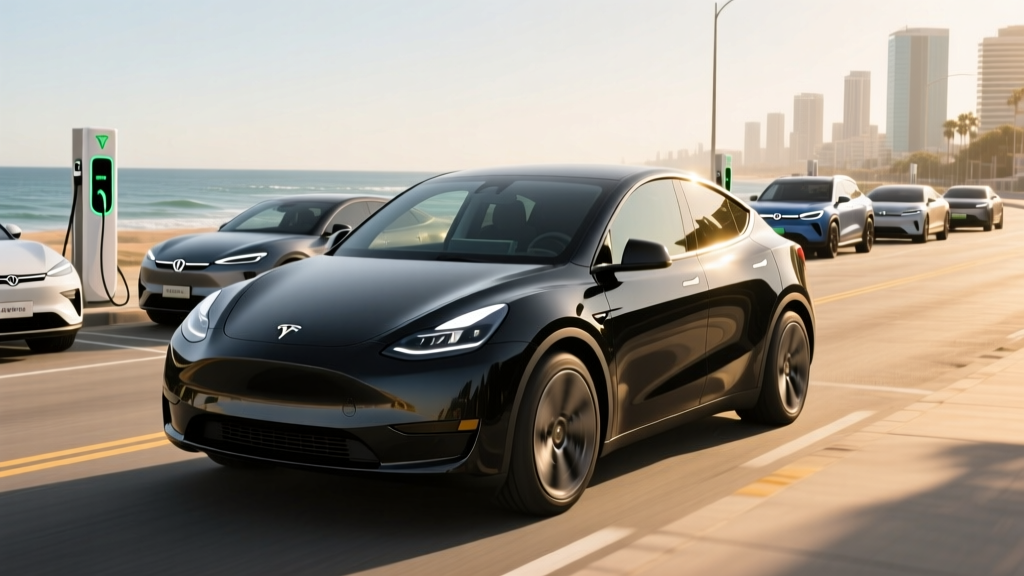
The 2026 Tesla Model Y remains the best-selling electric vehicle in the United States for good reason: it pairs class-leading efficiency with one of the most capable active-safety suites on the market. If you've been searching for real data on Tesla avoiding crashes in everyday driving, the Model Y is where Tesla's vision-based approach is most visible — and most scrutinized. Standard Automatic Emergency Braking (AEB), lane-departure intervention, and blind-spot monitoring have earned the Model Y top marks from both IIHS and NHTSA. But Tesla's optional Full Self-Driving (Supervised) software remains a Level 2 driver-assistance system that demands constant driver engagement, regardless of its name.
This review covers the refreshed 2026 Model Y Long Range AWD and Performance trims, breaking down real-world range, charging speeds, pricing after federal tax credits, and whether its crash-avoidance technology genuinely outperforms competitors like the Hyundai Ioniq 5 and Ford Mustang Mach-E.
Range, Battery, and Real-World Efficiency
The 2026 Model Y Long Range AWD carries an EPA-estimated range of 320 miles on its 78.1 kWh usable NMC (nickel-manganese-cobalt) battery pack. The Performance trim drops slightly to 298 miles EPA, trading range for acceleration. Base Rear-Wheel-Drive models equipped with an LFP (lithium iron phosphate) battery offer 279 miles EPA — a chemistry that sacrifices some energy density for longer cycle life and the ability to charge routinely to 100% without degradation concerns.
EPA: 320 mi (Long Range AWD). Real-world expectation: ~275–295 mi on mixed highway driving at 70+ mph; ~240–260 mi in sub-30°F winter conditions with cabin heating. The Model Y's heat pump helps mitigate cold-weather losses compared to older EVs, but plan for a 15–25% reduction in freezing temperatures. On a 300-mile road trip at highway speeds, you will likely need one DC fast-charge stop.
| Spec | RWD (Base) | Long Range AWD | Performance |
|---|---|---|---|
| EPA Range | 279 mi | 320 mi | 298 mi |
| Battery (usable) | 60 kWh (LFP) | 78.1 kWh (NMC) | 78.1 kWh (NMC) |
| Efficiency | 26 kWh/100mi (130 MPGe) | 25 kWh/100mi (135 MPGe) | 27 kWh/100mi (125 MPGe) |
| 0-60 mph | 6.6 sec | 4.8 sec | 3.5 sec |
| Horsepower | 295 hp | 384 hp | 456 hp |
| Drivetrain | RWD single motor | AWD dual motor | AWD dual motor |
| Top Speed | 135 mph | 125 mph | 155 mph |
Efficiency is where Tesla continues to lead the pack. At 25 kWh per 100 miles (combined), the Long Range AWD sips electrons more frugally than the Ioniq 5 AWD (28 kWh/100mi) or the Mach-E Extended Range AWD (29 kWh/100mi), per fueleconomy.gov. That efficiency edge translates directly into lower charging costs and fewer stops on road trips.
Charging: DC Fast, Level 2, and the Supercharger Advantage
The 2026 Model Y supports a peak DC fast-charge rate of 250 kW on V3 Superchargers and compatible CCS/NACS stations. In practice, a 10–80% charge takes approximately 22 minutes under ideal conditions (battery preconditioned via on-route navigation). The charge curve tapers significantly above 80%, so Tesla's navigation system strategically limits charging to 80% at Superchargers unless you override it — a behavior designed to protect battery longevity and reduce your stop time.
| Charging Level | Power | Speed (Approx.) | Notes |
|---|---|---|---|
| Level 1 (120V household) | 1.4 kW | ~4 mi/hr | Emergency/trickle only |
| Level 2 (240V home, 48A) | 11.5 kW | ~44 mi/hr | Fully charges overnight in ~7 hr |
| DC Fast (V3 Supercharger) | 250 kW peak | 10–80% in ~22 min | Preconditioning required for peak rate |
| DC Fast (V4 Supercharger) | 250 kW peak | 10–80% in ~22 min | Newer stalls with CCS adapter support |
For home charging, the Model Y's onboard charger accepts up to 11.5 kW (48 amps) on a 240V Level 2 circuit, adding roughly 44 miles of range per hour. A full charge from 10% takes about 7 hours — ideal for overnight replenishment. Tesla's Wall Connector costs around $475, and professional installation of a 60-amp dedicated circuit typically runs $800–$1,800 depending on your panel's proximity to the garage. If your home has a 100-amp main panel, budget an additional $1,500–$3,000 for a panel upgrade — a commonly overlooked cost.
The Tesla Supercharger network remains the most reliable public DC charging infrastructure in the US, with over 25,000 stalls nationally. Since 2024, Tesla has opened select Superchargers to non-Tesla EVs via a built-in CCS adapter, but Tesla owners still enjoy seamless plug-and-charge integration that third-party networks like Electrify America and EVgo have yet to match consistently.
Crash Avoidance and Active Safety: What the Data Shows
This is where the keyword question — is Tesla avoiding crashes better than its competitors? — deserves a data-driven answer rather than marketing claims.
Tesla Autopilot and Full Self-Driving (Supervised) are SAE Level 2 driver-assistance systems. This means the vehicle can handle steering and acceleration simultaneously under specific conditions, but the driver must remain fully engaged, monitor the environment, and be prepared to take over instantly. These are NOT self-driving systems. Only Level 4 services like Waymo operate without a human driver in defined geofenced areas.
Standard active safety (included on every Model Y):
- Automatic Emergency Braking (AEB): Detects vehicles, pedestrians, and cyclists. IIHS rated the Model Y's AEB as "Superior" in both vehicle-to-vehicle and vehicle-to-pedestrian tests.
- Lane Departure Avoidance: Actively steers the car back into its lane if you drift without signaling.
- Blind Spot Monitoring: Visual alerts on the center display plus steering resistance during lane changes.
- Side Collision Warning: Detects objects in adjacent lanes at low and high speeds.
- Rear Cross-Traffic Alert: Warns of approaching vehicles when reversing from parking spots.
Autopilot (included standard): Adds Traffic-Aware Cruise Control and Autosteer (lane-centering on highways). This is a competent Level 2 system for highway commuting but requires hands-on-wheel monitoring via torque detection.
Full Self-Driving Supervised ($8,000 option or $99/month): Adds automatic lane changes, Navigate on Autopilot (interchange routing), traffic-light and stop-sign recognition, and Autosteer on city streets. As of 2026, FSD (Supervised) uses a vision-only neural-net approach with no LiDAR or radar backup. It handles many routine scenarios smoothly but still requires intervention in construction zones, complex unprotected left turns, and poor-weather conditions.
- It does not drive autonomously — you are the driver and are liable for all actions.
- It does not handle all weather conditions (heavy rain, fog, snow impair cameras).
- It does not recognize temporary construction barriers reliably.
- It does not replace attentive driving — NHTSA has issued multiple investigations into Tesla crashes involving Autopilot/FSD where driver inattention was a factor.
Tesla's own Vehicle Safety Report (Q4 2025) claims that Tesla vehicles with Autopilot engaged recorded one crash for every 5.94 million miles driven, versus the US average of approximately one crash per 670,000 miles (NHTSA data). However, these figures are not directly comparable: Tesla's data includes all miles driven with Autopilot active (predominantly controlled highway driving), while NHTSA's national average encompasses all driving conditions, demographics, and vehicle types. Independent, apples-to-apples crash-avoidance data remains limited, and the IIHS has raised concerns about Tesla's driver-monitoring approach compared to GM's Super Cruise, which uses an infrared eye-tracking camera.
Pricing, Tax Credits, and Ownership Cost
| Trim | Base MSRP | As-Tested (with common options) | Est. Federal Credit (§30D) |
|---|---|---|---|
| RWD | $44,990 | $46,490 (with wheels) | $7,500 (if eligible) |
| Long Range AWD | $48,990 | $51,490 (FSD + wheels) | $7,500 (if eligible) |
| Performance | $53,990 | $62,990 (FSD + accel boost) | $7,500 (if eligible) |
The 2026 Model Y qualifies for the full $7,500 federal EV tax credit under IRS §30D — but only if you meet all eligibility requirements. Since the 2024 rule changes, this credit is available as a point-of-sale transfer, meaning the dealer (Tesla) reduces your purchase price by $7,500 at checkout, and Tesla claims the credit from the IRS.
- MSRP cap: SUVs/crossovers must be under $80,000 — all Model Y trims qualify.
- Buyer income cap: Modified AGI must not exceed $150,000 (single), $225,000 (head of household), or $300,000 (joint filers).
- Battery sourcing: Critical minerals and battery components must meet phased-in domestic/free-trade-agreement percentages. As of 2026, Tesla's US-built Model Y with its Nevada/California battery supply chain meets these thresholds, but always verify on the IRS's eligible vehicles list before purchasing.
- FEOC exclusion: Vehicles with battery components from a "foreign entity of concern" (e.g., certain Chinese suppliers) are disqualified. Tesla's current supply chain has navigated this, but rules tighten annually.
5-year total cost of ownership: Assuming 15,000 miles/year, $0.13/kWh home charging, and no tax credit, the Long Range AWD costs roughly $3,900 in electricity over five years — versus approximately $9,400 in gasoline for a comparable 25 MPG AWD crossover at $3.50/gallon. Factor in the $7,500 credit, lower maintenance (no oil changes, fewer brake replacements thanks to regen), and the Model Y's strong resale value, and the TCO advantage over gas rivals is significant, though higher insurance premiums (typically 15–25% above segment average) partially offset savings.
Interior, Cargo, and Tech
The 2026 Model Y's cabin is minimalist by design — a 15.4-inch center touchscreen handles virtually all controls, from climate to mirrors to glove-box release. There is no instrument cluster; speed and navigation data appear in the upper-left corner of the main display. Love it or not, the approach eliminates physical button clutter but can frustrate first-time EV buyers accustomed to traditional layouts.
Cargo volume: 30.2 cu ft behind the second row, expanding to 72.1 cu ft with the rear seats folded. The front trunk (frunk) adds 4.1 cu ft — useful for charging cables and groceries. Rear legroom measures 41.6 inches, adequate for adults on longer trips.
Tech highlights:
- Over-the-air updates continuously add features (Tesla has pushed braking and suspension improvements via software).
- Sentry Mode uses the car's cameras to record surroundings when parked, a useful anti-theft and hit-and-run documentation tool.
- Dog Mode maintains cabin temperature for pets, with a display message informing passersby.
- Theater mode streams Netflix/YouTube on the center screen while parked.
Notable drawbacks: The absence of Apple CarPlay and Android Auto remains a dealbreaker for some buyers. The panoramic glass roof provides no shade (an aftermarket sunshade is practically mandatory in warm climates). And the all-touchscreen interface requires a learning curve for basic adjustments like mirror positioning and vent direction.
Warranty Coverage
Tesla provides a 4-year/50,000-mile basic vehicle limited warranty and an 8-year/120,000-mile battery and drive unit warranty for the Long Range and Performance trims (8-year/100,000-mile for the RWD with LFP battery). The battery warranty guarantees retention of at least 70% of original capacity during the coverage period. Based on crowdsourced degradation data from high-mileage Tesla owners, Model Y batteries typically retain 90–93% capacity at 50,000 miles and 85–88% at 100,000 miles — well above the warranty threshold. Full battery replacement out of warranty currently costs between $12,000 and $16,000 at Tesla service centers, though this figure has been declining as battery costs fall industry-wide.
Pros, Cons, and Who Should Buy
- Best-in-class efficiency (25 kWh/100mi) lowers charging costs
- Supercharger network remains the gold standard for road-trip reliability
- Strong AEB and active safety (IIHS Top Safety Pick+)
- Spacious cargo area with useful frunk
- OTA updates improve the car over time
- $7,500 federal tax credit at point of sale
- No Apple CarPlay / Android Auto
- All-touchscreen interface frustrates some users
- FSD (Supervised) is expensive and still requires full driver attention
- Insurance premiums run 15–25% above segment average
- Glass roof lacks built-in shade
- 250 kW peak charging is slower than Hyundai's 350 kW E-GMP platform
- Choose the Model Y if: You want a proven EV ecosystem, reliable DC fast-charging access via Superchargers, strong crash-avoidance tech as standard, and efficient daily commuting in an SUV package.
- Consider the Hyundai Ioniq 5 instead if: You prioritize ultra-fast 350 kW charging (10–80% in 18 min), want Apple CarPlay, and prefer a more conventional interior with physical controls.
- Consider the Ford Mustang Mach-E if: You want a sportier driving feel, BlueCruise hands-free highway driving (with eye monitoring), and don't mind slightly lower efficiency.
Frequently Asked Questions
What is the real-world range of the 2026 Tesla Model Y?
The EPA rates the Long Range AWD at 320 miles. In real-world highway driving at 70–75 mph, expect 275–295 miles. In cold weather (below 30°F), plan for 240–260 miles due to battery chemistry limitations and cabin heating demands. The heat pump helps, but cold-weather range loss is unavoidable in all current lithium-ion EVs.
How fast does the Model Y charge at home and on the road?
At home on a 240V Level 2 charger (48A), the Model Y charges at 11.5 kW, adding about 44 miles per hour — a full overnight charge takes roughly 7 hours. On a V3 Supercharger (250 kW DC), a 10–80% session takes approximately 22 minutes when the battery is preconditioned. Charging above 80% slows dramatically to protect battery health.
Does the 2026 Model Y qualify for the $7,500 federal tax credit?
Yes — all trims are under the $80,000 SUV MSRP cap and Tesla's current US battery supply chain meets §30D critical-mineral and component sourcing requirements. However, you must also meet income caps ($150K single / $300K joint) and the vehicle must not contain FEOC-sourced components. The credit is available as a point-of-sale price reduction. Always verify on the IRS eligible vehicles list before purchasing.
Is Tesla's crash-avoidance technology better than competitors?
Standard AEB and active safety are excellent — the Model Y earns IIHS Top Safety Pick+ and 5-star NHTSA ratings. However, Tesla's Autopilot/FSD (Supervised) uses vision-only sensing (cameras, no LiDAR or radar), which has drawn NHTSA scrutiny for crashes in low-visibility and construction-zone scenarios. GM's Super Cruise and Ford's BlueCruise use driver-facing cameras for more robust attention monitoring. Tesla's crash-avoidance is strong for engaged drivers, but the system's permissiveness in allowing attention lapses is a legitimate concern.
Is the Model Y worth buying over the Ioniq 5 or Mach-E?
It depends on your priorities. The Model Y wins on efficiency, Supercharger access, cargo space, and OTA longevity. The Ioniq 5 wins on DC charging speed (350 kW), CarPlay support, and interior ergonomics. The Mach-E wins on driving dynamics and hands-free BlueCruise capability. For most US buyers who road-trip regularly, Tesla's Supercharger network remains the decisive advantage.
What does FSD (Supervised) actually cost, and is it worth it?
FSD (Supervised) costs $8,000 upfront or $99/month. It adds city-street autosteer, automatic lane changes, and traffic-light recognition. As of 2026, it remains a Level 2 system requiring constant supervision. Most owners find standard Autopilot sufficient for highway commuting. Buy FSD only if you regularly drive complex urban routes and understand you remain fully responsible for the vehicle.