The Tesla Model Y remains one of the best-selling electric vehicles in the United States, but sticker price is only the beginning. For buyers researching the Tesla cost of ownership, the real story lies in charging efficiency, insurance premiums, maintenance realities, and federal tax credit eligibility. This profile examines the 2026 Model Y Long Range AWD and Performance trims with exact EPA data, real-world range expectations, and a five-year total cost of ownership projection.
2026 Tesla Model Y: Core Specifications at a Glance
| Spec | Long Range AWD | Performance |
|---|---|---|
| EPA Range | 320 miles | 293 miles |
| Usable Battery | ~75 kWh (NMC) | ~75 kWh (NMC) |
| Peak DC Fast Charge | 250 kW | 250 kW |
| 10–80% DC Time | ~27 min | ~27 min |
| Level 2 Home Charge | 11.5 kW (~44 mi/hr) | 11.5 kW (~44 mi/hr) |
| 0–60 mph | 4.8 sec | 3.5 sec |
| Horsepower | 384 hp | 456 hp |
| Drivetrain | Dual-Motor AWD | Dual-Motor AWD |
| EPA Efficiency | 117 MPGe / 29 kWh/100mi | 111 MPGe / 30 kWh/100mi |
| Cargo (rear seats up) | 30.2 cu ft | 30.2 cu ft |
| Cargo (rear seats folded) | 72.1 cu ft | 72.1 cu ft |
| Base MSRP | $44,990 | $49,990 |
Real-World Range: What the EPA Sticker Doesn't Tell You
Real-World Expectation: 260–290 miles at sustained 70 mph highway speeds; 220–250 miles in sub-30°F winter conditions with cabin heating.
The Model Y Long Range's 320-mile EPA rating is competitive among midsize electric SUVs, but real-world results depend heavily on driving style and climate. Tesla's heat pump standard on all 2026 trims mitigates cold-weather losses better than resistive heating, yet LFP and NMC batteries still lose 15–25% range in freezing temperatures. On a 75°F day at mixed city/highway speeds, owners consistently report 290–310 miles before needing a charge. At sustained 80 mph on the interstate, expect the range to drop closer to 250–265 miles. For context, the EPA's fueleconomy.gov listing confirms the combined 117 MPGe rating for the Long Range trim.
The battery pack uses NMC (nickel manganese cobalt) chemistry, which offers higher energy density than LFP but is more sensitive to prolonged 100% state-of-charge storage. Tesla recommends daily charging to 80–90% for NMC packs, reserving 100% for road trips.
Charging Speed: DC Fast, Level 2, and Level 1 Reality
| Charging Level | Power | Miles Added per Hour | Notes |
|---|---|---|---|
| Level 1 (120V) | ~1.4 kW | ~3–4 mi/hr | Emergency/trickle only |
| Level 2 (240V, 48A) | 11.5 kW | ~44 mi/hr | Home Wall Connector; full charge in ~7 hr |
| DC Fast (V3 Supercharger) | Peak 250 kW | ~1,000 mi/hr at peak | 10–80% in ~27 min; tapers sharply above 80% |
| DC Fast (V4 Supercharger) | Peak 250 kW | ~1,000 mi/hr at peak | Newer stalls; same vehicle-side limit |
The Model Y's peak 250 kW DC fast-charge rate is a vehicle-side limitation — even at a 350 kW V4 Supercharger stall, the car will not accept more than 250 kW. The charge curve is aggressive: the battery pulls close to peak rate from roughly 10–45% state of charge, then tapers to ~150 kW by 60%, and drops below 100 kW past 80%. This is why Tesla's quoted 10–80% time of approximately 27 minutes is far more useful than the peak kW figure alone.
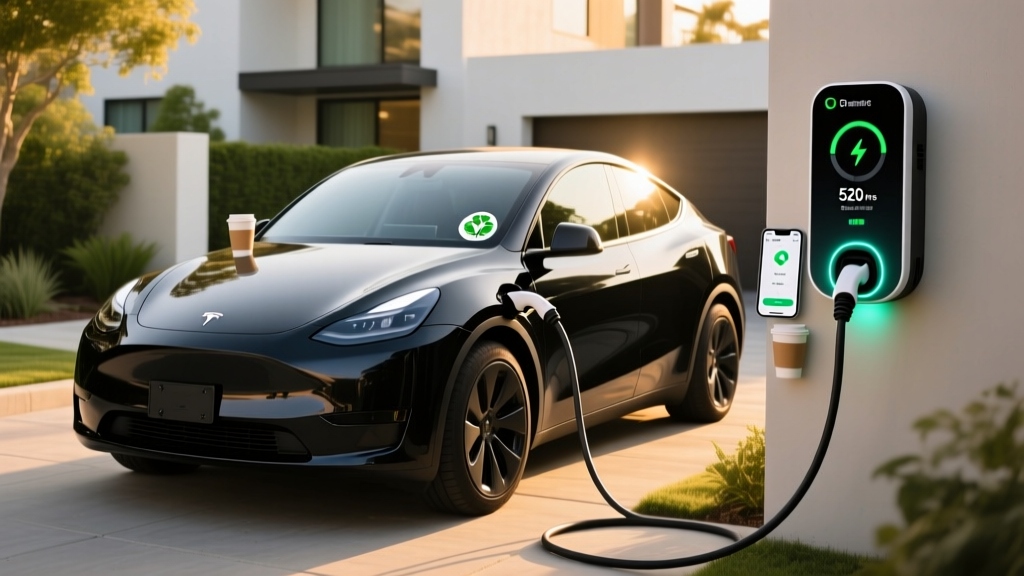
For home charging, the Tesla Wall Connector on a 60-amp circuit delivers the full 11.5 kW (48 amps), adding roughly 44 miles of range per hour. An overnight 8-hour session replenishes ~350 miles — more than enough for any daily commute. Installation costs typically range from $800 to $2,500 depending on panel proximity and local permit fees.
Pricing, Trims, and Federal Tax Credit Eligibility
| Trim | Base MSRP | Destination | Est. After §30D Credit |
|---|---|---|---|
| Long Range AWD | $44,990 | $1,390 | ~$38,880 (if eligible) |
| Performance | $49,990 | $1,390 | ~$43,880 (if eligible) |
The federal EV tax credit under IRS §30D can reduce the effective cost by up to $7,500, and as of 2024, buyers may elect to transfer the credit to the dealer as a point-of-sale discount. However, eligibility is not automatic. Key requirements for 2026 include:
- MSRP Cap: SUVs must not exceed $80,000 MSRP — both Model Y trims clear this easily.
- Buyer Income Cap: Modified adjusted gross income must not exceed $150,000 (single), $225,000 (head of household), or $300,000 (joint filers).
- Battery Sourcing: Critical minerals and battery components must meet phased-in percentages from US or free-trade-agreement countries. Tesla's shifting supply chain means eligibility can change month to month.
- North American Assembly: The Model Y is assembled in Fremont, CA, and Austin, TX — both qualify.
Always verify current eligibility on the IRS clean vehicle credit page before purchase, as battery-component sourcing rules have disqualified and re-qualified various Tesla configurations in prior years.
Five-Year Total Cost of Ownership vs. Competitors
Sticker price is only one variable. Here is how a 2026 Model Y Long Range AWD stacks up over five years and 75,000 miles against the Hyundai Ioniq 5 and Ford Mustang Mach-E, assuming home charging at $0.14/kWh and no major repairs:
| Cost Category | Tesla Model Y LR | Hyundai Ioniq 5 | Ford Mach-E ER AWD |
|---|---|---|---|
| Purchase (after $7,500 credit) | $38,880 | $41,490 | $42,995 |
| Electricity (75k mi) | $3,045 | $3,150 | $3,360 |
| Insurance (5 yr avg) | $9,500 | $7,800 | $8,200 |
| Maintenance (5 yr) | $1,200 | $1,400 | $1,500 |
| Estimated Depreciation | $15,200 | $16,800 | $18,500 |
| 5-Year Total | $67,825 | $70,640 | $74,555 |
The Model Y's efficiency advantage (29 kWh/100 mi vs. the Ioniq 5's ~30 and the Mach-E's ~32) compounds over 75,000 miles. However, Tesla insurance premiums are consistently 15–25% higher than competitors due to elevated collision repair costs. Depreciation favors Tesla due to strong resale demand, though aggressive price cuts in 2023–2024 softened residuals for earlier model years.
Warranty, Battery Longevity, and Maintenance Costs
Tesla provides a 4-year/50,000-mile basic limited warranty and an 8-year/120,000-mile battery and drive unit warranty. The battery warranty guarantees at least 70% capacity retention over the coverage period. If the pack degrades below that threshold, Tesla will repair or replace it to bring retention above 70%.
NMC chemistry in the Model Y typically shows 8–12% degradation over the first 100,000 miles based on fleet data, with the steepest loss occurring in the first 20,000 miles before leveling off. Owners who avoid frequent 100% charges and DC fast-charging exclusively tend to see less degradation.
Maintenance is minimal: cabin air filter replacement every 2–3 years (~$100–$180), tire rotation every 6,250 miles, brake fluid checks, and wiper fluid. Regenerative braking significantly extends pad life — many owners report original brake pads past 80,000 miles. Tesla does not require scheduled service visits to maintain warranty coverage, unlike some legacy automakers.
Tech, Driver Assists, and Interior Drawbacks
The 2026 Model Y continues with Tesla's minimalist interior centered on a 15.4-inch touchscreen running Tesla's proprietary infotainment OS. Navigation, media, and vehicle controls all route through the screen — there are no physical buttons for climate or mirrors. Apple CarPlay and Android Auto remain unavailable.
Standard Autopilot includes Traffic-Aware Cruise Control and Autosteer (lane centering), which constitute an SAE Level 2 driver-assist system. The driver must keep hands on the wheel and eyes on the road at all times. Full Self-Driving (Supervised) adds automated lane changes, traffic light recognition, and city-street navigation for an additional $8,000 one-time purchase or $99/month subscription — but it remains Level 2, not autonomous.
Interior space is generous for the class: 41.0 inches of front legroom and 38.4 inches rear. The 30.2 cu ft cargo area behind the second row expands to 72.1 cu ft with seats folded, aided by a flat load floor. The front trunk (frunk) adds 4.1 cu ft for cables and small bags.
Notable drawbacks include the absence of a traditional instrument cluster, no native smartphone integration, firm ride quality on the Performance trim's 21-inch wheels, and panel-gap inconsistencies that remain a Tesla hallmark. The turn-signal stalk was removed in the 2025 refresh, replaced by steering-wheel-mounted buttons — a polarizing change that persists in 2026.
Pros and Cons: The Honest Verdict
Pros
- Class-leading efficiency (117 MPGe combined)
- Access to Tesla Supercharger network — the most reliable DC fast-charging network in the US
- Strong resale value relative to EV peers
- Spacious cargo area with flat floor and frunk
- Over-the-air updates continuously add features
- Heat pump standard for cold-weather efficiency
Cons
- Insurance premiums 15–25% above segment average
- No Apple CarPlay or Android Auto
- Turn signals on steering wheel (no stalk) frustrate some drivers
- FSD (Supervised) costs $8,000 extra and remains Level 2
- Panel gap quality inconsistent vs. luxury competitors
- Peak DC charge rate of 250 kW trails Hyundai E-GMP's 350 kW capability
Who Should Buy the 2026 Tesla Model Y?
Choose the Model Y Performance if: You prioritize 3.5-second 0–60 acceleration and track-capable handling, and accept 27 fewer miles of EPA range and a firmer ride.
Look at competitors (Ioniq 5, Mach-E, EV6) if: You want Apple CarPlay, prefer physical buttons, need 800V ultra-fast charging (Hyundai/Kia), or want to avoid Tesla's steering-wheel turn signals.
Frequently Asked Questions
What is the real-world range of the 2026 Tesla Model Y?
The EPA rates the Long Range AWD at 320 miles. In real-world highway driving at 70 mph, expect 260–290 miles. In freezing weather with the heater running, range can drop to 220–250 miles. The standard heat pump helps but does not eliminate cold-weather losses.
How fast does the Model Y charge at home and on the road?
At home on a 240V/48A Tesla Wall Connector, the Model Y charges at 11.5 kW, adding about 44 miles of range per hour (a full charge in roughly 7 hours). On a V3 or V4 Supercharger, it peaks at 250 kW and charges from 10–80% in approximately 27 minutes. Charging slows significantly above 80% due to battery-protection tapering.
How much does the Tesla Model Y cost after tax credits?
The Long Range AWD starts at $44,990 plus $1,390 destination, totaling $46,380. If you qualify for the full $7,500 federal §30D credit (income caps, MSRP caps, and battery-sourcing rules apply), the effective price drops to approximately $38,880. Always confirm eligibility on IRS.gov before purchasing.
Does the Tesla Model Y qualify for the federal EV tax credit in 2026?
Generally yes — the Model Y is assembled in the US, falls under the $80,000 SUV MSRP cap, and Tesla has worked to comply with critical-mineral and battery-component sourcing rules. However, eligibility can change based on supply-chain shifts. Buyer income must not exceed $150K single / $300K joint. The credit can now be transferred to the dealer at point of sale for an instant discount.
Is the Model Y worth buying vs. the Hyundai Ioniq 5 or Ford Mach-E?
The Model Y wins on efficiency, Supercharger network access, and 5-year total cost of ownership. The Ioniq 5 offers faster 350 kW peak charging (on 800V chargers), Apple CarPlay, and a more conventional interior. The Mach-E provides a familiar crossover feel with BlueCruise hands-free driving. If Supercharger access and low per-mile cost are your priorities, the Model Y remains the strongest choice. If you prefer physical controls and CarPlay, look to Hyundai or Ford.
What are the biggest ongoing costs of owning a Tesla Model Y?
Insurance is the most significant variable — averaging $1,800–$2,200 per year depending on state and driving record, which is 15–25% above the midsize SUV average. Electricity costs roughly $600–$700 per year at 12,000 miles driven (based on $0.14/kWh national average). Maintenance is low at ~$200–$300 annually. Tire replacement may come sooner than gas vehicles due to the Model Y's weight and instant torque.