Quick Verdict: Tesla Model Y Comfort Meets Everyday Practicality
If you've been searching whether Tesla offers ventilated seating, the short answer is yes — but only on specific trims and through recent updates. The 2026 Tesla Model Y (including the refreshed "Juniper" variant introduced in early 2025) now includes ventilated front seats on Long Range and Performance trims in select markets, addressing one of the most frequent comfort complaints from owners in hot climates. Beyond the seats, the Model Y remains the benchmark compact electric SUV: efficient, fast-charging, and packed with tech — though not without trade-offs in ride quality and interior material feel.
This review covers everything a buyer needs: real-world range versus the EPA sticker, charging speeds at home and on the road, 2026 pricing after federal tax credits, and how the Model Y stacks up against rivals like the Hyundai Ioniq 5 and Ford Mustang Mach-E.
Does Tesla Have Cooled Seats? The Full Answer for 2026
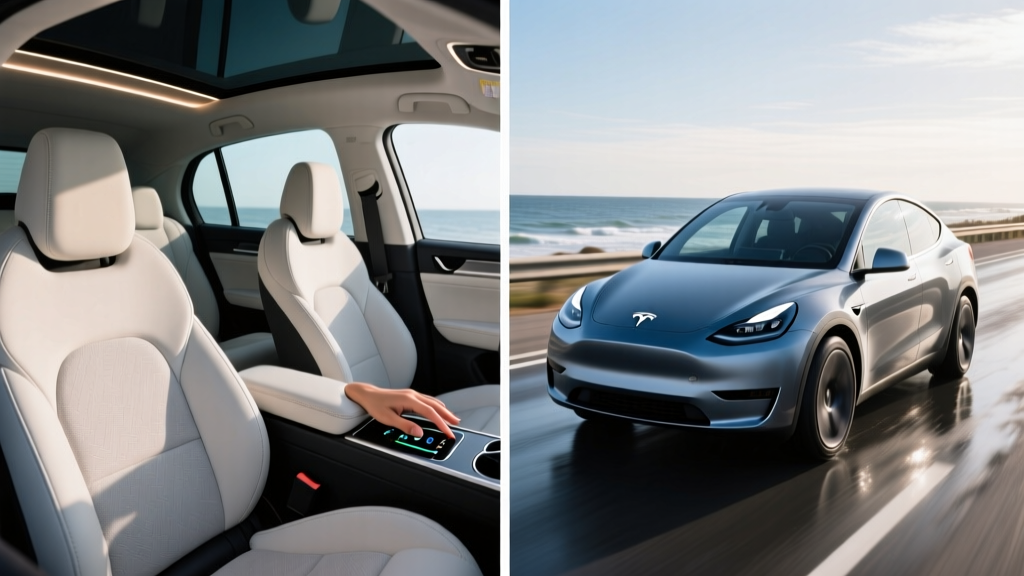
Ventilated (cooled) front seats are now available on the Tesla Model Y Long Range AWD and Model Y Performance trims as part of the Juniper interior refresh. The base Rear-Wheel Drive trim does not include them. The system uses fans embedded in the seat cushion and backrest to circulate air through perforated upholstery, reducing heat soak during summer months.
This is a meaningful upgrade from pre-2025 Model Y versions, where owners relied on aftermarket solutions or simply cranking the cabin AC. Tesla's implementation is integrated into the climate-control menu on the 15.4-inch touchscreen, with three intensity levels. It's worth noting that cooled seats are not unique to Tesla — the Hyundai Ioniq 5 and Kia EV6 have offered them for years — but their inclusion on the Model Y closes a competitive gap.
Range, Battery, and Efficiency: EPA vs. the Real World
The 2026 Tesla Model Y Long Range AWD carries an EPA-estimated range of 320 miles on a full charge, powered by a 78.1 kWh usable battery pack (approximately 82 kWh gross) using NMC (nickel manganese cobalt) lithium-ion chemistry. The base RWD trim uses a smaller 60 kWh LFP (lithium iron phosphate) pack with an EPA rating of 260 miles.
EPA estimates assume a mix of city and highway driving at moderate temperatures. In our experience and consistent third-party testing:
- Highway (70-80 mph, 75°F): Expect ~270–290 miles on the Long Range AWD.
- Cold weather (30°F, highway): Range drops to ~220–245 miles due to cabin heating demand and battery chemistry limitations.
- City driving with regen: You can approach or even exceed the EPA number thanks to aggressive regenerative braking recapturing energy.
Efficiency is rated at 122 MPGe combined (Long Range AWD), which translates to roughly 28 kWh per 100 miles — among the best in the compact electric SUV segment. Tesla's powertrain efficiency remains an industry benchmark, squeezing more miles per kilowatt-hour than nearly every competitor.
| Spec | Long Range AWD | Performance | RWD (Base) |
|---|---|---|---|
| EPA Range | 320 mi | 295 mi | 260 mi |
| Battery (Usable) | 78.1 kWh (NMC) | 78.1 kWh (NMC) | 60 kWh (LFP) |
| Drivetrain | Dual-Motor AWD | Dual-Motor AWD | Single-Motor RWD |
| Horsepower | 384 hp | 456 hp | 295 hp |
| 0-60 mph | 4.8 sec | 3.5 sec | 6.6 sec |
| Efficiency (MPGe) | 122 combined | 111 combined | 128 combined |
| Cargo (behind 2nd row) | 30.2 cu ft | 30.2 cu ft | 30.2 cu ft |
| Cargo (max, folded) | 72.1 cu ft | 72.1 cu ft | 72.1 cu ft |
| Base MSRP | $48,990 | $53,990 | $44,990 |
Charging Speed: DC Fast Charging and Home Level 2
Tesla's Supercharger network remains the gold standard for public charging reliability, and the 2026 Model Y takes full advantage. Here's what you need to know:
| Charging Level | Power / Rate | Speed (Miles Added) | Notes |
|---|---|---|---|
| Level 1 (120V household) | ~1.4 kW | ~3–4 mi/hr | Emergency/trickle only |
| Level 2 (240V home, 48A) | 11.5 kW | ~37 mi/hr | Full charge in ~7–8 hours (LR AWD) |
| DC Fast Charge (Supercharger V3) | Peak 250 kW | ~162 mi in 15 min | 10-80% in ~25 min; tapers above 80% |
| DC Fast Charge (V4 Supercharger) | Peak 250+ kW | Similar to V3 | Rolling out at select locations |
The Model Y Long Range peaks at 250 kW on a V3 or V4 Supercharger, but like all EVs, it doesn't sustain that rate. The charge curve holds near peak from roughly 10-40% State of Charge (SoC), then progressively tapers. The 10-80% charge takes approximately 25 minutes under ideal conditions (battery preconditioned via navigation to a Supercharger). Above 80%, the rate drops sharply to protect battery longevity — a 80-100% top-off can add another 20+ minutes.
At home on a Wall Connector (48 amps, 240V), you'll add about 37 miles of range per hour, meaning a depleted Long Range battery fully recharges overnight. A Tesla Wall Connector costs around $400 for the unit, with professional installation typically running $500–$1,500 depending on your electrical panel. For a detailed breakdown of home charging costs, see our Level 2 installation guide.
With Tesla's NACS connector now adopted industry-wide as the standard (SAE J3400), the Model Y can also access Electrify America and other networks using adapters, though native Supercharger compatibility remains the most seamless experience.
Performance, Interior Space, and Standout Tech
The Model Y's dual-motor AWD powertrain delivers 384 hp in the Long Range and a punchy 4.8-second 0-60 mph time. The Performance trim drops that to 3.5 seconds with 456 hp, accompanied by upgraded brakes, a lowered sport suspension, and 21-inch wheels. The RWD base model, while less thrilling at 6.6 seconds, is still quicker than most gas-powered compact SUVs.
Inside, the Juniper refresh brought meaningful improvements: a rear-seat touchscreen, ambient lighting, power-folding second-row seats, acoustic glass for a quieter cabin, and revised seat materials. Cargo volume stands at 30.2 cubic feet behind the second row and 72.1 cubic feet with seats folded — competitive with the Ioniq 5 (27.2 / 56.2 cu ft) and slightly less than the Mach-E (29.7 / 59.7 cu ft). The Model Y also retains a small front trunk (frunk) for additional storage.
Legroom measures 41.8 inches in front and 37.4 inches in the rear — adequate for adults on longer trips, though the sloping roofline limits headroom for taller rear passengers.
Tech highlights include:
- 15.4-inch center touchscreen with Tesla's latest UI (no Apple CarPlay/Android Auto — Tesla's native system handles navigation, media, and vehicle controls)
- Over-the-air software updates that regularly add features
- Tesla Autopilot (standard) — adaptive cruise control and lane centering (SAE Level 2)
- Full Self-Driving Supervised (optional, ~$8,000) — adds automatic lane changes, traffic light recognition, and navigation-on-Autopilot, but still requires active driver supervision
- Sentry Mode dashcam recording, Dog Mode climate control, and the Tesla mobile app for remote preconditioning
Notable drawbacks: The Model Y's ride quality on larger wheels can be firm over rough pavement. The minimalist interior (no physical buttons, no instrument cluster) remains polarizing. Panel gap consistency, while improved, still draws scrutiny compared to legacy automakers. And Tesla's reliance on touchscreen-only controls for features like wiper speed and mirror adjustment frustrates some drivers.
Pricing, Federal Tax Credit, and Total Cost
The 2026 Model Y starts at $44,990 for the base RWD, $48,990 for the Long Range AWD, and $53,990 for the Performance — before destination fees ($1,390) and options. Adding FSD Supervised ($8,000) or premium paint colors ($1,000–$2,500) can push an as-tested Long Range past $60,000.
| Trim | Base MSRP | Est. After §30D Credit | Credit Eligibility |
|---|---|---|---|
| RWD | $44,990 | $37,490* | Eligible (up to $7,500) |
| Long Range AWD | $48,990 | $41,490* | Eligible (up to $7,500) |
| Performance | $53,990 | $46,490* | Eligible (up to $7,500) |
*Estimated effective price assuming full $7,500 credit. Actual eligibility depends on multiple factors.
- MSRP cap: The Model Y qualifies as an SUV under IRS rules (under the $80,000 MSRP cap for SUVs/trucks).
- Buyer income limits (2026 MAGI): $150,000 single / $225,000 head of household / $300,000 joint filers.
- Battery sourcing: The credit splits into two halves ($3,750 each) — one for critical minerals and one for battery component manufacturing. Tesla's North American battery supply chain currently qualifies for both halves on most Model Y trims built at Giga Texas, but sourcing requirements tighten annually. Always verify current eligibility.
- Point-of-sale transfer: As of 2024+, you can transfer the credit to the dealer at purchase, reducing your out-of-pocket cost immediately rather than waiting for a tax refund.
For the latest rules, consult IRS.gov's clean vehicle credit page. Eligibility can change based on battery sourcing updates, so confirm with Tesla at the time of order.
Warranty, Ownership Costs, and Who the Model Y Suits Best
Tesla covers the Model Y with a 4-year/50,000-mile basic warranty and an 8-year/120,000-mile battery and drive unit warranty (Long Range/Performance). The RWD with its LFP battery carries an 8-year/100,000-mile battery warranty. Tesla guarantees the battery will retain at least 70% of its original capacity during the warranty period.
Ownership costs are favorable compared to gas equivalents: electricity costs roughly $0.04–$0.06 per mile (home charging) versus $0.12–$0.16 per mile for a comparable gas SUV. Maintenance is minimal — no oil changes, fewer brake replacements thanks to regenerative braking, and cabin air filter swaps every 2-3 years. Insurance premiums, however, tend to run 15-30% higher than average for the segment due to repair costs and Tesla's direct repair network.
Who should buy the Model Y?
- Daily commuters: Excellent efficiency, home charging convenience, and Autopilot reduce fatigue.
- Small families: Adequate cargo and passenger space, strong safety ratings (NHTSA 5-Star Overall).
- Road trippers: The Supercharger network makes long-distance EV travel the least stressful of any brand.
- Not ideal for: Buyers who prioritize plush ride quality, physical buttons, Apple CarPlay integration, or need three-row seating (look at the Model X or Kia EV9).
Model Y vs. Key Competitors: Ioniq 5, Mach-E, and EV6
Choose the Hyundai Ioniq 5 or Kia EV6 if: Ultra-fast 800V charging, a more conventional interior with physical controls, and available ventilated seats on more trims matter to you.
Choose the Ford Mustang Mach-E if: Ride comfort, Apple CarPlay/Android Auto, and a more traditional dealership service experience are priorities.
Pros and Cons at a Glance
- Class-leading efficiency (122 MPGe) and real-world range
- Supercharger network: the most reliable DC fast-charging ecosystem
- Spacious cargo area (72.1 cu ft) with flat-folding rear seats
- Over-the-air updates continuously improve the vehicle
- Ventilated seats now available on Long Range/Performance trims
- Strong federal tax credit eligibility (up to $7,500)
- Firm ride quality, especially on 20/21-inch wheels
- No Apple CarPlay or Android Auto
- Touchscreen-only controls for basic functions (mirrors, wipers)
- DC fast charging (250 kW peak) slower than 800V competitors
- Ventilated seats not available on base RWD trim
- Insurance costs above segment average
Frequently Asked Questions
Does the Tesla Model Y have cooled (ventilated) seats?
Yes, ventilated front seats are available on the 2026 Model Y Long Range AWD and Performance trims as part of the Juniper refresh. The base RWD trim does not include them. Availability may vary by market and delivery batch.
What is the real-world range of the 2026 Tesla Model Y?
The EPA rates the Long Range AWD at 320 miles. In real-world highway driving at moderate temperatures, expect approximately 270–290 miles. In cold weather (below freezing), plan for 220–245 miles due to battery and cabin heating demands.
How fast does the Model Y charge at home and on the road?
On a Level 2 home charger (48A, 240V), the Model Y adds about 37 miles of range per hour, fully charging overnight. On a Tesla Supercharger (V3/V4), it peaks at 250 kW, charging from 10-80% in roughly 25 minutes with a preconditioned battery.
How much does the 2026 Model Y cost after the federal tax credit?
The Long Range AWD starts at $48,990. If you qualify for the full $7,500 §30D credit (subject to income limits, MSRP caps, and battery sourcing rules), the effective price drops to approximately $41,490. The credit can be transferred at point of sale to reduce your purchase price immediately.
Does the Tesla Model Y qualify for the $7,500 federal EV tax credit?
Yes, as of 2026, the Model Y qualifies for up to $7,500 under IRS §30D, provided the buyer meets income limits ($150K single / $300K joint), the MSRP is under $80,000 (SUV classification), and battery sourcing requirements are met. Tesla's Giga Texas-built Model Y currently satisfies both the critical minerals and battery component halves. Always verify at IRS.gov before purchasing, as rules tighten annually.
Is the Tesla Model Y worth buying over the Ioniq 5 or Mach-E?
The Model Y wins on cargo space, efficiency, and Supercharger network access. The Ioniq 5 charges faster (350 kW peak on 800V). The Mach-E offers a more comfortable ride and CarPlay support. Your priority — charging speed, comfort, or ecosystem — should drive the decision.
What is the battery warranty on the Model Y?
Tesla covers the battery and drive unit for 8 years or 120,000 miles (Long Range/Performance) and 8 years or 100,000 miles (RWD). The battery is guaranteed to retain at least 70% of its original capacity during the warranty period.