2026 Tesla Model Y: Color Options Meet Real-World Capability
The Tesla Model Y remains America's best-selling electric vehicle for good reason: crossover practicality, Supercharger network access, and a starting price that undercuts many rivals. But beyond the spec sheet, buyers frequently search for Tesla Y colors and exterior configurations before pulling the trigger — and for 2026, Tesla has streamlined the palette while quietly updating efficiency and range figures. This guide pairs the visual customization details shoppers want with the hard performance, charging, and ownership data they need to make an informed purchase.
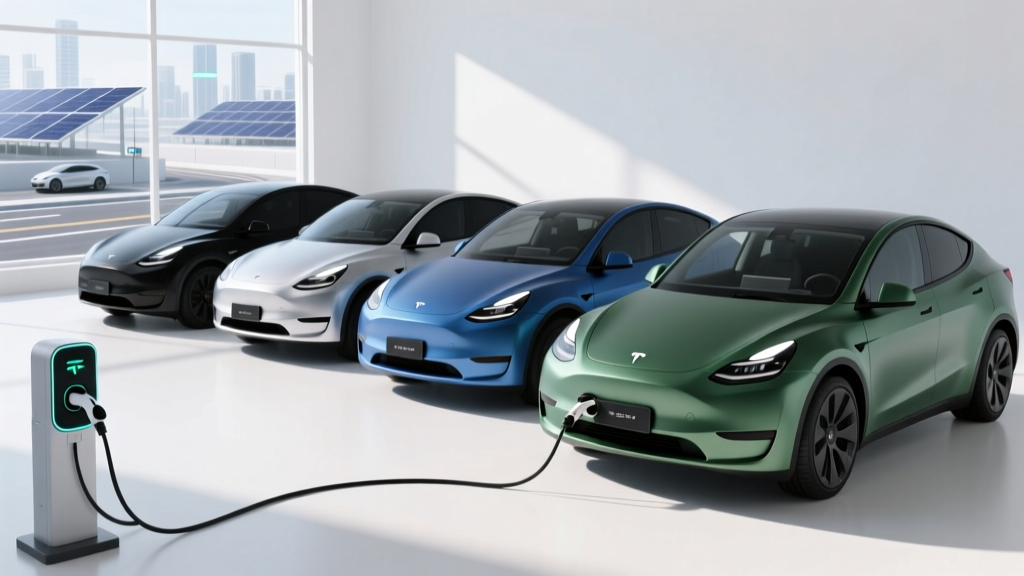
2026 Tesla Model Y Color Palette and Exterior Options
Tesla simplified its color lineup for the refreshed Model Y (internally called "Juniper"), moving away from some legacy options and introducing new premium finishes. Here is the current menu:
- Glacier Blue Metallic — A new hero color for the refresh; deep blue with metallic flake. No-cost option on some trims, premium on others.
- Deep Grey Metallic — Replaces the older Midnight Silver; darker, more sophisticated tone.
- Pearl White Multi-Coat — Tesla's long-standing no-cost standard color. Clean, high-resale-value choice.
- Solid Black — A premium-cost option; shows dirt and swirl marks more readily but delivers a stealthy, monochromatic look.
- Ultra Red — A multi-coat premium red with significant depth; replaces the older Red Multi-Coat.
- Quicksilver — A bright, liquid-metal silver that replaced Midnight Cherry Red in the premium slot for some markets.
Interior choices are similarly pared down: Black (standard) and Black and White (premium, light-colored vegan leather with wood trim). The Black and White interior adds roughly $1,000 to the build and is popular despite requiring more frequent cleaning.
Spec Table: Range, Battery, Charging, and Performance
| Specification | Model Y Long Range AWD | Model Y Performance |
|---|---|---|
| EPA Range | 320 miles | 293 miles |
| Battery Capacity (usable) | ~75 kWh (NMC) | ~75 kWh (NMC) |
| Battery Chemistry | NMC (Nickel Manganese Cobalt) | NMC |
| Max DC Fast Charge | 250 kW | 250 kW |
| 10–80% DC Charge Time | ~25 minutes | ~25 minutes |
| Level 2 Home Charge Rate | 11.5 kW (~44 mi/hr) | 11.5 kW (~44 mi/hr) |
| 0–60 mph | 4.8 seconds | 3.5 seconds |
| Horsepower | ~384 hp (dual motor) | ~456 hp (dual motor) |
| Drivetrain | Dual Motor AWD | Dual Motor AWD |
| Efficiency (MPGe) | 111 MPGe combined | 103 MPGe combined |
| Efficiency (kWh/100 mi) | 30 kWh/100 mi | 33 kWh/100 mi |
| Base MSRP | $44,990 | $48,990 |
| Battery Warranty | 8 yr / 120,000 mi | 8 yr / 120,000 mi |
Sources: EPA Fueleconomy.gov, Tesla.com Model Y configurator.
Charging Speed: DC Fast, Level 2, and the Supercharger Advantage
Charging speed is where the Model Y's integration with the Tesla Supercharger network pays dividends. The Long Range and Performance trims both peak at 250 kW on V3 Superchargers, though sustained rates depend on battery preconditioning and state of charge.
| Charging Level | Power (kW) | Speed (miles of range per hour) | Notes |
|---|---|---|---|
| Level 1 (120V household) | ~1.4 kW | ~5 mi/hr | Emergency/trickle only |
| Level 2 (240V home, 48A) | 11.5 kW | ~44 mi/hr | Full overnight charge in ~7 hrs |
| DC Fast (Tesla V3 Supercharger) | Up to 250 kW | ~1,000 mi/hr peak | 10–80% in ~25 min; tapers above 80% |
| DC Fast (CCS adapter, non-Tesla) | Up to 250 kW | ~1,000 mi/hr peak | Requires NACS-to-CCS adapter or native NACS port |
Charging curve reality: The Model Y does not sustain 250 kW for the entire session. Peak power is available roughly between 10–30% state of charge. From 50–80%, expect rates closer to 80–120 kW. This is normal for NMC chemistry but means the "25-minute" 10–80% time assumes you arrive at a low SoC with the battery preconditioned (navigate to a Supercharger in the car's nav to trigger this automatically).
For 2026, Tesla's NACS (North American Charging Standard) connector is the dominant plug in North America, with Ford, GM, Rivian, and others now adopting it. Model Y owners benefit from native compatibility at every Supercharger stall — no adapter required — and growing access to Electrify America and other networks via CCS adapters.
Real-World Range: What the EPA Number Doesn't Tell You
The EPA's 320-mile estimate for the Long Range AWD is measured under controlled laboratory conditions. Real-world results depend heavily on driving style, terrain, climate, and speed:
- City/suburban driving (30–50 mph): You may exceed the EPA estimate, reaching 330+ miles thanks to regenerative braking recapturing energy at lower speeds.
- Highway driving (70–80 mph): Expect 270–290 miles. Aerodynamic drag is the dominant energy consumer above 65 mph.
- Cold weather (below 32°F): Range drops 15–30%. At 20°F, a fully charged Model Y Long Range may deliver only 230–250 miles. The heat pump (standard on 2026 models) mitigates this somewhat compared to older resistive-heating EVs, but the loss is real.
- Towing: With a 3,500-lb trailer attached, range can fall below 200 miles. Towing is feasible for short hauls but requires careful route planning around Superchargers.
Tesla's trip planner in the navigation system is remarkably accurate at predicting arrival SoC, factoring in elevation, speed, and temperature. Trust it — and always keep a 10–15% buffer for detours.
Pricing, Trims, and Federal Tax Credit Eligibility
| Trim | Base MSRP | Destination Fee | Total Before Incentives |
|---|---|---|---|
| Model Y Long Range AWD | $44,990 | $1,390 | $46,380 |
| Model Y Performance | $48,990 | $1,390 | $50,380 |
Premium paint colors (Ultra Red, Solid Black, Quicksilver, Deep Grey) add $1,500–$2,500 depending on the finish. The Black and White interior adds $1,000. A fully loaded Model Y Performance with premium paint and FSD (Supervised) can approach $60,000 before incentives.
Does the 2026 Model Y Qualify for the Federal EV Tax Credit?
Under current IRS §30D rules, the Model Y may qualify for up to $7,500 in federal tax credits, but eligibility is not automatic. Key requirements include:
- MSRP cap: The vehicle must have an MSRP at or below $80,000 for SUVs/crossovers (the Model Y clears this easily).
- Buyer income cap: Modified adjusted gross income must not exceed $150,000 (single), $225,000 (head of household), or $300,000 (joint filers).
- Battery sourcing: Critical minerals and battery components must meet escalating domestic-content and free-trade-agreement thresholds that tighten annually through 2026. Tesla's Fremont and Austin-built Model Y batteries have generally met these thresholds, but specific build dates and supply chain shifts can affect eligibility.
- Point-of-sale transfer: Since 2024, qualified buyers can transfer the credit to the dealer at purchase, effectively reducing the out-of-pocket price by $7,500 at the time of sale rather than waiting for a tax refund.
Important: Tax credit rules change frequently. Always verify current eligibility on the IRS Clean Vehicle Credits page and consult a tax professional before relying on the credit in your budget.
Interior Space, Cargo, and Practicality
The Model Y's crossover form factor delivers genuine utility:
- Cargo volume (rear seats up): 30.2 cu ft
- Cargo volume (rear seats folded): 72.1 cu ft
- Front trunk (frunk): 4.1 cu ft — useful for charging cables, groceries, or a small bag
- Rear legroom: 41.6 inches — competitive with midsize SUVs
- Front headroom: 41.0 inches (with glass roof)
- Towing capacity: 3,500 lbs (when equipped with tow hitch)
The flat floor and absence of a transmission tunnel make the rear seat feel airier than its dimensions suggest. However, the sloping roofline cuts into cargo height for tall items, and the rear visibility through the small hatch glass is limited — rely on the backup camera and sensors.
Technology, Driver Assistance, and Drawbacks
The 2026 Model Y refresh brought a redesigned interior with ventilated front seats, ambient lighting, a rear-seat touchscreen, and improved sound insulation. The 15.4-inch center touchscreen runs Tesla's proprietary infotainment system — responsive, feature-rich, but lacking Apple CarPlay and Android Auto (a dealbreaker for some buyers).
Driver Assistance: Autopilot and FSD (Supervised)
Autopilot (included): Adaptive cruise control, lane centering, automatic emergency braking, blind-spot monitoring. Competent for highway cruising but requires active supervision.
FSD (Supervised) ($8,000 one-time or $99/month): Adds automatic lane changes, traffic light/stop sign recognition, and city-street navigation. Impressive in many scenarios but still makes errors — phantom braking, missed construction zones, inconsistent merges. Treat it as an advanced cruise control, not a chauffeur.
Notable Drawbacks
- No Apple CarPlay or Android Auto — Tesla's ecosystem is closed.
- Ride quality is firm; the refresh improved damping but it's still sportier than plush.
- Panel gaps and paint quality have improved but still lag legacy automakers at this price point.
- No physical instrument cluster — all information lives on the center screen, which some drivers find distracting.
- Insurance premiums are above segment average due to repair costs and Tesla's proprietary body structure.
Pros and Cons at a Glance
- Class-leading Supercharger network access
- Strong real-world efficiency (30 kWh/100 mi)
- 320-mile EPA range (Long Range)
- Spacious cargo area with frunk
- Over-the-air updates add features post-purchase
- Strong resale value relative to EV segment
- No Apple CarPlay/Android Auto
- Firm ride quality
- FSD costs $8,000 and is still Level 2
- Premium paint adds $1,500–$2,500
- Insurance costs above average
- Rear visibility limited by roofline
Who Should Buy the 2026 Tesla Model Y?
Choose the Model Y Long Range if: You want a daily-driver EV with 300+ miles of range, access to the most reliable DC fast-charging network in North America, and enough cargo space for a family of four with luggage. It's ideal for commuters with home Level 2 charging and road-trippers who value Supercharger predictability.
Choose the Model Y Performance if: You want sports-car acceleration (3.5 sec 0–60) in a practical crossover and don't mind sacrificing ~27 miles of range for the privilege. The upgraded brakes, lowered suspension, and 21-inch wheels sharpen the driving experience.
Look elsewhere if: You need Apple CarPlay, prefer a traditional dealer service experience, want a plush luxury ride (consider the Genesis GV60 or BMW iX), or need a third row (Kia EV9 or Rivian R1S).
Competitive Comparison: Model Y vs. Key Rivals
| Attribute | Tesla Model Y LR | Ford Mustang Mach-E ER AWD | Hyundai Ioniq 5 Long Range AWD |
|---|---|---|---|
| EPA Range | 320 mi | 290 mi | 290 mi |
| Max DC Charge | 250 kW | 150 kW | 235 kW |
| 10–80% Time | ~25 min | ~39 min | ~18 min |
| 0–60 mph | 4.8 sec | 5.1 sec | 5.1 sec |
| Base MSRP | $44,990 | $48,995 | $49,850 |
| Charging Network | Native NACS/Supercharger | NACS adapter for Superchargers | NACS adapter for Superchargers |
| Apple CarPlay | No | Yes | Yes |
The Ioniq 5 charges faster (18-min 10–80% on a 350 kW charger) and offers CarPlay, but the Model Y's range and Supercharger integration remain decisive for frequent road-trippers. The Mach-E offers a more engaging steering feel but trails on efficiency and charging speed.
Frequently Asked Questions
What Tesla Y colors are available for 2026?
The 2026 Model Y offers Pearl White Multi-Coat (standard/no-cost), Glacier Blue Metallic, Deep Grey Metallic, Solid Black, Ultra Red, and Quicksilver. Premium colors add $1,500–$2,500. Interior options are Black (standard) and Black and White (premium, +$1,000).
What is the real-world range of the 2026 Model Y?
The EPA rates the Long Range AWD at 320 miles. Real-world highway driving yields 270–290 miles. In cold weather (below freezing), expect 230–250 miles. City driving with regenerative braking can exceed the EPA estimate.
How fast does the Model Y charge at home and on the road?
At home on a 240V Level 2 charger (48A), the Model Y adds roughly 44 miles of range per hour, fully charging overnight in about 7 hours. On a Tesla V3 Supercharger, it peaks at 250 kW and charges from 10–80% in approximately 25 minutes, though charging slows significantly above 80% SoC.
Does the 2026 Model Y qualify for the $7,500 federal tax credit?
It may, depending on your income (must be under $150K single / $300K joint), the vehicle's MSRP (under $80K for SUVs — the Model Y qualifies), and current battery-sourcing rules. Tesla's US-built Model Y has generally met §30D sourcing requirements, but always verify on IRS.gov before purchasing. The credit can be transferred at point of sale to reduce your purchase price directly.
Is the Tesla Model Y worth buying over competitors?
For buyers who prioritize range, charging infrastructure, and software, the Model Y is difficult to beat. Its Supercharger network advantage is real, especially for road trips. However, if you need Apple CarPlay, prefer a softer ride, or want a traditional dealership experience, the Hyundai Ioniq 5, Ford Mach-E, or BMW iX may suit you better. Test-drive at least one rival before committing.
How long will the Model Y battery last?
Tesla warranties the battery for 8 years or 120,000 miles (whichever comes first), guaranteeing at least 70% capacity retention. Real-world data from high-mileage Tesla owners suggests NMC batteries in the Model Y retain approximately 85–90% capacity after 100,000 miles when charged primarily to 80% daily and avoiding frequent 100% charges. A full battery replacement outside warranty currently costs $12,000–$16,000.