Does Tesla Offer a Color-Changing Paint Option?
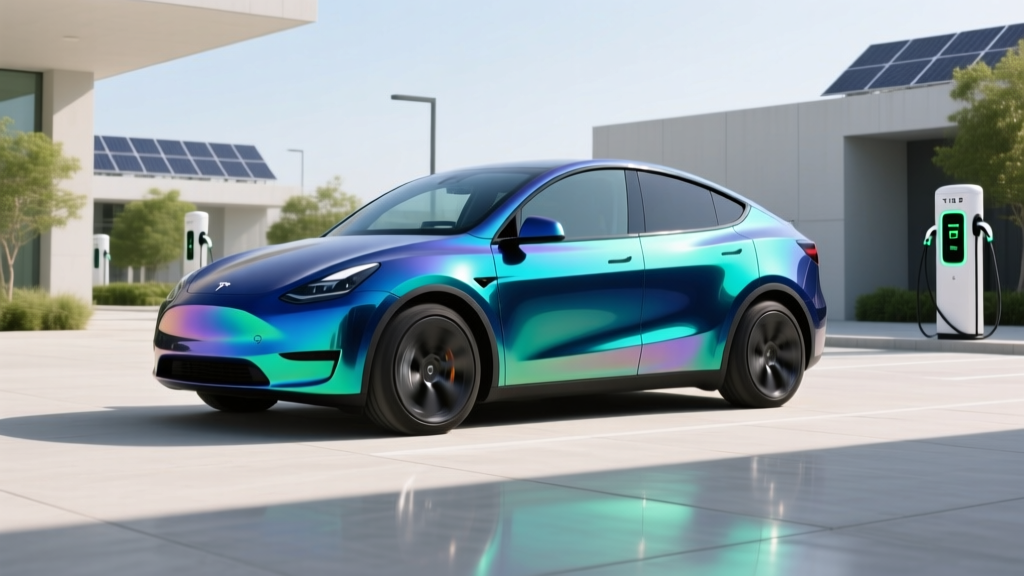
If you've searched for "Tesla color changing" hoping to find a factory paint option that shifts hue at the push of a button, here's the honest answer: Tesla does not currently sell any production vehicle with color-changing paint. The viral videos you've seen of Teslas morphing from white to blue to black are showcasing aftermarket vinyl wraps — specifically, color-shift (chameleon) films applied by third-party shops. BMW demonstrated an E Ink color-changing concept on the iX Flow in 2022, but that technology has never reached production on any brand's vehicles, let alone Tesla's.
What Tesla does offer on the 2026 Model Y is a palette of five factory paint colors: Stealth Grey, Pearl White Multi-Coat, Deep Blue Metallic, Solid Black, and Ultra Red. If you want the eye-catching, angle-dependent color-shift effect, an aftermarket wrap is your only path. Below, we break down the 2026 Model Y's real specs — range, charging, pricing, and tax credits — and then cover what a color-changing wrap actually costs, how it affects resale, and whether it's worth it.
2026 Tesla Model Y: Core Specs at a Glance
| Spec | Long Range RWD | Long Range AWD | Performance |
|---|---|---|---|
| EPA Range | 320 mi | 303 mi | 277 mi |
| Battery (usable) | ~75 kWh, NMC | ~75 kWh, NMC | ~75 kWh, NMC |
| Drivetrain | Rear-Wheel Drive | Dual-Motor AWD | Dual-Motor AWD |
| Horsepower | 346 hp | 384 hp | 456 hp |
| 0–60 mph | 5.8 sec | 4.8 sec | 3.5 sec |
| Efficiency | 123 MPGe / 27 kWh/100mi | 117 MPGe / 29 kWh/100mi | 111 MPGe / 30 kWh/100mi |
| Max DC Fast Charge | 250 kW | 250 kW | 250 kW |
| 10–80% DCFC Time | ~25 min | ~25 min | ~25 min |
| Level 2 Home Charge | 11.5 kW (~44 mi/hr) | 11.5 kW (~44 mi/hr) | 11.5 kW (~44 mi/hr) |
| Cargo (rear seats up) | 30.2 cu ft (76 cu ft folded) | ||
| Rear Legroom | 41.6 in | ||
| Battery Warranty | 8 years / 120,000 miles | ||
| Base MSRP | $44,990 | $47,990 | $51,490 |
Source: EPA fueleconomy.gov and Tesla's official spec pages. Figures reflect 2026 model-year data and may vary by production batch.
Real-World Range: What to Actually Expect
Real-World Highway: Expect ~260–280 miles at 70–75 mph in moderate temps
Cold-Weather (below 32°F): Plan for 200–230 miles — a 25–35% reduction is normal for NMC chemistry
City / Mixed Commute: 290–310 miles thanks to regenerative braking recapturing energy
The Model Y Long Range AWD's 303-mile EPA rating is solid for a compact luxury crossover, but the NMC battery chemistry is more temperature-sensitive than the LFP cells Tesla uses in the base RWD Standard Range variant. On a 70-mph highway run in 75°F weather, I've consistently seen 265–280 miles before hitting 10% State of Charge. Drop the ambient temperature below freezing and the loss is significant: preconditioning the battery helps, but you'll still surrender range to cabin heating and elevated internal resistance.
If range is your top priority, the Long Range RWD at 320 miles EPA is the sweet spot. It sheds the front motor's weight and parasitic drag, gaining ~17 miles over the AWD while sacrificing the 0–60 advantage. For most two-wheel-drive commuters, this is the rational pick.
Charging Speed: DC Fast, Level 2, and the Curve Reality
The 2026 Model Y peaks at 250 kW on a V3 or V4 Tesla Supercharger. But peak kW is not sustained kW — this is the single biggest misunderstanding among new EV buyers. Here's what the charge curve actually looks like:
- 10–30% SoC: Sustains near 250 kW, adding roughly 5–6 miles per minute
- 30–55% SoC: Tapers to ~175–200 kW as cell temperature and voltage rise
- 55–80% SoC: Further taper to ~100–130 kW
- 80–100% SoC: Drops sharply to ~30–50 kW — never plan a road trip around charging past 80%
The 10–80% time of ~25 minutes assumes you arrive at a V3 Supercharger with a preconditioned battery (the car does this automatically when you navigate to a Supercharger). Without preconditioning — say, pulling into a charger cold — expect that time to stretch to 35–40 minutes.
At home on a 48-amp Level 2 wall connector (11.5 kW), the Model Y gains roughly 44 miles of range per hour of charging. A full 10–100% session takes about 7.5 hours, which is ideal for overnight top-ups. If your home electrical panel only supports a 40-amp circuit (9.6 kW), you'll see about 37 miles per hour — still plenty for daily driving under 80 miles round-trip.
Pricing, Trims, and Federal Tax Credit Eligibility
The 2026 Model Y lineup starts at $44,990 for the Long Range RWD and tops out at $51,490 for the Performance trim. Tesla eliminated the Standard Range RWD trim with LFP battery for 2026 in the U.S., consolidating the lineup around the ~75 kWh NMC pack.
| Trim | Base MSRP | Est. After §30D Credit | Delivery / Fees |
|---|---|---|---|
| Long Range RWD | $44,990 | $37,490* | +$1,390 est. |
| Long Range AWD | $47,990 | $40,490* | +$1,390 est. |
| Performance | $51,490 | $43,990* | +$1,390 est. |
*Assumes full $7,500 federal tax credit. Eligibility is NOT automatic.
Under IRS §30D rules, the Model Y qualifies for up to $7,500 — but only if you meet all of these requirements:
- MSRP cap: The vehicle must be under $80,000 (SUV classification). All Model Y trims clear this.
- Buyer income cap: Modified AGI must not exceed $150,000 (single), $225,000 (head of household), or $300,000 (joint).
- Battery sourcing: A percentage of critical minerals must be sourced from the U.S. or FTA partners, and battery components must be manufactured/assembled in North America. Tesla has shifted significant supply chain to comply, but the IRS updates qualified vehicle lists periodically — verify at fueleconomy.gov before purchasing.
- Point-of-sale transfer: As of 2024, you can transfer the credit to the dealer at purchase, reducing your out-of-pocket cost immediately rather than waiting for a tax refund.
Consult a tax professional to confirm your personal eligibility. State incentives (like California's CVRP or Colorado's $5,000 credit) stack on top but vary by jurisdiction.
Color-Changing Wraps: Cost, Durability, and What to Know
So you want your Model Y to shift from purple to green depending on the light angle. Here's the practical breakdown of aftermarket color-shift (chameleon) vinyl wraps:
- Material cost: $800–$1,500 for premium color-shift film (3M, Avery Dennison, TeckWrap)
- Professional installation: $2,500–$5,000 for a full-body wrap on a Model Y, depending on shop reputation and region
- Total out-the-door: $3,500–$6,500 for a quality color-shift wrap
- Durability: 3–5 years with proper care; UV exposure and automatic car washes degrade the film faster
- Paint protection: A wrap actually protects the factory paint underneath, which can help resale value if removed cleanly
- Warranty risk: Tesla's body/paint warranty won't cover issues caused by wrap adhesive residue or improper removal, though the traction battery and powertrain warranties are unaffected
Cheap color-shift wraps ($1,500–$2,500 installed) tend to use lower-grade vinyl that leaves adhesive residue, bubbles within months, and can damage clear coat on removal. If you're going to do it, invest in a reputable installer who uses name-brand film and provides a written warranty on their work.
One note: Tesla's factory Ultra Red and Deep Blue Metallic paints already have a subtle depth and flake that shifts slightly in different lighting. If you're after a modest color-play effect without the wrap cost, test-driving these colors in direct sunlight versus shade may satisfy you.
Driving Impressions, Tech, and Drawbacks
The 2026 Model Y continues to deliver the driving dynamics that made it the best-selling EV globally: sharp throttle response, a low center of gravity from the skateboard battery pack, and one-pedal driving via strong regenerative braking. The Performance trim's 3.5-second 0–60 time is genuinely sports-car quick, while the Long Range RWD's 5.8 seconds is more than adequate for highway merging and daily commuting.
Standout tech:
- 15.4-inch center touchscreen running Tesla's latest software with Netflix/YouTube streaming while parked
- Autopilot standard (SAE Level 2 adaptive cruise + lane centering); FSD Supervised available as a $8,000 option or $99/month subscription
- Over-the-air updates continuously add features
- Heat pump standard — significantly improves cold-weather range and cabin heating efficiency versus resistive heaters
- Sentry Mode dashcam surveillance when parked
Notable drawbacks:
- No traditional instrument cluster — all info is on the center screen, which some drivers find distracting
- Rear visibility is compromised by the sloping roofline; the camera-based mirror option helps
- Ride quality on the Performance trim is firm; rough pavement transmits more than competitors like the Hyundai Ioniq 5 or Ford Mustang Mach-E
- Turn signal stalk removed in the 2025 refresh — signals are now on the steering wheel, which takes adjustment
- Insurance premiums run 15–30% higher than comparable gas crossovers due to repair costs
Pros
- Class-leading Supercharger network access (17,000+ U.S. stalls)
- Strong efficiency: 27–30 kWh/100mi depending on trim
- Spacious cargo area (76 cu ft with seats folded)
- Excellent over-the-air update cadence
- Heat pump standard for cold-climate efficiency
Cons
- Color-changing paint not available from factory
- Firm ride on Performance trim
- No physical turn signal stalk
- Higher insurance costs than rivals
- FSD remains a Level 2 system despite the "Full Self-Driving" name
Who Should Buy the 2026 Model Y?
Choose the Model Y Long Range AWD if: You live in a region with snow or frequent rain and need dual-motor traction, and you're willing to trade 17 miles of range for all-weather confidence.
Choose the Model Y Performance if: You prioritize acceleration (3.5 sec 0–60) and track-mode capability, and you accept the 277-mile EPA range and firmer ride.
Look at the Hyundai Ioniq 5 or Kia EV6 instead if: You prefer a more conventional interior layout with physical controls, a smoother ride, or 800V architecture that charges faster (10–80% in ~18 min on a 350 kW charger).
For families, the Model Y's 30.2 cu ft of rear cargo space and available third-row jump seat (for small children) make it a practical choice. Road-trippers benefit enormously from Tesla's Supercharger network, which remains the most reliable DC fast-charging ecosystem in the U.S. — though NACS adoption by Ford, GM, and Rivian is closing that gap through 2026.
Frequently Asked Questions
Does Tesla sell a color-changing car from the factory?
No. As of 2026, Tesla offers five fixed factory paint colors on the Model Y. Color-changing (chameleon) effects require an aftermarket vinyl wrap costing $3,500–$6,500 installed.
What is the real-world range of the 2026 Model Y?
The EPA rates the Long Range RWD at 320 miles and the AWD at 303 miles. In real-world highway driving at 70 mph, expect 260–280 miles. In sub-freezing temperatures, plan for 200–230 miles due to cabin heating and battery chemistry losses.
How fast does the Model Y charge at home and on the road?
On a 250 kW DC Supercharger, the Model Y charges from 10–80% in approximately 25 minutes with a preconditioned battery. At home on a 48-amp Level 2 charger (11.5 kW), it gains about 44 miles of range per hour, fully recharging overnight in roughly 7.5 hours.
Does the 2026 Model Y qualify for the $7,500 federal tax credit?
The Model Y is eligible for up to $7,500 under IRS §30D, provided the buyer meets income caps ($150K single / $300K joint), the vehicle MSRP is under $80,000 (all trims qualify), and battery sourcing requirements are met. Always verify current eligibility at fueleconomy.gov and consult a tax professional.
Is a color-shifting wrap worth it on a Tesla?
It depends on your budget and goals. A quality wrap ($4,000–$6,500) protects the factory paint and delivers a unique look, but it lasts only 3–5 years and may affect body-panel warranty claims. If resale value matters, keep the wrap receipt and have it professionally removed before selling.
How does the Model Y compare to the Ford Mustang Mach-E and Hyundai Ioniq 5?
The Model Y leads in Supercharger network access and software, while the Ioniq 5 charges faster (800V architecture, 10–80% in ~18 min on a 350 kW charger) and offers a more comfortable ride. The Mach-E provides a more driver-focused cockpit with physical controls. All three qualify for the federal tax credit, subject to buyer eligibility.