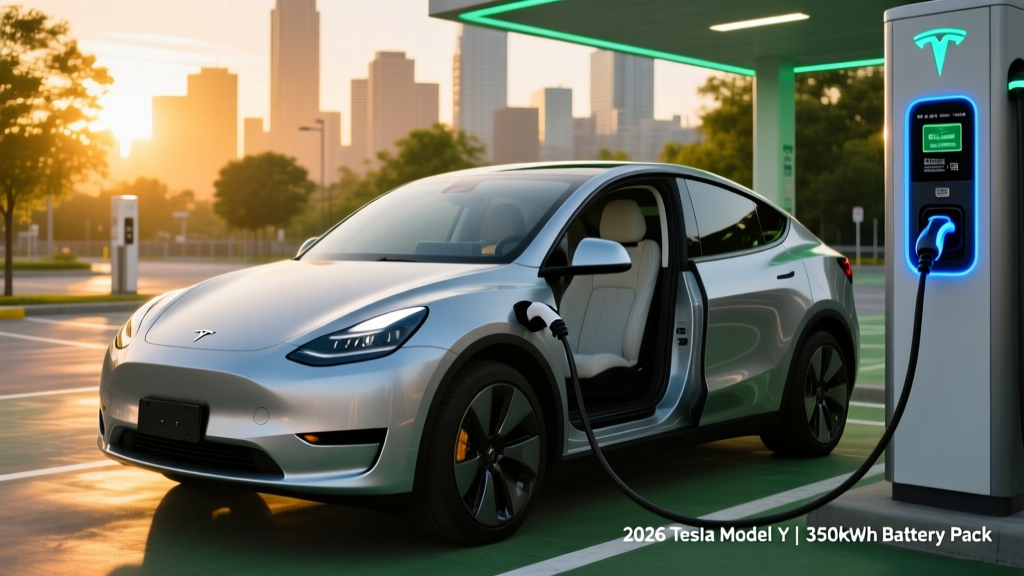
The Tesla Model Y remains the benchmark compact electric SUV in 2026, but buyers searching for Tesla Model Y clearance specs often hit a wall of conflicting forum posts and outdated figures. This review pins down the exact ground clearance, approach/departure angles, EPA range, charging speeds, and real-world ownership economics you need before signing a delivery agreement.
Tesla Model Y Ground Clearance and Off-Road Capability
The 2026 Tesla Model Y rides on 6.6 inches (168 mm) of ground clearance across all trims — Long Range AWD, Performance, and the standard-range RWD variant. That figure is measured at the lowest point of the underbody skid plate with the vehicle at curb weight and standard tire pressure.
For context, 6.6 inches sits in the middle of the compact crossover pack:
- Ford Mustang Mach-E: 5.7 inches
- Hyundai Ioniq 5: 6.1 inches
- Subaru Solterra: 8.3 inches
- Toyota RAV4 (gas): 8.4 inches
The Model Y's clearance is adequate for speed bumps, gravel driveways, and mild snow accumulation, but it is not a trail rig. Approach angle is approximately 17.5 degrees, departure angle around 24 degrees, and breakover angle roughly 18 degrees. If your commute involves steep driveway transitions or you regularly tackle unpaved mountain roads, the Solterra or a lifted RAV4 Hybrid offers more margin. For suburban and highway use, the Model Y's lower stance contributes directly to its class-leading aerodynamic efficiency (0.23 Cd).
Range, Battery, and Efficiency
Real-World Expectation: 260–285 miles highway at 70 mph; 230–250 miles in sub-30°F winter conditions. City driving with regen braking can match or slightly exceed the EPA sticker.
The 2026 Long Range AWD uses a 78.1 kWh usable battery pack with nickel-manganese-cobalt (NMC) chemistry. The standard-range RWD trim, where available, uses a 60 kWh lithium iron phosphate (LFP) pack — heavier per kWh but more durable for daily 100% charging.
| Trim | Battery (usable kWh) | Chemistry | EPA Range | MPGe (combined) | kWh/100 mi |
|---|---|---|---|---|---|
| Long Range AWD | 78.1 | NMC | 320 mi | 122 | 28 |
| Performance AWD | 78.1 | NMC | 295 mi | 111 | 30 |
| RWD (Std Range) | 60.0 | LFP | 268 mi | 128 | 26 |
Efficiency is where the Model Y flexes on rivals. At 28 kWh per 100 miles (Long Range), it converts more battery into miles than the Mach-E (34 kWh/100 mi) or Ioniq 5 AWD (30 kWh/100 mi). That translates directly into fewer charging stops on road trips and lower home-electricity costs.
Charging Speed: DC Fast and Home Level 2
The 2026 Model Y Long Range peaks at 250 kW on DC fast chargers via the native NACS connector — no adapter needed at Tesla Superchargers. On a CCS-equipped public charger (Electrify America, EVgo), you'll need the Tesla CCS adapter (included with new vehicles since 2024).
| Charging Level | Power (kW) | Speed | Notes |
|---|---|---|---|
| Level 1 (120V household) | ~1.4 kW | 3–4 mi/hr | Emergency/top-up only |
| Level 2 (240V, 48A Wall Connector) | 11.5 kW | 44 mi/hr | Full charge in ~7.5 hours |
| Level 2 (240V, 32A mobile) | 7.7 kW | 30 mi/hr | Slower; good for overnight |
| DC Fast Charge (peak) | 250 kW | 10–80% in ~22 min | Tapers above 50%; 80–100% adds ~25 min |
The charge curve matters: the Model Y holds above 150 kW through roughly 40% state of charge, then steps down in stages. A 10–80% session at a V3 Supercharger takes about 22 minutes when the battery is preconditioned (the navigation system does this automatically when you route to a charger). Without preconditioning — say, pulling into a charger cold — expect 28–35 minutes for the same session.
For home charging, the Tesla Wall Connector on a 60A circuit delivers the full 48A/11.5 kW. Most owners adding 40–50 miles of daily driving need only 2–3 hours on the Wall Connector overnight, easily covering commutes without ever touching a public charger.
Performance and Drivetrain
The Long Range AWD pairs dual motors (induction front, permanent-magnet rear) for 384 horsepower and a 4.8-second 0–60 mph time. The Performance trim bumps output to approximately 456 hp and drops the sprint to 3.5 seconds. The RWD single-motor variant runs 295 hp and 6.6 seconds to 60.
All trims feature a single-speed reduction gear — no shifting, instant torque from 0 rpm. The dual-motor AWD system can fully decouple the front motor for coasting efficiency, contributing to the Long Range's highway range advantage.
Towing capacity is rated at 3,500 pounds across AWD trims (not available on RWD). That handles a small boat trailer or light camper but falls short of the Ford F-150 Lightning or Rivian R1S for serious hauling.
Cargo, Passenger Space, and Interior
The Model Y's hatchback form factor delivers practical volume that sedan-based EVs cannot match:
- Cargo behind rear seats: 30.2 cu ft
- Cargo with rear seats folded: 72.1 cu ft
- Front trunk (frunk): 4.1 cu ft
- Rear legroom: 41.6 inches
- Front headroom: 41.0 inches
- Rear headroom: 39.4 inches
The 2026 refresh adds ventilated front seats, ambient lighting, and power-folding second-row seats as standard. The minimalist interior still routes nearly all controls through the 15.4-inch center touchscreen — including glovebox release, mirror adjustment, and wiper speed. Some buyers love the simplicity; others find it distracting while driving.
Build quality has improved significantly since early Fremont production. Panel gaps are tighter, and the Austin-built Juniper refresh added acoustic glass and improved suspension damping over rough pavement.
Pricing, Trims, and Federal Tax Credit
| Trim | Base MSRP | As-Tested (typical) | §30D Credit Eligible? | Effective Price |
|---|---|---|---|---|
| RWD (Std Range) | $44,990 | $45,990 | Yes (if sourcing rules met) | ~$37,490 |
| Long Range AWD | $48,990 | $50,490 | Yes (if sourcing rules met) | ~$41,490 |
| Performance AWD | $53,990 | $55,990 | Yes (if sourcing rules met) | ~$46,490 |
All Model Y trims fall under the IRS §30D MSRP cap of $80,000 for SUVs. However, qualifying for the full $7,500 credit depends on three moving targets that change frequently:
- Battery sourcing: At least 40% of critical minerals must be extracted or processed in the U.S. or a free-trade-agreement country, and battery components must meet escalating domestic-content thresholds.
- Buyer income caps: Modified AGI cannot exceed $150,000 (single), $225,000 (head of household), or $300,000 (joint).
- Point-of-sale transfer: Since 2024, you can transfer the credit to the dealer at purchase, reducing your out-of-pocket cost immediately rather than waiting for tax filing.
Verify current eligibility on IRS.gov's clean vehicle credit page before ordering — battery-sourcing compliance can shift between model years and even production months.
Tech, Driver Assistance, and Warranty
The Model Y ships with Basic Autopilot (traffic-aware cruise control + lane centering) standard. Full Self-Driving (Supervised) remains an $8,000 add-on or $99/month subscription. Despite the name, FSD is a SAE Level 2 system — you must keep your eyes on the road and hands near the wheel at all times. It is not autonomous driving.
Infotainment runs on Tesla's proprietary OS with a responsive 15.4-inch touchscreen, integrated streaming (Spotify, Apple Music, Netflix while parked), and over-the-air updates that add features monthly. There is no Apple CarPlay or Android Auto — a dealbreaker for some smartphone-dependent buyers.
Warranty coverage:
- Basic vehicle: 4 years / 50,000 miles
- Battery and drive unit: 8 years / 120,000 miles (Long Range/Performance); 8 years / 100,000 miles (RWD)
- Capacity retention threshold: 70% minimum over warranty period
Pros, Cons, and Who Should Buy
- Class-leading efficiency (28 kWh/100 mi)
- 250 kW Supercharger network access (19,000+ U.S. stalls)
- Spacious cargo area with hatchback versatility
- Strong resale value relative to EV peers
- OTA updates continuously add features
- 6.6 in ground clearance limits rough-road use
- No Apple CarPlay / Android Auto
- Touchscreen-dependent controls can distract
- Ride quality firm on broken pavement
- FSD subscription adds cost for Level 2 capability
Look elsewhere if: You need more than 7 inches of ground clearance for snow or trails (check the Subaru Solterra or Toyota RAV4 Hybrid), you rely on CarPlay, or you prefer physical buttons for climate and mirror controls.
Frequently Asked Questions
What is the ground clearance of the 2026 Tesla Model Y?
6.6 inches (168 mm) across all trims. This is adequate for suburban driving and light gravel but less than the Subaru Solterra (8.3 in) or a gas RAV4 (8.4 in).
What is the real-world range of the Model Y Long Range?
The EPA rates it at 320 miles. Expect 260–285 miles on a highway trip at 70 mph and 230–250 miles in freezing weather. City driving with regenerative braking can match the EPA figure.
How fast does the Model Y charge at home and on road trips?
At home on a 48A Level 2 Wall Connector, it adds 44 miles of range per hour (full charge ~7.5 hours). On a 250 kW Supercharger, 10–80% takes about 22 minutes with battery preconditioning.
Does the 2026 Model Y qualify for the $7,500 federal tax credit?
All trims are under the $80,000 SUV MSRP cap. Eligibility depends on battery-sourcing compliance, your income (≤$150K single / $300K joint), and current IRS rules. Check IRS.gov before ordering.
Is the Model Y worth buying over the Ioniq 5 or Mach-E?
The Model Y wins on efficiency, Supercharger network access, and cargo volume. The Ioniq 5 offers faster 10–80% charging (18 min on 350 kW chargers), 800V architecture, and CarPlay. The Mach-E provides a more traditional cockpit with physical controls. Test-drive all three before deciding.
Can the Model Y handle snow and light off-road conditions?
The dual-motor AWD system provides excellent traction in snow, and the 6.6 inches of clearance handles moderate accumulation. For deep snow, rutted trails, or steep rocky driveways, a higher-clearance vehicle is a safer choice.