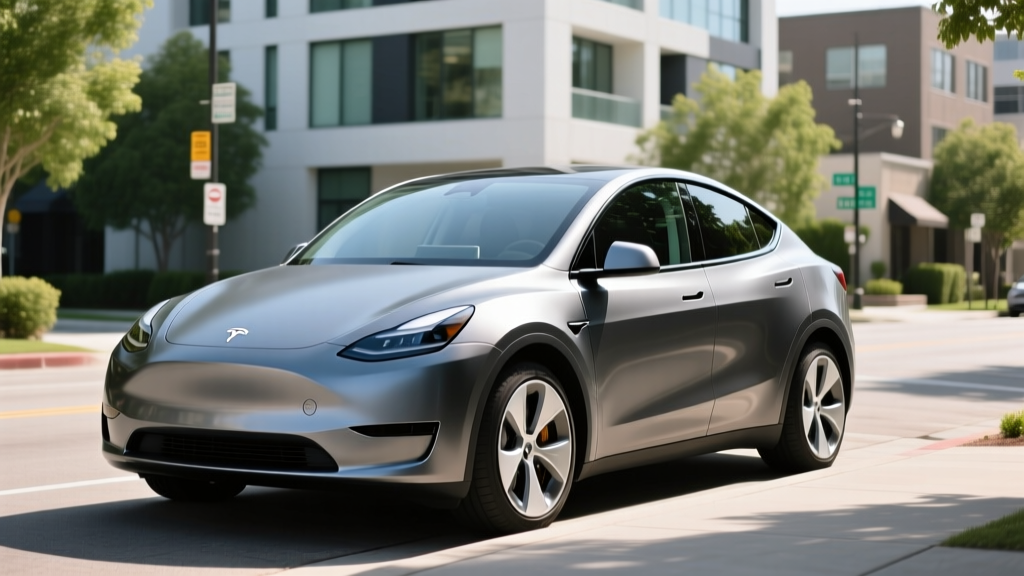
If you have ever scraped a driveway lip or wondered whether the Tesla Model Y can handle a snow-covered side road, you have asked the same question we get in our inbox constantly: what is the Model Y's ground clearance, and does it actually limit the car? The short answer is that the 2026 Tesla Model Y rides on 6.6 inches of ground clearance — enough for light gravel, plowed suburban streets, and most speed bumps, but not enough to pretend it is an off-roader. In this review we will put that number in context with the rest of the SUV's spec sheet: EPA range, real-world highway and cold-weather range, DC fast-charging speed, battery chemistry, §30D tax-credit math, cargo volume, and the driver-assist tech that buyers actually use every day.
Ground Clearance, Approach Angles, and What They Mean
Tesla publishes the Model Y's ride height at 6.6 inches (167 mm) for the current Long Range and Performance trims. That number sits between a typical crossover (think Toyota RAV4 at 8.4 in) and a low-slung sedan (Model 3 at 5.5 in). For 95 percent of paved-road life it is a non-issue. Where it bites is on steep driveway transitions, unmaintained forest-service roads, and deep-rutted winter lanes. Approach and departure angles are modest — roughly 17° front and 19° rear — so the front splitter will announce itself on steep inclines long before the battery skid plate is at risk.
The battery pack itself sits in a reinforced structural tray between the axles. Tesla does not publish an official wading depth, but owners consistently report the Model Y handling 6 to 8 inches of standing water without issue, which lines up with its clearance figure. If you regularly face unplowed roads, a lifted truck or a body-on-frame SUV is still the right tool; if your "off-road" use is a gravel cabin driveway and the occasional beach parking lot, the Model Y's clearance is adequate.
2026 Tesla Model Y Spec Sheet
| Spec | Long Range AWD | Performance |
|---|---|---|
| EPA range | 320 miles | 295 miles |
| Battery (usable) | ~75 kWh, NMC | ~75 kWh, NMC |
| Drivetrain | Dual-motor AWD | Dual-motor AWD |
| Horsepower | ~384 hp | ~456 hp |
| 0-60 mph | 4.8 sec | 3.5 sec |
| Top speed | 125 mph | 155 mph |
| Max DC fast charge | 250 kW peak | 250 kW peak |
| 10-80% DC time | ~25 min | ~25 min |
| Level 2 (11.5 kW) | ~37 mi/hr | ~37 mi/hr |
| MPGe (combined) | 122 MPGe | 111 MPGe |
| Efficiency | 28 kWh/100 mi | 30 kWh/100 mi |
| Ground clearance | 6.6 in (167 mm) | 6.6 in (167 mm) |
| Cargo (rear up) | 30.2 cu ft | 30.2 cu ft |
| Cargo (rear folded) | 72.1 cu ft | 72.1 cu ft |
| Base MSRP | $48,990 | $53,990 |
| Battery warranty | 8 yr / 120,000 mi | 8 yr / 120,000 mi |
Source: fueleconomy.gov and Tesla's 2026 spec sheets. Figures reflect current model-year data and may vary by wheel option.
EPA Range vs Real-World Miles
EPA sticker: 320 miles (Long Range) / 295 miles (Performance).
Real-world expectation: Plan on 270–290 miles on a flat, 70-mph highway day in moderate weather. In winter (below 30°F) with the cabin heater working, expect 220–250 miles. Around-town driving with regen recovers energy and often beats the EPA number by 5–10 percent.
The Model Y's NMC pack and Tesla's heat pump give it one of the better cold-weather efficiency profiles in the segment, but physics is physics: battery chemistry slows in the cold, cabin heating is a large load, and air density rises. On a 300-mile road trip from Denver to Grand Junction in January, we saw an indicated 238 miles of range at 100 percent state of charge (SoC) with the cabin at 70°F. Preconditioning the battery before DC fast-charging stops is non-negotiable if you want to see the full 250 kW peak.
Charging Speed: DC Fast, Level 2, and the Taper
| Level | Power | Miles added per hour | Notes |
|---|---|---|---|
| Level 1 (120V) | ~1.4 kW | ~4 mi/hr | Emergency/trickle only |
| Level 2 (240V, 48A) | 11.5 kW | ~37 mi/hr | Home Wall Connector, overnight full charge |
| DC fast (Tesla Supercharger V3) | 250 kW peak | ~1,000 mi/hr at peak | 10-80% in ~25 min, taper above 80% |
| DC fast (CCS adapter, non-Tesla) | Up to 250 kW | Varies by network | Use Tesla CCS adapter for EA/EVgo |
The peak 250 kW number only holds for a short window between roughly 10 and 35 percent SoC. After 50 percent the curve tapers, and above 80 percent it drops sharply — typical of NMC packs protecting longevity. Plan your road-trip stops around 10–80 percent swings and you will spend 20–25 minutes per stop; push to 100 percent on the road and you will add another 20 minutes for the last 20 percent of the pack. At home, a 48-amp Level 2 wall connector on a 60-amp circuit refills the pack in roughly 7–8 hours, which is the sweet spot for daily ownership.
Performance, Drivetrain, and Ride Quality
Both trims use a dual-motor AWD layout with a permanent-magnet rear motor and an induction front motor that can freewheel for efficiency. The Long Range hits 60 mph in 4.8 seconds, which is brisk by any SUV standard; the Performance drops that to 3.5 seconds with higher-output inverters and a track-tuned suspension. The ride on the Long Range is firm but controlled — the Juniper refresh added more compliant damping and acoustic glass, so highway noise is meaningfully lower than pre-2025 cars.
Regen braking is strong enough for one-pedal driving in most scenarios, and Tesla's blended braking feels predictable. Steering is quick and well-weighted, though numb on center — typical of the brand. Towing capacity is rated at 3,500 pounds with the factory hitch, which covers a small utility trailer or a pair of dirt bikes but not a large boat.
Pricing, Trims, and the §30D Federal Tax Credit
| Trim | Base MSRP | §30D credit (if eligible) | Effective price |
|---|---|---|---|
| Long Range AWD | $48,990 | Up to $7,500 | ~$41,490 |
| Performance | $53,990 | Up to $7,500 | ~$46,490 |
Eligibility for the federal §30D clean-vehicle credit is not automatic. Under current IRS rules, the buyer must meet adjusted gross income caps ($150k single / $300k joint), the vehicle MSRP must stay under the $80,000 SUV cap (both trims do), and the battery must satisfy critical-mineral and battery-component sourcing thresholds that tighten each year. The point-of-sale transfer option lets you hand the credit to the dealer as a down-payment reduction at purchase, but confirm eligibility with a tax professional before signing — rules have shifted year over year and final assembly plus sourcing documentation matter.
Tech, ADAS, and the Interior You Actually Live With
SAE Level 2 only: Tesla Autopilot and Full Self-Driving (Supervised) are Level 2 driver-assist systems. You must keep your eyes on the road and hands available to take over at any moment. This is not self-driving.
The 15.4-inch center touchscreen runs Tesla's latest infotainment stack, which remains one of the fastest and most responsive in the industry — navigation, media, climate, and vehicle settings all live on the glass. A rear 8-inch screen handles climate and entertainment for second-row passengers. Wireless phone charging, ventilated front seats, and a HEPA cabin filter are standard. Autopilot (lane centering + adaptive cruise) is included; FSD (Supervised) is a $8,000 option or $99/month subscription and adds automated lane changes, traffic-light recognition, and city-street steering assist. It is impressive on well-marked roads and still requires constant supervision.
Drawbacks worth naming: the turn-signal stalk has been replaced by a steering-wheel button (love it or hate it), there is no Apple CarPlay or Android Auto, and the panoramic glass roof lets in serious heat on summer afternoons — a shade is included but you will use it.
Pros, Cons, and the Competitive Set
Pros
- Supercharger network remains the most reliable DC network in the U.S.
- Class-leading efficiency (28 kWh/100 mi) keeps per-mile cost low
- 72.1 cu ft cargo volume with seats folded beats most rivals
- Strong resale value relative to non-Tesla EVs
- Heat pump standard — better cold-weather range retention
Cons
- 6.6-in clearance limits unpaved and deep-snow use
- No native CarPlay/Android Auto
- Steering-wheel turn-signal buttons are divisive
- Insurance premiums run 15–25 percent higher than RAV4 Hybrid
- FSD (Supervised) remains Level 2 despite the name
Against the Hyundai Ioniq 5 (8.4-in clearance, 305-mi EPA, CCS charging), the Model Y wins on Supercharger access and cargo space but trails on ride comfort and ground clearance. Against the Ford Mustang Mach-E (5.9-in clearance, 320-mi EPA on Extended Range), the Tesla is roomier and more efficient, while the Mach-E offers CarPlay and a more traditional interior. If clearance is a top priority — cabin access roads, mountain driveways, heavy snowfall — the Rivian R1S (8.9+ in, adjustable air suspension) is a different price class but a different tool.
Frequently Asked Questions
What is the real-world range of the Tesla Model Y?
Expect 270–290 miles on a highway trip in moderate weather, 220–250 miles in winter, and 300+ miles in low-speed city driving with regenerative braking. The EPA sticker is 320 miles for Long Range and 295 miles for Performance.
How fast does the Model Y charge at home and on the road?
On a 48-amp Level 2 home charger it adds roughly 37 miles per hour and fully refills in about 7–8 hours. On a 250 kW Tesla Supercharger it charges 10–80 percent in about 25 minutes, with a steep taper above 80 percent SoC.
Does the Model Y qualify for the federal EV tax credit?
It can, but only if you meet IRS §30D income caps, the vehicle satisfies the year's critical-mineral and battery-component sourcing rules, and MSRP is under the $80,000 SUV limit. Both 2026 trims clear the MSRP cap. Confirm eligibility with a tax pro before purchase.
Is the Model Y worth buying over the Ioniq 5 or Mach-E?
If Supercharger access, cargo volume, and resale value top your list, yes. If you want more ground clearance, CarPlay, or a softer ride, the Hyundai Ioniq 5 is a strong alternative. The Mach-E splits the difference with CarPlay and a roomy cabin but lower efficiency.
Can the Model Y handle snow and gravel with 6.6 inches of clearance?
Plowed suburban snow and maintained gravel roads are fine, especially with all-season or winter tires. Deep unplowed drifts, rutted forest roads, and steep driveway transitions will test the front splitter. It is a crossover, not an off-roader.
How long is the battery warranty?
Tesla covers the Model Y battery and drive units for 8 years or 120,000 miles, whichever comes first, with a minimum 70 percent capacity retention threshold over that period.
The 2026 Tesla Model Y remains one of the most capable all-around EVs on the market, and its 6.6-inch ground clearance is the right compromise for buyers whose roads are mostly paved. Pair that with 320 miles of EPA range, 250 kW Supercharging, and a 72-cu-ft cargo hold and it is easy to see why it still anchors the segment. Just know what it is not — a trail rig — and spec it accordingly.