2026 Tesla Model Y: Charging Speed, Range, and Real-World Ownership
For most EV shoppers, the single most urgent question isn't horsepower or 0-60 times — it's how fast the thing charges on a road trip and whether home charging fits their daily routine. The 2026 Tesla Model Y (refreshed "Juniper" generation, launched early 2025 and carried into 2026 with minor updates) remains the best-selling EV in the United States for good reason: it pairs access to the most reliable DC fast-charging network in North America with strong efficiency numbers and a practical crossover form factor. But marketing claims about "fast charging" obscure the details that actually matter to owners — sustained charge rates, charge-curve taper, chemistry differences between trims, and the gap between EPA range and real-world highway miles.
This review answers the question directly: how long does it take for a Tesla to charge? — across all three charging levels, across both battery chemistries Tesla currently sells, and in the real-world conditions that determine whether a 30-minute stop becomes a 45-minute one. We'll also cover range, pricing, tax-credit eligibility, and whether the Model Y still earns its segment lead against the Hyundai Ioniq 5, Ford Mustang Mach-E, and Chevrolet Equinox EV.
Charging Speed: The Numbers That Actually Matter
Tesla sells two distinct battery chemistries in the 2026 Model Y, and your charge times depend heavily on which one you buy. The base Long Range RWD uses a lithium iron phosphate (LFP) pack, while the Long Range AWD and Performance variants use nickel-manganese-cobalt (NMC). LFP cells tolerate frequent 100% charging and have longer cycle life, but they charge more slowly on DC fast chargers and lose more range in cold weather. NMC packs charge faster and deliver better cold-weather performance but carry Tesla's recommendation to limit daily charge to 80%.
| Spec | Long Range RWD (LFP) | Long Range AWD (NMC) | Performance AWD (NMC) |
|---|---|---|---|
| Battery Capacity (usable) | ~60 kWh | ~75 kWh | ~75 kWh |
| Chemistry | LFP (CATL) | NMC (Panasonic) | NMC (Panasonic) |
| Max DC Fast Charge | ~170 kW peak | 250 kW peak | 250 kW peak |
| 10-80% DCFC Time | ~30 min | ~25 min | ~25 min |
| Level 2 (240V/48A) | 11.5 kW (~44 mi/hr) | 11.5 kW (~44 mi/hr) | 11.5 kW (~44 mi/hr) |
| Level 1 (120V) | ~1 kW (~3-4 mi/hr) | ~1 kW (~3-4 mi/hr) | ~1 kW (~3-4 mi/hr) |
| Charge Port | NACS (native) | NACS (native) | NACS (native) |
Understanding the Charge Curve (Why Peak kW Lies)
Tesla advertises 250 kW peak charging on NMC trims, but no EV sustains peak power for the entire session. The Model Y's charge curve is aggressive from 10-30% State of Charge (SoC), holding near 250 kW when the battery is preconditioned and warm. From roughly 40-60%, power tapers to 150-170 kW. Above 80%, it drops sharply to protect cell longevity — sometimes below 50 kW. This is why the industry-standard metric is 10-80% time rather than a full 0-100% session.
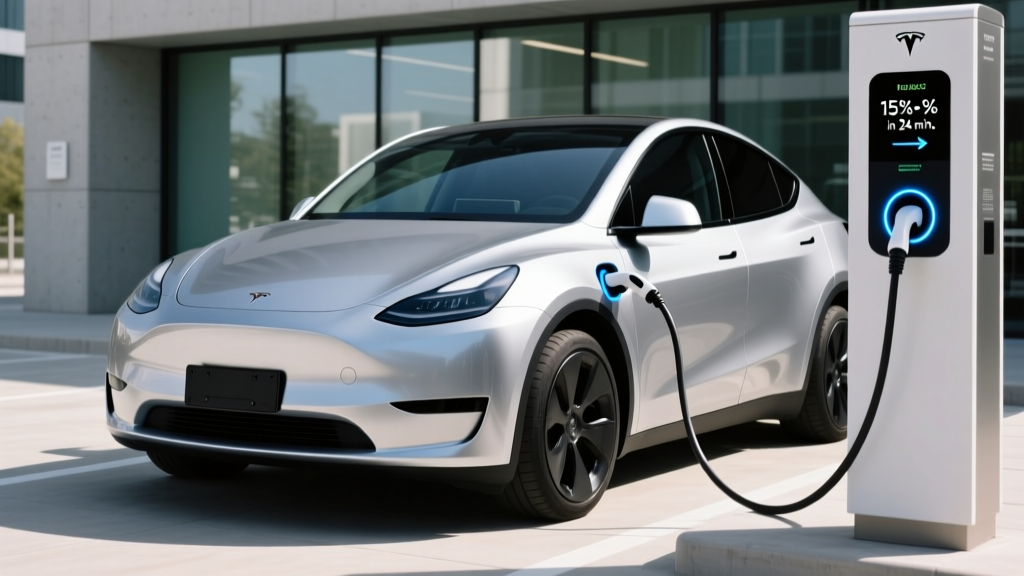
A practical road-trip strategy: arrive at a Supercharger at 10-15% SoC and depart at 80%. For the Long Range AWD, that's roughly 25 minutes and adds about 230 miles of range — enough to cover the next 2-3 hours of driving. Pushing past 80% at a DC fast charger is almost never worth the time unless you're ending your trip for the day.
Supercharger Network Advantage
Tesla's Supercharger network now exceeds 6,500 stations and 70,000+ individual stalls across North America, according to Tesla's official Supercharger page. V4 Supercharger cabinets support up to 350 kW (though the Model Y caps at 250 kW on its end). More importantly, Tesla chargers consistently deliver their rated power — a reliability advantage over third-party networks where out-of-service stalls and payment failures remain common pain points. The Model Y's native NACS port means no adapter is required at any Tesla Supercharger.
EPA Range vs. Real-World Miles
EPA Estimated Range: 320 miles (Long Range RWD) / 308 miles (Long Range AWD) / 277 miles (Performance)
Real-World Expectation: 260-285 miles at sustained 70-75 mph highway speeds in mild weather; 220-250 miles in freezing temperatures (below 32°F); up to 310+ miles in city/suburban driving with regenerative braking.
The EPA combined cycle blends city and highway driving, which flatters EVs because regenerative braking recaptures energy in stop-and-go traffic. On a flat interstate at 70 mph in 65-75°F weather, expect the Long Range AWD to deliver roughly 270-280 miles before hitting 10% SoC — about 90-92% of its sticker number. That's genuinely strong efficiency.
Cold weather is the equalizer. In sustained sub-freezing temperatures, battery chemistry slows and cabin heating draws significant power (the Model Y uses a heat pump, which helps but doesn't eliminate the penalty). Expect 20-30% range loss in bitter cold. If you live in Minnesota or Maine and commute 80+ miles daily in winter, the Long Range AWD's larger NMC pack is the safer choice over the LFP-equipped RWD, both for raw range and for NMC's better cold-weather charge acceptance.
According to fueleconomy.gov, the 2026 Model Y Long Range AWD achieves 111 MPGe combined (30 kWh/100 mi), placing it among the most efficient all-wheel-drive crossovers in its class.
Full 2026 Model Y Specifications
| Attribute | Long Range RWD | Long Range AWD | Performance AWD |
|---|---|---|---|
| EPA Range | 320 mi | 308 mi | 277 mi |
| Battery (usable) | ~60 kWh (LFP) | ~75 kWh (NMC) | ~75 kWh (NMC) |
| Horsepower | 315 hp | 384 hp | 456 hp |
| 0-60 mph | 5.8 sec | 4.8 sec | 3.5 sec |
| Drivetrain | RWD (single motor) | AWD (dual motor) | AWD (dual motor) |
| Efficiency | 118 MPGe / 28 kWh/100mi | 111 MPGe / 30 kWh/100mi | 103 MPGe / 33 kWh/100mi |
| Cargo (rear seats up) | 30.2 cu ft | 30.2 cu ft | 30.2 cu ft |
| Cargo (rear seats folded) | 72.1 cu ft | 72.1 cu ft | 72.1 cu ft |
| Front Legroom | 41.8 in | 41.8 in | 41.8 in |
| Rear Legroom | 37.5 in | 37.5 in | 37.5 in |
| Towing Capacity | 3,500 lbs | 3,500 lbs | 3,500 lbs |
| Base MSRP | $44,990 | $47,990 | $52,490 |
| Battery Warranty | 8 yr / 100,000 mi | 8 yr / 120,000 mi | 8 yr / 120,000 mi |
Notable for 2026: the Juniper refresh brought a redesigned interior with ventilated front seats, ambient lighting, a rear-seat touchscreen, power-folding second row, and a front-row wireless charging pad. The exterior received a smoother front fascia, updated lighting signatures, and slightly improved aerodynamics contributing to the range bump over pre-refresh models. Ride quality improved meaningfully with retuned suspension — a common complaint on 2020-2024 Model Ys was harshness over rough pavement.
Pricing, Tax Credits, and Total Cost
| Trim | Base MSRP | Dest. | Federal Credit (§30D) | Effective Price* |
|---|---|---|---|---|
| Long Range RWD | $44,990 | $1,390 | $7,500 (if eligible) | ~$38,880 |
| Long Range AWD | $47,990 | $1,390 | $7,500 (if eligible) | ~$41,880 |
| Performance AWD | $52,490 | $1,390 | $7,500 (if eligible) | ~$46,380 |
*Effective price assumes full §30D credit eligibility. Actual credit depends on buyer income, battery sourcing, and MSRP caps. See details below.
Federal Tax Credit Eligibility (§30D)
The Model Y qualifies for the full $7,500 federal EV tax credit under IRS §30D rules, but only if you meet all of the following requirements:
- MSRP Cap: The Model Y is classified as an SUV, so the cap is $80,000 — all trims clear this easily.
- Income Cap: Modified adjusted gross income (MAGI) must not exceed $150,000 (single), $225,000 (head of household), or $300,000 (married filing jointly).
- Battery Sourcing: At least 80% of critical minerals and 100% of battery components must meet North American sourcing/free-trade-agreement requirements for the full $7,500. Tesla's US-built battery packs have generally met these thresholds, but specific rules tighten annually. Confirm eligibility at the time of purchase on fueleconomy.gov.
- Point-of-Sale Transfer: As of 2024, you can transfer the credit to the dealer at purchase, reducing your out-of-pocket cost immediately rather than waiting for a tax refund.
If your income exceeds the caps, you do not qualify for the federal credit regardless of the vehicle. Consult a tax professional for your specific situation — state and local incentives vary widely and may stack on top.
Driver Assistance and Technology
SAE Automation Level: Tesla Autopilot and Full Self-Driving (Supervised) are Level 2 driver-assistance systems. The driver must remain fully engaged, hands on or near the wheel, and eyes on the road at all times. These systems do not make the vehicle self-driving. Only Level 4 services (Waymo, Zoox) operate without a human driver in defined areas.
The 2026 Model Y ships with Basic Autopilot (adaptive cruise control + lane centering) at no extra cost. The FSD (Supervised) package adds automatic lane changes, traffic light/stop sign recognition, and Navigate on Autopilot for highway on/off-ramp handling. As of 2026, FSD costs $8,000 as a one-time purchase or $99/month. It's improved substantially in city-street behavior, but it remains a driver-assist tool, not a replacement for attention.
The 15.4-inch center touchscreen runs Tesla's latest software with integrated navigation, streaming apps, Sentry Mode dashcam recording, and over-the-air updates. The Juniper refresh added a rear 8-inch touchscreen for climate and media control — a meaningful upgrade for families. There is no Apple CarPlay or Android Auto; Tesla's ecosystem is closed.
Key FSD Limitations: FSD (Supervised) does not handle construction zones reliably, may not detect stationary emergency vehicles in all conditions, and requires clear lane markings for optimal performance. It is not approved for hands-off or eyes-off driving. NHTSA continues to monitor Tesla's Autopilot/FSD safety record — review NHTSA crash data before purchasing.
Pros, Cons, and Who Should Buy
Pros
- Access to Tesla Supercharger network — most reliable DC fast-charging in North America
- Best-in-class efficiency (30 kWh/100mi for AWD)
- Strong real-world range: ~270+ mi highway for Long Range AWD
- Spacious cargo area (72.1 cu ft with seats folded)
- Continuous OTA updates improve the car post-purchase
- Heat pump standard — better cold-weather efficiency than resistive heating
- Strong resale value relative to most EVs
Cons
- LFP base model: slower DC charging, more cold-weather range loss
- No Apple CarPlay or Android Auto
- FSD (Supervised) remains expensive and Level 2 only
- Insurance costs above segment average
- Minimal physical controls — everything through the touchscreen
- Rear-seat headroom tight for taller passengers (sloping roofline)
- No frunk on Juniper refresh (reduced front storage vs. older Model Y)
Who the Model Y Suits Best
Ideal buyer: A two-adult household (with or without young children) that road-trips 3-5 times per year, values charging-network reliability, and wants a single vehicle for commuting, cargo hauling, and weekend getaways. The Long Range AWD is the sweet spot — NMC chemistry for cold-weather resilience and fast charging, dual-motor AWD for traction, and 308 miles of EPA range that translates to ~270 real-world highway miles.
Consider alternatives if: You need three-row seating (Kia EV9, Tesla Model X), you want Apple CarPlay (Hyundai Ioniq 5, Ford Mach-E), or your budget is under $35,000 (Chevrolet Equinox EV, used Model 3).
Frequently Asked Questions
How long does it take for a Tesla Model Y to charge at home?
With a Level 2 home charger (240V/48A), the Model Y adds approximately 44 miles of range per hour, or a full 10-100% charge in roughly 7-8 hours depending on the battery pack. Most owners charge overnight and wake up to a full battery every morning. A standard 120V outlet (Level 1) adds only 3-4 miles per hour — sufficient only for very low-mileage drivers or emergency trickle charging.
How long does a Tesla take to charge at a Supercharger?
At a V3 or V4 Supercharger, the Model Y Long Range AWD (NMC) charges from 10-80% in approximately 25 minutes. The LFP-equipped Long Range RWD takes about 30 minutes for the same session due to lower peak charge acceptance. Arriving with a preconditioned battery (the car does this automatically when you navigate to a Supercharger) is essential for achieving these times.
Does the Tesla Model Y qualify for the $7,500 federal tax credit?
Yes, the 2026 Model Y qualifies for the full $7,500 federal tax credit under §30D, provided the buyer meets income caps ($150K single / $300K married filing jointly) and the vehicle's battery meets critical-mineral and component-sourcing requirements. The credit can be transferred at point of sale to reduce your purchase price immediately. Always verify current eligibility on fueleconomy.gov before buying.
What is the real-world range of the Tesla Model Y?
The Long Range AWD delivers approximately 270-280 miles at highway speeds (70-75 mph) in mild weather, about 90% of its 308-mile EPA estimate. In freezing temperatures, expect 220-250 miles. City and suburban driving with regenerative braking can exceed the EPA number, sometimes reaching 310+ miles. The LFP RWD model's real-world range is more sensitive to cold weather.
Is the 2026 Tesla Model Y worth buying over competitors?
The Model Y's decisive advantage is the Supercharger network and overall efficiency. Against the Hyundai Ioniq 5 (which now supports NACS access to Superchargers via adapter or native port on newer models), the gap has narrowed — but Tesla's integrated navigation-to-charger preconditioning and stall reliability still lead. The Ford Mustang Mach-E and Chevrolet Equinox EV are strong value alternatives, particularly for buyers who want CarPlay or a lower entry price. If charging-network confidence is your top priority, the Model Y remains the benchmark.
How much does home Level 2 charger installation cost?
A typical Tesla Wall Connector installation runs $500-$1,500 if your electrical panel has sufficient capacity (a 60A circuit for 48A continuous charging). If your home needs a panel upgrade (100A to 200A), costs can reach $2,000-$4,000+. Hire a licensed electrician and check whether your utility offers rebates for EV charger installation — many do.
What is the Tesla Model Y battery warranty?
Tesla covers the Long Range AWD and Performance battery and drive unit for 8 years or 120,000 miles (whichever comes first), with a minimum 70% capacity retention guarantee. The Long Range RWD (LFP) is covered for 8 years or 100,000 miles. LFP chemistry generally degrades more slowly than NMC, so the shorter mileage cap may not reflect real-world longevity — but it's the contractual warranty limit.