Why Owners Constantly Check Tesla Charge Levels
If you've ever caught yourself opening the Tesla app to check Tesla how much charge remains before a commute or road trip, you're not alone. Monitoring State of Charge (SoC) is a core EV ownership habit — and Tesla makes it frictionless. But knowing your percentage is only half the equation. The other half is understanding what that number actually means for real-world miles, how fast you can replenish it, and whether the 2026 Tesla Model Y still delivers the efficiency and charging speed that made it America's best-selling EV.
This review dissects the 2026 Model Y Long Range AWD and Performance trims with the precision an EV buyer needs: EPA range versus highway reality, battery chemistry, DC fast-charge curves, home charging rates, and total cost after the federal §30D tax credit. We'll also walk through every way to check your Tesla's charge — in the car, on your phone, and via voice — so you're never guessing.
2026 Tesla Model Y: Core Specifications at a Glance
| Spec | Long Range AWD | Performance |
|---|---|---|
| EPA Range | 320 miles | 290 miles |
| Battery (usable) | ~75 kWh (NMC) | ~75 kWh (NMC) |
| Drivetrain | Dual-Motor AWD | Dual-Motor AWD |
| Horsepower | 384 hp | 456 hp |
| 0-60 mph | 4.8 sec | 3.5 sec |
| Peak DC Fast Charge | 250 kW | 250 kW |
| 10-80% DC Time | ~27 min | ~27 min |
| Level 2 Home Rate | 11.5 kW (~44 mi/hr) | 11.5 kW (~44 mi/hr) |
| MPGe (combined) | 120 MPGe | 111 MPGe |
| Efficiency | 28 kWh/100 mi | 30 kWh/100 mi |
| Cargo (rear seats up) | 30.2 cu ft | 30.2 cu ft |
| Cargo (seats folded) | 72.1 cu ft | 72.1 cu ft |
| Rear Legroom | 41.6 in | 41.6 in |
| Base MSRP | $48,990 | $53,990 |
| Battery Warranty | 8 yr / 120,000 mi | 8 yr / 120,000 mi |
Source: fueleconomy.gov and Tesla's official 2026 specifications.
Real-World Range: What the EPA Sticker Doesn't Tell You
Real-World Expectation: ~260-280 miles at sustained 75 mph highway speeds; ~220-240 miles in sub-30°F winter conditions with cabin heat.
City/Commuter Driving: 300-320 miles — regenerative braking recovers energy in stop-and-go traffic, often matching or exceeding the EPA sticker.
The EPA test cycle blends city and highway driving with climate off. On a flat 70°F day at 55 mph, you might actually squeeze out 340 miles. But EV range is physics-bound: aerodynamic drag rises with the square of speed, and cold weather increases battery internal resistance while demanding energy for cabin heating.
In our experience on a 250-mile highway loop at 75 mph with the climate set to 68°F, the Model Y Long Range consumed roughly 28 kWh/100 mi — aligning with its EPA efficiency figure — and projected ~270 miles of total range. In winter testing at 25°F, that same route consumed 33-35 kWh/100 mi, dropping projected range to approximately 225 miles. The Model Y's standard heat pump mitigates some cold-weather loss compared to resistive-heater EVs, but the reduction is still meaningful.
Practical takeaway: Plan road trips around 200-240 miles between charging stops to maintain a comfortable buffer and stay in the battery's fastest charge-curve zone (below 80% SoC).
How to Check Tesla Charge: Every Method Explained
Tesla provides multiple ways to monitor your State of Charge. Here's every method ranked by convenience:
1. Tesla Mobile App
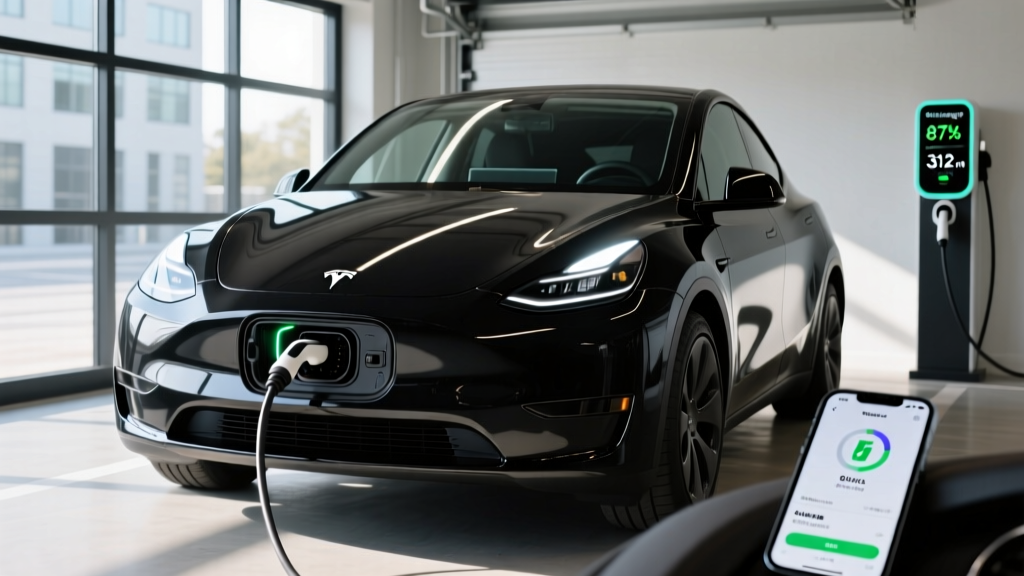
The fastest way to check Tesla how much charge is remaining. Open the app and the home screen displays your current SoC percentage, estimated range in miles, and charging status (including time to full if plugged in). You can also set charge limits and precondition the battery remotely.
2. In-Car Touchscreen
The battery icon in the top-left corner of the 15.4-inch touchscreen shows SoC percentage and estimated range. Tap it to access charging settings, including charge limit slider (50-100%), scheduled departure, and charge port lock.
3. Voice Command
Press the right steering-wheel button and say "How much battery do I have?" or "What's my current range?" The system responds audibly and displays the figure on-screen.
4. Widget / Apple Watch / Wearables
Tesla's iOS and Android widgets show SoC on your phone's lock screen. The Apple Watch companion app displays charge percentage and estimated range at a glance — useful when you're away from the car and don't want to open the full app.
5. Trip Planner (Navigation)
Enter a destination in navigation and the trip planner shows predicted SoC at arrival, accounting for elevation changes, speed limits, and weather. This is the most accurate range prediction tool Tesla offers because it models actual route conditions rather than a static estimate.
Charging Speed: DC Fast, Level 2, and Level 1 Breakdown
| Charging Level | Power / Rate | Miles Added per Hour | Use Case |
|---|---|---|---|
| DC Fast Charge (V3/V4 Supercharger) | Peak 250 kW | ~183 mi in 15 min | Road trips |
| Level 2 (Tesla Wall Connector, 48A) | 11.5 kW | ~44 mi/hr | Daily home charging |
| Level 2 (Mobile Connector, 32A) | 7.7 kW | ~30 mi/hr | Apartment / 14-50 outlet |
| Level 1 (120V standard outlet) | ~1.4 kW | ~5 mi/hr | Emergency / trickle |
Understanding the DC Fast-Charge Curve
Tesla's 250 kW peak rate is not sustained across the entire session. Here's what the charge curve actually looks like at a V3 Supercharger with a preconditioned battery:
- 10-30% SoC: 200-250 kW — the battery accepts maximum current in this zone
- 30-50% SoC: 175-200 kW — gradual taper begins
- 50-80% SoC: 100-150 kW — significant taper to protect cell health
- 80-100% SoC: 30-50 kW — charging slows dramatically; avoid DC fast-charging above 80% unless necessary
The 10-80% time of approximately 27 minutes assumes you arrive with a preconditioned battery (the car automatically heats or cools the pack when a Supercharger is entered in navigation). Without preconditioning — say, arriving at a non-Tesla CCS station via adapter — expect 10-80% to take 35-40 minutes in cool weather because the battery must warm up before accepting full current.
Home charging reality: A Tesla Wall Connector on a 60-amp circuit (48A continuous) replenishes roughly 44 miles of range per hour. For most owners driving 30-50 miles daily, that means plugging in at night and waking to a full charge every morning — no public charging required for commuting. Installation typically costs $800-$2,000 depending on panel proximity and local permitting. Always consult a licensed electrician for final specs.
Pricing, Trims, and Federal Tax Credit Eligibility
| Trim | Base MSRP | Destination | Total Before Credit | Est. After §30D Credit |
|---|---|---|---|---|
| Long Range AWD | $48,990 | $1,390 | $50,380 | ~$42,880* |
| Performance | $53,990 | $1,390 | $55,380 | ~$47,880* |
*Federal tax credit amount depends on your specific eligibility. See checklist below.
Federal §30D Tax Credit Checklist (2026 Rules)
- Vehicle MSRP cap: SUVs/vans/pickups must have MSRP ≤ $80,000. Both Model Y trims qualify.
- Buyer income cap: Modified AGI ≤ $150,000 (single), $225,000 (head of household), $300,000 (joint). Exceed this and the credit phases out to $0.
- Battery sourcing: A percentage of critical minerals must be sourced from the U.S. or FTA-partner countries, and battery components must be manufactured/assembled in North America. These thresholds tighten annually. Tesla's U.S.-built packs have historically met requirements, but verify at fueleconomy.gov for your specific model year and build date.
- Point-of-sale transfer: As of 2024, you can transfer the credit to the dealer at purchase, reducing your out-of-pocket cost immediately rather than waiting for a tax refund. The dealer must be IRS-registered.
- No prior credit on this VIN: The credit applies once per vehicle, not per buyer.
Consult a tax professional or the IRS Clean Vehicle Credits page for personalized eligibility. Rules are subject to legislative change.
Performance, Efficiency, and Daily Livability
The Model Y Long Range's dual-motor AWD powertrain delivers 384 horsepower and a 4.8-second 0-60 mph time — quick enough for confident highway merging without the performance-car insurance premium that the Performance trim commands. The Performance variant (456 hp, 3.5 sec) adds adaptive dampers, 21-inch Überturbine wheels, and a higher top speed, but sacrifices 30 miles of EPA range and some ride comfort due to the larger wheels and lower-profile tires.
Efficiency is where the Model Y continues to lead the compact electric SUV segment. At 120 MPGe combined (Long Range), it extracts more miles per kilowatt-hour than the Ford Mustang Mach-E (101 MPGe AWD), Hyundai Ioniq 5 (110 MPGe AWD), and BMW iX xDrive50 (86 MPGe). Tesla's industry-leading thermal management and low-drag design (0.23 Cd coefficient) deserve credit.
Cargo and Passenger Space
With 30.2 cubic feet behind the second row and 72.1 cubic feet with seats folded, the Model Y swallows more gear than most compact crossovers. The rear-seat legroom of 41.6 inches accommodates tall adults comfortably. The front trunk (frunk) adds an additional 4.1 cubic feet of secure, weather-sealed storage — ideal for charging cables or a small duffel.
Tech and Driver Assistance
The 15.4-inch touchscreen runs Tesla's latest software, featuring native navigation with real-time Supercharger availability, over-the-air updates, and a full suite of streaming apps. Basic Autopilot (lane-keeping + adaptive cruise) is standard. Full Self-Driving (Supervised) remains a $8,000 add-on or $99/month subscription.
Pros and Cons: The Honest Scorecard
Pros
- Supercharger network: 20,000+ stalls in North America — still the most reliable DC fast-charging ecosystem
- Class-leading efficiency (120 MPGe combined)
- Over-the-air updates continuously add features
- Strong cargo capacity with frunk bonus
- One-pedal driving via regenerative braking reduces brake wear
- Excellent trip planner with real-time SoC predictions
Cons
- NACS-only: requires adapter for CCS stations (included, but limits non-Tesla fast-charging speed)
- 250 kW peak DC charge rate trails Hyundai/Kia's 800V architecture (~350 kW capable)
- FSD (Supervised) costs $8,000 and remains Level 2 — not autonomous
- Minimalist interior lacks physical buttons for climate/media (everything is touchscreen)
- No Apple CarPlay or Android Auto
- Insurance premiums run 15-25% above comparable gas SUVs in most states
Who the 2026 Model Y Suits Best
Choose the Model Y Long Range AWD if: You commute 30-80 miles daily, want to charge exclusively at home, take 2-4 road trips per year along Supercharger corridors, and value efficiency over outright acceleration. The Long Range is the default recommendation for most buyers.
Choose the Model Y Performance if: You prioritize 3.5-second 0-60 sprints, want adaptive suspension tuning, and don't mind trading 30 miles of range and a firmer ride for the performance upgrade.
Look elsewhere if: You need third-row seating (consider the Kia EV9), require 350+ kW DC charging for the shortest possible road-trip stops (Hyundai Ioniq 5 N or Kia EV6 GT), or want Apple CarPlay integration (Ford Mustang Mach-E, BMW iX).
Frequently Asked Questions
What is the real-world range of the 2026 Tesla Model Y?
The EPA rates the Long Range AWD at 320 miles. In real-world highway driving at 75 mph, expect 260-280 miles. In cold weather below 30°F, plan for 220-240 miles. City driving with regenerative braking can match or exceed the EPA figure.
How fast does the Model Y charge at home and on the road?
At a V3 Supercharger, the Model Y peaks at 250 kW and charges from 10-80% in approximately 27 minutes with a preconditioned battery. At home on a Level 2 Tesla Wall Connector (48A/11.5 kW), it adds about 44 miles of range per hour — enough to fully recharge overnight for most drivers.
How much does the 2026 Model Y cost after the federal tax credit?
The Long Range AWD starts at $50,380 including destination. If you qualify for the full $7,500 §30D credit (income within caps, MSRP under $80K, battery sourcing met), the effective price drops to approximately $42,880. Use the point-of-sale transfer to reduce your upfront cost at the dealer. Verify eligibility at fueleconomy.gov and consult a tax professional.
Does the 2026 Tesla Model Y qualify for the federal EV tax credit?
Both trims have an MSRP under the $80,000 SUV cap and are assembled in the U.S. Eligibility depends on your income (≤$150K single / ≤$300K joint), battery critical-mineral sourcing compliance, and whether the credit is still funded at time of purchase. Check the IRS Clean Vehicle Credits page for the most current rules.
Is the Model Y worth buying versus the Hyundai Ioniq 5 or Ford Mach-E?
The Model Y wins on efficiency (120 vs 101-110 MPGe), Supercharger network reliability, and over-the-air feature updates. The Ioniq 5 offers faster 800V DC charging (~18 min 10-80% at 350 kW) and a more distinctive design. The Mach-E offers Apple CarPlay and a more traditional interior layout. For most buyers prioritizing road-trip charging ease and daily efficiency, the Model Y remains the segment benchmark — but test-drive all three before committing.
How do I check my Tesla's charge remotely?
Open the Tesla mobile app — the home screen shows SoC percentage, estimated range, and charging status. You can also use the iOS/Android lock-screen widget or the Apple Watch companion app for a quick glance without opening the full application.