The Tesla Model Y remains one of the best-selling electric vehicles in the United States for a reason: it threads the needle between everyday practicality, long range, and access to the most reliable fast-charging network on the road. But for buyers cross-shopping midsize electric SUVs, the question often narrows to utility. Just how much Tesla Model Y cargo space do you actually get, and does the rest of the package — range, charging, tech, and price — still hold up against a growing field of rivals?
We've driven, charged, and loaded the Model Y across multiple model years. Below is a data-driven profile of the current-generation Model Y (including the 2025-refreshed "Juniper" update now in showrooms for 2026), covering real-world range expectations, DC fast-charging behavior, interior dimensions, and total cost of ownership. If you're deciding between the Model Y and competitors like the Hyundai Ioniq 5, Ford Mustang Mach-E, or Chevrolet Equinox EV, this is the spec sheet you need.
Tesla Model Y Cargo Space and Interior Dimensions
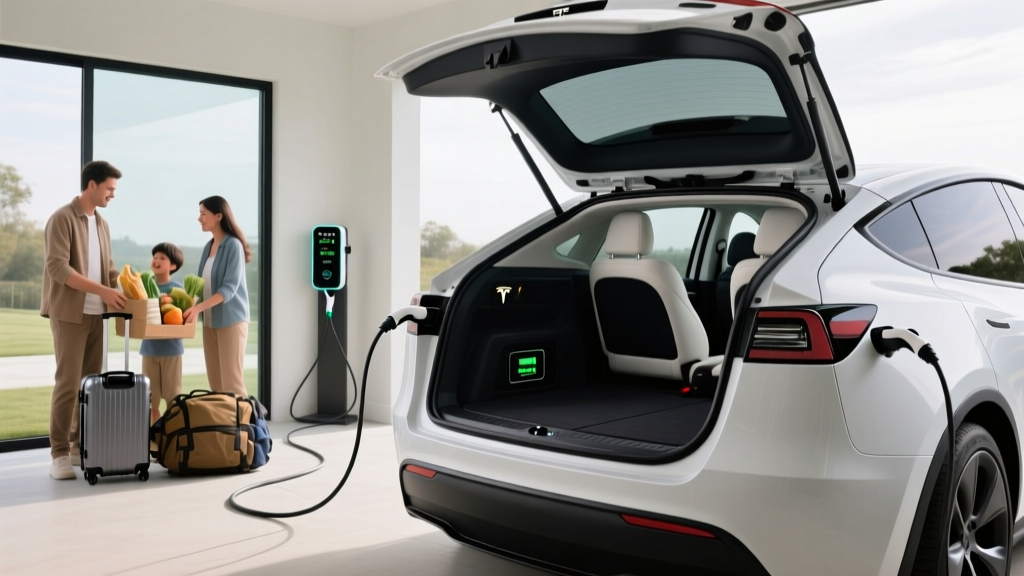
Cargo volume is where the Model Y earns its family-hauler credentials. The hatchback SUV design yields a tall, wide load floor that outpaces most competitors in its class.
| Measurement | Specification |
|---|---|
| Cargo volume (rear seats up) | 30.2 cu ft |
| Cargo volume (rear seats folded) | 72.1 cu ft |
| Front trunk (frunk) | 4.1 cu ft |
| Total maximum cargo | 76.2 cu ft |
| Front headroom | 41.0 in |
| Rear headroom | 39.4 in |
| Front legroom | 41.8 in |
| Rear legroom | 41.6 in |
| Seating capacity | 5 (optional 7-seat row available, significantly reduces cargo) |
With 76.2 cubic feet of maximum cargo volume (rear seats folded, including the frunk), the Model Y beats the Hyundai Ioniq 5 (~56 cu ft max) and the Ford Mustang Mach-E (~59.7 cu ft max) by a wide margin. The closest rival in pure volume is the Kia EV9 three-row SUV, which occupies a larger, more expensive segment.
A few real-world notes from loading the Model Y: the hatch opening is wide and the load floor is flat, but the sloping roofline cuts into vertical space for tall items like large dog crates or standing furniture. The frunk is best suited for charging cables, a small soft cooler, or a backpack — don't expect to fit a carry-on suitcase. If you opt for the available third-row seat, expect cargo space behind the third row to drop to roughly 12 cu ft, making it viable only for small children on short trips.
Range, Battery, and Efficiency
EPA Estimated Range: 320 miles (Long Range AWD) / 290 miles (RWD base)
Real-World Expectation: Plan for 260–285 miles on highway road trips at 70–75 mph; 200–230 miles in freezing temperatures (below 32°F) with cabin heating. City and suburban driving with regenerative braking can meet or slightly exceed the EPA sticker.
| Spec | RWD (Base) | Long Range AWD |
|---|---|---|
| Battery capacity (usable) | ~60 kWh | ~75 kWh |
| Battery chemistry | LFP (Lithium Iron Phosphate) | NMC (Nickel Manganese Cobalt) |
| EPA range | 290 mi | 320 mi |
| Efficiency (MPGe combined) | 133 MPGe | 122 MPGe |
| Energy consumption | 25 kWh/100 mi | 28 kWh/100 mi |
| Drivetrain | Rear-Wheel Drive | Dual-Motor AWD |
| Horsepower | 295 hp | 384 hp |
| 0–60 mph | 6.5 sec | 4.8 sec |
The base RWD Model Y uses an LFP battery, which trades some energy density for longevity and lower cost. LFP chemistry tolerates regular 100% charging without the degradation concerns associated with NMC — Tesla actually recommends periodic 100% charges for LFP packs to keep the battery management system calibrated. The Long Range AWD uses NMC chemistry for higher energy density and longer range; Tesla recommends daily charging to 80–90% and reserving 100% for road trips.
According to fueleconomy.gov, the Model Y Long Range achieves 122 MPGe combined, translating to roughly 28 kWh per 100 miles. At a national average residential electricity rate of ~$0.17/kWh, that's approximately $4.76 per 100 miles of home charging — roughly one-third the fuel cost of a comparable 25 MPG gas SUV at $3.50/gallon.
Charging Speed: DC Fast Charging and Home Level 2
Charging speed is where Tesla's ecosystem advantage becomes tangible. The refreshed Model Y features improved thermal management that sustains higher charge rates longer on the curve.
| Charging Level | Rate | Speed / Time |
|---|---|---|
| Level 1 (120V household) | ~1.4 kW | ~3–4 miles per hour |
| Level 2 (240V home, 48A) | 11.5 kW | ~44 miles per hour; full charge in ~7–8 hours |
| DC Fast Charge (Supercharger) | Peak 250 kW | 10–80% in ~22 minutes (Long Range) |
| DC Fast Charge (CCS adapter) | Up to 250 kW | Varies by third-party station; ~10–80% in 25–30 min |
Charging curve reality: The 250 kW peak rate applies only at low states of charge (roughly 10–30% SoC) on a V3 or V4 Tesla Supercharger. By 50% SoC, the rate tapers to approximately 120–140 kW, and above 80% it drops sharply to protect battery health. A 10–80% session takes about 22 minutes in ideal conditions; a 10–90% session pushes closer to 35 minutes. Preconditioning the battery (triggered automatically when you navigate to a Supercharger) is essential — arriving at a fast charger without preconditioning in cold weather can cut charge speeds by 50% or more.
For home charging, Tesla's Wall Connector at 48 amps on a 60-amp circuit delivers 11.5 kW, adding roughly 44 miles of range per hour. Most owners who charge overnight will wake to a full battery every morning. Installation typically requires a NEMA 14-50 outlet or hardwired connection; budget $500–$2,000 for a licensed electrician depending on panel proximity and local permit requirements.
Pricing, Trims, and Federal Tax Credit Eligibility
| Trim | Base MSRP | Est. After §30D Credit* |
|---|---|---|
| Long Range RWD | $44,990 | $37,490 |
| Long Range AWD | $47,990 | $40,490 |
| Performance AWD | $51,490 | $43,990 |
*Federal tax credit amount shown assumes full $7,500 eligibility. Actual credit depends on buyer income, battery sourcing, and MSRP cap compliance. See IRS rules below.
The Model Y qualifies for the IRS §30D Clean Vehicle Credit of up to $7,500, but eligibility is not automatic. Per irs.gov, the following requirements apply:
- MSRP Cap: SUVs/vans must have an MSRP at or below $80,000. All current Model Y trims qualify.
- Buyer Income Cap: Modified adjusted gross income must not exceed $150,000 (single), $225,000 (head of household), or $300,000 (joint filers).
- Battery Sourcing: The $7,500 credit is split into two halves — $3,750 for critical-minerals sourcing and $3,750 for battery-component manufacturing. Sourcing rules tighten annually; check the IRS qualifying vehicle list at time of purchase, as Tesla's supply chain shifts can affect eligibility month to month.
- Point-of-Sale Transfer: Eligible buyers can transfer the credit to the dealer at purchase, reducing the purchase price directly rather than waiting for a tax refund.
Because battery-sourcing rules are subject to change, always verify current eligibility on the IRS website or with your tax professional before committing to a purchase.
Technology, Driver Assistance, and Ownership Experience
The Model Y's interior centers on a single 15.4-inch touchscreen that controls virtually every vehicle function — climate, mirrors, glovebox, and navigation. The Juniper refresh added ambient lighting, ventilated front seats, a rear-seat touchscreen, and improved sound insulation. There is no traditional instrument cluster; all driving information appears on the central display.
Autopilot and FSD (Supervised): Every Model Y ships with Basic Autopilot (lane centering and adaptive cruise control). Tesla's Full Self-Driving (Supervised) package, priced at $8,000 or $99/month, adds automated lane changes, traffic light/stop sign recognition, and city-street navigation.
Autopilot and FSD (Supervised) are SAE Level 2 driver-assistance systems. The driver must remain fully engaged, hands on or near the wheel, and eyes on the road at all times. These systems do NOT make the Model Y self-driving. Only Level 4 robotaxi services like Waymo operate without a human driver.
The Model Y earns top marks from the NHTSA with a 5-Star Overall Safety Rating, and the IIHS has named it a Top Safety Pick+ in prior model years. Standard safety features include automatic emergency braking, blind-spot monitoring, lane departure warning, and 360-degree cameras.
Warranty Coverage:
| Component | Coverage |
|---|---|
| Basic Vehicle | 4 years / 50,000 miles |
| Battery & Drive Unit (Long Range/Performance) | 8 years / 120,000 miles (min 70% retention) |
| Battery & Drive Unit (RWD/LFP) | 8 years / 100,000 miles (min 70% retention) |
The battery warranty guarantees at least 70% capacity retention over the coverage period. In practice, Tesla's NMC packs have shown roughly 10–12% degradation over 100,000 miles based on fleet data, while LFP packs tend to degrade more slowly but may show a larger initial drop in the first year.
Pros, Cons, and Who Should Buy
✅ Pros
- Best-in-class cargo volume (76.2 cu ft)
- Access to Tesla Supercharger network (20,000+ stalls in North America)
- Industry-leading efficiency (25–28 kWh/100 mi)
- Strong safety ratings (NHTSA 5-Star)
- Over-the-air updates continuously add features
- LFP battery option tolerates 100% daily charging
❌ Cons
- Minimalist interior not for everyone (no physical buttons, no instrument cluster)
- Ride quality can feel firm on rough pavement
- Optional 7-seat third row is impractical for anyone but small children
- FSD costs $8,000 extra and is still Level 2 (not autonomous)
- Insurance premiums tend to run 15–30% higher than comparable gas SUVs
- Service center wait times can be long in some metro areas
Who the Model Y Suits Best
- Families and road-trippers who need maximum cargo space and reliable DC fast-charging access on long routes
- Commuters with home charging who want minimal fuel cost and low daily maintenance
- Tech-forward buyers comfortable with a screen-first interface and OTA-driven feature evolution
- Not ideal for: Buyers who prefer physical controls, need serious towing capacity (3,500-lb max), or live in areas with no Tesla Service Center nearby
How the Model Y Compares to Key Competitors
| Spec | Tesla Model Y LR AWD | Hyundai Ioniq 5 Limited AWD | Ford Mustang Mach-E GT |
|---|---|---|---|
| EPA Range | 320 mi | 290 mi | 292 mi |
| Max Cargo | 76.2 cu ft | 56.2 cu ft | 59.7 cu ft |
| Peak DC Charge | 250 kW | 238 kW | 150 kW |
| 10–80% Time | ~22 min | ~18 min | ~38 min |
| 0–60 mph | 4.8 sec | 5.1 sec | 3.5 sec |
| Base MSRP | $47,990 | $54,200 | $59,995 |
The Ioniq 5 charges slightly faster (10–80% in ~18 minutes thanks to its 800V architecture) but gives up nearly 20 cubic feet of cargo volume. The Mach-E GT delivers thrilling acceleration but trails in both range and charging speed. For buyers prioritizing cargo space and charging infrastructure, the Model Y still holds a clear edge in this segment.
Frequently Asked Questions
What is the real-world range of the Tesla Model Y?
The EPA rates the Long Range AWD at 320 miles and the base RWD at 290 miles. In real-world highway driving at 70–75 mph, expect 260–285 miles. In freezing weather with cabin heat, plan for 200–230 miles. The LFP battery in the RWD model is less energy-dense but more tolerant of full-charge routines.
How fast does the Model Y charge at home and on the road?
On a 48-amp Level 2 home charger (11.5 kW), the Model Y adds about 44 miles of range per hour, fully charging overnight in 7–8 hours. On a Tesla V3/V4 Supercharger, it peaks at 250 kW and charges from 10–80% in approximately 22 minutes, though the curve tapers significantly above 50%.
Does the Tesla Model Y qualify for the $7,500 federal tax credit?
It can, but eligibility depends on your income (under $150K single / $300K joint), the vehicle's MSRP (under $80K — all trims qualify), and battery-sourcing requirements that change periodically. The credit can be transferred at point of sale to reduce your purchase price. Always check the current IRS qualifying list at irs.gov before purchasing.
How much Tesla Model Y cargo space do you get with seats folded?
With the rear seats folded flat, the Model Y offers 72.1 cu ft behind the front seats, plus 4.1 cu ft in the frunk, for a total of 76.2 cu ft. That's the most in its class and enough for furniture, camping gear, or multiple large suitcases.
Is the Model Y worth buying over the Ioniq 5 or Mach-E?
If cargo space and charging-network access are your top priorities, yes — the Model Y's 76 cu ft of volume and Supercharger network remain unmatched. If you prefer a more traditional interior with physical controls or want the fastest possible DC charging, the Ioniq 5 is a strong alternative. The Mach-E appeals to driving enthusiasts but trails in efficiency and charging speed.
How long does the Model Y battery last?
Tesla warranties the battery for 8 years / 100,000–120,000 miles (depending on trim) with a minimum 70% capacity retention guarantee. Fleet data suggests most packs retain 88–90% capacity at 100,000 miles. Full battery replacement outside warranty currently costs between $12,000 and $16,000 depending on the pack.