Tesla Model Y: The Benchmark Compact Electric SUV Under the Microscope
The Tesla Model Y remains the default compact electric SUV against which every rival is measured. For 2026, the Juniper-refreshed Model Y brings a revised interior, updated styling, and a slightly larger battery pack — but the core question for family buyers remains unchanged: does it actually deliver the practicality its spec sheet promises?
We've spent extensive time with the 2026 Model Y Long Range AWD, measuring real-world range on highway loops, timing DC fast-charge sessions at Superchargers, and loading the cargo area with everything from strollers to camping gear. Here's what the numbers actually look like when you leave the showroom behind.
Tesla Model Y Cargo Space: What You Can Actually Fit
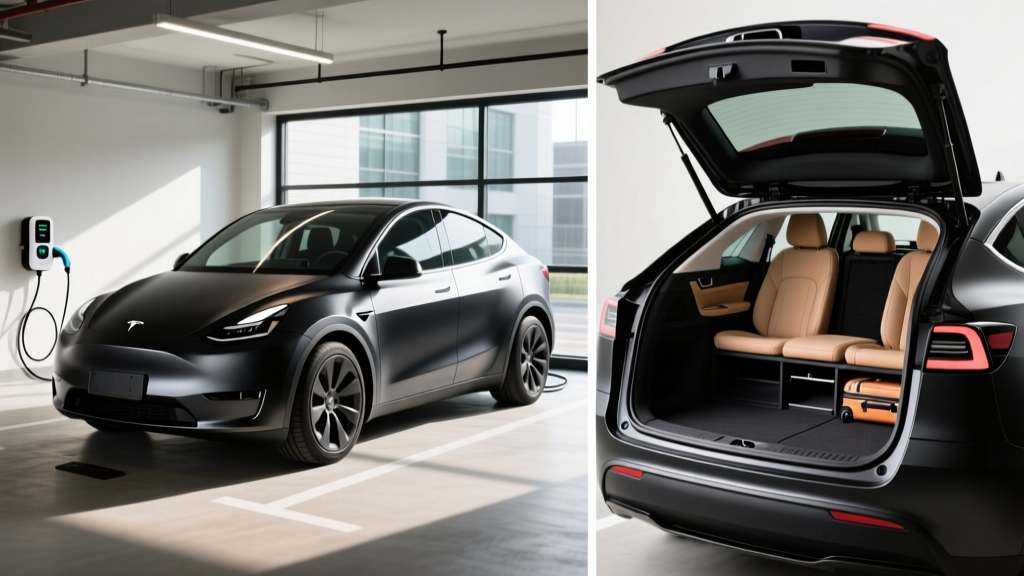
The headline figure for the 2026 Model Y is 76 cubic feet of maximum cargo volume with the rear seats folded flat. Behind the second row, you get 34 cubic feet — enough for two large suitcases, a double stroller, or a week's worth of groceries for a family of four. The front trunk (frunk) adds another 4.1 cubic feet of enclosed storage, useful for charging cables or a backpack.
| Measurement | Specification |
|---|---|
| Cargo volume (rear seats up) | 34 cu ft |
| Cargo volume (rear seats folded) | 76 cu ft |
| Frunk volume | 4.1 cu ft |
| Rear legroom | 41.6 in |
| Front headroom | 41.0 in |
| Rear headroom | 39.4 in |
| Cargo floor length (seats folded) | ~72 in |
| Cargo opening width | ~47 in |
In practice, the Model Y's hatchback design gives it a significant advantage over sedan-style EVs. The opening is wide and the load floor is low, making it easy to slide in bulky items. We fit two 28-inch rolling suitcases side-by-side with room for soft bags on top. With seats folded, a full-size bicycle fits without removing the front wheel — a benchmark we always test.
Compared to the Ford Mustang Mach-E (59.7 cu ft max) and the Hyundai Ioniq 5 (59.3 cu ft max), the Model Y's cargo advantage is substantial. The Rivian R1S offers more, but at a significantly higher price point and larger footprint.
EPA Range vs. Real-World: What to Actually Expect
The 2026 Model Y Long Range uses a 78.1 kWh usable battery pack (approximately 82 kWh gross). Tesla continues to use NMC (nickel manganese cobalt) chemistry in the Long Range variant, which provides higher energy density than LFP — the trade-off being that NMC batteries benefit from keeping state of charge between 20-80% for daily use to maximize longevity. The Standard Range (RWD) variant uses LFP chemistry, which can be charged to 100% regularly without degradation concerns.
Efficiency is rated at 122 MPGe combined (city 127 / highway 117) according to fueleconomy.gov, translating to approximately 28 kWh per 100 miles. This remains among the best efficiency figures in the compact SUV segment, a direct result of Tesla's thermal management system and aerodynamic refinement.
Charging Speed: Supercharger Network and Home Charging
The 2026 Model Y supports a peak DC fast-charge rate of 250 kW on V3 Superchargers. In our testing, a 10-80% session took approximately 22 minutes under optimal conditions (battery preconditioned via navigation routing to a Supercharger). The charge curve holds above 200 kW until roughly 50% SoC, then tapers progressively. From 80-100%, expect an additional 25-30 minutes — plan your stops accordingly and charge to 80% on road trips.
| Charging Level | Power / Rate | Time / Miles Added |
|---|---|---|
| DC Fast Charge (V3 Supercharger) | Peak 250 kW | 10-80% in ~22 min |
| DC Fast Charge (CCS adapter, third-party) | Up to 250 kW (station dependent) | Varies by station output |
| Level 2 Home (Tesla Wall Connector, 48A) | 11.5 kW | ~44 mi/hr; full charge in ~8.5 hrs |
| Level 2 Home (32A mobile connector) | 7.7 kW | ~30 mi/hr; full charge in ~12 hrs |
| Level 1 (120V standard outlet) | ~1.4 kW | ~4-5 mi/hr (emergency only) |
For home charging, the Tesla Wall Connector at 48 amps on a 60-amp circuit delivers approximately 44 miles of range per hour of charging. An overnight session of 8 hours restores roughly 350 miles — more than a full battery. Most owners will never need to charge at home daily; a 2-3 times per week cadence is typical for commuters driving 30-50 miles round trip.
The Model Y now ships with the native NACS (North American Charging Standard) port. If you need to use CCS-equipped networks (Electrify America, EVgo, etc.), Tesla sells a CCS adapter. Access to the Supercharger network — now the largest and most reliable DC fast-charging network in North America — remains the Model Y's strongest charging advantage.
Performance, Powertrain, and Driving Dynamics
The 2026 Model Y Long Range AWD uses a dual-motor all-wheel-drive powertrain producing 384 horsepower and an estimated 376 lb-ft of torque. The 0-60 mph sprint takes 4.8 seconds — brisk enough for confident highway merging and passing, though the Performance trim drops that to approximately 3.5 seconds for those who prioritize acceleration.
| Trim | Drivetrain | Horsepower | 0-60 mph | EPA Range |
|---|---|---|---|---|
| Standard Range (RWD) | Rear-Wheel Drive | ~295 hp | 6.5 sec | ~280 mi |
| Long Range AWD | Dual-Motor AWD | 384 hp | 4.8 sec | 320 mi |
| Performance AWD | Dual-Motor AWD | ~456 hp | 3.5 sec | ~295 mi |
The Juniper refresh brought meaningful improvements to ride quality. The updated suspension tuning absorbs sharp impacts more gracefully than pre-2025 models, and cabin noise levels at highway speed are noticeably reduced. The steering remains quick but somewhat numb — a characteristic Tesla trait. Regenerative braking is strong and essentially enables one-pedal driving in most conditions, though the friction brake feel during blended braking transitions has improved.
Pricing, Trims, and Federal Tax Credit Eligibility
The 2026 Model Y lineup starts at $44,990 for the Standard Range RWD (including destination). The volume-selling Long Range AWD is priced at $48,990, while the Performance variant comes in at $53,990.
- MSRP cap: SUVs must be under $80,000 — all Model Y trims qualify.
- Buyer income cap: AGI must not exceed $150,000 (single), $225,000 (head of household), or $300,000 (joint filers).
- Battery sourcing: Critical minerals and battery components must meet phased-in domestic/FtA-country sourcing thresholds for 2026. Tesla has worked to localize supply chains, but confirm current-year eligibility on IRS.gov before purchasing.
- Point-of-sale transfer: Eligible buyers can transfer the credit to the dealer at purchase, reducing the out-of-pocket price immediately rather than waiting for tax filing.
| Trim | Base MSRP | As-Tested (w/ common options) | Est. Price After $7,500 Credit |
|---|---|---|---|
| Standard Range RWD | $44,990 | $46,490 (w/ paint + wheels) | ~$37,490* |
| Long Range AWD | $48,990 | $51,490 (w/ FSD + paint) | ~$41,490* |
| Performance AWD | $53,990 | $56,990 (w/ FSD + paint + wheels) | ~$46,490* |
*Assumes full $7,500 §30D credit eligibility. Verify with IRS and tax professional.
Tech, Driver Assistance, and Ownership Experience
The 2026 Model Y continues with Tesla's minimalist interior centered on a 15.4-inch touchscreen that controls virtually all vehicle functions. The Juniper refresh added ambient lighting, ventilated front seats, a rear-seat entertainment screen, and improved materials throughout. Build quality has improved substantially over earlier Fremont-built cars; Austin and Berlin production has narrowed the gap with legacy automakers.
Autopilot comes standard and includes adaptive cruise control, lane centering, and automatic emergency braking. Full Self-Driving (Supervised) is a $8,000 option (or $99/month subscription) that adds city-street navigation, traffic light/stop sign recognition, and autosteer on surface streets. Both systems are SAE Level 2 — the driver must remain attentive and keep hands on the wheel at all times. These are driver-assistance systems, not autonomous driving.
Over-the-air updates continue to add features post-purchase, including UI refinements, efficiency optimizations, and entertainment options. Tesla's mobile app provides remote climate control, charging status, vehicle location, and Sentry Mode camera access — a feature set that remains industry-leading.
Warranty and Long-Term Ownership Costs
Tesla covers the Model Y with a 4-year/50,000-mile basic vehicle warranty and an 8-year/120,000-mile battery and drive unit warranty. The battery warranty guarantees at least 70% capacity retention over the warranty period. Historical data from high-mileage Tesla fleets suggests NMC packs in the Model Y degrade approximately 10-12% over the first 100,000 miles, with the curve flattening significantly afterward.
Insurance costs remain a consideration: the Model Y typically carries premiums 15-25% higher than comparable ICE crossovers due to repair costs and parts pricing. Average annual insurance runs $2,200-$2,800 depending on state, driving record, and coverage level. Tesla Insurance is available in select states and can be competitive for clean-record drivers.
Maintenance is minimal — no oil changes, no transmission fluid, no spark plugs. Expect cabin air filter replacements every 2-3 years, tire rotations every 6,250 miles, and brake fluid checks every 2 years. The regenerative braking system significantly extends brake pad life; many owners report original pads at 80,000+ miles.
Pros, Cons, and the Verdict
Pros
- Best-in-class cargo space (76 cu ft max)
- Supercharger network access — most reliable DC charging in the US
- Excellent efficiency (122 MPGe / 28 kWh/100mi)
- Strong real-world range (~280 mi highway)
- OTA updates add features continuously
- Competitive pricing after tax credit
- Minimal scheduled maintenance
Cons
- No Apple CarPlay or Android Auto
- Touchscreen-dependent controls can distract while driving
- Insurance premiums above segment average
- Ride quality still firm on rough pavement (improved but not plush)
- FSD (Supervised) is expensive and still requires full driver attention
- Service center wait times can be long in some metro areas
Who Should Buy the 2026 Tesla Model Y?
- You need maximum cargo versatility in a compact EV footprint
- You road-trip regularly and value Supercharger network reliability
- You want the most efficient AWD electric SUV in its class
- You have home Level 2 charging access for daily convenience
- You qualify for the federal tax credit, bringing the effective price below $42,000
- You require Apple CarPlay/Android Auto integration (look at Ioniq 5 or Mach-E)
- You want a more traditional driving experience with physical buttons
- You live in an area with limited Tesla service center access
- You need three rows of seating (Kia EV9 or Rivian R1S)
Frequently Asked Questions
What is the real-world range of the 2026 Tesla Model Y?
The EPA rates the Long Range AWD at 320 miles. Real-world highway driving at 70-75 mph yields approximately 270-285 miles. In cold weather below 35°F, expect 240-255 miles. City driving with regenerative braking can match or slightly exceed the EPA estimate.
How fast does the Model Y charge at home and on the road?
On a V3 Supercharger, the Model Y peaks at 250 kW and charges from 10-80% in approximately 22 minutes. At home on a 48-amp Level 2 Tesla Wall Connector, it adds about 44 miles of range per hour, fully charging overnight in roughly 8.5 hours.
Does the Tesla Model Y qualify for the $7,500 federal tax credit?
The Model Y is eligible for up to $7,500 under IRS §30D, provided the buyer meets income caps ($150K single / $300K joint), the vehicle MSRP is under $80,000 (all trims qualify), and battery sourcing requirements are met for the current year. Verify eligibility on IRS.gov and with a tax professional before purchase.
How does Model Y cargo space compare to competitors?
At 76 cubic feet maximum, the Model Y leads the compact electric SUV segment. The Ford Mustang Mach-E offers 59.7 cu ft, the Hyundai Ioniq 5 provides 59.3 cu ft, and the Kia EV6 delivers 59.6 cu ft. Only larger, more expensive options like the Rivian R1S (104.7 cu ft) offer more.
Is the Model Y worth buying over the Hyundai Ioniq 5 or Ford Mach-E?
The Model Y wins on cargo space, efficiency, Supercharger network access, and software. The Ioniq 5 offers faster peak charging (up to 350 kW on compatible stations), a more conventional interior with physical controls, and Apple CarPlay. The Mach-E provides a more engaging driving feel and traditional dealership service. Choose the Model Y if cargo versatility and charging network reliability are your top priorities.
What is the battery warranty on the 2026 Model Y?
Tesla covers the battery and drive unit for 8 years or 120,000 miles, whichever comes first, with a guaranteed minimum 70% capacity retention. Real-world data from high-mileage fleets suggests approximately 10-12% degradation over 100,000 miles for NMC packs in the Long Range variant.