The Tesla Model Y remains America's best-selling electric vehicle for good reason, but buyers increasingly ask one practical question above all others: how much can it actually carry? The 2026 Tesla Model Y cargo capacity is a headline advantage in the compact electric SUV segment, yet the vehicle's usefulness extends well beyond its load bay. In this review, we break down every number that matters — from real-world range and DC fast-charging curves to exact cargo dimensions, tax-credit-adjusted pricing, and how the refreshed Model Y stacks up against rivals like the Hyundai Ioniq 5, Ford Mustang Mach-E, and Chevrolet Equinox EV.
Tesla Model Y Cargo Capacity: Dimensions That Matter
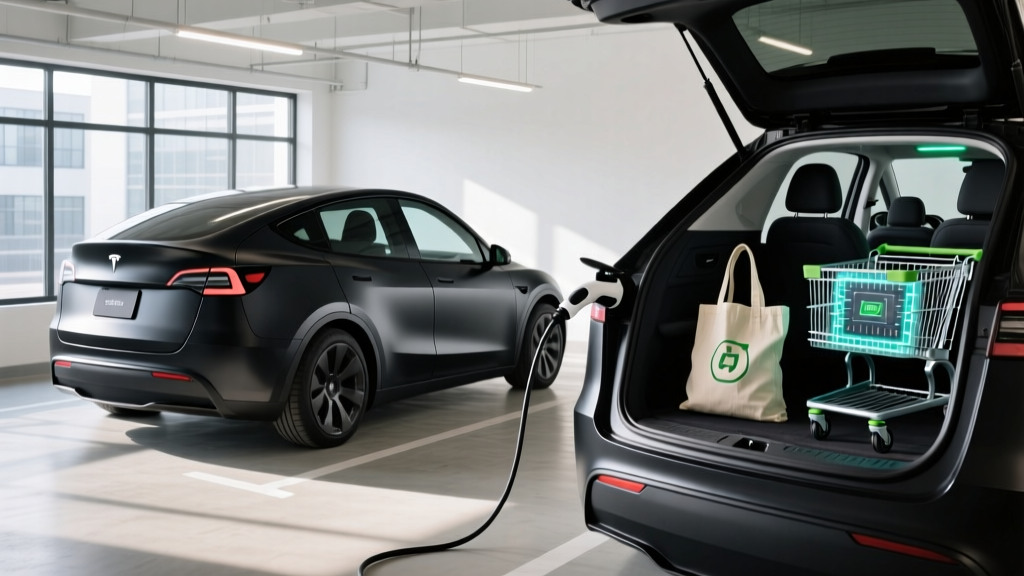
The 2026 Model Y (the "Juniper" refresh that debuted for model year 2025 and carries forward) offers a two-row SUV layout with a flat load floor, a front trunk (frunk), and a deep under-floor rear compartment. Here is the exact cargo breakdown:
- Behind second row (seats up): 30.2 cubic feet
- Second row folded (5-passenger config): 72.1 cubic feet
- Front trunk (frunk): 4.1 cubic feet
- Total maximum cargo volume: 76.2 cubic feet
- Rear legroom: 40.5 inches
- Front headroom: 41.0 inches
- Rear headroom: 39.4 inches
For comparison, the Hyundai Ioniq 5 provides 27.2 cu ft behind the rear seats and 59.3 cu ft folded — meaning the Model Y holds a roughly 12 cu ft advantage when you fold the back row. The Ford Mustang Mach-E offers 29.7 cu ft (seats up) and 59.7 cu ft (folded). If hauling is a priority — strollers, camping gear, home-improvement runs — the Model Y's cargo capacity is genuinely class-leading among electric crossovers at this price point.
The powered liftgate opens to a wide aperture, and the 60/40 split-folding rear seats fold nearly flat with a single pull. The frunk is best suited for a charging cable bag or a small soft cooler rather than a full suitcase. One practical note: the Juniper refresh eliminated the traditional turn-signal stalk and gear selector in favor of steering-wheel buttons and screen-based controls, which streamlines the cabin but requires a brief adaptation period.
Range, Battery & Efficiency: EPA vs. the Real World
The 2026 Model Y Long Range AWD pairs a 78.1 kWh usable battery (NMC chemistry — nickel manganese cobalt) with dual permanent-magnet motors. The base Long Range RWD variant uses a 60 kWh LFP (lithium iron phosphate) pack. The chemistry distinction matters:
- NMC (Long Range AWD): Higher energy density, better cold-weather performance, but Tesla recommends daily charging to 80% for longevity.
- LFP (Long Range RWD): Slightly lower energy density, but can be charged to 100% daily without degradation concern — ideal for owners who want full range every morning.
| Spec | Long Range RWD | Long Range AWD | Performance AWD |
|---|---|---|---|
| EPA Range | 307 mi | 320 mi | 295 mi |
| Battery (usable) | 60 kWh (LFP) | 78.1 kWh (NMC) | 78.1 kWh (NMC) |
| Horsepower | 315 hp | 384 hp | 456 hp |
| 0–60 mph | 5.8 sec | 4.6 sec | 3.5 sec |
| Drivetrain | RWD single motor | AWD dual motor | AWD dual motor |
| MPGe (combined) | 122 MPGe | 117 MPGe | 111 MPGe |
| kWh/100 mi | 28 | 29 | 30 |
| Top Speed | 135 mph | 135 mph | 155 mph |
Efficiency is a Tesla strong suit. At 29 kWh/100 mi (Long Range AWD), the Model Y is among the most efficient electric SUVs sold, translating to lower charging costs whether you plug in at home or on the road. According to fueleconomy.gov, that efficiency edge adds up: at $0.14/kWh (national residential average), a full home charge costs roughly $10.93 for 320 miles of range — or about 3.4 cents per mile.
Charging Speed: DC Fast, Level 2 & Home Setup
The Juniper-generation Model Y uses a 400V architecture (not 800V like the Hyundai Ioniq 5 or Kia EV6), but Tesla's thermal management and Supercharger network integration keep charging times competitive.
| Charging Level | Power | Speed / Time | Connector |
|---|---|---|---|
| Level 1 (120V) | ~1.4 kW | ~3–4 mi/hr | NACS (J3400) |
| Level 2 (240V, 48A) | 11.5 kW | ~37 mi/hr; full charge in ~8 hr | NACS (J3400) |
| DC Fast (Supercharger V3/V4) | Peak 250 kW | 10–80% in ~23 min | NACS (J3400) |
| DC Fast (CCS adapter, non-Tesla) | Up to ~250 kW | Varies by station | CCS1 via adapter |
Charging curve reality check: The 250 kW peak only holds between roughly 10–30% state of charge. From 30–60%, expect ~170–200 kW. From 60–80%, the rate tapers to ~90–120 kW. That taper is why the 10–80% time is 23 minutes rather than the theoretical ~18 minutes a sustained 250 kW would deliver. On a road trip, plan stops around the 20–80% window for the fastest average speed.
At home, the onboard 11.5 kW AC charger is adequate for overnight replenishment. Most owners will need a Tesla Wall Connector ($420 for the unit) installed on a 60-amp circuit. Expect $800–$2,000 for professional installation depending on panel proximity and local permit fees. If your home has a 100-amp electrical panel, a $1,500–$3,000 panel upgrade may be required — factor this into your purchase budget.
The 2026 Model Y ships with the NACS (J3400) connector natively. Tesla's Supercharger network now exceeds 25,000 V3/V4 stalls in North America, and with major automakers (Ford, GM, Rivian, Hyundai, and others) adopting NACS, congestion at Superchargers is increasing in some metro corridors. Plan off-peak charging when possible.
Pricing, Trims & Federal Tax Credit Eligibility
| Trim | Base MSRP | Est. §30D Credit | Effective Price |
|---|---|---|---|
| Long Range RWD | $44,990 | Up to $7,500* | ~$37,490 |
| Long Range AWD | $47,990 | Up to $7,500* | ~$40,490 |
| Performance AWD | $51,990 | Up to $7,500* | ~$44,490 |
*Federal §30D tax credit eligibility is NOT automatic. Per IRS rules, you must meet all of the following:
- MSRP cap: SUVs/vans must be ≤ $80,000 (all Model Y trims qualify).
- Income cap: Modified AGI ≤ $150,000 (single), $225,000 (head of household), or $300,000 (joint).
- Battery sourcing: Critical minerals and battery components must meet escalating domestic/free-trade-partner thresholds. Tesla's U.S.-built packs have generally met the $3,750 critical-minerals requirement and the $3,750 component requirement for a combined $7,500, but sourcing rules tighten annually — verify at the point of sale.
- Point-of-sale transfer: You can transfer the credit to the dealer at purchase for an immediate price reduction, rather than waiting to claim it on your tax return.
Always confirm eligibility with your tax professional and the IRS's official clean-vehicle credit lookup tool before signing paperwork. State and utility incentives may stack on top — check afdc.energy.gov for your ZIP code.
Driving Dynamics, Tech & Driver Assistance
The Juniper refresh brought a noticeably quieter cabin (acoustic glass all around), a redesigned interior with ventilated front seats, a rear-seat entertainment screen, and ambient lighting. Ride quality improved over the pre-2025 Model Y thanks to retuned dampers, though it still leans firm compared to an Ioniq 5 or Equinox EV.
Performance: The Long Range AWD hits 0–60 mph in 4.6 seconds — quicker than nearly every gasoline compact SUV and more than adequate for highway merging. The Performance trim drops that to 3.5 seconds. Dual-motor AWD provides confident all-weather traction, though the Model Y is not a dedicated off-roader; ground clearance is 7.2 inches.
Infotainment: All vehicle controls route through a 15.4-inch center touchscreen running Tesla's proprietary software. There is no Apple CarPlay or Android Auto — a dealbreaker for some, a non-issue for Tesla loyalists. Navigation, streaming, and over-the-air updates are best-in-class. The 2026 model includes an upgraded audio system with 16 speakers and immersive sound.
The Model Y earned the IIHS Top Safety Pick+ designation and a 5-star overall NHTSA rating. Standard safety equipment includes automatic emergency braking, blind-spot monitoring, lane-keeping assist, and eight cameras for the vision-based driver-assist suite.
Warranty, Ownership Costs & Who Should Buy
Tesla provides a 4-year/50,000-mile basic vehicle warranty and an 8-year/120,000-mile battery and drive unit warranty (Long Range/Performance). The battery warranty guarantees at least 70% capacity retention over the coverage period. Real-world degradation data from Tesla's fleet reports show most Model Y packs retain 88–92% capacity after 100,000 miles — well above the warranty floor.
Total cost of ownership (5-year estimate, 75,000 miles):
- Home electricity (at $0.14/kWh): ~$3,045
- Equivalent gasoline (25 MPG SUV at $3.50/gal): ~$10,500
- Maintenance savings: ~$2,500–$3,500 (no oil changes, fewer brake replacements due to regen)
- Insurance: Expect $1,800–$2,600/year depending on state and driving record — typically 15–25% higher than a comparable gas SUV
- Depreciation: Model Y values have stabilized post-2023 price cuts, but EV depreciation remains higher than Toyota/Honda gas vehicles over 5 years
- Families who haul: 72+ cu ft cargo capacity and 40.5 inches of rear legroom handle car seats, strollers, and road-trip luggage with room to spare.
- Commuters with home charging: 320 mi EPA range means charging once or twice a week; overnight Level 2 covers daily needs effortlessly.
- Road-trippers: The Supercharger network remains the most reliable and densest DC fast-charging system in the U.S. — a genuine advantage on cross-country drives.
- Tech-forward buyers: OTA updates, app-based climate/charging control, and the Tesla ecosystem are unmatched in integration.
- You need Apple CarPlay/Android Auto
- You want a softer, more traditional ride (try Ioniq 5 or Equinox EV)
- You tow heavy — the Model Y is rated for only 3,500 lbs
- You live in a charging desert with no reliable DC fast-charger access
Pros, Cons & Verdict
Pros
- Class-leading 76.2 cu ft total cargo capacity
- Best-in-class Supercharger network access
- Excellent efficiency (29 kWh/100 mi)
- Strong real-world range (270–290 mi highway)
- Top Safety Pick+ / 5-star NHTSA
- Continuous OTA improvements
- Point-of-sale tax credit transfer available
Cons
- No Apple CarPlay or Android Auto
- FSD Supervised is expensive ($8,000) and still Level 2
- Increasing Supercharger congestion from NACS adoption
- Insurance premiums above segment average
- Firm ride compared to Hyundai/Kia competitors
- 3,500-lb tow rating trails some rivals
Frequently Asked Questions
What is the real-world range of the 2026 Tesla Model Y?
The EPA rates the Long Range AWD at 320 miles. In real-world highway driving at 70–75 mph, expect 270–290 miles. In freezing temperatures with cabin heat, plan for 230–260 miles. City driving with regenerative braking can match or slightly exceed the EPA figure.
How fast does the Model Y charge at home and on the road?
On a Level 2 home charger (240V, 48A), the Model Y adds ~37 miles of range per hour, filling the battery overnight in about 8 hours. On a Tesla Supercharger V3/V4, it peaks at 250 kW and charges from 10–80% in approximately 23 minutes. Expect the rate to taper significantly above 80% SoC.
Does the 2026 Tesla Model Y qualify for the federal EV tax credit?
All Model Y trims fall under the $80,000 SUV MSRP cap. However, the full $7,500 §30D credit depends on your income (AGI ≤ $300,000 joint), battery-sourcing compliance (which Tesla has generally met), and purchasing new from a qualified manufacturer. The credit can be transferred at the point of sale for an instant price reduction. Verify current-year rules on irs.gov.
How does the Model Y cargo capacity compare to competitors?
The Model Y offers 30.2 cu ft behind the rear seats and 72.1 cu ft folded (76.2 cu ft total including the frunk). The Hyundai Ioniq 5 provides 59.3 cu ft max, the Ford Mustang Mach-E offers 59.7 cu ft, and the Chevrolet Equinox EV delivers 63.5 cu ft. The Model Y leads the segment by a significant margin.
Is the Tesla Model Y worth buying over the Hyundai Ioniq 5 or Ford Mustang Mach-E?
Choose the Model Y if cargo capacity, Supercharger network access, and efficiency are your top priorities. Choose the Ioniq 5 if you prefer 800V ultra-fast charging (10–80% in ~18 min), a softer ride, and CarPlay. Choose the Mach-E if you want a more engaging driving feel and traditional interior controls. All three are strong — the decision comes down to which trade-offs matter most to your daily use.
What battery chemistry does the Model Y use, and does it matter?
The Long Range AWD and Performance use NMC (nickel manganese cobalt) for higher energy density and better cold-weather range — charge to 80% daily for longevity. The Long Range RWD uses LFP (lithium iron phosphate), which tolerates daily 100% charging without degradation but offers slightly less range. Both chemistries are covered by the 8-year/120,000-mile battery warranty.
What is the towing capacity of the 2026 Model Y?
The Model Y is rated to tow up to 3,500 lbs with the optional tow hitch. This is adequate for a small utility trailer or a pair of dirt bikes but trails the Ford Mustang Mach-E (which is not rated for towing in all trims) and the Rivian R2 (announced at 5,000+ lbs). If towing is a priority, consider the Ford F-150 Lightning or Rivian R1S.