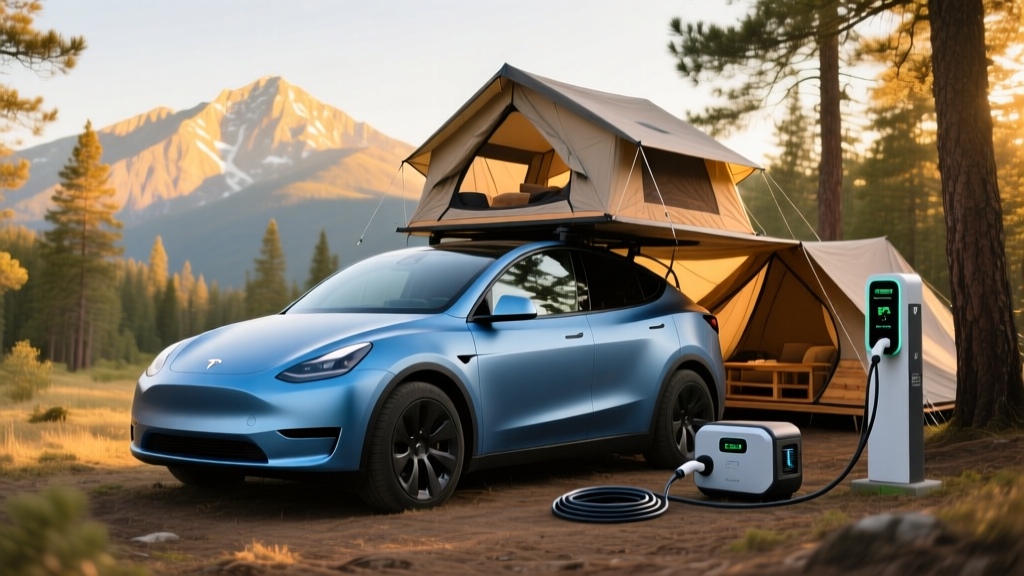
Search interest in pairing a Tesla Model Y camping tent setup with the best-selling electric crossover continues to climb as overlanding and car-camping enthusiasts realize just how capable this EV is in the backcountry. The Model Y's flat-load floor, integrated 12V/16V accessory power, and Tesla's Camp Mode make it a legitimate platform for rooftop and tailgate tent camping — but only if you understand the range, charging, and energy-management realities before heading off-grid.
This review covers the 2026 Tesla Model Y (post-refresh "Juniper" generation) with exact EPA range figures, real-world highway and cold-weather expectations, DC fast-charge speeds, cargo dimensions for tent and gear fitment, and the federal tax credit math that determines your true out-of-pocket cost. Whether you're eyeing a rooftop tent like the Thule Tepui or a tailgate annex, the numbers below will tell you whether the Model Y can handle your camping itinerary.
2026 Tesla Model Y: Core EV Specifications at a Glance
| Specification | Long Range AWD | Performance AWD | Standard Range RWD |
|---|---|---|---|
| EPA Range | 320 miles | 298 miles | 303 miles |
| Battery Capacity (usable) | ~75 kWh (NMC) | ~75 kWh (NMC) | ~60 kWh (LFP) |
| Drivetrain | Dual-Motor AWD | Dual-Motor AWD | Single-Motor RWD |
| Horsepower | 384 hp | 456 hp | 295 hp |
| 0-60 mph | 4.8 sec | 3.5 sec | 6.6 sec |
| Max DC Fast Charge | 250 kW | 250 kW | 170 kW |
| 10-80% DC Charge Time | ~27 min | ~27 min | ~32 min |
| Level 2 Home Charge Rate | 11.5 kW (~44 mi/hr) | 11.5 kW (~44 mi/hr) | 11.5 kW (~44 mi/hr) |
| EPA Efficiency | 122 MPGe (28 kWh/100mi) | 111 MPGe (30 kWh/100mi) | 127 MPGe (26 kWh/100mi) |
| Cargo Volume (rear seats folded) | 72.1 cu ft | 72.1 cu ft | 72.1 cu ft |
| Cargo Volume (seats up) | 30.2 cu ft | 30.2 cu ft | 30.2 cu ft |
| Front Trunk (Frunk) | 4.1 cu ft | 4.1 cu ft | 4.1 cu ft |
| Base MSRP | $46,630 | $52,130 | $39,130 |
| Battery/Drive Unit Warranty | 8 yr / 120,000 mi | 8 yr / 120,000 mi | 8 yr / 100,000 mi |
Source: fueleconomy.gov and Tesla official specifications. Prices reflect 2026 model year MSRP before destination fees.
Real-World Range for Camping Trips: What the EPA Number Doesn't Tell You
The Long Range AWD carries a 320-mile EPA estimate. In real-world camping use, expect approximately 260–285 miles on mixed highway driving at 70–75 mph. Add a rooftop tent (100–150 lbs plus aerodynamic drag) and you should budget 230–260 miles of practical range per charge. In cold weather (below 35°F), reduce that figure by an additional 15–25%, landing around 190–220 miles of usable range before needing a charger.
For overlanding and camping use cases, range planning is critical. Most rooftop tent campers are driving to dispersed BLM land, national forest roads, or state parks where DC fast chargers may be 50–100 miles from the campsite. The Long Range AWD's 320-mile EPA figure gives you a comfortable buffer for a 150-mile one-way trip to a remote site — but only in moderate temperatures and without aggressive driving or heavy cargo loads.
The Standard Range RWD model, with its LFP (lithium iron phosphate) battery, sacrifices about 17 miles of EPA range compared to the Long Range but gains a chemistry advantage for campers: LFP cells tolerate regular 100% charging without the degradation concerns of NMC. If you're charging at a campground Level 2 station or via solar and want to max out every morning, LFP is the more forgiving chemistry.
Charging Speed and Infrastructure: Getting Back on the Trail Fast
| Charging Level | Power | Miles Added per Hour | Notes for Campers |
|---|---|---|---|
| Level 1 (120V household) | ~1.4 kW | ~4–5 mi/hr | Emergency/trickle; useful at cabins or campsites with standard outlets |
| Level 2 (240V home or destination) | 11.5 kW | ~44 mi/hr | Full overnight charge (~7–8 hrs); many campgrounds now offer 240V RV pedestals |
| DC Fast Charge (Supercharger) | Up to 250 kW (LR) | ~1,000+ mi/hr (peak) | 10-80% in ~27 min; NACS connector native — no adapter needed at Superchargers |
| DC Fast Charge (CCS station) | Up to 250 kW | Varies | 2026 Model Y ships with NACS; use Tesla CCS adapter for Electrify America, EVgo, etc. |
The 250 kW peak DC fast-charge rate on the Long Range and Performance trims is strong but not class-leading — the Hyundai Ioniq 5 peaks at 350 kW on 800V architecture. However, Tesla's Supercharger network reliability remains the gold standard for road-trip charging. According to Tesla's network data, Supercharger uptime exceeds 99.5%, which matters enormously when you're routing through rural corridors to reach a campsite.
Charge curve reality check: The 250 kW peak only sustains roughly from 10% to 35% State of Charge. From 50% to 80%, expect the rate to taper to 80–120 kW. That 27-minute 10-80% figure assumes you arrive at the charger with a preconditioned battery (the car does this automatically when you navigate to a Supercharger). Plan 30–35 minutes per charging stop on a camping road trip for a realistic comfort and stretch-leg break.
Cargo Space, Tent Compatibility, and Camp Mode
The Model Y's 72.1 cubic feet of cargo volume with rear seats folded creates a nearly flat load floor measuring approximately 70 inches long and 41 inches wide between the wheel wells — enough for a full-size sleeping platform or a compact tailgate tent attachment. This is a key reason the Tesla Model Y camping tent search trend has grown: the geometry actually works for sleeping inside the vehicle.
Camp Mode is Tesla's integrated feature that maintains cabin climate control, keeps USB ports powered, and displays ambient visuals on the touchscreen while the car is parked. It draws roughly 1–2 kWh over an 8-hour night depending on outside temperature and HVAC demand. On the 75 kWh Long Range pack, that means Camp Mode consumes about 10–15% of your battery overnight in moderate conditions — a manageable trade-off for climate-controlled sleeping without a separate power station.
Rooftop tent considerations: The Model Y does not come with factory roof rails on all trims. You'll need Tesla's aftermarket crossbar system or a third-party option rated for dynamic loads. Most rooftop tents (Thule Tepui, iKamper, Roofnest) weigh 120–180 lbs, which falls within the Model Y's dynamic roof load limit when properly equipped. Expect a 5–10% range reduction from the added weight and aerodynamic drag at highway speeds.
Tailgate tents and annexes: Several manufacturers (Tentree, Napier, Auto Home) produce vehicle-specific annex tents that attach to the Model Y's liftgate. With the rear seats folded and a sleeping platform installed, you gain a weatherproof sleeping area of roughly 40 sq ft inside the car plus the annex footprint outside.
Performance and Drivetrain: Does AWD Matter for Camping?
For camping and overlanding, the Long Range AWD's dual-motor all-wheel drive is the recommended configuration. The independent front and rear motors provide torque vectoring to individual axles, which helps on gravel forest roads, muddy campsite entries, and light snow. The Model Y is not a dedicated off-roader — ground clearance is 6.6 inches, which limits you to maintained dirt and gravel roads rather than technical trails.
The Performance trim's 3.5-second 0-60 mph time is thrilling but irrelevant for camping. What matters more is the 384 hp in the Long Range, which provides confident highway merging when loaded with 400+ lbs of camping gear and a rooftop tent. The RWD Standard Range model will save you $7,500 at purchase but sacrifices the AWD traction that most campers want for remote sites.
Pricing, Trims, and Federal Tax Credit Eligibility
| Trim | Base MSRP | Destination | Est. Total Before Credit | Potential §30D Credit | Effective Price (Max Credit) |
|---|---|---|---|---|---|
| Standard Range RWD | $39,130 | $1,990 | $41,120 | Up to $7,500 | ~$33,620 |
| Long Range AWD | $46,630 | $1,990 | $48,620 | Up to $7,500 | ~$41,120 |
| Performance AWD | $52,130 | $$1,990 | $54,120 | Up to $7,500 | ~$46,620 |
Federal tax credit rules (§30D) for 2026: The full $7,500 credit requires meeting two $3,750 sub-requirements — critical minerals sourcing and battery component manufacturing, both with escalating domestic-content thresholds. Per IRS guidelines, the buyer must also meet income caps ($150,000 single / $300,000 joint modified AGI), and the vehicle MSRP must not exceed $55,000 for SUVs (all Model Y trims currently qualify). The credit can be transferred to the dealer at point of sale, reducing your purchase price directly.
Tesla's battery sourcing compliance has fluctuated with supply chain changes. Always verify current eligibility on fueleconomy.gov before purchasing, as the qualifying credit amount can change based on battery component and critical mineral sourcing updates.
Pros and Cons of the Model Y as a Camping Platform
- 72.1 cu ft flat-load cargo floor fits sleeping platforms and tailgate tents
- Camp Mode provides climate-controlled sleeping with ~10-15% overnight battery draw
- Supercharger network reliability exceeds 99.5% for road-trip peace of mind
- AWD dual-motor traction handles gravel and light mud at campsites
- 12V/16V accessory power runs CPAP, laptops, LED lights without a generator
- LFP option (Standard Range) allows daily 100% charging without degradation worry
- 6.6 inches of ground clearance limits off-road capability vs. SUV competitors
- Rooftop tent requires aftermarket crossbars — not factory-equipped
- No V2L (vehicle-to-load) AC outlet — you need an inverter for 120V appliances
- 250 kW peak DC charge rate trails 800V rivals (Ioniq 5 at 350 kW)
- Camp Mode battery drain means you must plan charging before remote overnight stays
- No spare tire — Tesla provides a tire repair kit only
How the Model Y Stacks Up Against Camping-Oriented EV Rivals
The most direct competitor for EV camping is the Ford Mustang Mach-E (EPA range up to 320 miles, 65.4 cu ft cargo) and the Hyundai Ioniq 5 (up to 318 miles, 59.3 cu ft cargo). The Model Y wins on cargo volume — 72.1 cu ft beats both — and on charging infrastructure access via Superchargers. The Ioniq 5 counters with faster 350 kW peak charging and V2L capability (you can plug a standard 120V appliance directly into the car). The Rivian R1S offers vastly superior off-road capability and 104 cu ft of cargo but starts above $75,000.
For the specific Tesla Model Y camping tent use case, the cargo dimensions and Camp Mode integration give Tesla a practical edge — just know that you're trading ground clearance and V2L flexibility for range efficiency and charging reliability.
Frequently Asked Questions
What is the real-world range of the Tesla Model Y with a rooftop tent?
With a rooftop tent adding approximately 120–150 lbs and aerodynamic drag, expect 230–260 miles of real-world range from the Long Range AWD (EPA 320 mi) in moderate temperatures at highway speeds. Cold weather below 35°F will reduce this further to roughly 190–220 miles.
How fast does the Model Y charge on a road trip to a campsite?
At a V3 Supercharger (250 kW), the Long Range AWD charges from 10-80% in approximately 27 minutes with a preconditioned battery. Expect 30–35 minutes per stop in practice, accounting for tapering above 50% SoC. At a campground Level 2 charger (11.5 kW), a full charge takes about 7–8 hours.
How much does the Model Y cost after the federal EV tax credit?
The Standard Range RWD starts at $41,120 with destination and could drop to approximately $33,620 with the full $7,500 §30D credit. The Long Range AWD effectively starts around $41,120 after the maximum credit. Eligibility depends on your income (under $150K single / $300K joint), battery sourcing compliance, and point-of-sale transfer at purchase. Verify current eligibility on fueleconomy.gov.
Is the Model Y worth buying for camping vs. a Rivian or Ford?
The Model Y wins on cargo volume (72.1 cu ft), Supercharger reliability, and Camp Mode integration. It loses to the Rivian R1S on ground clearance and off-road capability and to the Hyundai Ioniq 5 on V2L flexibility and peak charge speed. If your camping involves maintained gravel roads and established campgrounds, the Model Y is an excellent platform. If you need technical trail access, look at the Rivian.
Does Camp Mode drain the battery significantly overnight?
Camp Mode typically consumes 1–2 kWh over 8 hours (roughly 10–15% of the Long Range battery) in moderate temperatures. In very cold conditions, HVAC demand can push this to 20–25%. Always arrive at a remote campsite with at least 30–40% SoC to ensure Camp Mode runs through the night with a safety buffer for the drive out.
Can I run a CPAP machine or laptop from the Model Y while camping?
Yes. The Model Y's USB-C ports and 12V accessory outlet can power a CPAP machine, LED lights, and laptops. However, the car does not have a native 120V AC outlet (no V2L). You'll need a small pure-sine-wave inverter plugged into the 12V socket for AC appliances — keep the load under 150W to stay within the 12V system's capacity.
Does the Tesla Model Y qualify for the federal EV tax credit in 2026?
All Model Y trims fall under the $55,000 SUV MSRP cap for §30D eligibility. The full $7,500 credit depends on current battery component and critical mineral sourcing compliance, plus buyer income limits. Tesla's US-built vehicles have historically qualified, but sourcing rules tighten annually. Confirm current status on fueleconomy.gov before purchase.