Why the Tesla Model Y Has Become the Default EV Camping Rig
The Tesla Model Y has quietly become one of the most popular vehicles for car camping and overlanding — not because Tesla marketed it that way, but because its combination of flat cargo space, efficient powertrain, and built-in Camp Mode solves most of the problems that make EV camping difficult. If you're researching Model Y camping setups, this guide covers the 2026 model year with exact range figures, cargo dimensions, charging logistics, and the practical realities of sleeping in an electric SUV off-grid.
We'll also address the hard questions: Can you run climate control all night without killing your range? Where do you charge when you're 80 miles from the nearest Supercharger? And how does the Model Y stack up against competing electric SUVs for camping duty?
2026 Tesla Model Y Core Specs: What Campers Need to Know
| Spec | Long Range AWD | Performance | RWD (Standard) |
|---|---|---|---|
| EPA Range | 337 mi | 303 mi | 295 mi |
| Battery (usable) | ~75 kWh (NMC) | ~75 kWh (NMC) | ~57.5 kWh (LFP) |
| Drivetrain | Dual-Motor AWD | Dual-Motor AWD | Single-Motor RWD |
| Horsepower | 384 hp | 455 hp | 295 hp |
| 0–60 mph | 4.8 sec | 3.5 sec | 6.6 sec |
| Max DC Fast Charge | 250 kW | 250 kW | 170 kW |
| 10–80% DCFC Time | ~27 min | ~27 min | ~35 min |
| Level 2 Home Charge | 11.5 kW (~44 mi/hr) | 11.5 kW (~44 mi/hr) | 7.6 kW (~30 mi/hr) |
| MPGe (combined) | 122 MPGe | 111 MPGe | 125 MPGe |
| Efficiency | 28 kWh/100mi | 30 kWh/100mi | 27 kWh/100mi |
| Cargo (rear seats up) | 30.2 cu ft | 30.2 cu ft | 30.2 cu ft |
| Cargo (rear seats folded) | 72.1 cu ft | 72.1 cu ft | 72.1 cu ft |
| Base MSRP | $48,990 | $53,990 | $44,990 |
Sources: fueleconomy.gov, Tesla spec sheets. Pricing reflects 2026 model year and is subject to change.
Real-World Range: What Actually Happens on a Camping Trip
EPA sticker: 337 miles. Real-world expectation for camping trips:
- Mixed highway/city (70 mph, moderate temps): ~280–305 miles
- Sustained highway at 75–80 mph: ~255–275 miles
- Cold weather (below 32°F) + highway: ~220–250 miles
- Cold weather + roof cargo box or bike rack: ~200–230 miles
Plan your legs around 200–220 usable miles to preserve a safety buffer and avoid arriving at a charger below 10% SoC.
The gap between EPA range and real-world camping range isn't unique to Tesla — it applies to every EV. EPA testing includes low-speed city driving and moderate climate loads that don't reflect a loaded vehicle climbing mountain passes at 75 mph. For camping trips, three factors compound range loss:
- Aerodynamic drag from gear. A rooftop cargo box or tent can cut efficiency by 10–18%, which translates to 30–50 fewer miles per charge.
- Elevation gain. Climbing to mountain campgrounds (think Colorado, Sierra Nevada) consumes significantly more energy. Expect to burn 350–450 Wh/mile on sustained 5–7% grades versus the rated ~280 Wh/mile on flat ground.
- Temperature. Below freezing, the battery's internal resistance increases and cabin heating draws 2–5 kW continuously. The Model Y's heat pump (standard on all 2026 trims) is more efficient than resistive heating, but cold still costs 20–30% of range.
Charging Logistics: Getting to Remote Campsites and Back
Charging is the single biggest planning challenge for EV camping. Here's how the Model Y handles it across all three charging levels:
| Charging Level | Power | Miles Added per Hour | Best For |
|---|---|---|---|
| Level 1 (120V household) | ~1.4 kW | ~4–5 mi/hr | Emergency trickle at a campsite or cabin |
| Level 2 (240V home/public) | 7.6–11.5 kW | 30–44 mi/hr | Overnight at home or campground with EV hookups |
| DC Fast Charge (Supercharger) | 170–250 kW peak | ~200+ mi in 15 min (initial) | Road-trip corridor charging |
Tesla Supercharger Network: The Camping Advantage
Tesla's Supercharger network remains the most reliable DC fast-charging ecosystem in the U.S., with over 6,500 stalls domestically as of early 2026. For camping, this matters enormously: many Superchargers are positioned along the highways you'd take to reach national parks and forest campgrounds. The Model Y's native navigation preconditions the battery automatically when you route to a Supercharger, which means you'll consistently hit peak charge rates of 250 kW on the Long Range and Performance trims (170 kW on the RWD).
A critical nuance: the charge curve tapers significantly above 80% SoC. You'll add roughly 175 miles in the first 15 minutes of a 10–80% session, but going from 80–100% can take an additional 25–30 minutes. For camping trips, charge to 80% and move on — the time savings are substantial.
Off-Grid Charging Reality
If your campsite has no electrical hookup, you're running on battery alone. Here's what overnight climate control actually costs:
- Camp Mode overnight (70°F, mild night): ~8–12 kWh over 8 hours — roughly 35–50 miles of range consumed
- Camp Mode overnight (30°F, cold night with heating): ~15–22 kWh over 8 hours — roughly 55–80 miles consumed
- Extreme cold (below 15°F): ~25–35 kWh over 8 hours — plan for 90–120 miles of range loss
For most three-season camping, budget ~50 miles of range per night for climate control. That's manageable with a Long Range Model Y, but it means you need to arrive at your campsite with at least 100 miles of buffer if you plan to drive out the next morning without charging.
Cargo Space and Sleep Setup: Dimensions That Matter
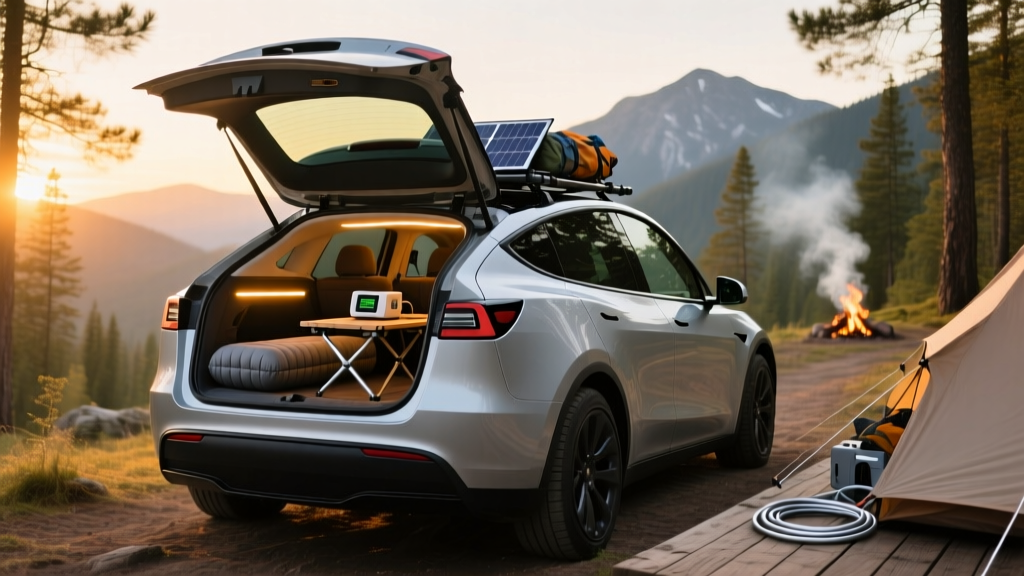
The Model Y's 72.1 cubic feet of cargo volume with rear seats folded is the primary reason it dominates EV camping conversations. Here's how that translates to a sleeping platform:
- Flat load floor length (seats folded): ~74 inches (6'2") with front seats pushed forward — sufficient for most adults to lie flat
- Width between wheel wells: ~39 inches at the narrowest, ~52 inches at widest
- Vertical clearance (tailgate to floor): ~28 inches — tight for sitting up, fine for sleeping
Popular camping setups include a custom-cut foam mattress (6" thick, tri-fold), inflatable camping pads designed for the Model Y's floor contours, or aftermarket platforms like the Tescamp or Expedit systems that add under-bed storage drawers. The slight floor incline (roughly 3–4 degrees from the folded seat hinge) can be leveled with a small wedge or platform.
Frunk and Additional Storage
The Model Y's front trunk (frunk) adds approximately 4.1 cubic feet of lockable storage — useful for charging cables, a portable Level 1/2 charger, cooking gear, or a small cooler. Combined with the under-floor rear cargo compartment (~2.5 cu ft), you have enough concealed storage for most camping essentials without blocking the main sleep area.
Camp Mode and Standout Tech Features
Tesla's Camp Mode is the feature that makes Model Y camping practical. When activated, it:
- Maintains cabin temperature and airflow continuously
- Keeps USB ports and the 12V outlet powered
- Leaves the touchscreen on (useful as ambient lighting or for media)
- Prevents the car from locking you out or entering sleep mode
You can run Camp Mode all night without the vehicle "waking up" and shutting systems down. Pair it with the Model Y's HEPA air filtration (Bioweapon Defense Mode) for clean air at dusty campsites or during wildfire smoke events — a feature that has become increasingly relevant for western U.S. camping.
Other Tech Relevant to Camping
- 15.4-inch touchscreen with streaming apps — doubles as a cabin entertainment system on rainy nights
- Over-the-air updates — Tesla regularly adds features; recent updates have improved Camp Mode's energy efficiency
- Sentry Mode — 360° camera surveillance when parked, useful at unattended campsites
- Autopilot / FSD (Supervised) — SAE Level 2 driver-assist, not self-driving. Reduces fatigue on long highway drives to remote campgrounds, but you must remain engaged and hands-on-wheel at all times.
Unlike the Hyundai Ioniq 5 or Ford F-150 Lightning, the Model Y does not offer vehicle-to-load power export. You cannot plug a standard 120V appliance directly into the car to run a blender, coffee maker, or external lights. Campers who want V2L capability need a third-party inverter connected to the 12V system (limited to ~150W continuous) or a standalone portable power station (Jackery, EcoFlow). This is the Model Y's biggest camping drawback relative to competitors.
Pricing, Trims, and Federal Tax Credit Eligibility
| Trim | Base MSRP | Federal §30D Credit | Effective Price (if eligible) |
|---|---|---|---|
| RWD (Standard) | $44,990 | Up to $7,500 | ~$37,490 |
| Long Range AWD | $48,990 | Up to $7,500 | ~$41,490 |
| Performance | $53,990 | Up to $7,500 | ~$46,490 |
IRS §30D Tax Credit: The Fine Print
The federal EV tax credit under IRS §30D offers up to $7,500, but eligibility depends on several requirements that change periodically:
- MSRP cap: SUVs must be priced at or below $80,000 — all Model Y trims qualify
- Buyer income limits: AGI must not exceed $300,000 (joint), $225,000 (head of household), or $150,000 (individual)
- Battery sourcing: A portion of the credit ($3,750) requires critical minerals sourced from the U.S. or FTA partners; the other $3,750 requires battery components manufactured in North America. Tesla's supply chain has been progressively qualifying, but verify current eligibility at purchase
- Point-of-sale transfer: As of 2024+, you can transfer the credit to the dealer at purchase, reducing your out-of-pocket cost immediately rather than waiting for tax filing
Tax credit rules are subject to legislative changes. Consult a tax professional and verify current eligibility on irs.gov before purchasing.
Warranty Coverage for Adventure Use
| Coverage | Term |
|---|---|
| Basic Vehicle | 4 years / 50,000 miles |
| Battery & Drive Unit | 8 years / 120,000 miles (Long Range/Performance) |
| Battery & Drive Unit (RWD) | 8 years / 100,000 miles |
| Battery capacity retention guarantee | ≥70% of original capacity during warranty period |
Tesla's warranty does not exclude camping or light off-road use. However, suspension or undercarriage damage from rough forest roads is not covered — that's considered wear/abuse. If you plan to drive to remote dispersed campsites on unpaved roads, consider aftermarket skid plates and ensure your insurance policy covers off-highway incidents.
Model Y Camping vs. Key Competitors
| Feature | Tesla Model Y LR | Hyundai Ioniq 5 | Ford Mustang Mach-E | Rivian R1S |
|---|---|---|---|---|
| EPA Range | 337 mi | 310 mi | 312 mi | 352 mi |
| Cargo (seats folded) | 72.1 cu ft | 56.2 cu ft | 59.7 cu ft | 88.2 cu ft |
| V2L Power Export | No | Yes (3.6 kW) | No | Yes (camping outlet) |
| Sleep Mode / Camp Mode | Yes (excellent) | Utility Mode (basic) | No dedicated mode | Camp Mode (good) |
| DC Fast Charge Peak | 250 kW | 240 kW | 150 kW | 220 kW |
| Charging Network | Supercharger (best coverage) | CCS (EA, etc.) | CCS (EA, etc.) | Supercharger + CCS |
| Starting MSRP | $48,990 | $44,900 | $42,995 | $75,900 |
| Ground Clearance | 6.6 in | 6.1 in | 5.7 in | 14.9 in (max) |
The Model Y wins on cargo volume (relative to price), Supercharger access, and Camp Mode maturity. It loses on V2L capability and ground clearance. If you need to power external appliances or tackle serious off-road terrain, the Ioniq 5 (V2L) or Rivian R1S (clearance + V2L) may be better fits — though the R1S costs significantly more.
Pros and Cons for Camping
✅ Pros
- 72.1 cu ft cargo with flat floor — best-in-class sleep platform
- Camp Mode with continuous climate control is mature and reliable
- Supercharger network provides unmatched road-trip charging coverage
- HEPA air filtration excellent for dusty/smoky environments
- Low energy consumption (28 kWh/100mi LR) means more range per charge
- OTA updates continuously improve features
- Strong resale value relative to competitors
❌ Cons
- No V2L — can't power external appliances or devices
- 6.6 inches ground clearance limits rough-road campsite access
- No spare tire — only a tire repair kit (risky on remote forest roads)
- Rear seat fold creates a slight incline — requires leveling for comfortable sleep
- Vertical interior height (28 in) means no sitting up in bed
- Reliance on Tesla's app and connectivity for many features
- Insurance costs above segment average
Frequently Asked Questions
What is the real-world range of the Model Y on a camping trip?
Expect 255–305 miles from the Long Range AWD in typical camping conditions (mixed driving, moderate load, 50–80°F). In cold weather or with a rooftop cargo box, plan for 200–250 miles. Always keep a 50-mile buffer for detours and elevation changes.
How fast does the Model Y charge at home and on the road?
On a home Level 2 charger (11.5 kW / 48A), the Long Range adds ~44 miles of range per hour — a full overnight charge from 20% to 100% takes about 7 hours. On a Supercharger, it peaks at 250 kW and charges from 10–80% in roughly 27 minutes, though charging slows significantly above 80%.
How much does the Model Y cost after federal tax credits?
The Long Range AWD starts at $48,990. If you qualify for the full $7,500 §30D credit (meeting income, sourcing, and MSRP requirements), your effective price drops to ~$41,490. The RWD trim can reach ~$37,490 with the full credit. Verify current eligibility on irs.gov before purchase.
Does the Model Y qualify for the federal EV tax credit?
As of 2026, the Model Y qualifies for up to $7,500 under §30D, subject to buyer income limits, battery critical-mineral sourcing, and North American component manufacturing requirements. The MSRP cap for SUVs is $80,000, which all trims clear. Credit availability can change — always confirm at point of sale.
Is the Model Y worth buying for camping vs. competitors?
If your priority is maximum flat cargo space, reliable long-distance charging, and a polished Camp Mode, the Model Y Long Range is the strongest all-around EV camping vehicle under $55,000. If you need V2L power export for running appliances or more ground clearance for off-road sites, consider the Hyundai Ioniq 5 (V2L, lower price, less cargo) or the Rivian R1S (superior off-road, much higher price).
Can I run the heater all night in Camp Mode without draining the battery?
Yes, but plan accordingly. In mild conditions (50–65°F), Camp Mode uses ~8–12 kWh overnight — about 35–50 miles of range. In freezing temps, expect 15–22 kWh (~55–80 miles). The heat pump on the 2026 Model Y is significantly more efficient than older resistive heaters, but cold weather still demands a meaningful energy budget.
What's the best mattress setup for sleeping in a Model Y?
A 4–6 inch tri-fold memory foam mattress cut to ~72" x 40" fits the folded cargo floor well. Several companies (Tescamp, Exped, Therm-a-Rest) sell Model Y-specific camping pads. Add a small wedge under the head end to compensate for the 3–4 degree floor incline. Pair with window covers for privacy and insulation.
Do I need a roof rack for Model Y camping?
It depends on your gear volume. Tesla's official cross bars support ~165 lbs dynamic load and work with most cargo boxes and bike racks. Be aware that a loaded roof box reduces range by 10–18% and increases wind noise. For minimalist camping (two people, compact gear), the interior cargo space alone is usually sufficient.