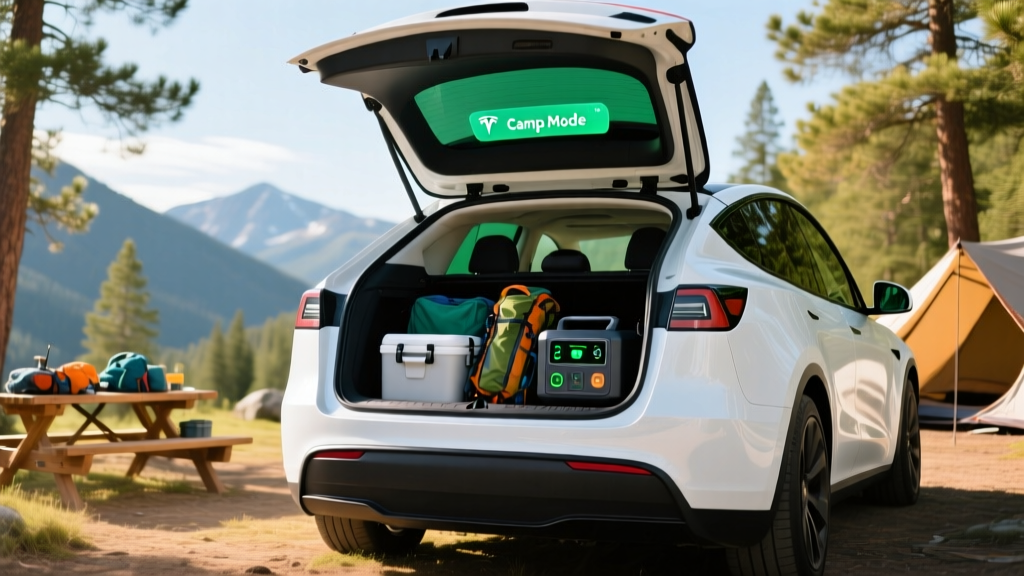
If you're researching Tesla Model Y camping, you're not alone. The Model Y's combination of flat-load cargo space, over-the-air software features like Camp Mode, and access to Tesla's Supercharger network has made it one of the most popular EVs for car camping and overlanding. But taking an electric vehicle into the backcountry requires more planning than a gas-powered SUV — you need to understand real-world range, charging logistics, battery drain overnight, and whether the cargo dimensions actually fit your gear.
This guide covers everything you need to know about camping in a 2026 Tesla Model Y, from the exact specs that matter to the real-world limitations no brochure will tell you.
2026 Tesla Model Y: Core Specs at a Glance
| Spec | Value |
|---|---|
| EPA Range | 320 miles (Long Range AWD) |
| Battery Capacity | ~75 kWh usable (NMC chemistry, Long Range) |
| Efficiency | 122 MPGe combined / 28 kWh/100mi |
| Max DC Fast Charge | 250 kW peak (V3 Supercharger) |
| 10–80% DC Charge Time | ~25 minutes (optimal conditions) |
| Level 2 Home Charging | 11.5 kW (44 mi/hr on 48A circuit) |
| 0–60 mph | 4.8 seconds (Long Range AWD) |
| Horsepower | 384 hp (dual motor) |
| Drivetrain | Dual Motor AWD |
| Cargo (rear seats folded) | 76.2 cu ft |
| Cargo (seats up) | 30.2 cu ft |
| Battery Warranty | 8 years / 120,000 miles |
| Base MSRP (Long Range AWD) | $48,990 |
Note: The Standard Range RWD variant uses an LFP (lithium iron phosphate) battery with ~60 kWh usable capacity and an EPA range of approximately 260 miles. LFP chemistry offers longer cycle life and can be charged to 100% daily without degradation concerns — a genuine advantage for campers who want a full battery before heading out.
Real-World Range: What the EPA Sticker Doesn't Tell You
EPA Estimate: 320 miles (Long Range AWD)
Real-World Highway (70 mph, mild weather): ~270–290 miles
Real-World Camping Load (roof box, gear, hills, 65 mph): ~240–265 miles
Cold Weather (below 32°F, heater on): ~210–240 miles
Plan your charging stops around 220–240 miles of usable range to maintain a safety buffer.
The EPA range figure assumes a mix of city and highway driving at moderate temperatures with no cargo load. When you load a Model Y with camping gear, add a rooftop cargo box (which increases aerodynamic drag substantially), and drive at sustained highway speeds to reach a campsite, expect to lose 15–25% of the sticker range.
Cold weather is the bigger enemy. According to testing data referenced by fueleconomy.gov, EVs can lose 20–30% of range in temperatures below freezing when cabin heating is engaged. The Model Y's heat pump (standard on current models) mitigates this somewhat compared to resistive heating, but physics still applies. If you're camping in mountain or northern climates between November and March, plan around 210–240 miles of real range.
The key insight for campers: range isn't just about getting to the campsite — it's about getting back to a charger. Map your round-trip distance plus a 40-mile buffer before committing to a remote site without charging access.
Cargo Space and Sleeping Setup: Will Your Gear Fit?
The Model Y's 76.2 cubic feet of cargo space with rear seats folded is the primary reason it dominates the EV camping conversation. For reference, that's roughly comparable to a Subaru Outback (75.7 cu ft) and significantly more than a Ford Mustang Mach-E (59.7 cu ft).
With seats folded, the load floor is nearly flat — there's a slight incline from the rear hatch to the front seats, but it's negligible for sleeping. The usable sleeping length from the tailgate to the back of the front seats is approximately 72–75 inches (6'0"–6'3"), depending on front seat position. Taller campers may need to angle slightly or push the front seats fully forward.
What Fits Inside
- Sleeping platform: A queen-size inflatable mattress (60" x 80") fits with front seats pushed forward, though it's tight on width at the wheel wells (~51" between wells).
- Custom foam mattresses: Companies like Tesmat and Expedit offer Model Y-specific tri-fold mattresses (~$200–$400) that account for the wheel-well contour.
- Camping gear: Two large duffels, a cooler, a camp stove, and a two-person tent fit behind the rear seats (30.2 cu ft) without folding anything.
- Rooftop tent: The Model Y's roof rack capacity is 165 lbs dynamic (driving) — sufficient for most hard-shell rooftop tents, though the added drag reduces highway range by roughly 10–15%.
The frunk (front trunk) adds about 4.1 cu ft of additional storage — useful for charging cables, a small cooler, or dirty gear you want separated from the cabin.
Camp Mode: The Feature That Makes It Work
Tesla's Camp Mode is the software feature that transforms the Model Y from a commuter into a viable camping platform. Activated from the climate controls menu, Camp Mode:
- Maintains cabin temperature and airflow continuously overnight
- Keeps USB ports and the 12V accessory outlet powered
- Leaves the touchscreen on (you can play ambient sounds, white noise, or media)
- Prevents the vehicle from entering sleep mode, which would cut climate control
Overnight Battery Drain in Camp Mode
Based on owner reports and testing, Camp Mode consumes approximately 1–2% of battery per hour in mild weather (60–75°F) and 2–4% per hour in cold weather (below 40°F) when the heat pump works harder. Over an 8-hour sleep period:
- Mild weather: Expect ~8–16% total drain (roughly 25–50 miles of range lost)
- Cold weather: Expect ~16–30% total drain (roughly 50–95 miles of range lost)
This means if you arrive at a campsite with 60% battery in summer, you'll wake up with roughly 45–52% — plenty to drive to the nearest Supercharger. In winter, arriving at 60% could leave you at 30–44%, making charging logistics more critical.
Pro tip: Use the Tesla app to precondition the cabin while plugged in at your last charging stop before arriving at camp. Starting with a warm cabin and a 90%+ charge dramatically improves the overnight equation.
Charging Logistics: Reaching the Campsite and Getting Home
| Charging Level | Power | Speed | Use Case |
|---|---|---|---|
| Level 1 (120V outlet) | ~1.4 kW | ~4–5 mi/hr | Emergency trickle at campsite |
| Level 2 (240V, 48A) | 11.5 kW | ~44 mi/hr | Home charging, some campgrounds |
| DC Fast (V3 Supercharger) | 250 kW peak | 10–80% in ~25 min | Road-trip highway stops |
| DC Fast (V4 Supercharger) | Up to 350 kW | 10–80% in ~20 min | Newer Supercharger stations |
The Supercharger Advantage for Campers
Tesla's Supercharger network remains the most reliable DC fast-charging ecosystem for road trips, with over 6,000 V3/V4 stalls across the U.S. as of early 2026. For campers, this means highway-adjacent charging stops are predictable and fast. The Model Y's peak 250 kW charge rate on V3 stalls delivers roughly 170 miles of range in 15 minutes under optimal conditions (battery preconditioned, SoC below 20%).
However, the charging curve tapers significantly above 80% SoC. Charging from 80–100% can take as long as 10–80%. For camping trips, charge to 80% and go — don't wait for a full battery at a Supercharger unless you're about to tackle a long stretch with no chargers.
Campsite Charging: The Level 1 Reality
Many campgrounds offer standard 120V (NEMA 5-15) outlets at their sites. Plugging in the Model Y's Mobile Connector at 120V yields roughly 4–5 miles of range per hour — or about 35–40 miles over an 8-hour overnight stay. This isn't enough to meaningfully recharge a depleted battery, but it can offset Camp Mode drain in mild weather.
Some campgrounds are beginning to install 240V NEMA 14-50 outlets (the same as a home dryer outlet). With the Mobile Connector and a 14-50 adapter, you can pull up to 32A (~7.7 kW), adding roughly 30 miles of range per hour. An overnight stay at a 240V-equipped site can add 200+ miles — a genuine game-changer for multi-day camping loops.
Apps like PlugShare and Campendium increasingly list campgrounds with EV charging. Filter for "NEMA 14-50" or "Level 2" when planning.
Pricing, Trims, and Federal Tax Credit Eligibility
| Trim | MSRP | Est. Price After §30D Credit |
|---|---|---|
| Standard Range RWD | $44,990 | ~$37,490* |
| Long Range AWD | $48,990 | ~$41,490* |
| Performance AWD | $52,490 | ~$44,990* |
*Tax credit estimates assume full $7,500 eligibility. Actual credit depends on buyer income, battery sourcing, and MSRP caps per IRS §30D rules.
Federal Tax Credit Eligibility Checklist
- MSRP Cap: The Model Y qualifies as an SUV under IRS definitions, so the MSRP cap is $80,000 — all trims clear this easily.
- Buyer Income Cap: Modified adjusted gross income must not exceed $150,000 (single), $225,000 (head of household), or $300,000 (joint filing).
- Battery Sourcing: As of 2026, critical mineral and battery component sourcing requirements are fully phased in. Tesla has worked to qualify North American mineral supply chains, but eligibility can shift. Verify current status on fueleconomy.gov before purchasing.
- Point-of-Sale Transfer: The $7,500 credit can be applied at purchase as a down-payment reduction through a registered dealer, rather than waiting to claim it on your tax return.
Always confirm eligibility with a tax professional before relying on the credit for budgeting. Rules have shifted annually since the Inflation Reduction Act, and battery-sourcing compliance can change mid-year.
Pros and Cons of Model Y Camping
- 76.2 cu ft flat-load floor sleeps two adults comfortably
- Camp Mode maintains climate overnight without idling or emissions
- Supercharger network makes highway-adjacent camping accessible
- Heat pump minimizes cold-weather range loss vs. older EVs
- LFP option (Standard Range) allows 100% charging without degradation worry
- Quiet operation — no generator noise at campsites
- V2L not natively supported, but 12V/USB power runs laptops, lights, CPAP
- No native V2L (Vehicle-to-Load) — can't power 120V AC appliances directly
- Remote campsites without any outlet access limit multi-day stays
- Cold-weather Camp Mode drain can consume 20–30% of battery overnight
- Ground clearance (6.6 in) limits off-road/rough-road campsite access
- Rooftop tent use reduces range by 10–15% due to drag
- No spare tire — tire puncture in remote areas is a real risk
- Glass roof offers no shade — requires window covers for privacy and heat management
Who Should Camp in a Model Y (and Who Shouldn't)
- You car-camp at established campgrounds with some charging access (or within 100 miles of a Supercharger)
- You prioritize quiet, emission-free overnighting without a generator
- You want a daily-driver that doubles as a weekend camping rig without owning a second vehicle
- You camp in mild-to-moderate climates where overnight battery drain stays manageable
Consider alternatives if:
- You frequently boondock in remote areas far from any electrical infrastructure
- You need serious off-road capability (ground clearance and approach/departure angles are limited)
- You need to power 120V AC appliances (induction cooktop, coffee maker) — consider a Hyundai Ioniq 5 or Ford F-150 Lightning with V2L/V2H instead
- You tow a camping trailer (Model Y towing is rated at 3,500 lbs, but range drops dramatically when towing)
Frequently Asked Questions
Can you sleep in a Tesla Model Y comfortably?
Yes. With rear seats folded, the Model Y offers a nearly flat load floor measuring roughly 72–75 inches long and 41–51 inches wide (narrower at the wheel wells). Two adults can sleep on a Model Y-specific foam mattress or a queen inflatable. Camp Mode maintains temperature and airflow overnight. The main comfort challenge is the glass roof, which lets in early morning light and heat — blackout window covers ($40–$80) are essential.
How much battery does Camp Mode use overnight?
Typically 8–16% over 8 hours in mild weather (60–75°F) and 16–30% in cold weather (below 40°F). The heat pump is efficient but still draws meaningful energy when maintaining 68–72°F in freezing conditions. Arrive at your campsite with at least 50–60% battery for a comfortable overnight margin.
Does the Model Y have V2L (Vehicle-to-Load)?
No. Unlike the Hyundai Ioniq 5, Kia EV6, or Ford F-150 Lightning, the Tesla Model Y does not support native V2L — you cannot plug standard 120V AC appliances into the vehicle. You can power USB devices, laptops, LED lights, and CPAP machines via the 12V outlet (with an appropriate inverter, limited to ~150W continuous). For full AC appliance power, you'd need a separate portable power station (like a Jackery or EcoFlow) charged from the 12V system during driving.
Can I charge at a campground?
It depends on the campground's infrastructure. A standard 120V outlet adds ~4–5 miles of range per hour — enough to offset Camp Mode drain but not meaningfully recharge. A 240V NEMA 14-50 outlet (available at a growing number of EV-friendly campgrounds) adds ~30 miles per hour and can fully recover overnight. Always call ahead or check PlugShare/Campendium for EV charging availability.
Is the Model Y good for off-road camping?
Limited. The Model Y has 6.6 inches of ground clearance and no low-range gearing. It handles gravel fire roads and maintained dirt roads fine, but it is not a rock crawler or deep-sand vehicle. AWD models offer decent traction in mud and light snow. If your camping involves technical off-road trails, a Rivian R1S, Ford F-150 Lightning, or a traditional body-on-frame SUV is a better fit.
Does the Tesla Model Y qualify for the $7,500 federal tax credit in 2026?
The Model Y qualifies under the SUV MSRP cap ($80,000), and all current trims are well below that. However, the full $7,500 credit depends on the buyer's income (must be under $150K single / $300K joint), battery critical-mineral sourcing compliance, and point-of-sale dealer registration. Check fueleconomy.gov for the latest eligibility status, as sourcing requirements tighten annually under IRS §30D.