If you've searched "camera inside Tesla" you're likely wondering what the inward-facing lens above the rearview mirror actually does, when it records, and whether it affects your privacy. In the 2026 Tesla Model Y Juniper refresh, that cabin camera has evolved beyond a simple driver-monitoring tool into a core piece of Tesla's safety, security, and Autopilot supervision stack. But the Model Y is much more than its interior camera — it's the best-selling EV in the world for concrete reasons: efficiency, charging speed, and cargo versatility.
This review covers the cabin camera system in detail, then moves into the numbers that matter for buyers: EPA range, real-world efficiency, DC fast-charging curves, battery chemistry, pricing after federal tax credits, and how the refreshed Model Y stacks up against the Hyundai Ioniq 5, Ford Mustang Mach-E, and Kia EV6.
What Does the Camera Inside Tesla Actually Do?
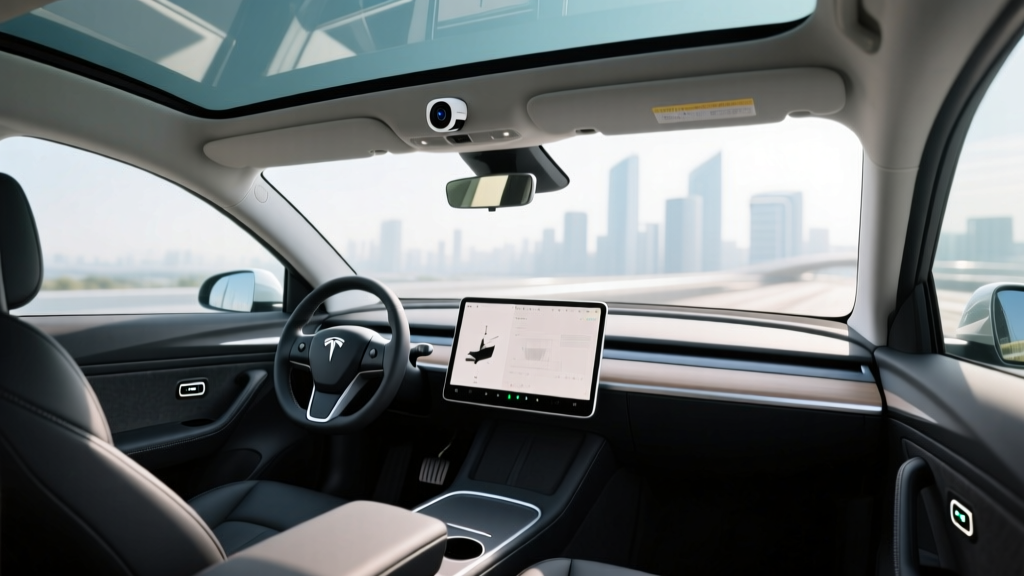
The cabin camera in the 2026 Model Y is mounted at the top of the windshield, just above the rearview mirror housing. It serves three distinct functions:
- Driver Monitoring (Autopilot/FSD Supervised): When Basic Autopilot or Full Self-Driving (Supervised) is engaged, the camera tracks your eye gaze and head position to verify attentiveness. If you look away from the road for too long, the system issues escalating alerts — chime, then visual warning, then autosteer disengagement with a "strike" logged against your profile. This is a SAE Level 2 system, meaning the driver must remain fully engaged at all times.
- Sentry Mode Cabin View: When Sentry Mode is active (parked, locked), the cabin camera can record interior footage if a break-in or disturbance is detected. This footage is saved to the USB drive or Tesla's glovebox storage and viewable via the Tesla app. Starting with 2025 software updates, Tesla added the ability to livestream the cabin camera remotely through the app when Sentry Mode triggers — a significant anti-theft feature.
- Dashcam (Interior): Owners can enable continuous interior dashcam recording, which saves rolling clips alongside exterior camera footage. Useful for rideshare drivers, parents of teen drivers, or fleet operators.
2026 Tesla Model Y: Core Specifications
| Spec | Long Range RWD | Long Range AWD | Performance AWD |
|---|---|---|---|
| EPA Range | 320 mi | 300 mi | 277 mi |
| Battery (Usable) | ~75 kWh (NMC) | ~75 kWh (NMC) | ~75 kWh (NMC) |
| Drivetrain | Rear-Wheel Drive | Dual-Motor AWD | Dual-Motor AWD |
| Horsepower | 346 hp | 384 hp | 456 hp |
| 0–60 mph | 5.8 sec | 4.8 sec | 3.5 sec |
| Max DC Fast Charge | 250 kW | 250 kW | 250 kW |
| 10–80% DCFC Time | ~24 min | ~24 min | ~24 min |
| Level 2 Home Charging | 11.5 kW (~44 mi/hr) | 11.5 kW (~44 mi/hr) | 11.5 kW (~44 mi/hr) |
| MPGe (Combined) | 123 MPGe | 115 MPGe | 111 MPGe |
| Efficiency | 27 kWh/100 mi | 29 kWh/100 mi | 30 kWh/100 mi |
| Base MSRP | $44,990 | $47,990 | $52,990 |
| Battery Warranty | 8 years / 120,000 miles (70% capacity retention) | ||
Source: fueleconomy.gov, Tesla.com specifications. Pricing reflects 2026 model-year MSRPs before destination fees.
Real-World Range vs. EPA Estimates
The Juniper refresh improved thermal management with a more efficient heat pump and revised battery preconditioning algorithm. On a DC fast-charging road trip, the car now begins warming the battery earlier when a Supercharger is set as your navigation destination, which helps sustain peak charge rates even in cooler weather. That said, the 75 kWh NMC pack is smaller than the Hyundai Ioniq 5's 84 kWh unit, so the Model Y relies heavily on its aerodynamic efficiency (0.23 Cd) and lightweight platform to achieve its range.
Charging Speed: DC Fast and Home Level 2
| Charging Level | Power | Speed (Approx.) | Notes |
|---|---|---|---|
| Level 1 (120V) | 1.4 kW | ~5 mi/hr | Emergency/trickle only |
| Level 2 (240V, 48A) | 11.5 kW | ~44 mi/hr | Full charge in ~7.5 hrs |
| DC Fast (Peak) | 250 kW | ~1,000 mi/hr (peak) | Sustains ~180 kW avg to 50% |
| DC Fast (10–80%) | — | ~24 minutes | Tapers sharply above 80% SoC |
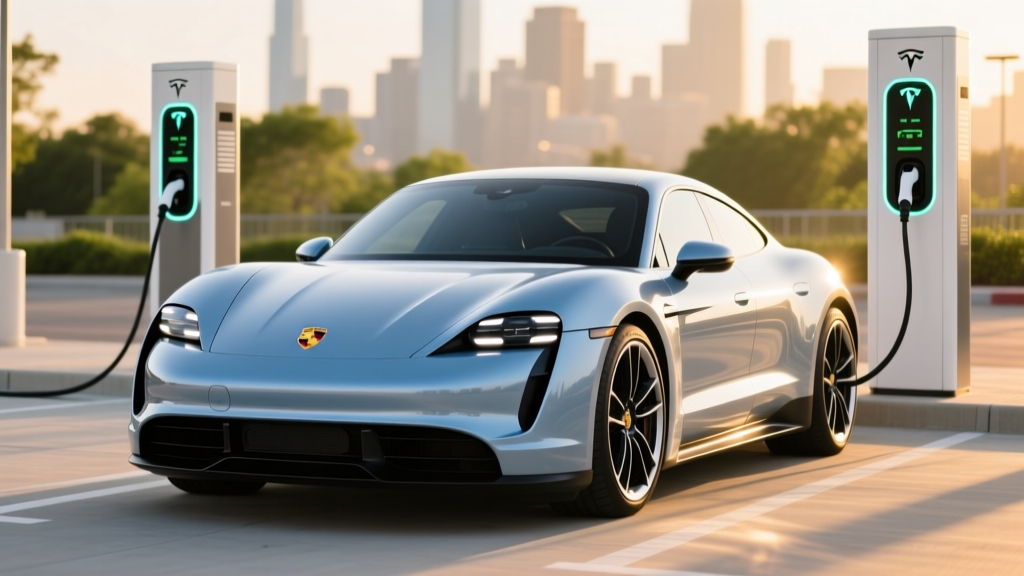
At a V3 or V4 Tesla Supercharger (250 kW capable), the Model Y Juniper peaks around 250 kW at low states of charge (10–20%) and sustains above 150 kW through approximately 55% SoC. The charge curve then tapers progressively: by 80%, you're typically seeing 60–80 kW. This means a 10–80% session takes roughly 24 minutes in optimal conditions (warm battery, preconditioned). In cold weather without adequate preconditioning, expect 30–35 minutes for the same session.
For home charging, a Tesla Wall Connector on a 60-amp circuit delivers the full 11.5 kW (48 amps continuous). That's roughly 44 miles of range per hour of charging, or a full overnight replenishment for most daily commutes. A NACS-to-CCS adapter (included with 2026 models) also lets you use Electrify America, EVgo, and other non-Tesla DC networks — though Supercharger reliability remains the gold standard.
Performance and Driving Dynamics
The Performance AWD trim hits 60 mph in 3.5 seconds with 456 hp — genuinely sports-car acceleration in a crossover. The Long Range AWD's 4.8-second run is more than adequate for highway merging and passing. All trims feature Tesla's low center of gravity from the under-floor battery pack, yielding flat cornering with minimal body roll.
Ride quality in the Juniper generation is noticeably improved over the pre-2025 Model Y, with revised damping, acoustic glass, and additional sound deadening. The cabin is significantly quieter at highway speeds. The adaptive cruise and lane-centering (Basic Autopilot, included standard) remain among the smoothest Level 2 systems available, though GM's Super Cruise still holds an edge on pre-mapped divided highways for hands-free operation.
Interior, Cargo, and Technology
The Juniper interior is minimalist but functional. Key dimensions:
- Front legroom: 41.8 inches
- Rear legroom: 41.6 inches (improved over pre-2025)
- Cargo (rear seats up): 30.2 cu ft
- Cargo (rear seats folded): 72.1 cu ft
- Front trunk (frunk): 4.1 cu ft
- Display: 15.4-inch center touchscreen (front); 8-inch rear touchscreen (new for Juniper)
The rear touchscreen is a standout addition — it controls climate, seat heaters, and media for rear passengers, eliminating the previous frustration of reaching forward to adjust settings. Ventilated front seats, ambient lighting, and power-folding second-row seats are now standard across all trims.
Infotainment runs on Tesla's proprietary OS with native streaming (Netflix, YouTube, Spotify), a full web browser, and gaming capability while parked. There is no Apple CarPlay or Android Auto — a dealbreaker for some buyers accustomed to phone projection. Navigation is excellent, with real-time Supercharger availability and automatic route planning that includes charging stops on long trips.
Pricing, Trims, and Federal Tax Credit Eligibility
| Trim | Base MSRP | Destination | Est. After §30D Credit |
|---|---|---|---|
| Long Range RWD | $44,990 | $1,390 | ~$38,880* |
| Long Range AWD | $47,990 | $1,390 | ~$41,880* |
| Performance AWD | $52,990 | $1,390 | ~$46,880* |
*Estimated prices assume full $7,500 §30D federal tax credit eligibility. See checklist below.
- ✔ MSRP must be at or below $80,000 for SUVs (all Model Y trims qualify)
- ✔ Buyer modified AGI must not exceed $150,000 (single) / $300,000 (joint)
- ✔ Vehicle must meet critical-mineral and battery-component sourcing requirements (Tesla has sourced compliant supply chains for 2026 US-built Model Y units, but verify VIN eligibility at fueleconomy.gov)
- ✔ Credit can be transferred to the dealer at point of sale as a purchase-price reduction (new for 2024+, still active in 2026)
Always confirm eligibility with your tax professional and check the specific VIN against the IRS/Fuel Economy portal before purchase, as battery-sourcing compliance can shift with supply-chain changes.
Pros and Cons
- Class-leading efficiency (27 kWh/100 mi LR RWD)
- Supercharger network access — most reliable DC charging in the US
- Excellent cargo space (72.1 cu ft max)
- Over-the-air updates continuously add features
- Cabin camera adds Sentry Mode security + driver monitoring
- Strong resale value relative to EV segment
- No Apple CarPlay or Android Auto
- FSD (Supervised) costs $8,000 extra — still Level 2, not autonomous
- Rear visibility is limited; relies heavily on camera/sensors
- Insurance costs above segment average
- Ride still firm on rough pavement vs. Ioniq 5
- Minimalist interior not for everyone (no physical buttons)
Who Should Buy the 2026 Tesla Model Y?
- You road-trip frequently and value Supercharger network reliability
- You want maximum cargo versatility in a midsize EV crossover
- You prefer OTA software updates that add real features over time
- You use Sentry Mode for vehicle security in urban environments
- You need Apple CarPlay/Android Auto (Hyundai Ioniq 5, Kia EV6)
- You want hands-free Level 2 driving on highways (GM Super Cruise on Cadillac Lyriq, Ford BlueCruise on Mach-E)
- You prioritize ride comfort over sportiness (Ioniq 5, EV6)
Frequently Asked Questions
Can the camera inside Tesla record me without my knowledge?
By default, the cabin camera only activates for driver monitoring when Autopilot/FSD is engaged, or when Sentry Mode triggers an alert while parked. Continuous interior dashcam recording must be manually enabled. You can disable the cabin camera entirely in vehicle settings. Tesla states footage is stored locally unless you explicitly share it.
How fast does the 2026 Model Y charge on a road trip?
At a 250 kW V3/V4 Supercharger, the Model Y charges from 10–80% in approximately 24 minutes under optimal conditions (preconditioned battery, moderate temperatures). Cold weather or a cold-soaked battery can extend this to 30–35 minutes. The charge curve tapers sharply above 80%, so it's efficient to charge only to 80% and move on.
Does the 2026 Model Y qualify for the $7,500 federal tax credit?
All 2026 Model Y trims fall under the $80,000 SUV MSRP cap. Eligibility depends on buyer income limits ($150K single / $300K joint AGI), battery-sourcing compliance, and US assembly. Tesla's US-built Model Y has generally met sourcing requirements, but always verify your specific VIN at fueleconomy.gov and consult a tax professional.
What is the real-world range of the Model Y Long Range AWD?
The EPA rates it at 300 miles. Expect roughly 265–280 miles in real-world highway driving at 70+ mph, and 220–245 miles in freezing temperatures. City driving with regenerative braking can yield 290–310 miles. The heat pump helps mitigate cold-weather losses compared to resistive heating.
Is the Model Y worth buying over the Ioniq 5 or EV6?
The Model Y wins on Supercharger access, cargo space, and software. The Ioniq 5 and EV6 win on 800V charging architecture (faster 10–80% times on compatible chargers), ride comfort, and CarPlay support. If road-trip charging reliability is your top priority, Tesla's ecosystem remains the strongest. If daily comfort and phone integration matter more, the Korean competitors are compelling.
What warranty covers the Model Y battery?
Tesla covers the battery and drive unit for 8 years or 120,000 miles (whichever comes first), with a guaranteed minimum 70% capacity retention. This is competitive with the segment standard, though some competitors like Hyundai offer 10-year/100,000-mile battery warranties.