Search "bullet proof tesla" and you'll find forums full of owners claiming their Model 3 or Model Y has crossed 100,000 miles with minimal issues. The phrase has become shorthand for an electric vehicle that simply works — day in, day out, with predictable range, reliable charging, and software that keeps improving. But does the refreshed 2026 Tesla Model Y actually earn that reputation, or is the internet conflating survivorship bias with engineering durability?
After extensive analysis of EPA data, owner reports, and Tesla's current specifications, we're putting the latest Model Y through a comprehensive ownership lens. This isn't a track test or a drag-strip comparison. This is about whether the Model Y can serve as a dependable, low-drama daily driver — the EV equivalent of a Camry that just happens to do 0-60 in under five seconds.
2026 Tesla Model Y: Core Specifications at a Glance
| Specification | Long Range AWD | Performance |
|---|---|---|
| EPA Range | 320 miles | 285 miles |
| Battery Capacity (usable) | ~75 kWh (NMC) | ~75 kWh (NMC) |
| Drivetrain | Dual-Motor AWD | Dual-Motor AWD |
| Horsepower | 384 hp | 456 hp |
| 0-60 mph | 4.8 seconds | 3.5 seconds |
| Max DC Fast Charge | 250 kW | 250 kW |
| 10-80% DC Charge Time | ~27 minutes | ~27 minutes |
| Level 2 Home Charge Rate | 11.5 kW (~44 mi/hr) | 11.5 kW (~44 mi/hr) |
| MPGe (combined) | 122 MPGe | 111 MPGe |
| Efficiency | 27 kWh/100 mi | 30 kWh/100 mi |
| Cargo Volume (rear seats up) | 30.2 cu ft | 30.2 cu ft |
| Cargo Volume (rear seats folded) | 72.1 cu ft | 72.1 cu ft |
| Base MSRP | $44,990 | $51,490 |
| Battery Warranty | 8 yr / 120,000 mi | 8 yr / 120,000 mi |
Real-World Range: What the EPA Sticker Doesn't Tell You
EPA Estimate: 320 miles (Long Range AWD)
Real-World Highway (70 mph, mild weather): ~265-280 miles
Real-World City/Mixed Commuting: ~290-310 miles
Cold Weather (below 30°F, highway): ~210-240 miles
The Model Y's heat pump helps mitigate winter range loss compared to resistive heating systems, but expect 20-30% reduction in freezing conditions, especially at sustained highway speeds.
The 320-mile EPA figure for the Long Range AWD is legitimate and verified by fueleconomy.gov. However, EPA range tests use a mix of city and highway driving cycles at moderate speeds with climate control off. In practice, sustained 75-80 mph highway driving — where most road trips actually happen — pushes consumption closer to 30-32 kWh/100 miles, dropping effective range to roughly 265-280 miles in fair weather.
Cold weather is the equalizer for every EV, and the Model Y is no exception. Tesla's heat pump system is among the better thermal management setups on the market, pulling ambient heat rather than relying solely on resistive elements. Even so, sub-freezing temperatures combined with highway speeds will cost you 20-30% of your range. A 320-mile sticker becomes roughly 220-240 miles of practical range on a January road trip through the Rockies. Preconditioning the battery while plugged in before departure helps, and the Model Y's navigation system will automatically warm the battery when it detects you're routing to a Supercharger.
Charging Speed: Supercharger Network Advantage
Tesla's charging ecosystem remains a significant ownership differentiator. The Model Y supports up to 250 kW peak DC fast charging at V3 and V4 Superchargers, though it's critical to understand that peak rate is not sustained rate.
| Charging Level | Power | Miles Added per Hour | Notes |
|---|---|---|---|
| Level 1 (120V outlet) | ~1.4 kW | ~5-6 mi/hr | Emergency/trickle only |
| Level 2 (240V, 48A) | 11.5 kW | ~44 mi/hr | Home Wall Connector |
| Level 2 (240V, 32A) | 7.7 kW | ~30 mi/hr | Mobile Connector, NEMA 14-50 |
| DC Fast (Supercharger V3/V4) | Up to 250 kW | ~162 mi in 15 min | Peak rate, tapers above 60% |
| DC Fast (CCS adapter, 3rd party) | Up to 250 kW | Varies by station | Requires Tesla CCS adapter |
The 10-80% charge time of approximately 27 minutes assumes you arrive at the charger with a warm battery (the car preconditions automatically when navigating to a Supercharger) and a functioning V3 or V4 stall. The charge curve is aggressive: the Model Y pulls close to 250 kW from roughly 10-30% state of charge, then progressively tapers. By 60% SoC, you're seeing roughly 120-140 kW, and above 80% it drops sharply to protect battery longevity. This is standard lithium-ion behavior, not a Tesla limitation specifically.
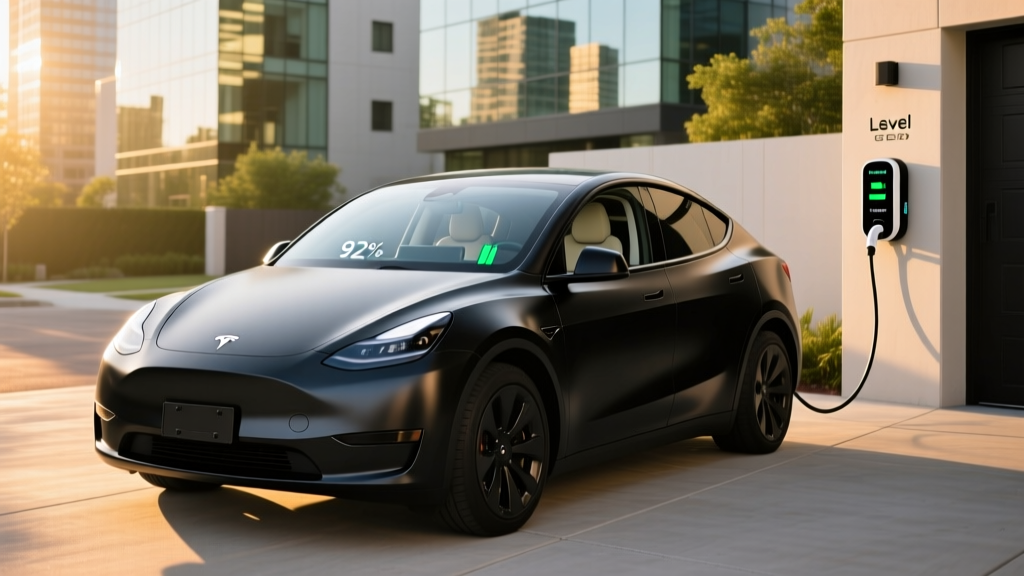
At home, the Tesla Wall Connector on a 60-amp circuit delivers 11.5 kW (48 amps), adding roughly 44 miles of range per hour. An overnight charge from 20% to 80% takes about 4-5 hours — more than sufficient for daily driving. If your electrical panel only supports a 40-amp circuit, you'll get 7.7 kW (~30 mi/hr), which still covers most daily needs but requires longer plug-in times for road-trip recovery.
Since Tesla opened the Supercharger network to non-Tesla EVs via NACS, station congestion has increased at some popular corridors. However, Tesla owners still benefit from seamless plug-and-charge integration — no app fumbling or payment cards required. The car handles authentication and billing automatically.
Performance and Drivetrain: Quick Enough for Anyone
The Long Range AWD's 384 horsepower and 4.8-second 0-60 time place it firmly in "more than adequate" territory. This isn't a performance vehicle, but it will merge onto highways, pass on two-lane roads, and handle mountain grades without any sense of strain. The dual-motor AWD system provides confident traction in rain and light snow, with torque vectoring that feels natural rather than intrusive.
The Performance trim's 456 hp and 3.5-second sprint are genuinely fast by any measure, but the trade-off is 35 fewer miles of EPA range and a firmer ride quality that some daily commuters find fatiguing over rough pavement. For most buyers evaluating a "bullet proof" daily driver, the Long Range is the rational pick.
One-pedal driving via regenerative braking is well-calibrated in the Model Y. Tesla removed the driver-adjustable regen strength setting in recent model years, defaulting to strong regen that brings the car to a near-stop when you lift off the accelerator. Most owners adapt within a week and prefer it, but if you're coming from a vehicle with coasting behavior, expect a learning curve.
Interior Space, Tech, and Daily Livability
The refreshed Model Y interior addresses several longstanding complaints. Materials quality has improved with softer-touch surfaces, ventilated front seats are now standard on Long Range and Performance trims, and ambient lighting replaces the previous generation's stark minimalism. The 15.4-inch center touchscreen remains the command hub for virtually all vehicle functions — climate, navigation, media, vehicle settings, and even the glovebox release.
Passenger space is competitive for the compact electric SUV segment:
- Front legroom: 41.8 inches
- Rear legroom: 38.5 inches (improved over pre-refresh)
- Rear headroom: 39.0 inches
- Cargo (seats up): 30.2 cu ft
- Cargo (seats folded): 72.1 cu ft
- Front trunk (frunk): 4.1 cu ft
The rear seat is genuinely usable for adults on longer trips, not just a penalty box for children. The 8-inch rear touchscreen gives back-seat passengers climate and media control, reducing front-seat distraction. A panoramic glass roof creates an airy cabin but does increase solar heat gain in summer — the included tint helps, but some owners in hot climates add aftermarket ceramic film.
On the technology front, Tesla's infotainment system remains the segment benchmark for responsiveness and over-the-air update frequency. Navigation is excellent, with real-time Supercharger availability and automatic route planning that includes charging stops. The phone-as-key system works reliably via Bluetooth, and the Tesla app provides remote climate control, charge monitoring, and vehicle location.
Driver Assistance: Autopilot and FSD Supervised
Tesla Autopilot and Full Self-Driving (Supervised) are Level 2 driver-assistance systems. The driver must remain fully engaged, hands on or near the wheel, eyes on the road, and ready to take over at any moment. These systems are not self-driving. They do not make the vehicle autonomous.
Standard Autopilot includes Traffic-Aware Cruise Control and Autosteer (lane centering) and is included with every Model Y at no extra cost. It works well on clearly marked highways and reduces fatigue on long drives.
Full Self-Driving (Supervised), available as an $8,000 add-on or $99/month subscription, adds automatic lane changes, intersection handling, and city-street navigation. As of 2026, FSD has improved substantially in urban environments, but it still makes errors — particularly at complex intersections, construction zones, and unusual road geometries. It requires constant supervision. For buyers evaluating a "bullet proof" ownership experience, the standard Autopilot is the lower-drama choice; FSD adds capability but also adds situations where you'll need to intervene.
Pricing, Tax Credits, and Total Cost
| Trim | Base MSRP | Destination | As-Tested Range | Federal Credit Eligibility |
|---|---|---|---|---|
| Long Range AWD | $44,990 | $1,390 | $46,380 - $55,000+ | Eligible (up to $7,500)* |
| Performance | $51,490 | $1,390 | $52,880 - $62,000+ | Eligible (up to $7,500)* |
*Federal EV tax credit eligibility under IRS §30D is subject to multiple requirements. The Model Y qualifies as an SUV under the $80,000 MSRP cap. However, the full $7,500 credit depends on battery critical-mineral sourcing and component manufacturing requirements that shift annually. Buyer income caps also apply: $300,000 joint / $225,000 head of household / $150,000 individual modified AGI. As of 2026, the credit can be transferred to the dealer at point of sale, reducing your purchase price directly. Consult a tax professional and check the latest IRS guidance before purchasing.
With the full $7,500 credit applied at point of sale, a Long Range AWD starts at roughly $38,880 — positioning it against the Hyundai Ioniq 5 ($42,400 base), Ford Mustang Mach-E ($42,995 base), and Chevrolet Equinox EV ($33,600 base, but with less range and slower charging).
Insurance costs for the Model Y tend to run 15-25% higher than comparable gas-powered SUVs, reflecting repair costs for aluminum body panels and sensor-dense bumpers. Expect annual premiums in the $1,800-$2,800 range depending on your location, driving record, and coverage level. Tesla offers its own insurance product in many states, which uses real-time driving data to set rates — safe drivers may save, but aggressive braking or frequent Autopilot disengagements can increase premiums.
Warranty and Long-Term Battery Durability
Tesla covers the Model Y's battery and drive units for 8 years or 120,000 miles, whichever comes first, with a minimum 70% capacity retention threshold. The basic vehicle limited warranty is 4 years or 50,000 miles.
The "bullet proof" reputation partly rests on Tesla's battery longevity data. NMC (nickel manganese cobalt) chemistry in the Long Range and Performance trims has demonstrated roughly 10-12% degradation over 100,000 miles in fleet and owner-reported data. That means a 320-mile Model Y might realistically deliver 280-290 miles of range at the 100,000-mile mark — still well within daily usability for most owners.
Tesla's thermal management system actively heats and cools the battery pack to maintain optimal temperature, which is a key factor in long-term cell health. Best practices for longevity include:
- Charging to 80% for daily use (the car's scheduled departure feature automates this)
- Avoiding prolonged periods at 100% state of charge
- Minimizing frequent DC fast charging when Level 2 is available
- Keeping the vehicle plugged in during extreme heat or cold so the thermal system can manage battery temperature
Out-of-warranty battery replacement costs remain significant — roughly $12,000-$16,000 for a Model Y pack based on current service center estimates. However, the failure rate within the warranty period appears low based on available owner data, and Tesla typically replaces individual modules rather than the entire pack when isolated cell degradation occurs.
Pros, Cons, and Who Should Buy
- 320-mile EPA range covers most daily and road-trip needs
- Supercharger network reliability and plug-and-charge ease
- 250 kW DC fast charging, ~27 min 10-80%
- Spacious cargo area (72.1 cu ft) and usable rear seat
- Continuous OTA software improvements
- Strong battery warranty (8yr/120,000mi)
- Federal tax credit eligible, bringing effective price under $40K
- Higher insurance premiums than gas SUV competitors
- FSD ($8,000) is optional and still requires full driver supervision
- Ride quality can be firm on rough pavement (especially Performance)
- No Apple CarPlay or Android Auto — Tesla's ecosystem only
- Increasing Supercharger congestion as network opens to non-Tesla EVs
- Repair costs for collision damage can be high
- Minimal physical controls — everything runs through the touchscreen
Best suited for: Daily commuters with home charging access, families needing cargo flexibility, road-trippers willing to plan around Supercharger stops, and tech-forward buyers who value OTA updates over traditional dealership service. The Model Y is less ideal for buyers in rural areas far from Supercharger corridors, those who prefer physical buttons and CarPlay integration, or anyone expecting Level 4 autonomy from FSD.
Frequently Asked Questions
What is the real-world range of the 2026 Tesla Model Y?
The EPA rates the Long Range AWD at 320 miles. In real-world mixed driving, expect 290-310 miles. Sustained highway driving at 75+ mph drops this to roughly 265-280 miles, and cold weather (below 30°F) can reduce range to 210-240 miles depending on conditions.
How fast does the Model Y charge at home and on the road?
On a Tesla Wall Connector (Level 2, 11.5 kW), the Model Y adds about 44 miles of range per hour — a full overnight session replenishes most daily driving. At a V3/V4 Supercharger (DC fast, up to 250 kW), a 10-80% charge takes approximately 27 minutes under optimal conditions with a preconditioned battery.
How much does the Model Y cost after federal tax credits?
The Long Range AWD starts at $44,990 plus $1,390 destination. With the full $7,500 federal tax credit applied at point of sale, the effective price drops to roughly $38,880. Eligibility requires meeting IRS income caps ($150K individual / $300K joint MAGI) and the vehicle must meet battery sourcing requirements. Always verify current rules at irs.gov.
Does the Tesla Model Y qualify for the $7,500 federal EV tax credit?
Yes, the Model Y qualifies under the SUV MSRP cap of $80,000. However, the actual credit amount ($3,750 or $7,500) depends on battery critical-mineral and component sourcing requirements that change annually. Buyer income limits also apply. The credit can be transferred at point of sale as of 2024 onward, reducing your out-of-pocket cost directly.
Is the Model Y worth buying vs. the Hyundai Ioniq 5 or Ford Mach-E?
The Model Y wins on Supercharger network access, charging speed integration, and cargo space. The Ioniq 5 offers 800V architecture (faster peak charging at compatible stations), a more conventional interior with physical controls, and Apple CarPlay. The Mach-E provides a more traditional driving feel and Ford dealership service. If Supercharger reliability and Tesla's software ecosystem matter most, the Model Y remains the default choice. If you prefer CarPlay, physical buttons, or non-Tesla dealer service, the Ioniq 5 and Mach-E are strong alternatives.
Is the Tesla Model Y actually "bullet proof" in terms of reliability?
The powertrain and battery have demonstrated strong longevity in owner-reported data, with 10-12% battery degradation at 100,000 miles being typical. However, "bullet proof" overstates it — Tesla's build quality inconsistencies (panel gaps, trim rattles) and higher collision repair costs are real ownership considerations. The car is highly reliable mechanically and electronically, but cosmetic and body-related issues remain more common than with legacy automakers at this price point.