The Tesla Model Y remains one of the most popular electric vehicles in the U.S. market, and for good reason: it combines strong range, fast charging, and practical cargo space in a crossover package. But when buyers search for "Tesla boot" capacity, they're often looking for real-world answers about how much gear this EV actually holds—and whether the numbers translate to family road trips, airport runs, or weekend adventures.
This 2026 review covers the Model Y's cargo versatility alongside the specs that matter most: EPA range, charging speed, battery chemistry, and total ownership cost. We'll separate marketing claims from owner reality.
Tesla Model Y Boot Space and Cargo Practicality
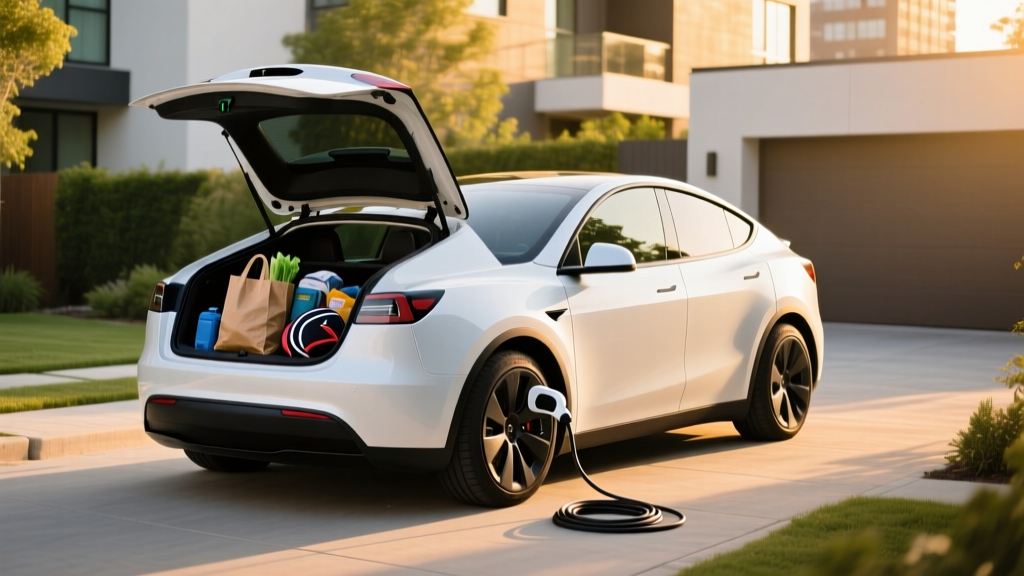
The Model Y's hatchback design gives it a significant cargo advantage over sedan alternatives like the Model 3. Here's how the space breaks down:
- Behind second row: 30.2 cubic feet (all seats up)
- Maximum cargo volume: 76.2 cubic feet (rear seats folded)
- Front trunk (frunk): 4.1 cubic feet—enough for a charging cable bag or small duffel
- Rear legroom: 41.6 inches
- Front headroom: 41.0 inches
- Rear headroom: 39.4 inches
The 76.2 cu ft maximum puts the Model Y ahead of the Ford Mustang Mach-E (59.7 cu ft) and Hyundai Ioniq 5 (56.2 cu ft) in raw volume. The wide, flat load floor accommodates full-size suitcases, strollers, or camping gear without the wheel-well intrusion you'd find in some competitors.
Real-world limitation: The sloping roofline cuts into vertical space for tall items. A large dog crate fits, but you'll need to measure carefully. The rear seats fold 60/40, allowing long items like skis or lumber while preserving one rear passenger seat.
EPA Range and Real-World Expectations
EPA Estimated: 320 miles (Long Range AWD)
Real-World Highway: Expect 260-280 miles at 70-75 mph
Cold Weather (below 32°F): 220-250 miles with cabin heating
City/Regen-Heavy Driving: 290-310 miles
The 2026 Model Y Long Range AWD carries a 78.1 kWh usable battery (NMC chemistry), delivering an EPA-rated 320 miles. But EPA tests don't reflect sustained highway speeds or winter conditions.
On a 300-mile road trip at 75 mph with mild temperatures, expect to arrive with 40-60 miles of buffer—meaning one DC fast-charge stop is necessary. In winter, that same trip requires earlier charging or a slower pace. The Model Y's heat pump (standard since 2021) reduces cold-weather range loss compared to resistive heating, but you'll still see 20-30% reduction in sub-freezing temps.
The base Rear-Wheel Drive trim uses a 60 kWh LFP (lithium iron phosphate) battery with a 260-mile EPA rating. LFP chemistry allows regular 100% charging without degradation concerns, but range is lower and cold-weather performance suffers more than NMC.
Charging Speed: DC Fast and Home Level 2
| Charging Method | Power | Speed | Notes |
|---|---|---|---|
| DC Fast Charge (Peak) | 250 kW | ~10-80% in 27 min | Sustained 250 kW only to ~50% SoC |
| DC Fast Charge (Average) | ~170 kW | ~180 miles in 15 min | Real-world average across curve |
| Level 2 Home (48A) | 11.5 kW | ~44 miles/hour | Full charge in ~7 hours |
| Level 2 Home (32A) | 7.7 kW | ~30 miles/hour | Common for 40A circuit |
| Tesla Supercharger V4 | 250-350 kW | Faster at V4 stalls | Availability varies by location |
The Model Y's 250 kW peak DC fast-charge rate sounds impressive, but peak ≠ sustained. The charging curve peaks around 250 kW only between 10-50% state of charge, then tapers to 150 kW, then 100 kW, then slower still above 80%. That's why the 10-80% time is 27 minutes, not the theoretical 18 minutes you'd get at sustained peak rate.
For home charging, Tesla's Wall Connector at 48 amps adds 44 miles per hour—enough to fully replenish overnight on a 240V/60A circuit. Most owners charging from 20% to 80% wake up with a full battery. Installation costs $500-$1,500 depending on panel proximity and local permitting, plus $475 for the Wall Connector itself.
The Model Y uses the NACS (North American Charging Standard) connector natively. With Tesla opening Superchargers to other brands, you'll see non-Teslas at Supercharger stalls, but Tesla owners still benefit from the largest reliable DC network in the U.S.
Performance and Drivetrain
| Trim | 0-60 mph | Horsepower | Drivetrain | Base MSRP |
|---|---|---|---|---|
| Rear-Wheel Drive | 6.6 sec | 295 hp | RWD (single motor) | $44,990 |
| Long Range AWD | 4.8 sec | 384 hp | Dual-motor AWD | $49,990 |
| Performance | 3.5 sec | 456 hp | Dual-motor AWD | $54,990 |
The Long Range AWD hits the sweet spot: 4.8-second 0-60, dual-motor traction for snow/rain, and 320 miles of range. The Performance trim drops 0-60 to 3.5 seconds but sacrifices 15 miles of EPA range (305 miles) and rides firmer—noticeable on rough pavement.
All trims include Tesla's regenerative braking with one-pedal driving capability. The Model Y's efficiency lands at 122 MPGe combined (Long Range AWD), or 28 kWh per 100 miles—among the best in its class.
Federal Tax Credit and Pricing Reality
Maximum Credit: $7,500 (if all requirements met)
MSRP Cap: Vans/SUVs/pickups ≤$80,000 (Model Y qualifies)
Buyer Income Cap: $150K single / $225K head of household / $300K joint
Battery Sourcing: Critical minerals + battery components must meet % thresholds from U.S./FTA partners
Point-of-Sale: Credit can transfer to dealer at purchase (reduces upfront cost)
The Model Y Long Range AWD starts at $49,990. If you meet income limits and the vehicle's battery sourcing qualifies for the full $7,500 credit, your effective price drops to $42,490. But here's the catch: battery component and critical mineral sourcing requirements tighten annually. As of 2026, a significant percentage must come from the U.S. or free-trade-agreement countries, and any "foreign entity of concern" content disqualifies the credit entirely.
Check the current eligibility on IRS.gov before purchasing. The point-of-sale transfer option (available since 2024) lets you apply the credit as a down payment reduction rather than waiting for tax filing—useful if you don't have $7,500 in tax liability to offset.
| Trim | MSRP | Est. with $7,500 Credit | Destination |
|---|---|---|---|
| RWD | $44,990 | $37,490 | $1,390 |
| Long Range AWD | $49,990 | $42,490 | $1,390 |
| Performance | $54,990 | $47,490 | $1,390 |
Technology, Driver Assists, and Notable Drawbacks
The Model Y's 15.4-inch touchscreen handles everything: navigation, climate, media, vehicle settings. There's no instrument cluster—speed and range appear in the upper-left corner of the main display. This minimalist approach divides buyers: some love the clean aesthetic, others miss redundant physical controls.
Autopilot (standard): SAE Level 2 driver assistance with adaptive cruise and lane-centering. Requires hands on wheel and active supervision. This is not self-driving.
Full Self-Driving (Supervised): $8,000 option (or $99/month) adds automatic lane changes, traffic light/stop sign recognition, and Navigate on Autopilot. Still SAE Level 2—you must remain engaged. Tesla's FSD beta has improved, but NHTSA investigations into Autopilot crashes remind us this is assistive tech, not autonomy.
Drawbacks:
- No Apple CarPlay or Android Auto—Tesla's native interface only
- Rear visibility compromised by thick C-pillars and small rear window
- Panel gap quality inconsistent (improving but still a complaint)
- Insurance costs 20-40% higher than comparable gas crossovers
- Service center wait times can stretch weeks in high-volume markets
Warranty and Long-Term Ownership
Tesla's warranty covers:
- Basic vehicle: 4 years / 50,000 miles
- Battery & drive unit: 8 years / 120,000 miles (Long Range/Performance) or 8 years / 100,000 miles (RWD)
- Battery retention: Tesla warrants 70% minimum capacity over the warranty period
Real-world degradation data shows Model Y batteries (NMC) typically lose 8-12% capacity over 100,000 miles, with most loss occurring in the first 20,000 miles. LFP batteries in the RWD trim degrade slower but start with less range. Battery replacement outside warranty runs $12,000-$16,000—rare but not impossible.
Who Should Buy the Tesla Model Y?
Choose the Model Y if:
- You need maximum cargo versatility (76 cu ft boot) with strong range
- You have home charging access and want overnight convenience
- You value Supercharger network reliability for road trips
- You want fast acceleration (4.8 sec 0-60 in Long Range) without sacrificing practicality
- You qualify for the $7,500 federal credit, bringing effective price below $43K
Consider competitors if:
- You prefer physical buttons and traditional interfaces (Hyundai Ioniq 5, Kia EV6)
- You need third-row seating (Kia EV9, though it costs more)
- You want Apple CarPlay/Android Auto integration
- You're in a Tesla service-desert area with long wait times
Frequently Asked Questions
What is the real-world range of the Tesla Model Y?
EPA rates the Long Range AWD at 320 miles, but expect 260-280 miles on highway road trips at 75 mph, and 220-250 miles in cold weather below freezing. City driving with regenerative braking can approach 300 miles.
How fast does the Model Y charge at home and on the road?
DC fast charging peaks at 250 kW, delivering 10-80% in about 27 minutes (averaging ~170 kW across the curve). Home Level 2 at 48 amps adds 44 miles per hour, fully charging overnight. Slower 32A Level 2 adds 30 miles/hour.
Does the Tesla Model Y qualify for the $7,500 federal tax credit?
The Model Y's MSRP falls under the $80,000 SUV cap, so it can qualify. But you must also meet income limits ($150K single / $300K joint) and the vehicle's battery must satisfy critical-mineral and component sourcing rules. Check current eligibility at IRS.gov before purchase.
Is the Model Y worth it vs. the Ford Mustang Mach-E or Hyundai Ioniq 5?
The Model Y wins on cargo space (76 vs. 60 cu ft), Supercharger access, and efficiency (122 MPGe). The Mach-E and Ioniq 5 offer physical controls, CarPlay, and sometimes faster 10-80% charging. If cargo and road-trip charging matter most, Model Y leads. If interface preference or 800V charging speed (Ioniq 5) matters, test-drive competitors.
What are the biggest pros and cons?
Pros: Class-leading cargo space, strong real-world efficiency, Supercharger network, fast acceleration, over-the-air updates, one-pedal driving.
Cons: No CarPlay, minimalist interior not for everyone, insurance costs, service wait times, rear visibility, panel gap inconsistency.
How much boot space does the Tesla Model Y actually have?
30.2 cubic feet behind the second row, expanding to 76.2 cubic feet with rear seats folded. The frunk adds 4.1 cubic feet. This beats the Mach-E (59.7 cu ft max) and Ioniq 5 (56.2 cu ft max) for total cargo volume.