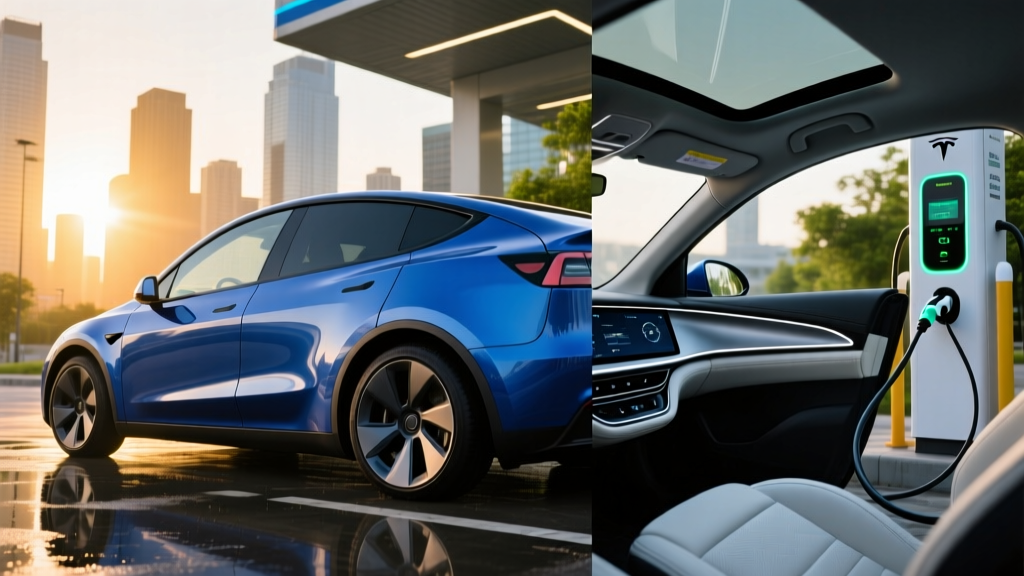
If you've been browsing Tesla's configurator and hovering over the Deep Blue Metallic swatch, you're not alone. Blue is one of the most popular non-free colors on the Model Y, and with the 2025 refresh (internally dubbed "Juniper") carrying into the 2026 model year, there's more to consider than just aesthetics. This review covers the 2026 Tesla Model Y in Deep Blue Metallic — its real-world range, charging behavior, pricing after federal incentives, and how it stacks up against the Hyundai Ioniq 5, Ford Mustang Mach-E, and Kia EV6.
2026 Tesla Model Y Blue: Quick Verdict
The 2026 Model Y Long Range AWD in Deep Blue Metallic remains the default compact electric SUV for buyers who prioritize Supercharger network access, cargo versatility, and over-the-air updates. The Juniper refresh brought a quieter cabin, ventilated front seats, a rear touchscreen, and a slightly larger battery pack. Deep Blue Metallic is a $1,500 multi-coat option that photographs beautifully but shows swirl marks more readily than lighter colors. Mechanically, the blue Model Y is identical to any other exterior color — the same 78.4 kWh usable LFP or NMC pack, the same 250 kW peak DC charge rate, and the same 320-mile EPA rating.
Range, Battery, and Real-World Efficiency
Real-World Expectation: ~270–290 miles mixed highway/city at 65–70 mph; ~230–250 miles in sub-30°F winter driving; ~300+ miles in moderate city commuting with regen.
| Spec | Value |
|---|---|
| EPA Range | 320 miles |
| Battery (usable) | ~78.4 kWh |
| Battery Chemistry | NMC (Long Range AWD); LFP (RWD base) |
| Efficiency | 122 MPGe combined / 27 kWh/100 mi |
| Peak DC Fast Charge | 250 kW (CCS via NACS adapter or native NACS) |
| 10–80% DC Charge Time | ~25 minutes |
| Level 2 Home Charge Rate | 11.5 kW (~44 mi/hr) |
| 0–60 mph | 4.8 seconds |
| Horsepower | 384 hp (dual motor) |
| Drivetrain | AWD, dual motor |
| Cargo (rear seats up) | 30.2 cu ft |
| Cargo (rear seats folded) | 72.0 cu ft |
| Rear Legroom | 40.5 in |
| Battery Warranty | 8 years / 120,000 miles (≥70% retention) |
| Base MSRP | $44,990 (before destination) |
| As-Tested (Blue, no FSD) | $47,990 incl. destination + Deep Blue Metallic |
The Long Range AWD uses a nickel-manganese-cobalt (NMC) cathode, which delivers higher energy density than the LFP pack in the base RWD model. If you opt for the RWD trim (EPA 300 miles, ~$39,990), you'll get an LFP battery that tolerates routine 100% charging — a practical advantage for daily commuters who can charge at home every night. The Long Range NMC pack, by contrast, benefits from an 80–90% daily charge limit for longevity, with 100% reserved for road trips.
According to fueleconomy.gov, the 2026 Model Y LR AWD achieves 122 MPGe combined. In our experience, sustained 75-mph highway driving in 40°F weather with the heat pump running yields roughly 250–260 miles before the low-battery warning — about 20% below the EPA sticker. Preconditioning the battery while plugged in (a feature Tesla enables via scheduled departure) mitigates some of this loss by warming the pack before you drive.
Charging Speed: DC Fast, Level 2, and the Supercharger Advantage
| Level | Power / Rate | Miles Added per Hour |
|---|---|---|
| Level 1 (120V household) | ~1.4 kW | ~4–5 mi/hr |
| Level 2 (240V, 48A Wall Connector) | 11.5 kW | ~44 mi/hr |
| DC Fast (Tesla Supercharger V3/V4) | Peak 250 kW | ~200 mi in 15 min (10–80% ~25 min) |
| DC Fast (CCS station via adapter) | Up to 250 kW (station dependent) | Varies; ~150 mi in 15 min at 150 kW stations |
The Model Y's charge curve is well-mapped by now. At a V3 Supercharger (or a V4 cabinet with a NACS connector), a 2026 Model Y LR peaks near 250 kW between roughly 5% and 25% state of charge, then tapers progressively: ~175 kW by 40%, ~100 kW by 60%, and ~45 kW by 80%. This is why the 10–80% time of ~25 minutes is a more useful metric than peak kW. Above 80%, charging slows dramatically — expect another 20–25 minutes to go from 80% to 100%.
For home charging, Tesla's Gen 2 Wall Connector (hardwired, 60A circuit, 48A continuous) delivers 11.5 kW on the Model Y's onboard charger. That translates to roughly 44 miles of range per hour of charging, or a full 0–100% session in about 7–8 hours. Most owners wake up to a full battery every morning with a Level 2 setup. Installation costs vary widely — budget $500–$2,000 depending on whether your electrical panel needs an upgrade to 200A service.
Deep Blue Metallic: Paint Quality, Cost, and Care
Deep Blue Metallic is a $1,500 premium color on the 2026 Model Y. It's a multi-coat finish with metallic flake that shifts between navy and near-black depending on lighting. Compared to the no-cost Pearl White Multi-Coat, Deep Blue Metallic has a richer visual depth but is more prone to showing:
- Swirl marks and micro-scratches — common on dark metallics, especially from automated car washes. Touchless washes or hand washing are strongly recommended.
- Water spots and dust — more visible than on white or silver.
- Paint thickness variability — Tesla's Fremont and Austin paint shops have improved since 2023, but owners still report occasional orange-peel texture on lower door panels. A paint-depth gauge check at delivery is worthwhile.
If you're set on blue but want a more forgiving finish, consider the aftermarket paint protection film (PPF) route — a full-front PPF application runs $1,500–$2,500 and preserves the finish significantly. Ceramic coating ($800–$1,500) adds hydrophobic properties but doesn't prevent rock chips.
Pricing, Trims, and Federal Tax Credit Eligibility
| Trim | Base MSRP | With Deep Blue + Destination | Est. After §30D Credit |
|---|---|---|---|
| Long Range RWD | $39,990 | $42,740 | ~$35,240 (if eligible) |
| Long Range AWD | $44,990 | $47,740 | ~$40,240 (if eligible) |
| Performance AWD | $48,990 | $51,740 | ~$44,240 (if eligible) |
Under the IRS §30D clean vehicle credit, the Model Y may qualify for up to $7,500 — split into two halves: $3,750 for meeting critical-minerals sourcing requirements and $3,750 for battery-component manufacturing in North America. As of the 2026 model year, Tesla's Austin-built Model Y with U.S.-sourced LFP cells (RWD) has a stronger claim to the full credit than the Long Range AWD with NMC cells, which may only qualify for the $3,750 critical-minerals half depending on supply-chain shifts.
Eligibility requirements (2026):
- MSRP cap: SUVs must be ≤$80,000 (all Model Y trims clear this easily).
- Buyer income cap: Modified AGI ≤$150,000 single / ≤$300,000 joint.
- Battery sourcing: Critical minerals and component thresholds increase annually; verify current-year compliance on the IRS qualified-vehicles list.
- Point-of-sale transfer: You can transfer the credit to the dealer at purchase, reducing your out-of-pocket cost immediately rather than waiting for tax filing.
Tax rules shift frequently. Confirm eligibility on the IRS qualified vehicles list before ordering, and consult a tax professional if your income is near the cap or if you have alternative minimum tax considerations.
Interior, Tech, and Driver Assistance
The Juniper-refreshed Model Y interior is a meaningful step up from the pre-2025 cabin. Key updates include:
- Ambient lighting strip across the dashboard, similar to the refreshed Model 3 Highland.
- Ventilated front seats — a long-requested feature, standard on all trims.
- 8-inch rear touchscreen for rear-seat passengers (climate, media, gaming).
- 15.4-inch front touchscreen with faster Ryzen-based processor and improved responsiveness.
- Acoustic glass on all windows, reducing highway noise by a noticeable margin.
Cargo volume remains best-in-class at 30.2 cu ft behind the second row and 72.0 cu ft with seats folded. The front trunk (frunk) adds roughly 4.1 cu ft — useful for charging cables or a small bag.
Driver Assistance (SAE Level 2 — NOT self-driving):
Autopilot includes Traffic-Aware Cruise Control and Autosteer (lane centering). FSD Supervised adds automatic lane changes, Navigate on Autopilot (highway on-ramp to off-ramp), traffic-light and stop-sign recognition, and Autopark. In practice, FSD Supervised is most useful on highways; city-street performance varies significantly by geography and road-marking quality.
How It Compares: Model Y Blue vs. Key Rivals
| Spec | Tesla Model Y LR AWD | Hyundai Ioniq 5 Limited AWD | Ford Mustang Mach-E ER AWD |
|---|---|---|---|
| EPA Range | 320 mi | 290 mi | 305 mi |
| Battery | 78.4 kWh (NMC) | 84.0 kWh (NMC) | 91.0 kWh (NMC) |
| Peak DC Charge | 250 kW | 240 kW | 150 kW |
| 10–80% Time | ~25 min | ~18 min (800V) | ~38 min |
| 0–60 mph | 4.8 sec | 5.1 sec | 5.5 sec |
| Cargo (rear up) | 30.2 cu ft | 27.2 cu ft | 29.7 cu ft |
| Base MSRP (AWD) | $44,990 | $52,600 | $48,995 |
| Charging Network | Supercharger (native NACS) | CCS + NACS adapter avail. | CCS + NACS adapter avail. |
The Ioniq 5's 800V architecture gives it a faster 10–80% charge time (~18 min vs. ~25 min), but the Model Y's Supercharger network remains more reliable and geographically complete in the U.S. The Mach-E has fallen behind on DC charging speed. For pure cargo space and efficiency, the Model Y still leads.
- Best-in-class cargo volume (72 cu ft max)
- Supercharger network reliability — still the gold standard
- Lowest energy consumption in segment (27 kWh/100 mi)
- Over-the-air updates continuously add features
- Strong resale value relative to non-Tesla EVs
- Deep Blue Metallic shows swirl marks; PPF recommended
- DC charge speed (250 kW peak) trails Ioniq 5's 800V system
- No Apple CarPlay / Android Auto — Tesla-only infotainment
- FSD Supervised remains Level 2 despite the "Full Self-Driving" name
- Rear visibility is compromised by the sloping roofline
Who Should Buy the Blue Model Y?
- You take regular road trips and want the most reliable DC fast-charging network.
- You need SUV cargo space for family gear, camping, or dogs.
- You can install a Level 2 home charger and want to wake up to ~320 miles daily.
- You value OTA updates and a minimal-button interior.
- Fastest possible DC charging is a priority (look at Ioniq 5 / EV6 with 800V).
- You want Apple CarPlay or a more traditional infotainment layout.
- You live in an apartment without home-charging access and rely entirely on public CCS stations.
Frequently Asked Questions
What is the real-world range of the 2026 Model Y Long Range AWD?
The EPA rates it at 320 miles. In mixed highway driving at 65–70 mph and moderate temperatures, expect 270–290 miles. In winter (below 30°F), plan for 230–250 miles unless you precondition the battery while plugged in.
How fast does the Model Y charge at home and on the road?
At home on a 240V / 48A Level 2 Wall Connector, it charges at 11.5 kW — roughly 44 miles of range per hour, or a full charge overnight. On a Tesla V3/V4 Supercharger, it peaks at 250 kW and charges from 10–80% in about 25 minutes.
How much does the blue Model Y cost after the federal tax credit?
A Long Range AWD in Deep Blue Metallic stickers at approximately $47,740 including destination. If you qualify for the full $7,500 §30D credit (income ≤$300k joint, battery sourcing met), the effective price drops to ~$40,240. Verify current eligibility on irs.gov before ordering.
Is the Model Y worth buying over the Ioniq 5 or Mach-E?
For Supercharger access, cargo space, and efficiency, yes. For fastest DC charging and Apple CarPlay, the Ioniq 5 is the stronger pick. The Mach-E has competitive range but lags on charging speed.
Does Deep Blue Metallic cost more than other colors?
Yes. Deep Blue Metallic is a $1,500 premium option. Pearl White Multi-Coat is the no-cost standard color. Solid Black and Midnight Silver Metallic are also $1,500; Ultra Red is $2,500.
Does the Model Y qualify for the federal EV tax credit in 2026?
It may qualify for up to $7,500 under §30D, depending on battery-component and critical-mineral sourcing for the specific build, plus buyer income limits ($150k single / $300k joint MAGI) and the $80k SUV MSRP cap (which all trims meet). The credit can be transferred at point of sale to reduce your purchase price immediately. Check the IRS qualified vehicles list for the latest status.