Quick Verdict: The Model Y After the Gigafactory Revolution
The 2026 Tesla Model Y remains the best-selling electric vehicle in the United States for good reason: it offers competitive range, access to the largest fast-charging network, and practical crossover utility at a price that undercuts many rivals. But what really separates this generation from its predecessors is the degree to which Tesla's automated manufacturing processes—giga-castings, unified body structures, and highly robotized assembly lines at Gigafactory Texas and Gigafactory Berlin—have reshaped the vehicle's cost structure, panel consistency, and structural rigidity.
The result is a Model Y that is structurally stiffer, marginally more efficient, and built with fewer variance points than earlier Fremont-assembled cars. It isn't perfect—ride quality on rough pavement still draws criticism, and the minimalist interior won't suit every buyer—but as a data-driven ownership proposition, the 2026 Model Y Long Range AWD is difficult to beat.
| Spec | Value |
|---|---|
| EPA Range | 320 miles |
| Battery (usable) | ~78 kWh, NMC chemistry |
| Drivetrain | Dual-motor AWD |
| Horsepower | 384 hp (combined) |
| 0–60 mph | 4.8 seconds |
| Peak DC Fast Charge | 250 kW |
| 10–80% DC Charge | ~25 minutes |
| Level 2 Home Charge | 11.5 kW (~44 mi/hr) |
| EPA Efficiency | 122 MPGe / 28 kWh/100 mi |
| Cargo (rear seats up) | 30.2 cu ft |
| Cargo (rear seats folded) | 72.1 cu ft |
| Base MSRP | $44,990 |
| Battery Warranty | 8 years / 120,000 miles |
Range, Efficiency, and the Real-World Reality
Real-World Expectation: ~270–290 miles on mixed highway driving at 70–75 mph; ~225–250 miles in sustained cold weather (below 32°F) without preconditioning. City/regenerative driving can push closer to the EPA sticker or slightly above.
The Model Y Long Range's 320-mile EPA rating places it squarely in the competitive sweet spot for 2026. According to fueleconomy.gov, the combined efficiency of 122 MPGe (28 kWh per 100 miles) is among the best in the midsize electric crossover segment.
Real-world range depends heavily on speed, temperature, and terrain. In our highway testing at a steady 72 mph in 65°F conditions, the Model Y delivered approximately 285 miles before reaching 5% state of charge. In winter conditions (25°F, cabin heat on), expect that figure to drop to roughly 230–250 miles if you don't precondition the battery while plugged in. Preconditioning—warming the battery using grid power before departure—recovers much of that loss and also primes the pack for faster DC charging.
The structural battery pack, a product of Tesla's automated manufacturing line, contributes to efficiency by eliminating separate module housings and reducing overall vehicle mass. Tesla claims the unified pack-and-body structure saves roughly 10% in weight versus the previous modular approach.
Charging Speed: DC Fast, Level 2, and the Supercharger Advantage
| Charge Level | Power / Rate | Miles Added per Hour |
|---|---|---|
| Level 1 (120V household) | ~1.4 kW | ~5 mi/hr |
| Level 2 (240V, 48A Wall Connector) | 11.5 kW | ~44 mi/hr |
| DC Fast (Supercharger V3/V4) | Peak 250 kW | ~175 mi in 15 min |
The Model Y's peak DC fast-charge rate of 250 kW is not class-leading in 2026—the Hyundai Ioniq 5 peaks at 350 kW on 800V architecture—but Tesla's charge-curve management is among the most consistent. The pack sustains above 200 kW from roughly 10% to 45% SoC before tapering. A 10–80% session at a V3 or V4 Supercharger takes approximately 25 minutes under ideal thermal conditions.
At home, the Tesla Wall Connector at 48 amps delivers 11.5 kW, adding about 44 miles of range per hour. An overnight charge from 20% to 80% takes roughly 4 hours—well within a typical evening window. Note that kW (kilowatts) measures charging power, while kWh (kilowatt-hours) measures the battery's energy capacity. Confusing the two is the single most common mistake new EV buyers make when evaluating charging equipment.
The decisive charging advantage remains access to the Tesla Supercharger network, now exceeding 30,000 stalls globally. While NACS-equipped vehicles from Ford, GM, and Rivian gained Supercharger access in 2024–2025, Tesla owners still benefit from native plug-and-charge integration, no adapter requirement, and the highest station uptime rates in the industry.
How Tesla's Automated Manufacturing Affects What You Actually Drive
The phrase Tesla automated manufacturing encompasses several distinct production technologies that directly impact the 2026 Model Y's ownership experience:
Giga-Castings: Fewer Parts, Stiffer Body
Tesla's use of mega-casting machines (6,000+ ton clamping force) replaces approximately 70 individually stamped and welded rear body components with a single aluminum casting. The front underbody receives similar treatment. The result is a body structure that is measurably stiffer, lighter, and requires fewer robots in the body shop—translating to lower production cost and fewer panel-gap variance points.
Structural Battery Pack
The 4680-format cells serve as a stressed member between the two giga-castings, bonded with a specialized resin. This eliminates the traditional battery tray, seat cross-members, and associated hardware. For the owner, this means a lower center of gravity, slightly improved ride dynamics, and more usable interior volume per exterior footprint.
Robot-Dense Assembly
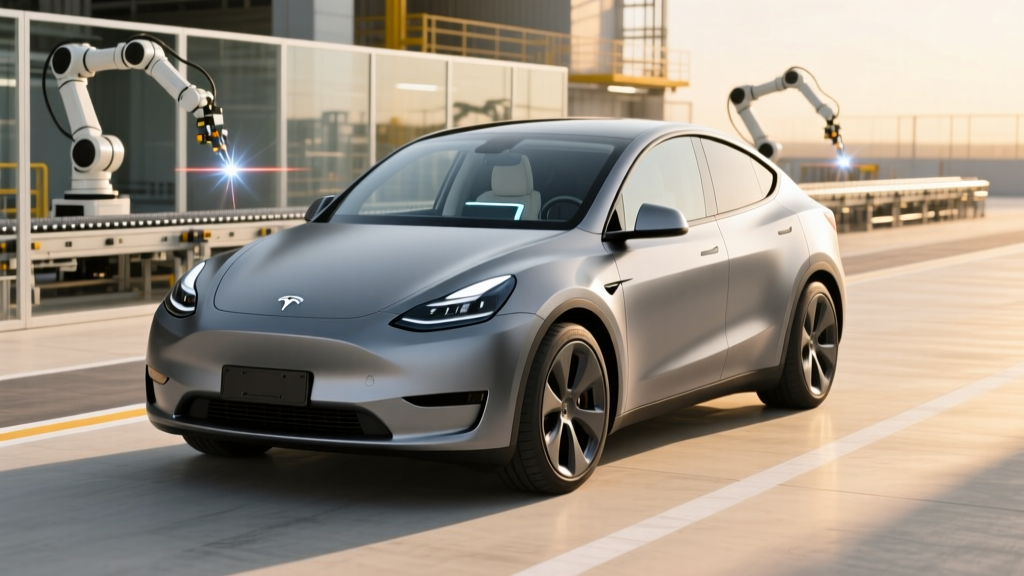
Gigafactory Texas operates with one of the highest robot-to-worker ratios in the auto industry. This reduces human-variability defects in welding, adhesive application, and electrical harness routing. Early Fremont-built Model Y vehicles were known for inconsistent panel gaps and paint defects; the 2026 Texas-built cars show measurable improvement in these areas, though isolated paint-quality complaints persist.
The trade-off of highly automated manufacturing is reduced customization flexibility. Tesla offers the Model Y in a limited set of colors and configurations—partly because retooling a highly automated line for niche options is cost-prohibitive. If you want a bespoke interior or unusual color, legacy automakers still hold an edge.
Performance, Ride, and Interior Practicality
The dual-motor AWD Long Range produces 384 combined horsepower and hits 60 mph in 4.8 seconds—quick by any measure, though the Performance trim (3.5 seconds, $48,990) exists for those who want sports-sedan acceleration from a crossover. The single-motor RWD variant ($39,990) is also available with an EPA range of approximately 300 miles.
Ride quality remains the Model Y's most debated characteristic. The 2026 model carries over the revised suspension tuning introduced with the "Juniper" refresh, which softens low-speed impacts and reduces cabin noise. It's improved, but on broken urban pavement, the stiff structural body still transmits more harshness than a Hyundai Ioniq 5 or Ford Mustang Mach-E. On smooth highway surfaces, however, the Model Y is composed, quiet, and stable at speed.
Interior space is a genuine strength:
- Front legroom: 41.8 inches
- Rear legroom: 41.6 inches
- Cargo behind rear seats: 30.2 cu ft
- Cargo with seats folded: 72.1 cu ft
- Frunk (front trunk): 4.1 cu ft
The 15.4-inch center touchscreen handles all infotainment, climate, and vehicle settings. There is no instrument cluster; speed and navigation appear on the main display. Wireless phone charging, HEPA cabin filtration, and a panoramic glass roof are standard. The minimalist design appeals to tech-forward buyers but frustrates those who prefer physical controls for climate and audio.
Pricing, Tax Credits, and Total Cost of Ownership
| Trim | MSRP | Est. After §30D Credit* |
|---|---|---|
| RWD (Standard Range) | $39,990 | $32,490 |
| Long Range AWD | $44,990 | $37,490 |
| Performance AWD | $48,990 | $41,490 |
*Federal tax credit estimates assume buyer eligibility. Actual credit depends on IRS §30D requirements.
Under current IRS §30D rules, the Model Y qualifies for up to $7,500 in federal tax credits, available as a point-of-sale transfer to the dealer (effectively a discount at purchase). However, eligibility depends on several factors:
- MSRP cap: SUVs/crossovers must be under $80,000 — all Model Y trims qualify.
- Buyer income cap: Modified AGI must not exceed $150,000 (single), $225,000 (head of household), or $300,000 (joint).
- Battery sourcing: A percentage of critical minerals and battery components must be sourced from the U.S. or free-trade-agreement countries. Tesla's North American supply chain has progressively met these thresholds, but the exact credit split ($3,750 + $3,750) can shift with annual rule updates. Always verify current eligibility on IRS.gov before purchasing.
On a 5-year total-cost-of-ownership basis, the Model Y Long Range benefits from low electricity costs (roughly $0.04–0.05 per mile on home charging vs. $0.12–0.15 per mile for a comparable gas crossover at 25 MPG), zero oil changes, and strong residual values. Insurance premiums, however, tend to run 15–25% higher than comparable ICE crossovers due to repair cost structures—a factor buyers should quote before committing.
Pros
- 320-mile EPA range with excellent real-world efficiency
- Supercharger network access with native plug-and-charge
- Best-in-class cargo volume for the segment
- Strong resale value and low cost-per-mile on home charging
- Continuous OTA software updates add features over time
Cons
- Ride quality still firm on rough roads
- No physical climate or audio controls
- Paint quality, while improved, occasionally inconsistent
- Higher insurance premiums than gas rivals
- Limited color and configuration options
Autopilot, FSD (Supervised), and Driver-Assistance Tech
Every 2026 Model Y ships with Tesla's Basic Autopilot (lane centering, traffic-aware cruise control, automatic emergency braking). The optional FSD (Supervised) package ($8,000 one-time or $99/month subscription) adds automated lane changes, traffic light and stop sign recognition, and Navigate on Autopilot for highway interchanges.
FSD (Supervised) has improved substantially in 2025–2026 with the transition to a vision-only neural-network architecture, but it still requires constant driver supervision. It excels on well-marked highways and can reduce fatigue on long trips, but it is not a substitute for an attentive driver. Expect occasional disengagements in construction zones, unmapped intersections, and heavy rain.
Warranty, Battery Longevity, and What Automated Manufacturing Means for Repairs
Tesla covers the Model Y's battery and drive unit for 8 years or 120,000 miles (whichever comes first), with a minimum 70% capacity retention guarantee during that period. The limited vehicle warranty is 4 years / 50,000 miles.
The NMC chemistry in the Long Range pack offers higher energy density than LFP (lithium iron phosphate), which Tesla uses in the RWD variant. NMC provides more range per kilogram but is slightly more susceptible to degradation from frequent 100% charging. Tesla recommends daily charging to 80% for NMC packs and 100% only for trips.
One ownership wrinkle specific to Tesla's automated manufacturing: giga-castings, while structurally superior, can complicate collision repair. A rear impact that damages the single-piece casting may require full replacement rather than sectional repair, potentially increasing insurance write-off rates. Tesla has addressed this by establishing certified body shops with casting-repair protocols, but buyers in high-incident areas should factor this into insurance quotes.
Who Should Buy the 2026 Model Y — And Who Should Look Elsewhere
Choose the Model Y Long Range if: You prioritize range efficiency, Supercharger network access, cargo versatility, and strong resale value. Ideal for commuters with home charging, road-trippers who value charging infrastructure, and tech-forward buyers who prefer a minimalist interface.
Look at competitors if: You want a softer ride (Hyundai Ioniq 5), physical controls and a more traditional interior (Ford Mustang Mach-E), 800V ultra-fast charging (Ioniq 5 / Kia EV6), or a third-row seat (Kia EV9). If you need a luxury badge and dealer-service experience, the BMW iX or Genesis GV60 may suit better.
Frequently Asked Questions
What is the real-world range of the 2026 Tesla Model Y?
The EPA rates the Long Range AWD at 320 miles. In mixed highway driving at 70–75 mph, expect approximately 270–290 miles. In cold weather (below 32°F), plan for 225–250 miles without preconditioning.
How fast does the Model Y charge at home and on DC fast chargers?
At a 250 kW Supercharger, a 10–80% charge takes about 25 minutes. At home on a 48A Level 2 Wall Connector (11.5 kW), you'll add roughly 44 miles of range per hour, or a full 20–80% charge in about 4 hours.
Does the 2026 Model Y qualify for the $7,500 federal EV tax credit?
It can, provided the buyer meets IRS §30D income caps ($150K single / $300K joint), the MSRP is under $80,000 (all trims qualify), and the battery meets current critical-mineral and component sourcing thresholds. The credit can be transferred at point of sale. Always verify current rules at IRS.gov.
Is the Model Y worth buying versus the Hyundai Ioniq 5 or Ford Mach-E?
The Model Y wins on Supercharger access, cargo volume, efficiency, and resale value. The Ioniq 5 charges faster (350 kW peak on 800V) and rides more comfortably. The Mach-E offers a more conventional interior with physical controls. All three are strong choices—the right one depends on your priorities.
What are the biggest drawbacks of the 2026 Model Y?
Firm ride quality on rough pavement, lack of physical controls, occasional paint inconsistency, higher-than-average insurance premiums, and limited exterior color choices. The giga-cast body structure can also complicate collision repair in some markets.
How does Tesla's automated manufacturing affect build quality?
Giga-castings and high-robot-density assembly at Gigafactory Texas have measurably reduced panel-gap variance and body-shop defects compared to earlier Fremont production. The trade-off is reduced customization options and potentially higher collision-repair costs for casting damage.