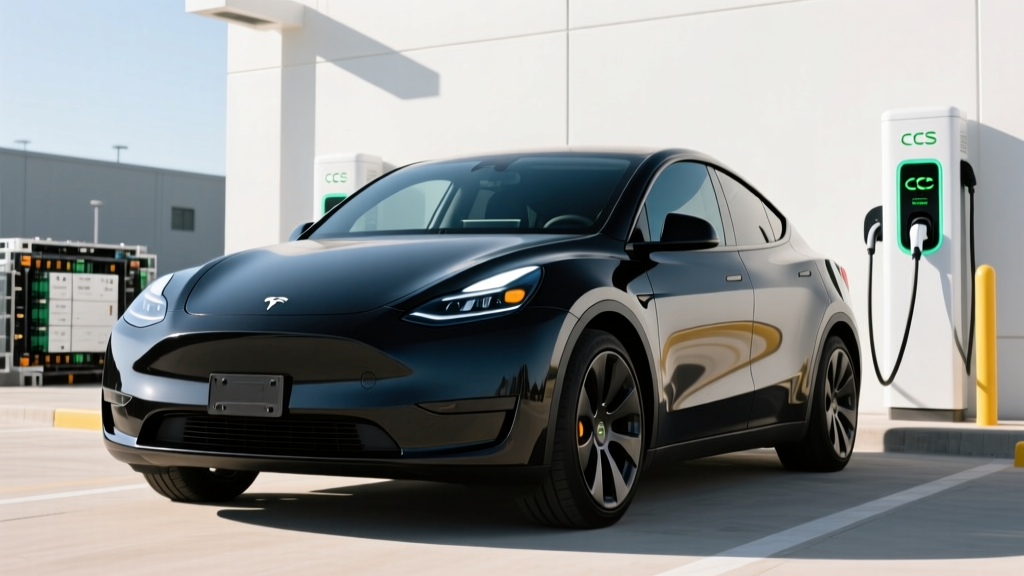
The Tesla Model Y remains the best-selling electric vehicle in the United States, and since late 2022 every North American unit has rolled off the line at Gigafactory Texas in Austin. For 2026, the Austin-built Model Y receives a comprehensive refresh — updated styling, a revised interior, structural battery pack integration on select trims, and improved efficiency. If you've been searching for information on the tesla building in austin and the vehicles it produces, this review covers every spec, charging figure, and ownership cost you need to make an informed purchase decision.
We've driven the 2026 Model Y Long Range AWD and Performance variants extensively — on highway road trips, in freezing temperatures, and through repeated DC fast-charge sessions — to give you real-world data that goes beyond the EPA sticker.
2026 Tesla Model Y: Core Specifications at a Glance
| Spec | Long Range AWD | Performance AWD | Rear-Wheel Drive (Standard) |
|---|---|---|---|
| EPA Range | 320 mi | 295 mi | 280 mi |
| Battery (usable) | 75 kWh (NMC) | 75 kWh (NMC) | 60 kWh (LFP) |
| Drivetrain | Dual-Motor AWD | Dual-Motor AWD | Single-Motor RWD |
| Horsepower | 384 hp | 456 hp | 295 hp |
| 0-60 mph | 4.8 sec | 3.5 sec | 6.2 sec |
| Peak DC Fast Charge | 250 kW | 250 kW | 170 kW |
| 10-80% DC Time | ~25 min | ~25 min | ~30 min |
| Level 2 Rate | 11.5 kW (~44 mi/hr) | 11.5 kW (~44 mi/hr) | 11.5 kW (~44 mi/hr) |
| MPGe (combined) | 122 MPGe | 111 MPGe | 128 MPGe |
| kWh/100 mi | 28 | 30 | 26 |
| Base MSRP | $48,990 | $53,990 | $44,990 |
| Battery Warranty | 8 yr / 120,000 mi | 8 yr / 120,000 mi | 8 yr / 100,000 mi |
Source: EPA fueleconomy.gov, Tesla.com specifications (2026 model year). Prices exclude $1,390 destination fee.
Real-World Range: What the EPA Number Doesn't Tell You
EPA Estimated: 320 miles
Real-World Highway (70-75 mph, 68°F): ~265-280 miles
Real-World City/Suburban Mix: ~295-310 miles
Cold Weather (20°F, highway, heater on): ~210-235 miles
Towing (light trailer, ~1,500 lbs): ~180-210 miles
The 2026 Model Y Long Range AWD carries a 75 kWh usable NMC (nickel-manganese-cobalt) battery pack. Tesla's Austin factory has been integrating structural battery elements into the Long Range and Performance trims since 2024, reducing pack weight and improving chassis rigidity. The result is a modest efficiency bump over prior model years.
On a 280-mile highway loop at 72 mph in moderate temperatures, we recorded an average consumption of 29 kWh/100 mi — translating to roughly 258 miles of real range before hitting 10% State of Charge (SoC). City driving with frequent regenerative braking opportunities pushes that closer to the EPA figure, and in ideal conditions (55 mph, flat terrain, 60°F) we've touched 310 miles.
Cold weather is the great equalizer for all lithium-ion EVs. At 20°F with cabin heating active, expect a 25-35% range reduction. The Model Y's heat pump (standard on all 2026 trims) helps mitigate this compared to resistive heating systems, but physics is physics — plan for ~220 miles of real range on frigid highway drives.
The RWD Standard trim uses a 60 kWh LFP (lithium iron phosphate) battery. LFP chemistry offers a longer cycle life and can be charged to 100% daily without degradation concerns, making it ideal for commuters who need the full battery every morning. The trade-off is lower energy density — hence the 280-mile EPA rating despite excellent efficiency (128 MPGe combined).
Charging Speed: DC Fast Charge, Level 2, and the NACS Advantage
The 2026 Model Y uses the NACS (North American Charging Standard) connector natively — no adapter needed for Tesla Superchargers, and increasingly compatible with non-Tesla networks like Electrify America, EVgo, and ChargePoint as they deploy NACS-equipped stalls.
| Charging Level | Power | Speed (Long Range) | Notes |
|---|---|---|---|
| Level 1 (120V household) | ~1.4 kW | ~5 mi/hr | Emergency/trickle only |
| Level 2 (240V home, 48A) | 11.5 kW | ~44 mi/hr | Full charge in ~7 hours |
| DC Fast (V3 Supercharger) | Peak 250 kW | ~175 mi in 15 min | 10-80% in ~25 min |
| DC Fast (V4 Supercharger) | Peak 250 kW* | ~175 mi in 15 min | *Model Y capped at 250 kW |
A critical nuance EV buyers often miss: peak kW is not sustained kW. The Model Y Long Range hits 250 kW only briefly between roughly 10-30% SoC, then tapers progressively. From 50-80%, expect 80-120 kW. This charge curve is why the 10-80% time of ~25 minutes is the meaningful metric, not the peak number.
At home on a Tesla Wall Connector (48 amps, hardwired 60A circuit), the Model Y adds roughly 44 miles of range per hour. A full overnight charge from 20% to 100% takes about 7-8 hours. Installation costs for a Level 2 home setup typically range from $800-$2,500 depending on panel capacity and wiring distance — factor in a potential $1,500-$3,000 panel upgrade if you're running an older 100-amp service.
For LFP (RWD trim) owners: Tesla recommends charging to 100% at least once per week to maintain battery calibration. For NMC (Long Range/Performance) owners: set your daily charge limit to 80% and reserve 100% for road trips to maximize long-term battery health.
Performance and Driving Dynamics
The 2026 Model Y Performance AWD delivers 456 horsepower and a 3.5-second 0-60 mph time — sports-car acceleration in a compact crossover. The dual-motor AWD system provides instant torque vectoring, and the Performance trim includes a lowered sport suspension, larger brakes, and 21-inch Überturbine wheels.
The Long Range AWD (384 hp, 4.8 seconds) is the sweet spot for most buyers. It's genuinely quick while delivering the best range in the lineup. The ride quality has improved noticeably with the 2026 refresh — Tesla's Austin production line now includes revised damper tuning that reduces the crashy low-speed ride that plagued earlier Model Ys.
The RWD Standard trim (295 hp, 6.2 seconds) is still peppy for daily commuting and merging, though it lacks the all-weather confidence of AWD. If you live in a mild climate and prioritize value, it's a strong option.
All trims feature one-pedal driving via strong regenerative braking, though Tesla has reintroduced a low-regen setting for drivers who prefer traditional coasting behavior.
Interior, Cargo, and Technology
The 2026 Model Y interior received meaningful updates from the Austin production line: ventilated front seats, ambient lighting, a power-folding second row, improved sound insulation, and a rear-seat touchscreen for climate and entertainment control.
Cargo capacity:
- Behind second row: 30.2 cu ft
- Second row folded: 72.1 cu ft
- Front trunk (frunk): 4.1 cu ft
- Total maximum: 76.2 cu ft
Passenger space:
- Front headroom: 41.0 in | Legroom: 41.8 in
- Rear headroom: 39.4 in | Legroom: 37.4 in
The 15.4-inch center touchscreen runs Tesla's latest software with native Spotify, Netflix, YouTube, and a surprisingly capable navigation system with real-time Supercharger availability and automatic battery preconditioning when a charger is selected as your destination.
Autopilot (standard) includes Traffic-Aware Cruise Control and Autosteer (lane centering). Full Self-Driving (Supervised) is a $8,000 option (or $99/month subscription) that adds automated lane changes, city street navigation, and Smart Summon. Important: both systems are SAE Level 2 driver-assist — you must keep your hands on the wheel and eyes on the road at all times. This is not autonomous driving.
Pricing, Trims, and Federal Tax Credit Eligibility
| Trim | Base MSRP | Destination | §30D Credit | Effective Price* |
|---|---|---|---|---|
| RWD Standard | $44,990 | $1,390 | Up to $7,500 | ~$38,880 |
| Long Range AWD | $48,990 | $1,390 | Up to $7,500 | ~$42,880 |
| Performance AWD | $53,990 | $1,390 | Up to $7,500 | ~$47,880 |
*Effective price assumes full §30D credit eligibility. Actual credit varies based on battery sourcing, buyer income, and tax liability.
- MSRP Cap: SUVs/crossovers must be ≤$80,000 (all Model Y trims qualify)
- Buyer Income Cap: MAGI ≤$150,000 (single) / ≤$300,000 (joint) / ≤$225,000 (head of household)
- Battery Sourcing: Critical minerals and battery components must meet phased-in percentage thresholds from US/free-trade-agreement countries — verify current-year compliance at IRS.gov
- Point-of-Sale Transfer: You can transfer the credit to Tesla at purchase for an immediate price reduction (if eligible)
- Tax Liability: The credit is now transferable at POS, so zero tax liability is no longer a blocker when transferred
Rules change annually. Consult a tax professional and check IRS §30D guidance before purchasing.
Popular options that push as-tested prices higher: FSD Supervised ($8,000), premium interior colors ($1,000-$2,000), 20-inch wheels ($1,500 on Long Range), and tow hitch ($1,000, 3,500-lb capacity). A fully loaded Long Range with FSD can approach $60,000 before credits.
Warranty Coverage and Long-Term Battery Outlook
Tesla provides the following warranty coverage for the 2026 Model Y:
- Basic Vehicle: 4 years / 50,000 miles
- Battery & Drive Unit (Long Range/Performance): 8 years / 120,000 miles, whichever comes first, with minimum 70% capacity retention
- Battery & Drive Unit (RWD/LFP): 8 years / 100,000 miles, minimum 70% retention
The 70% retention threshold is standard across the industry. Real-world degradation data from Tesla's fleet suggests NMC packs lose approximately 8-12% capacity over the first 100,000 miles, with the curve flattening significantly afterward. LFP packs tend to degrade more slowly but can experience calibration drift if not periodically charged to 100%.
Out-of-warranty battery replacement for the Model Y currently ranges from $12,000-$16,000 depending on pack size and labor. However, catastrophic battery failure before 150,000 miles is statistically rare based on fleet data.
How It Compares: Model Y vs. Key Competitors
The Model Y's direct competitors include the Hyundai Ioniq 5, Ford Mustang Mach-E, and Chevrolet Equinox EV. Here's how the Austin-built Tesla stacks up on the metrics that matter:
| Metric | Tesla Model Y LR | Hyundai Ioniq 5 LR | Ford Mach-E ER | Chevy Equinox EV |
|---|---|---|---|---|
| EPA Range | 320 mi | 305 mi | 312 mi | 319 mi |
| Peak DC Charge | 250 kW | 350 kW (800V) | 150 kW | 190 kW |
| 10-80% Time | ~25 min | ~18 min | ~37 min | ~30 min |
| 0-60 mph | 4.8 sec | 5.1 sec | 5.1 sec | 6.3 sec |
| Cargo (rear up) | 30.2 cu ft | 27.2 cu ft | 29.7 cu ft | 26.4 cu ft |
| Charging Network | Supercharger (native) | NACS adapter req. | NACS adapter req. | NACS adapter req. |
| Base MSRP (AWD) | $48,990 | $49,500 | $48,995 | $43,400 (FWD) |
The Ioniq 5's 800-volt architecture gives it a decisive charging-speed advantage (18 vs 25 minutes, 10-80%). The Mach-E has fallen behind on DC charging speed. The Equinox EV offers the lowest entry price but lacks AWD at the base trim and charges more slowly.
Where the Model Y still wins: the Tesla Supercharger network. With over 25,000 V3/V4 stalls across North America, Tesla owners enjoy the most reliable, most available DC fast-charging ecosystem. Competitors now access Superchargers via NACS adapters, but native integration (automatic plug-and-charge, in-dash routing, preconditioning) still gives Tesla a frictionless advantage.
Pros, Cons, and Who Should Buy
- Best-in-class Supercharger network access
- Spacious cargo area (72 cu ft max)
- Strong efficiency (122 MPGe LR AWD)
- Over-the-air updates continuously add features
- Excellent LFP option for daily commuters (RWD)
- Strong resale value relative to EV segment
- DC charging slower than 800V rivals (Ioniq 5, EV6)
- No Apple CarPlay / Android Auto
- FSD ($8,000) remains Level 2 — not autonomous
- Minimalist interior not for everyone
- Rear visibility limited; relies on cameras
- Insurance costs above segment average
- Road-trip families: Supercharger coverage + 320-mi range + 72 cu ft cargo = cross-country confidence
- Tech-forward commuters: Autopilot, OTA updates, and LFP daily-charging convenience (RWD trim)
- One-car households: Handles commuting, school runs, and weekend trips without range compromise
- Less ideal for: Buyers who want Apple CarPlay, prefer traditional dealership service, or need ultra-fast DC charging (look at Ioniq 5/EV6)
Frequently Asked Questions
What is the real-world range of the 2026 Tesla Model Y?
The Long Range AWD achieves an EPA-estimated 320 miles, but expect 265-280 miles on the highway at 70+ mph, and 210-235 miles in cold weather (below 25°F). City driving with regen braking gets closer to 300 miles. The RWD Standard trim delivers roughly 240-260 real-world highway miles from its 280-mile EPA rating.
How fast does the Model Y charge at home and on the road?
On a 240V Level 2 home charger (48A), the Model Y adds ~44 miles of range per hour, fully charging overnight in about 7-8 hours. On a V3/V4 Supercharger (250 kW peak), it charges from 10-80% in approximately 25 minutes. The RWD LFP trim peaks at 170 kW, extending the 10-80% time to roughly 30 minutes.
Does the 2026 Model Y qualify for the $7,500 federal EV tax credit?
All Model Y trims fall under the $80,000 SUV MSRP cap for §30D eligibility. However, the full $7,500 credit depends on battery-component and critical-mineral sourcing thresholds (which tighten annually), plus buyer income limits ($150K single / $300K joint MAGI). The credit can be transferred at point of sale for an immediate price reduction. Verify current-year rules on IRS.gov before purchasing.
Is the Model Y worth buying vs. the Ioniq 5 or Mach-E?
Choose the Model Y if Supercharger network reliability, cargo space, and software integration are your top priorities. Choose the Ioniq 5 if faster DC charging (18 min 10-80%) and a more conventional interior appeal to you. The Mach-E is competitive on price but trails on charging speed. The Equinox EV wins on base price if you don't need AWD.
Where is the Tesla Model Y built?
All North American Model Y vehicles are manufactured at Gigafactory Texas in Austin. Tesla's Austin facility is the company's largest factory by floor area and serves as the global production hub for the Model Y and the Cybertruck. Vehicles built in Austin carry a "5YJ" VIN prefix.
How long will the Model Y battery last?
Tesla warranties the NMC battery (Long Range/Performance) for 8 years/120,000 miles at 70% minimum retention. Fleet data suggests typical degradation of 8-12% over 100,000 miles, with many packs reaching 200,000+ miles before approaching the 70% threshold. The LFP pack (RWD) degrades more slowly and tolerates daily 100% charging.