The Short Answer: Does Tesla Have Apple CarPlay?
No. As of the 2026 model year, Tesla does not offer Apple CarPlay or Android Auto on any of its vehicles — not the Model Y, Model 3, Model S, Model X, or Cybertruck. Tesla uses a proprietary, Linux-based infotainment system that runs entirely on the vehicle's central touchscreen. This is one of the most polarizing decisions in the EV market, and it's the single biggest tech-culture clash for buyers switching from legacy automakers.
Instead of mirroring your phone, Tesla's system integrates your smartphone via Bluetooth for calls, media, and messaging, while Tesla's own apps handle navigation (with real-time traffic and Supercharger routing), music streaming (Spotify, Apple Music via Bluetooth, Tidal), podcasts, and theater. The system supports over-the-air (OTA) updates that regularly add features — something CarPlay cannot do at the vehicle-OS level.
If CarPlay is a non-negotiable for your next EV purchase, you'll need to look at competitors like the Hyundai Ioniq 5, Ford Mustang Mach-E, or BMW iX. But before you cross Tesla off the list, here's a full breakdown of the 2026 Model Y — the best-selling EV in the U.S. — so you can weigh the trade-offs with real numbers.
2026 Tesla Model Y: Quick Spec Snapshot
| Spec | Long Range RWD | Long Range AWD | Performance AWD |
|---|---|---|---|
| EPA Range | 320 mi | 295 mi | 277 mi |
| Battery (usable) | ~75 kWh (LFP) | ~75 kWh (NMC) | ~75 kWh (NMC) |
| Drivetrain | RWD, single motor | AWD, dual motor | AWD, dual motor |
| Horsepower | 295 hp | 384 hp | 510 hp |
| 0–60 mph | 6.5 sec | 4.8 sec | 3.5 sec |
| Max DC Fast Charge | 170 kW | 250 kW | 250 kW |
| 10–80% DC Time | ~30 min | ~25 min | ~25 min |
| Level 2 Home Rate | 11.5 kW (~44 mi/hr) | 11.5 kW (~44 mi/hr) | 11.5 kW (~44 mi/hr) |
| MPGe (combined) | 122 MPGe | 116 MPGe | 111 MPGe |
| Efficiency | 28 kWh/100 mi | 29 kWh/100 mi | 30 kWh/100 mi |
| Base MSRP | $44,990 | $47,990 | $52,490 |
| Battery Warranty | 8 yr / 120,000 mi | 8 yr / 120,000 mi | 8 yr / 120,000 mi |
Source: fueleconomy.gov and Tesla's official specifications. Figures reflect 2026 model-year data.
Range: EPA Sticker vs. Real-World Driving
EPA Estimated: 320 miles (Long Range RWD) | 295 miles (AWD) | 277 miles (Performance)
Real-World Expectation: Plan for ~250–280 miles on highway road trips at 70–75 mph. In freezing temperatures (below 32°F), expect a 15–25% range reduction, dropping effective range to roughly 210–240 miles for the Long Range RWD. City driving with regen braking can match or slightly exceed EPA estimates.
Tesla's range figures are competitive within the compact luxury EV SUV segment, but the real-world picture is more nuanced. The Model Y's heat pump — standard on all 2026 trims — significantly reduces cold-weather cabin-heating energy draw compared to resistive heaters used in older EVs. In our experience, the heat pump cuts cold-weather range loss by roughly 5–8 percentage points versus vehicles without one.
The LFP (lithium iron phosphate) battery in the Long Range RWD trim trades some energy density for longevity and cost. LFP cells tolerate regular 100% charging without accelerated degradation, meaning Tesla actually recommends charging this trim to 100% at least weekly. That effectively gives you the full 320 miles daily — unlike NMC trims, where Tesla recommends an 80% daily charge limit (yielding ~236 usable miles day-to-day on the AWD).
Charging Speed: DC Fast, Level 2, and the Supercharger Advantage
Charging is where Tesla's ecosystem still holds a measurable edge over competitors, even as the broader industry adopts the NACS connector standard that Tesla opened up in 2024.
| Charging Level | Power | Speed (mi/hr added) | Typical Use Case |
|---|---|---|---|
| Level 1 (120V household) | ~1.4 kW | ~4–5 mi/hr | Emergency / trickle top-up |
| Level 2 (240V home, 48A) | 11.5 kW | ~44 mi/hr | Daily home charging |
| DC Fast (V3 Supercharger) | Up to 250 kW | ~162 mi in 15 min | Road trips |
| DC Fast (V4 Supercharger) | Up to 350 kW* | Theoretical ~200+ mi in 15 min | Next-gen stations (limited) |
*The Model Y's onboard architecture caps at 250 kW even at V4 stations capable of higher output.
Real-world charging curve reality: The 250 kW peak rate applies only between roughly 10–30% state of charge. Above 50%, the rate tapers to ~100 kW, and above 80%, it drops further to ~40–50 kW to protect battery health. The advertised 10–80% time of ~25 minutes assumes a preconditioned battery (the car automatically does this when you navigate to a Supercharger) and a V3 or V4 stall that isn't shared with another vehicle.
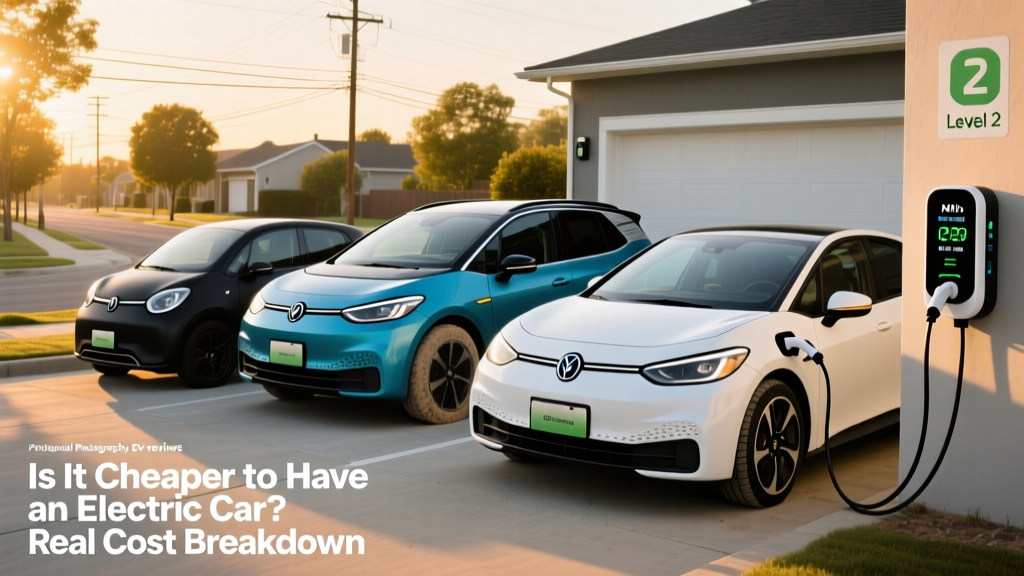
For home charging, a Tesla Wall Connector on a 60-amp circuit delivers 48 amps / 11.5 kW, adding roughly 44 miles of range per hour. An overnight charge from 20% to 80% takes about 4.5 hours — more than sufficient for daily use. Installation costs typically range from $800 to $2,000 depending on your electrical panel's capacity and distance from the panel to the charger location.
Infotainment & Tech: What You Get Instead of CarPlay
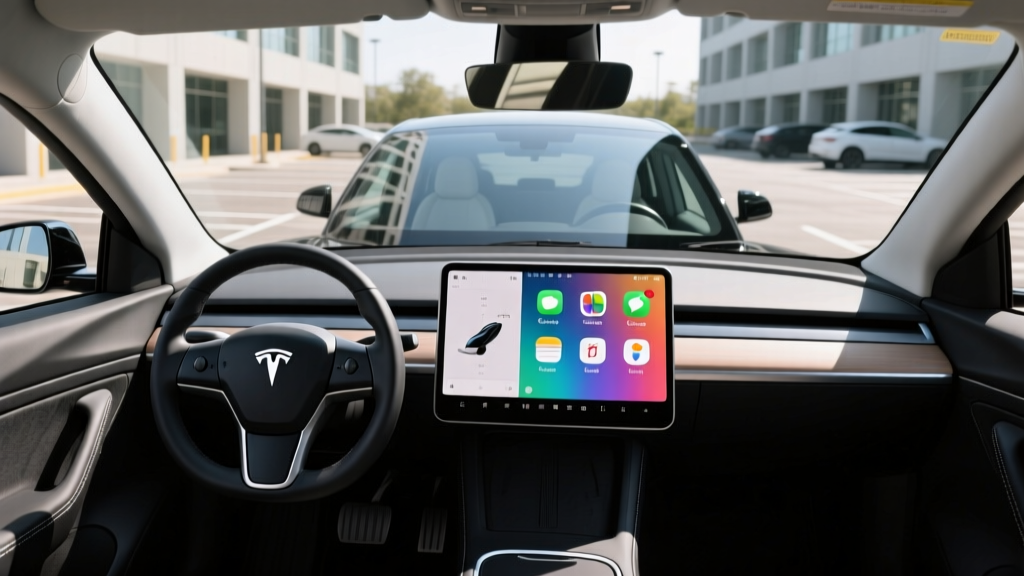
Tesla's 15.4-inch center touchscreen runs the entirety of the vehicle's interface — there are no physical gauges, buttons for climate, or a separate instrument cluster. Everything routes through this single display, including the speedometer, climate controls, media, navigation, and vehicle settings.
What works well without CarPlay:
- Navigation — Tesla's built-in nav is genuinely excellent. It routes around traffic in real time, preconditions the battery automatically for Supercharger stops, shows live stall availability, and estimates arrival SoC with high accuracy.
- Phone integration — Bluetooth handles calls, texts (dictated replies), and audio streaming. Apple Music, Spotify, and Tidal are native apps. Your phone's podcast app streams cleanly over Bluetooth.
- OTA updates — Tesla pushes meaningful feature additions every few months: new games, UI refinements, efficiency improvements, and driver-assist enhancements. This is a living system, not a static one.
- Dashcam & Sentry Mode — Built-in camera recording with no phone tethering required.
What CarPlay users will miss:
- Familiar interface — If you've spent years in CarPlay's tile layout, Tesla's UI requires a learning curve (typically 1–2 weeks of daily use).
- Waze / Google Maps — You cannot run third-party navigation apps on Tesla's display. Tesla's native nav is strong, but Waze's crowd-sourced police/hazard reporting is not available.
- Siri voice control — Tesla's voice assistant handles vehicle commands well ("navigate to," "set temperature to," "play") but doesn't integrate with Siri or your phone's ecosystem for non-vehicle tasks.
- App continuity — Calendar events, restaurant reservations, and shared ETA features that CarPlay surfaces from your phone don't appear on Tesla's screen.
Driver-Assist Note: Tesla's Autopilot and Full Self-Driving (Supervised) are SAE Level 2 driver-assistance systems — not autonomous driving. You must keep your hands on the wheel and eyes on the road at all times. FSD (Supervised) can navigate on-ramps, city streets, and stoplights, but it makes errors and requires constant supervision. Only Level 4 services like Waymo operate without a human driver.
Performance, Interior, and Practicality
The 2026 Model Y received the "Juniper" refresh (introduced in early 2025), bringing a redesigned interior, ventilated front seats, ambient lighting, a rear-seat touchscreen, power-folding second row, and improved sound insulation. The ride quality is noticeably better than pre-2025 models, with retuned suspension that absorbs road imperfections without the harshness earlier Model Y owners reported.
Cargo and passenger space:
- Rear cargo (seats up): 30.2 cu ft
- Rear cargo (seats folded): 72.0 cu ft
- Front trunk (frunk): 4.1 cu ft
- Rear legroom: 41.6 inches
- Front headroom: 40.8 inches
The Model Y remains one of the most cargo-capable vehicles in its class, and the frunk adds useful space for charging cables or a small bag. The optional third row (available on Long Range trims) adds two small seats suitable for children under ~5'4", but it eliminates the rear cargo floor storage area and is best treated as occasional-use only.
0–60 mph performance ranges from a perfectly adequate 6.5 seconds (Long Range RWD) to a sports-car-rivaling 3.5 seconds in the Performance trim with 510 hp. The dual-motor AWD trims provide confident all-weather traction, and the low center of gravity (battery pack under the floor) keeps body roll well-controlled through corners.
Pricing, Trims, and Federal Tax Credit Eligibility
| Trim | Base MSRP | Est. After §30D Credit* | Destination |
|---|---|---|---|
| Long Range RWD | $44,990 | $37,490 | $1,390 |
| Long Range AWD | $47,990 | $40,490 | $1,390 |
| Performance AWD | $52,490 | $44,990 | $1,390 |
*Credit eligibility is not guaranteed. See rules below.
IRS §30D Federal Tax Credit — 2026 Requirements:
- Credit amount: Up to $7,500 ($3,750 for critical minerals + $3,750 for battery component sourcing)
- MSRP cap: Vehicle must be under $80,000 (SUVs/vans/pickups) — all Model Y trims qualify
- Buyer income cap: AGI must not exceed $150,000 (single), $225,000 (head of household), or $300,000 (joint)
- Battery sourcing: Critical minerals and battery components must meet escalating domestic/free-trade-partner percentages — Tesla's U.S. manufacturing gives the Model Y an advantage here, but partial credit ($3,750) is possible if only one prong is met
- Point-of-sale transfer: You can apply the credit as a price reduction at purchase rather than waiting for tax filing
- Verify current rules: Sourcing requirements tighten annually — check IRS.gov §30D guidance before purchasing
The Model Y's pricing positions it in the heart of the premium compact EV SUV market. With the full $7,500 credit, the Long Range RWD effectively starts around $37,490 — undercutting most AWD competitors even before factoring in fuel savings. However, if your income exceeds the caps or the battery sourcing rules aren't fully met in a given model year, you may only qualify for $3,750 or no credit at all. Always confirm eligibility with a tax professional before counting on the full amount.
Model Y vs. Key Competitors: Is It Worth Buying?
The Model Y's biggest rivals in 2026 include the Hyundai Ioniq 5, Ford Mustang Mach-E, and Volkswagen ID.4. Here's how the decision breaks down:
Choose the Tesla Model Y if:
- You value Supercharger network reliability for road trips (though competitors now access NACS-equipped Superchargers, Tesla's native integration remains seamless)
- You want OTA updates that add real features over time
- Cargo space and efficiency are top priorities
- You can adapt to a CarPlay-free touchscreen-centric interface
Choose a competitor (Ioniq 5, Mach-E, ID.4) if:
- Apple CarPlay or Android Auto is non-negotiable for your workflow
- You prefer physical buttons for climate and volume
- You want a more traditional dealership service experience
- The Hyundai Ioniq 5's 800V architecture and ~18-minute 10–80% charge time appeal to you
Pros
- Class-leading efficiency (28 kWh/100 mi on RWD)
- Supercharger network with native routing integration
- Strong OTA update cadence
- Spacious cargo area (72 cu ft seats folded)
- LFP battery option allows daily 100% charging
- Competitive pricing after §30D credit
Cons
- No Apple CarPlay or Android Auto
- Everything through one screen — no physical climate buttons
- Service center wait times can be long in some markets
- FSD (Supervised) is an expensive add-on ($8,000) that remains Level 2
- Insurance premiums tend to run higher than segment average
Warranty and Long-Term Ownership
Tesla provides a 4-year/50,000-mile basic vehicle warranty and an 8-year/120,000-mile battery and drive unit warranty (Long Range and Performance trims). The RWD trim carries an 8-year/100,000-mile battery warranty. Tesla guarantees the battery will retain at least 70% of its original capacity during the warranty period — a threshold consistent with industry norms.
Real-world degradation data from Tesla's fleet shows most Model Y batteries retain 88–92% capacity at 100,000 miles, well above the warranty floor. LFP batteries in the RWD trim tend to show even less measurable degradation due to the chemistry's inherent cycle-life advantage, though they trade off some energy density (slightly lower range per kg).
Maintenance costs are minimal: no oil changes, no spark plugs, cabin air filter replacement every 2–3 years (~$50–$100 DIY), brake fluid checks, and tire rotation. Regenerative braking significantly extends brake pad life — many owners report original pads at 80,000+ miles. The main ownership cost to budget for is tires (EVs wear tires faster due to weight and instant torque) and potentially higher insurance premiums.
Frequently Asked Questions
Can I add Apple CarPlay to a Tesla aftermarket?
There are third-party hardware solutions (like CarPlay AI boxes) that attempt to inject a CarPlay-like interface through Tesla's browser or a secondary screen, but none are officially supported by Tesla, most are unreliable, and they can interfere with OTA updates. We do not recommend them. If CarPlay is essential, choose a different EV brand.
What is the real-world range of the 2026 Tesla Model Y?
Expect roughly 250–280 miles on highway road trips for the Long Range RWD (EPA: 320 mi). In cold weather below freezing, plan for 210–240 miles. City driving with regenerative braking can match or slightly exceed EPA figures. The AWD and Performance trims deliver proportionally less due to their lower EPA ratings.
How fast does the Model Y charge at home and on road trips?
At home on a Level 2 Tesla Wall Connector (11.5 kW / 48A), you'll add ~44 miles of range per hour, fully replenishing overnight. On DC fast charging, the Long Range AWD and Performance trims peak at 250 kW, achieving 10–80% in approximately 25 minutes with a preconditioned battery at a V3/V4 Supercharger. The RWD trim peaks at 170 kW, taking ~30 minutes for the same range.
Does the 2026 Model Y qualify for the $7,500 federal EV tax credit?
The Model Y is eligible for up to $7,500 under IRS §30D, provided you meet the income caps ($150K single / $300K joint AGI) and the vehicle's battery sourcing meets current-year critical mineral and component requirements. The MSRP cap for SUVs is $80,000 — all Model Y trims fall well under this. Because sourcing rules tighten annually, verify your specific purchase date's eligibility on IRS.gov or with a tax professional.
Is the Tesla Model Y worth buying over the Hyundai Ioniq 5 or Ford Mach-E?
It depends on your priorities. The Model Y wins on efficiency (28 kWh/100 mi vs. the Ioniq 5's ~30), cargo space, Supercharger integration, and OTA updates. The Ioniq 5 wins on charging speed (800V architecture, ~18 min 10–80%), physical buttons, and CarPlay/Android Auto. The Mach-E offers a more traditional driving feel and CarPlay support. Test-drive all three and weigh whether CarPlay and button-based controls matter more than Tesla's ecosystem advantages.
Is Tesla's Autopilot or FSD self-driving?
No. Both Autopilot and Full Self-Driving (Supervised) are SAE Level 2 systems that require you to remain fully engaged — hands on the wheel, eyes on the road. FSD can handle highway ramps, city intersections, and parking, but it makes mistakes and is not autonomous. You are the driver at all times. NHTSA provides further guidance on automation levels.
Bottom line: Tesla does not have Apple CarPlay, and there's no indication that will change. The 2026 Model Y remains a compelling EV for buyers who can adapt to Tesla's self-contained ecosystem — its efficiency, charging network, cargo space, and value after tax credits are genuinely hard to beat. But if your phone's interface is an extension of your daily workflow, the CarPlay gap is a legitimate reason to consider the Ioniq 5, Mach-E, or ID.4. Test both paths before committing.