Quick Verdict: What the AOC Trim Actually Adds
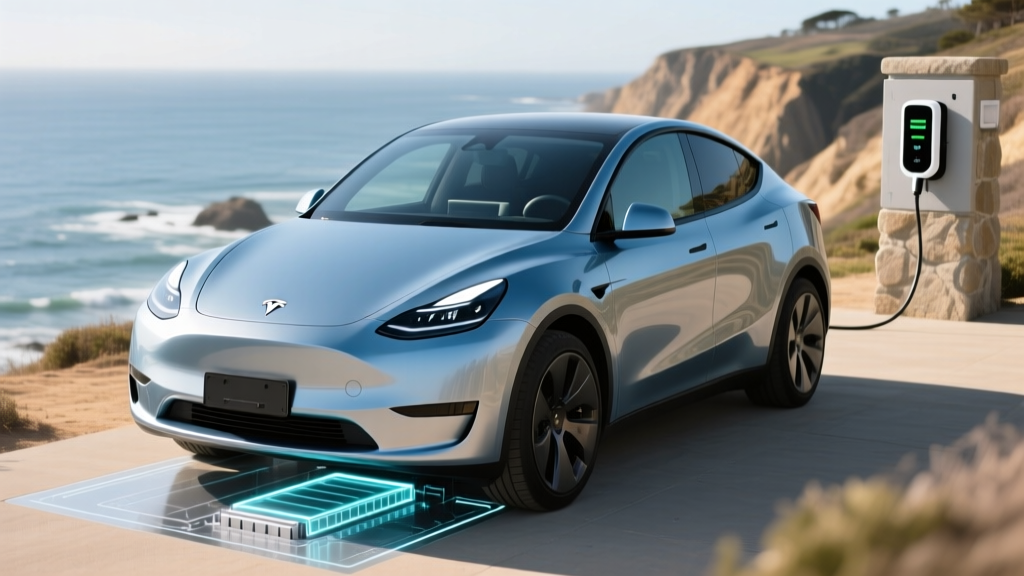
The "AOC" badge on the 2026 Tesla Model Y stands for All-Out Comfort — Tesla's mid-tier trim positioned between the base Long Range RWD and the Performance variant. It bundles the Juniper refresh's acoustic glass, ventilated front seats, a premium 16-speaker audio system, and power-folding second-row seats into a package that targets daily commuters who prioritize cabin refinement over track times. At a starting MSRP of $46,990 (before destination), the AOC undercuts the Performance by roughly $6,000 while retaining the same 75 kWh (usable) LFP battery pack and dual-motor AWD layout.
This review covers the Model Y AOC specifically — its real-world range behavior, charging curve characteristics, federal tax credit eligibility under current IRS §30D rules, and how it stacks up against the Hyundai Ioniq 5, Ford Mustang Mach-E, and Chevrolet Equinox EV.
Range, Efficiency, and Real-World Expectations
Real-World Expectation: ~265–285 miles on highway trips at 70 mph; ~240–260 miles in sub-30°F winter conditions. City driving with regen braking recovers closer to the EPA sticker, often 300+ miles in mild weather.
The 2026 Model Y AOC carries an EPA rating of 320 miles, identical to the standard Long Range AWD. That figure is achievable in mixed city/suburban driving at moderate temperatures (55–75°F). However, sustained highway speeds above 70 mph push consumption to roughly 28–30 kWh/100 mi, dropping effective range to the 265–285 mile band. In cold weather (below 30°F), expect a 15–25% reduction depending on cabin heating use — the AOC's standard heat pump mitigates some of this loss compared to resistive heating, but physics still wins.
Efficiency is rated at 122 MPGe combined (126 city / 115 highway) per fueleconomy.gov, translating to approximately 27 kWh/100 miles. That's competitive with the Ioniq 5 Long Range AWD (119 MPGe) and meaningfully better than the Mach-E Extended Range AWD (101 MPGe).
Battery Chemistry and Long-Term Degradation
The AOC uses a 75 kWh usable (82 kWh gross) lithium iron phosphate (LFP) battery pack manufactured by CATL. Tesla shifted most non-Performance Model Y trims to LFP beginning in 2024, and the chemistry carries distinct trade-offs:
| Attribute | LFP (Model Y AOC) | NMC (Performance Trim) |
|---|---|---|
| Energy Density | Lower (~160 Wh/kg cell) | Higher (~250 Wh/kg cell) |
| Cycle Life | 3,000+ cycles to 80% SoH | 1,500–2,000 cycles to 80% SoH |
| Cold-Weather Performance | More range loss in freezing temps | Better low-temp conductivity |
| Recommended Charge Habit | Charge to 100% weekly (per Tesla) | Daily limit to 80–90% |
| Thermal Runaway Risk | Extremely low | Low but higher than LFP |
For AOC buyers, the practical takeaway is longevity: LFP packs degrade more slowly, and Tesla explicitly recommends charging to 100% at least once per week to maintain cell balancing. If you plan to own the vehicle 8+ years, LFP's slower degradation curve is a meaningful advantage.
Charging Speed: DC Fast, Level 2, and the Curve Reality
| Charging Level | Power / Rate | Speed | Notes |
|---|---|---|---|
| Level 1 (120V) | 1.4 kW | ~4 miles/hour | Emergency/trickle only |
| Level 2 (240V, 48A) | 11.5 kW | ~37 miles/hour | Full overnight charge in ~8 hrs |
| DC Fast (V3 Supercharger) | Peak 250 kW | 10–80% in ~25 min | Sustained ~170 kW average to 80% |
| DC Fast (V4 Supercharger) | Peak 250 kW (CCS-native) | 10–80% in ~23 min | Improved cable cooling, wider availability 2026 |
The AOC's peak DC fast-charge rate is 250 kW on V3 and V4 Superchargers. However, peak rate is not sustained rate — the LFP pack holds near 250 kW only between roughly 5–25% state of charge (SoC), then tapers progressively. From 10–80%, expect an average charge rate around 170 kW, resulting in a 10–80% time of approximately 25 minutes. Above 80%, charging slows dramatically to protect cell health — plan to unplug at 80% on road trips unless you specifically need the final 20%.
At home on a Level 2 Wall Connector (48 amps / 11.5 kW), a full 0–100% charge takes roughly 8 hours. Tesla includes the Mobile Connector with the vehicle, which delivers up to 30 miles/hour on a 240V NEMA 14-50 outlet.
Connector note: The 2026 Model Y uses the NACS (J3400) port natively. If you own a CCS-equipped home charger from a previous EV, you'll need a CCS-to-NACS adapter (~$150–200). The Supercharger network remains the most reliable public DC network in the US, with over 6,500 V3/V4 stalls as of early 2026.
Performance and Drivetrain
| Specification | 2026 Model Y AOC |
|---|---|
| Drivetrain | Dual-Motor AWD |
| Horsepower | 384 hp combined |
| Torque | 375 lb-ft |
| 0–60 mph | 4.8 seconds |
| Top Speed | 135 mph |
| Towing Capacity | 3,500 lbs (with tow package) |
The dual-motor AWD setup provides confident all-weather traction and a 4.8-second 0–60 time — quick for daily merging but a full second behind the Performance trim's 3.5-second sprint. The AOC's suspension tuning is slightly softer than the Performance's adaptive dampers, trading cornering flatness for ride compliance over rough pavement. For the commuter-and-family use case, this is the right trade-off.
Interior, Cargo, and Standout Tech
The AOC trim's interior upgrades over the base Long Range include:
- Acoustic laminated glass on all four doors and rear windows (measurably quieter at highway speed)
- Ventilated front seats with perforated synthetic leather
- 16-speaker premium audio with immersive sound processing
- Power-folding second-row seats (60/40 split, fold-flat via cargo-area button)
- Ambient lighting with 128-color customization
Cargo volume: 30.2 cu ft behind the second row, expanding to 72.1 cu ft with seats folded. The front trunk (frunk) adds 4.1 cu ft. Rear legroom is 40.5 inches — adequate for adults on long trips, though the sloping roofline cuts headroom for passengers over 6 feet.
Infotainment: The 15.4-inch center touchscreen runs Tesla's proprietary OS with native navigation, streaming apps, and over-the-air updates. There is no Apple CarPlay or Android Auto — a dealbreaker for some buyers. The rear passengers get their own 8-inch screen for climate and entertainment control.
Driver Assistance: Basic Autopilot (lane centering + adaptive cruise) is standard. Full Self-Driving (Supervised) remains a $8,000 add-on or $99/month subscription. Per NHTSA SAE classification, FSD Supervised is a Level 2 system — the driver must remain fully engaged and is legally responsible for all vehicle operation. It is not autonomous driving.
Pricing, Trims, and Federal Tax Credit Eligibility
| Trim | Base MSRP | Destination | Est. After §30D Credit |
|---|---|---|---|
| Model Y Long Range RWD | $44,990 | $1,390 | ~$38,890* |
| Model Y AOC (AWD) | $46,990 | $1,390 | ~$40,890* |
| Model Y Performance | $52,990 | $1,390 | ~$46,890* |
*Tax credit estimates assume full eligibility. Actual credit depends on individual tax liability and sourcing compliance.
The 2026 Model Y AOC is priced at $46,990 before the $1,390 destination fee. Adding FSD Supervised, a tow package, and Ultra Red paint pushes an as-tested price to approximately $57,000.
- MSRP Cap: SUVs/vans/pickups must be ≤$80,000 — Model Y AOC qualifies ✓
- Buyer Income Cap: AGI ≤$150,000 (single) / ≤$300,000 (joint) — verify with your tax professional
- Battery Sourcing: Critical minerals and battery components must meet phased-in domestic/free-trade-partner thresholds — Tesla's LFP cells (CATL, China) face the strictest scrutiny under 2026 FEOC rules
- Point-of-Sale Transfer: Eligible buyers can apply the credit as a down-payment reduction at purchase rather than waiting for tax filing
- Assembled in North America: Fremont, CA production qualifies ✓
Critical caveat: The Model Y AOC's CATL-sourced LFP battery may face reduced or eliminated credit eligibility under 2026 Foreign Entity of Concern (FEOC) restrictions on critical minerals. Tesla has been transitioning some supply chains to comply, but buyers should verify current eligibility on IRS.gov or via the dealer's point-of-sale system at the time of purchase. Never assume the full $7,500 applies without confirming your specific vehicle's VIN against the current sourcing database.
Pros, Cons, and Who Should Buy
- LFP battery offers exceptional long-term cycle life (3,000+ cycles)
- Supercharger network access remains the most reliable DC fast-charging ecosystem
- 320-mile EPA range covers most commutes and regional road trips comfortably
- Acoustic glass and ventilated seats genuinely elevate daily comfort
- OTA updates continuously add features post-purchase
- No Apple CarPlay / Android Auto — Tesla-only ecosystem
- LFP chemistry loses more range in extreme cold vs NMC
- FSD Supervised is Level 2, not autonomous — $8K for supervised cruise control
- Battery sourcing may jeopardize federal tax credit eligibility
- Minimal physical controls — all functions routed through touchscreen
Who the AOC suits best: Daily commuters with home Level 2 charging who drive 40–80 miles round-trip, live in moderate climates, and value cabin quietness and seat comfort over maximum performance. It's also strong for families needing AWD traction and 72 cu ft of cargo space for gear. Who should look elsewhere: Cold-climate buyers who frequently drive 300+ miles in winter (the Mach-E or Ioniq 5's NMC packs handle cold better), or buyers who require CarPlay integration for work calls and navigation familiarity.
Competitive Comparison
| Spec | Tesla Model Y AOC | Hyundai Ioniq 5 Long Range AWD | Ford Mach-E ER AWD |
|---|---|---|---|
| EPA Range | 320 mi | 290 mi | 290 mi |
| Battery (usable) | 75 kWh (LFP) | 84 kWh (NMC) | 91 kWh (NMC) |
| Peak DC Charge | 250 kW | 240 kW | 150 kW |
| 10–80% Time | ~25 min | ~18 min | ~45 min |
| 0–60 mph | 4.8 sec | 5.1 sec | 5.1 sec |
| Base MSRP (AWD) | $46,990 | $50,100 | $48,995 |
| CarPlay/Android Auto | No | Yes | Yes |
The Model Y AOC leads on range, charging speed, and price. The Ioniq 5 charges faster from 10–80% due to its 800V architecture (despite lower peak kW, it sustains the rate longer) and offers CarPlay. The Mach-E trails on charging speed but provides a more traditional interior with physical controls and stronger dealer-service infrastructure in rural areas.
Frequently Asked Questions
What is the real-world range of the Tesla Model Y AOC?
The EPA rates it at 320 miles. In real-world highway driving at 70 mph, expect 265–285 miles. In sub-30°F winter conditions, plan for 240–260 miles. City driving with regenerative braking often yields 300+ miles in mild weather.
How fast does the Model Y AOC charge at home and on the road?
At home on a Level 2 Wall Connector (11.5 kW), it adds ~37 miles per hour and fully charges in about 8 hours. On a V3/V4 Supercharger, it peaks at 250 kW and charges from 10–80% in approximately 25 minutes.
Does the Model Y AOC qualify for the $7,500 federal EV tax credit?
It may, but eligibility depends on your income (≤$300K joint / ≤$150K single), and critically, on the vehicle's battery sourcing compliance with 2026 FEOC rules. The CATL-sourced LFP pack faces scrutiny. Verify your specific VIN's eligibility on IRS.gov or at the point of sale before committing.
Is the AOC worth buying over the base Long Range or Performance?
If you value cabin quietness, ventilated seats, and premium audio — and don't need the Performance's 3.5-second 0–60 — the AOC is the sweet spot. The $2,000 premium over the base Long Range RWD buys meaningful daily comfort upgrades and adds AWD.
What is the battery warranty?
Tesla covers the battery and drive unit for 8 years or 120,000 miles, whichever comes first, with a minimum 70% capacity retention threshold. This is competitive with Hyundai's 10-year/100,000-mile pack warranty and Ford's 8-year/100,000-mile coverage.
Can I tow with the Model Y AOC?
Yes. With the optional tow package ($1,000), the AOC is rated for 3,500 lbs. Towing reduces range by approximately 30–50% depending on trailer aerodynamics and weight, so plan Supercharger stops accordingly.