Quick Verdict: Tesla's Anti-Theft Approach Explained
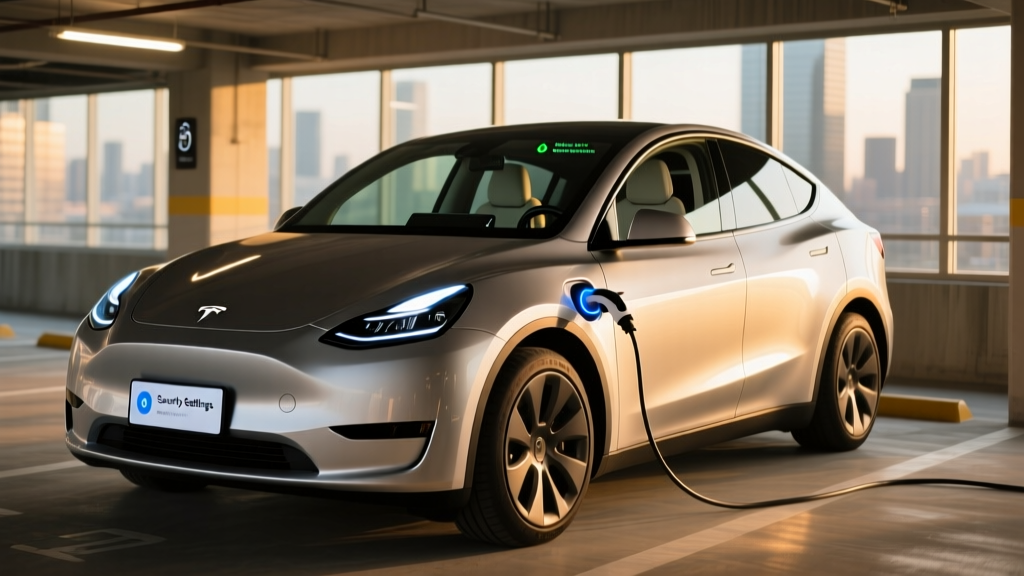
If you've been searching whether Tesla has an anti-theft device, the answer is yes — but not in the traditional sense of a steering-wheel lock or aftermarket alarm. Tesla vehicles, including the 2026 Model Y, rely on a layered digital security ecosystem rather than conventional hardware deterrents. The core pillars are Sentry Mode (a 360-degree camera surveillance system), GPS tracking with remote immobilization, PIN to Drive, and Phone Key authentication. Together, these systems make Tesla vehicles among the most trackable and recoverable EVs on the road.
But security is only part of the ownership equation. Below, we deliver a full review of the 2026 Tesla Model Y — the best-selling EV in America — covering its real-world range, charging speeds, pricing after federal tax credits, and how it stacks up against the Hyundai Ioniq 5 and Ford Mustang Mach-E.
Tesla's Anti-Theft & Security Features in Detail
Unlike legacy automakers that rely on immobilizer chips and audible alarms, Tesla built its security architecture around connectivity and software. Here's what protects a 2026 Model Y:
Sentry Mode
When parked and locked, Sentry Mode uses the vehicle's external cameras to monitor the surroundings. If a threat is detected — someone leaning on the car, attempting a break-in, or striking the vehicle — the system records video clips to a USB drive (or built-in storage in newer builds), flashes the headlights, and sends a push notification to the owner's phone. In 2026, Sentry Mode also supports live camera access remotely via the Tesla app, letting you view your car's surroundings in real time.
Power cost: Sentry Mode consumes roughly 200–300 watts continuously, which translates to about 1–2 miles of range lost per hour of use. Over a 24-hour park, expect to lose 5–8% of State of Charge. Tesla allows you to set a battery threshold (e.g., disable Sentry below 20% SoC) to protect your range.
GPS Tracking & Remote Immobilization
Every Tesla has a built-in cellular connection and GPS module. If your Model Y is stolen, you can track its real-time location through the Tesla app and share coordinates directly with law enforcement. Tesla support can also remotely disable the vehicle, preventing it from being driven once it's stopped. According to the IIHS and insurance industry data, Tesla vehicles consistently rank among the lowest theft-loss rates in their segments, largely because of this always-connected tracking.
PIN to Drive
This feature requires the driver to enter a 4-digit PIN on the touchscreen before the car can be driven — even if a valid key fob or phone key is present. It's a powerful defense against relay attacks (where thieves amplify a key fob signal from inside your home). You can configure PIN to Drive to activate only in specific scenarios, such as when the car is parked in unfamiliar locations.
Phone Key & Walk-Away Lock
The Tesla phone key uses Bluetooth Low Energy (BLE) to authenticate. The car automatically locks when you walk away and unlocks when you approach. Unlike traditional fobs, the BLE signal is harder to intercept with relay devices. Tesla also disabled the passive-entry feature for key cards (which must be tapped on the B-pillar), reducing the window for opportunistic theft.
Speed Limit Mode & Valet Mode
If you hand your car to a valet or a mechanic, Valet Mode restricts top speed to 70 mph, locks the glovebox and frunk, hides personal data from the touchscreen, and disables Sentry Mode access. Speed Limit Mode lets you cap maximum speed as low as 50 mph — useful for teen drivers.
2026 Tesla Model Y: Range, Battery, and Efficiency
EPA Estimated Range: 320 miles (Long Range AWD) | 290 miles (Performance) | 260 miles (RWD Standard Range)
Real-World Note: On highway trips at 75 mph in moderate temperatures, expect 275–295 miles from the Long Range AWD. In freezing conditions (below 30°F), range drops 15–25%, yielding roughly 220–250 miles on the highway. City driving with regenerative braking recovers energy and can match or slightly exceed the EPA sticker. The Model Y's heat pump (standard since 2021) significantly reduces cold-weather HVAC energy draw compared to resistive heaters.
| Specification | Long Range AWD | Performance AWD | RWD (Standard Range) |
|---|---|---|---|
| EPA Range | 320 mi | 290 mi | 260 mi |
| Battery Capacity (usable) | 75 kWh (NMC) | 75 kWh (NMC) | 60 kWh (LFP) |
| Efficiency (MPGe) | 122 MPGe combined | 115 MPGe combined | 128 MPGe combined |
| Energy Consumption | 28 kWh/100 mi | 30 kWh/100 mi | 26 kWh/100 mi |
| Drivetrain | Dual-Motor AWD | Dual-Motor AWD | Single-Motor RWD |
| Horsepower | 384 hp | 456 hp | 295 hp |
| 0–60 mph | 4.8 sec | 3.5 sec | 6.6 sec |
| Max DC Fast Charge | 250 kW | 250 kW | 175 kW |
| 10–80% DC Charge Time | ~25 min | ~25 min | ~30 min |
| Level 2 Home Charge Rate | 11.5 kW (~44 mi/hr) | 11.5 kW (~44 mi/hr) | 11.5 kW (~44 mi/hr) |
| Cargo Volume (rear seats up) | 30.2 cu ft | 30.2 cu ft | 30.2 cu ft |
| Cargo Volume (seats folded) | 72.1 cu ft | 72.1 cu ft | 72.1 cu ft |
| Rear Legroom | 41.6 in | 41.6 in | 41.6 in |
| Base MSRP | $47,990 | $52,990 | $44,990 |
Battery Chemistry: LFP vs. NMC in the Model Y Lineup
The 2026 Model Y RWD uses a lithium iron phosphate (LFP) battery, while Long Range and Performance trims use nickel manganese cobalt (NMC). The practical differences matter:
- LFP (RWD): Can be charged to 100% daily without accelerating degradation. Slightly lower energy density (hence the smaller kWh pack), but longer cycle life and lower fire risk. Heavier per kWh, which partially explains the RWD's lower range.
- NMC (Long Range/Performance): Higher energy density enables the 320-mile range. Tesla recommends daily charging to 80% and 100% only for road trips. Long-term degradation data from fleet studies shows roughly 8–12% capacity loss over 150,000 miles.
Charging: DC Fast, Home Level 2, and the Supercharger Advantage
| Charging Level | Power (kW) | Miles Added per Hour | Notes |
|---|---|---|---|
| Level 1 (120V household) | 1.4 kW | ~5 mi/hr | Emergency/trickle only; ~50+ hours for full charge |
| Level 2 (240V, Tesla Wall Connector) | 11.5 kW | ~44 mi/hr | Full charge in ~7 hours; ideal for daily home use |
| DC Fast (Tesla Supercharger V3) | 250 kW peak | ~1,000 mi/hr (peak) | 10–80% in ~25 min; tapers sharply above 80% |
| DC Fast (Supercharger V4) | 250 kW (current) | ~1,000 mi/hr (peak) | V4 cabinets deployed; cable-cooled for sustained speed |
Charging curve reality: The Model Y Long Range peaks at 250 kW only between roughly 10–30% SoC. From 30–60%, it sustains around 150–180 kW, then tapers to 60–80 kW above 60%. Above 80%, charging slows dramatically to protect the battery — expect 30+ minutes to go from 80–100% on DC. For road trips, the practical strategy is to charge to 80% and move on.
NACS connector: All 2026 Tesla vehicles use the native North American Charging Standard (NACS) port. With Ford, GM, Rivian, and most other automakers adopting NACS for 2025–2026, Tesla Superchargers are now the de facto national fast-charging network. Non-Tesla EVs with NACS ports can access select Supercharger stalls via Tesla's open network program.
Home charging cost: A Tesla Wall Connector costs $475 (equipment). Professional installation by a licensed electrician typically runs $500–$2,000 depending on panel capacity and run length. If your home has a 200-amp panel with spare capacity, expect the lower end. A panel upgrade to 200A can add $1,500–$3,000. At the national average electricity rate of $0.16/kWh, a full 75 kWh charge costs roughly $12 — compared to $50–$65 for a gas equivalent at 25 MPG and $3.50/gallon.
Pricing, Trims, and Federal Tax Credit Eligibility
| Trim | Base MSRP | Federal §30D Credit | Effective Price (if eligible) | Destination Fee |
|---|---|---|---|---|
| RWD (Standard Range) | $44,990 | Up to $7,500 | ~$37,490 | $1,390 |
| Long Range AWD | $47,990 | Up to $7,500 | ~$40,490 | $1,390 |
| Performance AWD | $52,990 | Up to $7,500 | ~$45,490 | $1,390 |
- MSRP Cap: SUVs must be priced at or below $80,000 (all Model Y trims qualify).
- Buyer Income Cap: Modified Adjusted Gross Income (MAGI) ≤ $150,000 (single), $225,000 (head of household), $300,000 (married filing jointly).
- Battery Sourcing: Increasing percentages of critical minerals and battery components must be sourced from the U.S. or FTA partners. Tesla has significantly localized supply chains via its Nevada and Texas battery plants, but verify current-year compliance on IRS.gov before purchase.
- Point-of-Sale Transfer: Since 2024, buyers can transfer the credit to the dealer at purchase, reducing the out-of-pocket price immediately — no need to wait for tax filing.
- U.S. Final Assembly: Vehicle must undergo final assembly in North America. All Model Y vehicles are assembled at Giga Texas or Giga Shanghai (U.S.-sold units are Texas-built).
Consult a tax professional for your specific eligibility. Rules are subject to legislative change. Source: IRS §30D
Performance, Tech, and Daily Ownership
Performance: The Model Y Performance does 0–60 mph in 3.5 seconds — sports-car territory in a crossover that seats five and hauls 72 cubic feet of cargo with seats folded. The Long Range AWD at 4.8 seconds is brisk for daily driving, while the RWD at 6.6 seconds is adequate but noticeably less punchy for highway merging.
Infotainment: The 2026 Model Y "Juniper" refresh features a 15.4-inch front touchscreen, an 8-inch rear passenger screen, ventilated front seats, ambient lighting, and a significantly improved suspension tuning over pre-2025 models. The minimalist interior remains polarizing — no physical buttons, no instrument cluster, and all climate/media controls live on the screen. Apple CarPlay and Android Auto are still not supported natively; Tesla's own interface handles navigation, media, and phone integration via Bluetooth.
Driver Assistance — Autopilot & FSD (Supervised):
Tesla Autopilot and Full Self-Driving (Supervised) are Level 2 driver-assist systems, meaning the driver must remain fully engaged, hands on the wheel (or providing torque input), and eyes on the road at all times. These are not self-driving systems. Only Level 4 robotaxi services like Waymo operate without a human driver in defined areas. Tesla's FSD (Supervised) offers impressive point-to-point navigation on highways and some city streets, but disengagements and interventions are still regularly required. See NHTSA guidance on automated vehicles.
Standard Autopilot includes Traffic-Aware Cruise Control and Autosteer (lane centering on highways). FSD (Supervised) is a $8,000 add-on or $99/month subscription that adds automatic lane changes, traffic light/stop sign recognition, and city-street navigation. As of early 2026, FSD remains under NHTSA scrutiny for its safety record and driver-monitoring adequacy.
Notable Drawbacks:
- No Apple CarPlay/Android Auto — a dealbreaker for some buyers accustomed to phone-mirrored interfaces.
- Minimalist interior lacks physical controls; even glovebox release and mirror adjustment are screen-based.
- Ride quality improved with Juniper but still firmer than the Hyundai Ioniq 5 or Kia EV6.
- Insurance premiums run 15–30% higher than comparable ICE crossovers due to repair costs and parts pricing.
- Panel gaps and paint quality have improved but still draw complaints from some owners.
Model Y vs. Competitors: Ioniq 5 and Mustang Mach-E
The Model Y's closest rivals are the Hyundai Ioniq 5 (310 mi EPA, starting ~$44,000) and the Ford Mustang Mach-E (310 mi extended-range, starting ~$43,000). The Model Y wins on Supercharger network access, cargo space, and over-the-air update cadence. The Ioniq 5 counters with 800V architecture (10–80% in ~18 minutes on 350 kW chargers), physical buttons, and CarPlay support. The Mach-E offers a more traditional crossover feel and Ford dealer service access.
- You want access to the Supercharger network for hassle-free road trips.
- Maximum cargo space (72 cu ft) is a priority for family hauling.
- You value OTA software updates and integrated digital security features.
- You prefer a minimalist, screen-centric interior.
- You want faster peak charging (Ioniq 5's 800V architecture).
- Apple CarPlay/Android Auto is non-negotiable.
- You prefer physical buttons and a more traditional cabin layout.
- Local dealer service access matters more than a direct-to-consumer model.
Warranty and Long-Term Ownership
Tesla provides a 4-year/50,000-mile basic vehicle warranty and an 8-year/120,000-mile battery and drive unit warranty for Long Range and Performance trims (8-year/100,000-mile for the RWD). The battery warranty guarantees retention of at least 70% capacity during the warranty period. Based on fleet data aggregated by sources like fueleconomy.gov and owner surveys, Model Y batteries typically retain 88–92% capacity at 100,000 miles with normal charging habits (daily 80% charge, occasional 100% for trips).
Replacement cost out of warranty: a Model Y battery pack replacement currently ranges from $12,000–$16,000 including labor, though prices continue to decline as cell manufacturing scales.
Pros and Cons
- Best-in-class Supercharger network access for road trips
- Industry-leading digital anti-theft suite (Sentry Mode, GPS tracking, PIN to Drive)
- 320-mile EPA range (Long Range) covers most commutes and trips comfortably
- 72 cu ft cargo space — largest in the compact EV SUV segment
- OTA updates continuously add features and improve performance
- Strong resale value relative to EV segment average
- Juniper refresh significantly improved ride comfort and cabin quality
- No Apple CarPlay or Android Auto
- All-screen interior frustrates buyers who want physical controls
- Insurance costs 15–30% above segment average
- FSD (Supervised) remains Level 2 despite the "Full Self-Driving" name
- RWD trim's LFP battery limits range to 260 miles
- DC fast charging peaks at 250 kW — slower than 800V rivals at 350 kW chargers
- Service center wait times can be long in some metro areas
Frequently Asked Questions
Does Tesla have an anti-theft device?
Yes. Tesla uses a multi-layer digital security system including Sentry Mode (360° camera surveillance), GPS tracking with remote immobilization, PIN to Drive, and Bluetooth phone key authentication. These systems collectively deter theft, record incidents, and enable vehicle recovery. There is no traditional audible alarm or steering-wheel lock.
Can a Tesla be stolen without the key?
It's extremely difficult. Relay attacks on traditional key fobs don't apply to Tesla's Bluetooth phone key in the same way. PIN to Drive adds a second authentication layer even if someone gains physical access. GPS tracking means a stolen Tesla can be located in real time and remotely immobilized by Tesla support.
What is the real-world range of the 2026 Tesla Model Y?
The Long Range AWD is EPA-rated at 320 miles. In real-world highway driving at 75 mph in mild weather, expect 275–295 miles. In freezing temperatures, highway range drops to approximately 220–250 miles. City driving with regenerative braking can match or exceed the EPA estimate.
How fast does the Model Y charge at home and on the road?
At home on a Level 2 Tesla Wall Connector (11.5 kW), the Model Y gains about 44 miles of range per hour, fully charging in roughly 7 hours. On a Tesla Supercharger V3/V4, it peaks at 250 kW and charges from 10–80% in approximately 25 minutes, though the charge curve tapers significantly above 80% SoC.
How much does the 2026 Model Y cost after the federal tax credit?
The Long Range AWD starts at $47,990. If you qualify for the full $7,500 federal §30D tax credit (subject to income caps, MSRP limits, and battery sourcing rules), the effective price drops to approximately $40,490 before destination fees. The credit can be transferred at point of sale to reduce your out-of-pocket cost immediately.
Does the Tesla Model Y qualify for the federal EV tax credit?
As of 2026, the Model Y qualifies for up to $7,500 under IRS §30D, provided the buyer meets income limits ($150K single / $300K joint), the vehicle MSRP is under $80,000 (all trims qualify), and battery sourcing requirements are met. Tesla has localized much of its battery supply chain, but verify current-year compliance on IRS.gov before purchasing.
Is the Model Y worth buying vs. the Ioniq 5 or Mach-E?
The Model Y is the strongest pick if Supercharger access, cargo space, and digital security features are your priorities. The Ioniq 5 is better for peak charging speed (800V architecture) and CarPlay support. The Mach-E suits buyers who prefer a traditional crossover feel and Ford dealer service. All three qualify for the federal credit and offer 290+ miles of range.