The 2026 Tesla Model Y arrives with a meaningful hardware upgrade that owners have requested for years: Tesla adaptive headlights are now standard across the lineup, replacing the fixed-beam units that drew criticism in earlier model years. Combined with the Juniper refresh's improved ride quality, quieter cabin, and revised interior, the Model Y remains the best-selling EV in the United States for good reason — but the competitive landscape has shifted dramatically. This review breaks down the exact numbers on range, charging speed, pricing, and federal tax credit eligibility so you can make a data-driven decision.
Quick Verdict: Who Should Buy the 2026 Model Y?
Choose the Model Y if: You want access to the Supercharger network (still the most reliable DC fast-charging ecosystem in North America), value over-the-air updates, need a practical family crossover with strong cargo space, and prioritize charging speed over luxury interior materials.
Look elsewhere if: You want a premium cabin on par with Genesis or BMW, need physical controls for climate and mirrors, or want Apple CarPlay/Android Auto integration. Consider the Hyundai Ioniq 5, Kia EV6, or Ford Mustang Mach-E for different trade-offs.
Range, Battery & Efficiency: The Real Numbers
The 2026 Model Y Long Range AWD carries a 75 kWh usable battery (NMC chemistry — nickel manganese cobalt), delivering an EPA-estimated 320 miles of range. The base Rear-Wheel Drive model uses a 60 kWh LFP (lithium iron phosphate) battery rated at 268 miles EPA.
EPA Range vs. Real-World Expectations:
• Model Y Long Range AWD: EPA 320 mi — expect ~280-295 mi in mixed driving, ~260-275 mi sustained highway at 70-75 mph, and ~240-255 mi in freezing temperatures with cabin heat.
• Model Y RWD: EPA 268 mi — expect ~230-245 mi mixed, ~210-225 mi highway, and ~190-205 mi in cold weather.
LFP batteries (RWD model) tolerate regular 100% charging without degradation concerns, while NMC packs (Long Range/Performance) benefit from daily charging limits of 80-90% per Tesla's recommendation.
| Spec | RWD | Long Range AWD | Performance AWD |
|---|---|---|---|
| EPA Range | 268 mi | 320 mi | 295 mi |
| Battery (usable) | 60 kWh (LFP) | 75 kWh (NMC) | 75 kWh (NMC) |
| Efficiency | 26 kWh/100mi (130 MPGe) | 25 kWh/100mi (135 MPGe) | 27 kWh/100mi (125 MPGe) |
| 0-60 mph | 5.8 sec | 4.8 sec | 3.5 sec |
| Horsepower | 295 hp | 384 hp | 456 hp |
| Drivetrain | RWD (single motor) | AWD (dual motor) | AWD (dual motor) |
| Top Speed | 135 mph | 135 mph | 155 mph |
Source: fueleconomy.gov and Tesla's official specifications.
Tesla Adaptive Headlights: What Changed and Why It Matters
The headline hardware update for the 2026 model year is the inclusion of Tesla adaptive headlights across all trims. Unlike the static projector units on pre-2025 models, the new matrix LED system can:
- Selectively dim individual LED segments to avoid blinding oncoming traffic while maintaining high-beam illumination elsewhere
- Swivel with steering input to illuminate curves up to approximately 15 degrees
- Adjust beam height automatically based on vehicle load and pitch
- Project turn-signal patterns onto the road surface during low-speed maneuvers
In practice, the adaptive headlights are a meaningful upgrade for rural and suburban drivers who regularly encounter unlit two-lane roads. On divided highways with overhead lighting, the benefit is less pronounced. The system is controlled entirely through software — no manual adjustment is needed — and Tesla has indicated via OTA updates that additional lighting patterns may be added over time. One limitation: the matrix high-beam assist still occasionally dims for reflective road signs, a quirk shared with similar systems from Audi and Mercedes-Benz.
Charging Speed: DC Fast Charge, Home Level 2 & the Supercharger Advantage
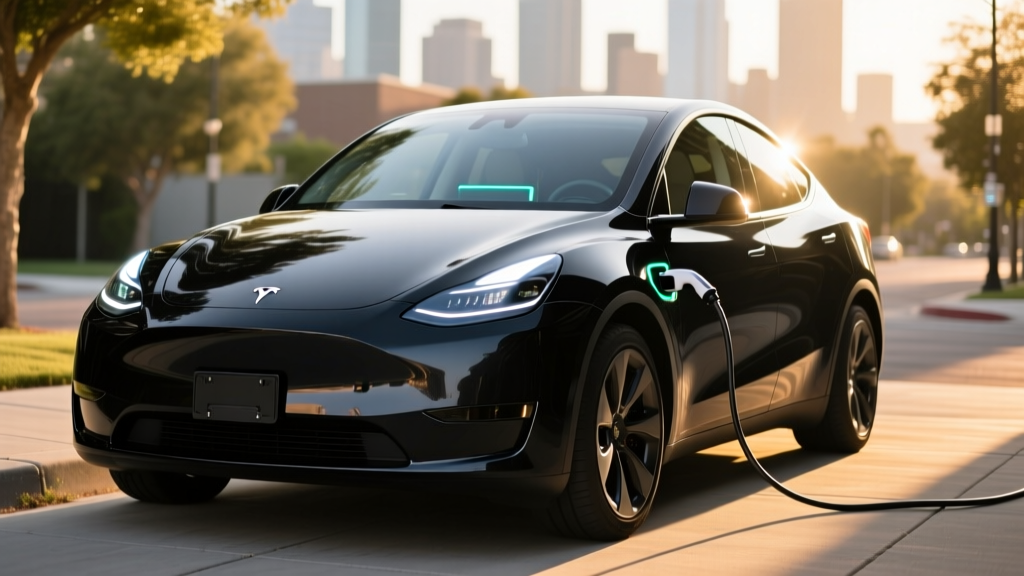
The Model Y uses the NACS (North American Charging Standard) connector natively — no adapter needed for Tesla Superchargers. With most major automakers transitioning to NACS through 2025-2026, the Model Y's native compatibility is now less of a differentiator, but the Supercharger network itself remains a significant advantage in reliability and coverage.
| Charging Level | Power / Rate | Speed | Notes |
|---|---|---|---|
| Level 1 (120V household) | ~1.4 kW | ~3-4 mi/hr | Emergency/trickle only |
| Level 2 (240V home, 48A) | 11.5 kW | ~37 mi/hr | Full charge overnight (~8-9 hrs for Long Range) |
| DC Fast Charge (Supercharger V4) | Peak 250 kW | 10-80% in ~25 min | Long Range; RWD peaks ~170 kW |
| DC Fast Charge (3rd-party CCS via adapter) | Up to 250 kW | Varies by station | Requires NACS-to-CCS adapter for Electrify America, etc. |
Charging curve reality: The Long Range AWD peaks at ~250 kW only between roughly 10-30% state of charge. From 30-60%, expect ~150-180 kW. Above 80%, the rate drops sharply to ~40-60 kW. This means the advertised 10-80% time of ~25 minutes is achievable at a V3 or V4 Supercharger with battery preconditioning enabled, but 10-90% will take closer to 40-45 minutes. The LFP-equipped RWD model has a lower peak rate (~170 kW) and a slightly longer 10-80% window of ~30 minutes, though LFP chemistry allows frequent 100% charging without the same degradation concerns.
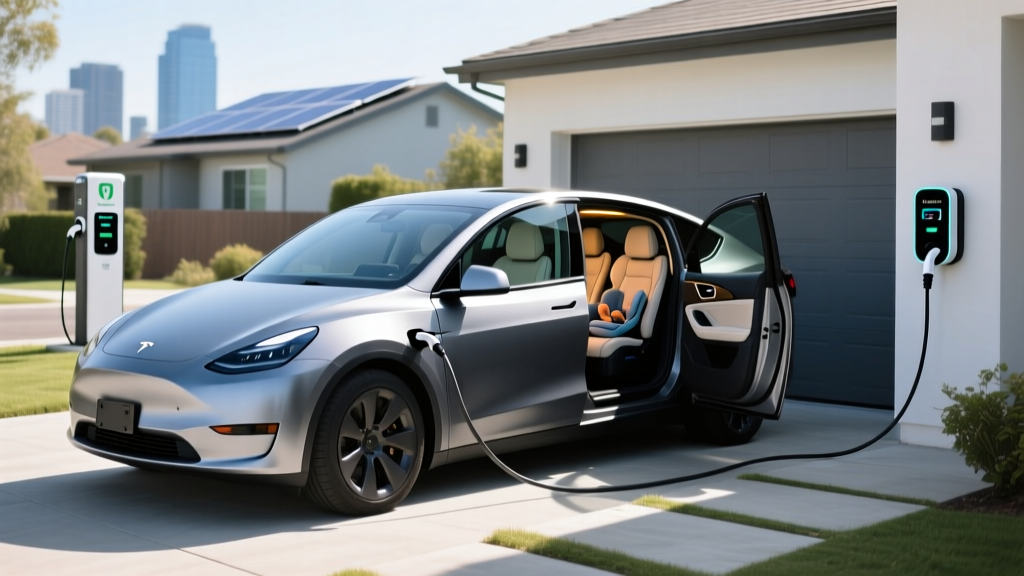
Home charging setup: Tesla's Wall Connector ($420) is a 48-amp, hardwired Level 2 unit delivering 11.5 kW. Budget $600-$1,800 for professional installation on an existing 60A circuit, or $1,500-$3,500+ if your electrical panel needs an upgrade to 200A service. Consult a licensed electrician for your specific situation.
Pricing, Trims & Federal Tax Credit Eligibility
| Trim | Base MSRP | Est. §30D Credit | Effective Price (if eligible) |
|---|---|---|---|
| RWD | $44,990 | Up to $7,500 | ~$37,490 |
| Long Range AWD | $48,990 | Up to $7,500 | ~$41,490 |
| Performance AWD | $53,990 | Up to $7,500 | ~$46,490 |
Federal tax credit rules (§30D) — critical caveats:
- MSRP cap: SUVs/crossovers must be under $80,000 — all Model Y trims qualify.
- Buyer income cap: Modified AGI must not exceed $150,000 (single), $225,000 (head of household), or $300,000 (joint). Exceed these and you lose the credit entirely.
- Battery sourcing: The $7,500 credit splits into two halves — $3,750 for critical-minerals sourcing and $3,750 for battery-component manufacturing. Tesla's Fremont-built Model Y has met the full $7,500 threshold for recent model years, but sourcing requirements tighten annually. Verify current eligibility on IRS.gov before purchasing.
- Point-of-sale transfer: Since 2024, you can transfer the credit to the dealer at purchase, reducing your out-of-pocket cost immediately rather than waiting for a tax refund. Tesla supports this at checkout.
Always confirm eligibility with a tax professional. Rules are subject to change and depend on your individual tax situation, the vehicle's VIN-specific battery sourcing, and the purchase date.
Interior, Cargo, Tech & the Adaptive Headlight Experience
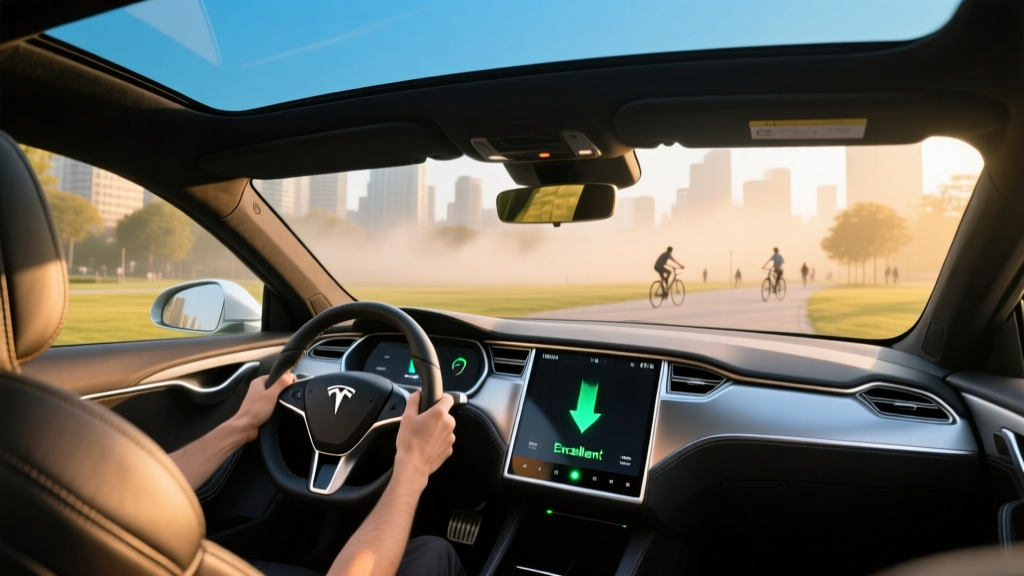
The Juniper-generation Model Y interior is noticeably improved over the 2020-2024 models. Ventilated front seats, ambient lighting, a rear-seat touchscreen, and substantially improved sound insulation make the cabin feel a tier above the outgoing car. However, it still relies on a single 15.4-inch center touchscreen for virtually all controls — no physical buttons for climate, mirrors, or glovebox.
Cargo and passenger dimensions:
- Cargo (behind 2nd row): 30.2 cu ft
- Cargo (2nd row folded): 72.1 cu ft
- Frunk (front trunk): 4.1 cu ft
- Rear legroom: 40.5 inches
- Front headroom: 40.8 inches
The Juniper refresh introduced a power-folding second row (accessible via the rear touchscreen or the Tesla app), a full-width light bar up front, and a rear cargo camera integrated into the backup display. The 15-speaker audio system is excellent for the price class.
Driver assistance: Basic Autopilot (lane-centering + adaptive cruise) is standard. Full Self-Driving (Supervised) remains a $8,000 option or $99/month subscription. FSD is a SAE Level 2 system — it does not make the car self-driving, and the driver must remain fully engaged at all times. Tesla's vision-only approach (no lidar or radar) continues to draw scrutiny, and real-world performance varies significantly by geography, weather, and road-marking quality.
ADAS Limitation Warning: Tesla Autopilot and FSD (Supervised) are SAE Level 2 driver-assistance systems. They require continuous driver supervision, hands-on-wheel (or torque) monitoring, and visual attention. They do NOT handle all driving scenarios, construction zones, or adverse weather reliably. The driver is legally and practically responsible for the vehicle at all times.
Warranty, Ownership Costs & Long-Term Outlook
Tesla's warranty coverage for the 2026 Model Y:
- Basic vehicle: 4 years / 50,000 miles
- Battery & drive unit (Long Range/Performance): 8 years / 120,000 miles, with minimum 70% capacity retention
- Battery & drive unit (RWD/LFP): 8 years / 100,000 miles, with minimum 70% capacity retention
The 70% retention threshold is industry-standard but worth noting — if your battery degrades to 71% over eight years, Tesla owes you nothing. In practice, Tesla's NMC batteries have shown ~10-12% degradation at 100,000 miles based on fleet data, and LFP packs tend to degrade more slowly in terms of capacity but may show more variance in state-of-charge accuracy.
Insurance: Model Y insurance premiums remain above the EV average. Expect $1,800-$2,800/year depending on your state, driving record, and coverage level. Tesla offers its own insurance product in many states, which uses real-time driving data (the "Safety Score") to set monthly premiums — this can be cheaper for safe drivers but more expensive for those with hard braking or aggressive steering events.
Maintenance: Minimal — cabin air filter replacement (~$50-80 every 2 years), tire rotation, wiper fluid, and brake fluid checks. Expect to replace tires more frequently than on ICE vehicles due to the Model Y's weight (~4,300 lbs for Long Range) and instant torque. A set of four 255/45R19 all-seasons runs $800-$1,200.
Pros and Cons
Pros
- Supercharger network — still the gold standard for reliability and coverage
- Adaptive matrix headlights are a genuine safety upgrade for 2026
- Class-leading efficiency (25 kWh/100mi Long Range)
- OTA updates continuously add features and refinements
- Strong cargo capacity with power-folding rear seats
- Excellent DC fast-charge speed (250 kW peak)
- Qualifies for full $7,500 federal tax credit (verify sourcing annually)
Cons
- No physical controls — everything runs through the touchscreen
- No Apple CarPlay or Android Auto
- Ride quality improved but still firm over sharp impacts
- Insurance premiums above segment average
- Vision-only ADAS struggles in heavy rain, fog, and faded lane markings
- Rear visibility is limited; relies heavily on cameras
- Build quality improved but still inconsistent panel gaps reported
How the Model Y Stacks Up Against Competitors
The crossover EV segment in 2026 is crowded. Here's how the Model Y Long Range AWD compares on key specs:
| Spec | Tesla Model Y LR AWD | Hyundai Ioniq 5 LR AWD | Ford Mustang Mach-E ER AWD |
|---|---|---|---|
| EPA Range | 320 mi | 305 mi | 312 mi |
| Battery | 75 kWh (NMC) | 84 kWh (NMC) | 91 kWh (NMC) |
| Peak DC Charge | 250 kW | 238 kW | 150 kW |
| 10-80% DC Time | ~25 min | ~20 min | ~38 min |
| 0-60 mph | 4.8 sec | 5.0 sec | 5.1 sec |
| Base MSRP (AWD) | $48,990 | $50,200 | $49,995 |
| Native Connector | NACS | NACS (2025+) | NACS (2025+) |
| Adaptive Headlights | Standard | Standard (Limited+) | Optional |
The Model Y's efficiency advantage (smaller battery, same or better range) translates to lower charging costs over time. The Ioniq 5 charges slightly faster from 10-80% thanks to its 800V architecture, and the Mach-E offers a more conventional interior with physical buttons. All three now use NACS, so the Supercharger exclusivity advantage has narrowed — but Tesla's network uptime and stall density still lead.
Frequently Asked Questions
What is the real-world range of the 2026 Tesla Model Y?
The EPA rates the Long Range AWD at 320 miles and the RWD at 268 miles. In real-world mixed driving, expect roughly 280-295 miles (Long Range) and 230-245 miles (RWD). Sustained highway driving at 75 mph drops range to approximately 260-275 miles for Long Range. In freezing weather with cabin heat, plan for 240-255 miles from the Long Range and 190-205 from the RWD. Preconditioning the battery and using seat heaters instead of cabin heat can recover 10-15 miles in cold conditions.
How fast does the Model Y charge at home and on the road?
At home on a 240V Level 2 Tesla Wall Connector (48A), the Model Y charges at 11.5 kW, adding roughly 37 miles of range per hour — a full Long Range charge takes about 8-9 hours from empty. On a V3/V4 Supercharger, the Long Range peaks at 250 kW and charges from 10-80% in approximately 25 minutes. The RWD (LFP battery) peaks at ~170 kW with a 10-80% time of ~30 minutes. Above 80%, charging slows significantly to protect battery health — plan to charge to 80% on road trips and move on rather than waiting for a full charge.
How much does the 2026 Model Y cost after the federal tax credit?
The Model Y RWD starts at $44,990, the Long Range AWD at $48,990, and the Performance at $53,990. If you qualify for the full $7,500 §30D federal tax credit (income under the caps, vehicle meets battery sourcing requirements), effective prices drop to approximately $37,490 / $41,490 / $46,490 respectively. You can apply the credit at point of sale through Tesla's checkout process. Always verify current eligibility on IRS.gov and consult a tax professional, as sourcing requirements tighten annually.
Does the 2026 Model Y qualify for the federal EV tax credit?
As of the 2026 model year, the Tesla Model Y has qualified for the full $7,500 §30D credit. However, eligibility depends on three factors: (1) your income must fall below the AGI caps ($150K single / $300K joint), (2) the vehicle MSRP must be under $80,000 (all trims qualify), and (3) the battery must meet critical-mineral and component-sourcing thresholds that tighten each year. Tesla has historically met these requirements, but always verify the specific VIN's eligibility before purchase.
Are Tesla's adaptive headlights worth the upgrade?
If you frequently drive on unlit rural or suburban roads, yes — the matrix LED system provides meaningfully better nighttime visibility without blinding oncoming traffic. For primarily urban and well-lit highway driving, the benefit is modest. The adaptive headlights are now standard equipment on all 2026 Model Y trims, so there's no additional cost to weigh — they're included in the base price.
Is the Model Y worth buying vs. the Ioniq 5 or Mach-E?
The Model Y wins on efficiency (lower kWh per mile means lower charging costs), Supercharger network access, and over-the-air feature updates. The Hyundai Ioniq 5 offers a more spacious rear seat, 800V ultra-fast charging, and available physical buttons. The Ford Mach-E provides a more traditional driving experience and better dealership service infrastructure. If Supercharger reliability and lowest cost-per-mile are your priorities, the Model Y remains the strongest choice. If interior quality, ride comfort, or physical controls matter more, test-drive the Ioniq 5 and Mach-E before committing.
Sources: fueleconomy.gov, IRS.gov §30D Clean Vehicle Credits, Tesla Model Y specifications. All specifications reflect 2026 model year data available at time of publication. Tax credit eligibility is subject to change — verify before purchase.