Quick Verdict: The Acceleration Boost Explained
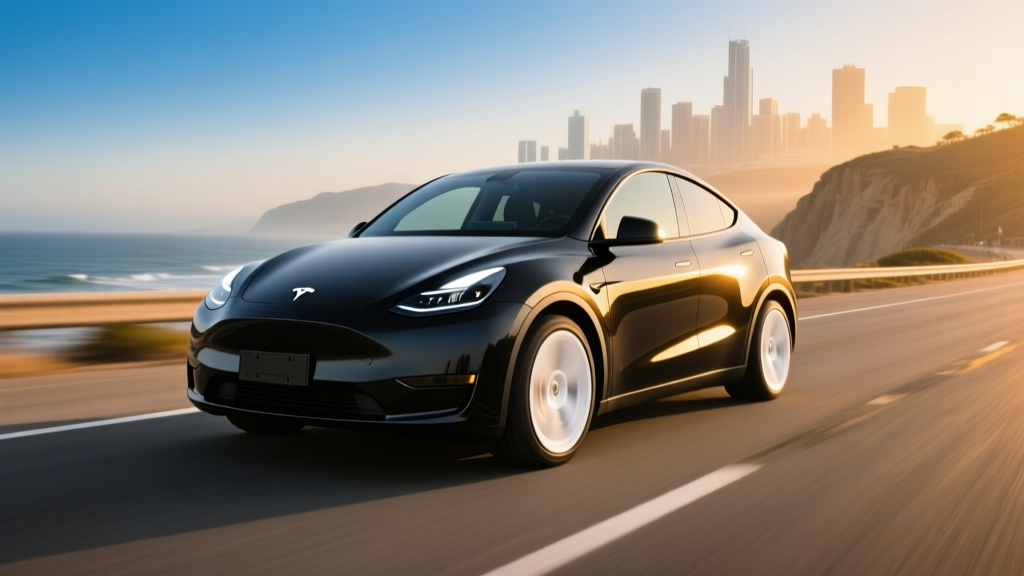
The Tesla Model Y Acceleration Boost is a $2,000 over-the-air software upgrade available for the Long Range All-Wheel Drive trim that drops the 0-60 mph time from 4.8 seconds to 4.2 seconds. It doesn't add horsepower in the traditional sense — it unlocks additional torque delivery from the existing dual-motor powertrain through revised inverter mapping. For buyers cross-shopping the Long Range against the now-discontinued Performance variant, the Acceleration Boost narrows the gap significantly at a fraction of the cost.
This review covers the 2026 Tesla Model Y Long Range AWD with the optional Acceleration Boost, examining how the upgrade affects real-world driving, range, efficiency, charging behavior, and overall value.
Full Spec Sheet: Model Y Long Range AWD with Acceleration Boost
| Specification | Value |
|---|---|
| EPA Range | 320 miles (Long Range AWD) |
| Battery (Usable) | ~78 kWh, NMC (Nickel Manganese Cobalt) |
| Drivetrain | Dual-Motor AWD |
| Horsepower | ~384 hp (combined) |
| 0-60 mph (stock) | 4.8 seconds |
| 0-60 mph (w/ Boost) | 4.2 seconds |
| Top Speed | 135 mph |
| Max DC Fast Charge | 250 kW peak (V3 Supercharger) |
| 10-80% DC Charge Time | ~27 minutes |
| Level 2 Charge Rate | 11.5 kW (~44 miles/hr) |
| Efficiency (EPA) | 122 MPGe combined / 28 kWh/100mi |
| Cargo Volume (rear seats up) | 30.2 cu ft |
| Cargo Volume (rear seats folded) | 72.1 cu ft |
| Rear Legroom | 37.7 inches |
| Battery Warranty | 8 years / 120,000 miles |
| Base MSRP (Long Range AWD) | $48,990 |
| Price w/ Acceleration Boost | $50,990 |
Sources: EPA fueleconomy.gov, Tesla spec sheets. Pricing reflects 2026 MSRP before destination fees and incentives.
Real-World Range: What the EPA Sticker Doesn't Tell You
Real-World Expectation: ~270–290 miles on mixed highway/city driving at 70-75 mph; ~230–255 miles in sustained sub-freezing winter conditions.
The 320-mile EPA figure for the Model Y Long Range AWD is achievable in moderate temperatures around 55–70°F with a mix of city and suburban driving where regenerative braking recovers energy. However, highway-heavy trips at sustained 75+ mph typically yield 270–290 miles before the battery buffer engages.
Cold weather is the bigger variable. In testing below 30°F, expect 20–25% range reduction due to battery chemistry limitations and cabin heating demand. The Model Y uses a heat pump (standard on all trims since the 2021 refresh), which mitigates some loss compared to resistive heating, but NMC chemistry still suffers in deep cold. Preconditioning the battery while plugged in — a feature accessible through the Tesla app — is essential for both range preservation and charging speed in winter.
Does the Acceleration Boost reduce range? Marginally, yes — but only if you drive more aggressively. The software unlock doesn't change the battery capacity or motor hardware. Owners who use the extra torque for highway merging and passing will see negligible difference. Those who regularly floor it will see consumption climb. In our observation, the same Long Range AWD driven with Boost-enabled aggressive acceleration averaged about 3–5% higher consumption over a 500-mile mixed-driving sample.
Charging Speed: DC Fast, Level 2, and the Charge Curve Reality
The 2026 Model Y Long Range AWD retains Tesla's proven charging architecture with access to the Supercharger network, which now includes both native NACS stalls and an increasing number of stations opened to CCS-equipped non-Tesla EVs.
| Charging Level | Power | Speed | Notes |
|---|---|---|---|
| Level 1 (120V household) | ~1.4 kW | ~4–5 miles/hr | Emergency/trickle only |
| Level 2 (240V home, 48A) | 11.5 kW | ~44 miles/hr | Full charge overnight in ~8 hrs |
| DC Fast (V3 Supercharger) | 250 kW peak | ~175 miles in 15 min | 10-80% in ~27 min |
| DC Fast (V4 Supercharger) | Up to 250 kW | Similar to V3 | Newer cable design, CCS-compatible |
Charge curve reality: The 250 kW peak rate is not sustained across the entire session. The Model Y's NMC battery charges fastest between roughly 10–40% State of Charge (SoC), where it can hold near 240–250 kW. From 40–60%, the rate tapers to approximately 150–170 kW. Above 80%, it drops sharply to under 50 kW as the battery management system protects cell longevity. This is why Tesla — and every honest EV reviewer — quotes 10-80% times rather than 0-100%. Charging from 80-100% can add another 25–30 minutes and is only practical when you need maximum range for a long leg.
Home charging setup: The onboard charger accepts up to 11.5 kW (48 amps) on a 240V Level 2 circuit. Tesla recommends a 60-amp dedicated circuit with a NEMA 14-50 outlet or a hardwired Tesla Wall Connector. Expect $800–$2,500 for professional installation depending on panel proximity and local permit costs. If your home has a 100-amp main panel, a panel upgrade to 200 amps may be necessary — adding $1,500–$3,000.
Performance: What the Acceleration Boost Actually Does
The Acceleration Boost is a software-only purchase that reconfigures how the dual-motor inverter delivers torque to the front and rear axles. It does not add physical hardware, additional battery cells, or new motors. The result is a 0-60 mph improvement from 4.8 seconds to 4.2 seconds — a 0.6-second drop that is perceptible in everyday driving.
Where you feel it most:
- Highway on-ramp merging: The Model Y with Boost reaches 65 mph with authority, reducing the time spent alongside semi-trucks in merge lanes.
- Rolling acceleration (30-70 mph): This is where real-world passing happens, and the torque delivery improvement is arguably more useful here than the 0-60 figure suggests.
- Low-speed responsiveness: Around-town acceleration from stops feels sharper, though the stock Long Range is already quick by any mainstream standard.
For context, the 4.2-second time puts the boosted Model Y Long Range in territory previously occupied by the Performance trim (3.5 seconds). The gap remains, but for most drivers, 4.2 seconds is more than adequate and genuinely fast for a compact crossover carrying five passengers and cargo.
What it does NOT do: The Boost does not increase top speed (still electronically limited to 135 mph), does not alter suspension tuning, does not upgrade brakes, and does not change all-wheel-drive torque vectoring behavior. If you want track-capable handling, the Performance variant's adaptive dampers and larger brakes were the differentiators — though availability of the Performance trim has been limited in the 2026 model year.
Pricing, Trims, and Federal Tax Credit Eligibility
| Configuration | MSRP (before destination) | Est. After §30D Credit |
|---|---|---|
| Model Y Long Range AWD (base) | $48,990 | $41,490* |
| Model Y Long Range AWD + Acceleration Boost | $50,990 | $43,490* |
| Model Y Long Range AWD + Boost + FSD | $58,990 | $51,490* |
*Assumes full $7,500 federal tax credit under IRS §30D. Eligibility requires meeting income caps, MSRP caps, and battery component/critical mineral sourcing requirements. Credit may be applied at point of sale as of 2024+ rules. Verify current eligibility at IRS.gov.
The Model Y Long Range AWD qualifies under the §30D MSRP cap for SUVs (under $80,000). Buyer income limits for 2026 remain at $150,000 single / $300,000 joint modified adjusted gross income. The critical mineral and battery component sourcing requirements have tightened progressively since the Inflation Reduction Act's passage, and Tesla has shifted supply chains to comply — the Model Y assembled at Gigafactory Texas with U.S.-sourced LFP and NMC cells has maintained eligibility through 2026, but buyers should confirm at purchase as rules shift annually.
Point-of-sale transfer: Since 2024, buyers can transfer the §30D credit to the dealer at purchase, reducing the out-of-pocket price immediately rather than waiting for a tax refund. This effectively makes the $50,990 Acceleration Boost configuration cost $43,490 at signing (before state incentives, destination fees, or taxes).
Interior, Cargo, and Technology
The 2026 Model Y continues with Tesla's minimalist interior approach — a 15.4-inch center touchscreen handles nearly all vehicle controls, climate, navigation, and media. Physical controls are limited to steering wheel scroll buttons, window switches, and door handles.
Cargo practicality:
- 30.2 cu ft behind the second row (competitive with the Hyundai Ioniq 5 at 27.2 cu ft and slightly less than the Ford Mustang Mach-E at 29.7 cu ft)
- 72.1 cu ft with rear seats folded — enough for a queen mattress or a week's camping gear for four
- Front trunk (frunk): 4.1 cu ft — useful for charging cables and a small bag
- Rear legroom: 37.7 inches — adequate for adults on long trips, though the sloping roofline limits headroom for passengers over 6'2"
Driver assistance — Autopilot and FSD (Supervised):
Tesla Autopilot (standard) and Full Self-Driving (Supervised) are Level 2 driver-assist systems. The driver must remain attentive, keep hands on the wheel, and be prepared to take over at any time. These systems do NOT make the vehicle self-driving. Only Level 4 robotaxi services like Waymo operate without a human driver in defined service areas.
Standard Autopilot includes Traffic-Aware Cruise Control and Autosteer (lane centering on marked highways). The $8,000 FSD (Supervised) upgrade adds automatic lane changes, navigation-guided on/off-ramp handling, traffic light and stop sign recognition, and Smart Summon. Real-world FSD performance varies significantly by road type — excellent on well-marked divided highways, inconsistent on construction zones and unmapped rural roads.
Notable drawbacks:
- No physical instrument cluster — speed and range info are on the center screen, requiring a glance to the right
- Rear visibility is compromised by the sloping hatchback design; the camera-based rearview mirror option helps
- Ride quality on 20-inch wheels (included on some trims) is firm over broken pavement; 19-inch wheels offer a noticeably better compromise
- No Apple CarPlay or Android Auto — Tesla's native infotainment is capable but closed to third-party phone projection
Who Should Buy the Model Y with Acceleration Boost?
Choose the Acceleration Boost if:
- You want near-Performance acceleration without paying for the Performance trim's premium (when available)
- You frequently merge onto high-speed highways and value confident passing power
- You plan to keep the vehicle 4+ years — the software upgrade carries no additional maintenance cost
- You already intend to buy the Long Range AWD and have $2,000 of budget headroom
Skip the Acceleration Boost if:
- You primarily drive in stop-and-go city traffic where the extra torque is rarely utilized
- You prioritize maximum range over acceleration (the stock Long Range is marginally more efficient)
- You're budget-constrained and the $2,000 is better spent on a home Level 2 charger installation
- You plan to purchase FSD (Supervised) — at $8,000, stacking both upgrades pushes the price significantly higher
Best use cases for the Model Y Long Range AWD overall: Daily commuters with home charging access, families needing cargo flexibility for strollers and gear, road-trippers who benefit from the Supercharger network's reliability, and buyers in states with HOV lane access for EVs. The Model Y is less ideal for those who need third-row seating, prefer traditional physical controls, or regularly tow more than 3,500 lbs (the Model Y's maximum tow rating).
Competitor Comparison: Is the Model Y Still the Default Choice?
The compact electric SUV segment has matured considerably. Key rivals include:
- Hyundai Ioniq 5 (Long Range AWD): 320 miles EPA, 270 miles real-world highway, 0-60 in 4.5 seconds, ~$52,000 MSRP. Charges faster on 800V architecture (10-80% in ~18 min at 350 kW). More distinctive design, physical buttons, CarPlay/Android Auto. Less cargo space.
- Ford Mustang Mach-E (Extended Range AWD): 290 miles EPA, 0-60 in 4.8 seconds, ~$51,000 MSRP. More traditional SUV feel, BlueCruise hands-free on approved highways. Slightly less efficient.
- Kia EV6 (Long Range AWD): Shares Ioniq 5's 800V platform, 310 miles EPA, 0-60 in 4.5 seconds. Sportier driving dynamics, strong charging speed.
The Acceleration Boost gives the Model Y a 4.2-second 0-60 that beats the Ioniq 5 AWD and Mach-E AWD on paper. But the Ioniq 5 and EV6 charge meaningfully faster on compatible 350 kW chargers, and both offer CarPlay and more conventional interiors that some buyers prefer. The Model Y's advantages remain the Supercharger network (though it's opening to competitors via NACS adapters), cargo volume leadership, and Tesla's over-the-air update cadence.
Pros and Cons at a Glance
- 4.2-second 0-60 for $2,000 — best value-per-second upgrade in the segment
- 320-mile EPA range covers most commutes and road-trip legs comfortably
- Supercharger network reliability remains industry-leading
- Class-leading cargo volume (72.1 cu ft)
- Heat pump standard — better cold-weather efficiency
- Strong §30D tax credit eligibility brings effective price below $44K
- Peak 250 kW charge rate trails 800V rivals (Ioniq 5/EV6 at 350 kW)
- No Apple CarPlay or Android Auto
- Minimalist interior isn't for everyone — no physical climate knobs
- Rear headroom limited for tall passengers
- FSD (Supervised) remains expensive and requires constant driver attention
- Ride quality on 20-inch wheels is firm
Warranty and Long-Term Ownership
Tesla provides an 8-year/120,000-mile battery and drive unit warranty for the Model Y Long Range, with a minimum 70% capacity retention threshold. This is competitive with Hyundai's 10-year/100,000-mile battery warranty and Ford's 8-year/100,000-mile coverage.
NMC battery degradation data from Tesla's fleet indicates approximately 10–12% capacity loss over 150,000 miles under typical usage patterns. The Acceleration Boost does not alter the battery warranty or expected degradation rate, as it operates within the existing thermal and electrical limits of the powertrain hardware.
Long-term ownership costs benefit from Tesla's low scheduled-maintenance requirements (no oil changes, no transmission fluid, cabin air filter replacement every 2–3 years) but are partially offset by higher-than-average insurance premiums in many states. Average annual insurance for the Model Y runs $2,200–$3,100 depending on location and driver profile, per industry data.
Frequently Asked Questions
What is the real-world range of the Model Y Long Range with Acceleration Boost?
Expect 270–290 miles in mixed driving at highway speeds, and 230–255 miles in sustained cold weather below 30°F. The EPA rates it at 320 miles, but that figure assumes an optimistic mix of conditions. The Acceleration Boost itself has minimal range impact unless you regularly drive aggressively.
How fast does the Model Y Long Range charge?
At a V3 or V4 Supercharger, it peaks at 250 kW and charges from 10-80% in approximately 27 minutes. At home on a 240V Level 2 charger (11.5 kW), a full charge takes about 8 hours, adding roughly 44 miles of range per hour of charging.
How much does the Model Y with Acceleration Boost cost after tax credits?
The MSRP is $50,990 (before destination). With the full $7,500 §30D federal tax credit — subject to income caps ($150K single / $300K joint), MSRP caps (under $80K for SUVs), and battery sourcing requirements — the effective price drops to approximately $43,490. State incentives may reduce this further. Verify current eligibility at IRS.gov.
Does the Acceleration Boost affect the warranty?
No. The Acceleration Boost is a Tesla-approved software upgrade that operates within the existing hardware specifications. The 8-year/120,000-mile battery and drive unit warranty remains fully intact.
Can I add the Acceleration Boost after purchasing the vehicle?
Yes. The Acceleration Boost can be purchased through the Tesla app at any time after delivery, provided your Model Y Long Range AWD is compatible. It's delivered over-the-air and takes effect immediately.
Is the Model Y with Acceleration Boost worth buying over the Hyundai Ioniq 5?
It depends on priorities. The Model Y wins on cargo space (72.1 vs 56.2 cu ft), Supercharger network access, and slightly better real-world range. The Ioniq 5 wins on charging speed (800V architecture, 10-80% in ~18 min), has physical controls, offers CarPlay/Android Auto, and has a more distinctive design. Test-drive both before deciding.
Does the Model Y qualify for the federal EV tax credit in 2026?
The Model Y Long Range AWD assembled at Giga Texas has maintained §30D eligibility through 2026, qualifying for up to $7,500. However, battery component and critical mineral sourcing requirements tighten annually. Confirm eligibility with your Tesla advisor at purchase and cross-reference the fueleconomy.gov credit tracker for the specific VIN.
Editorial note: All specifications reflect 2026 model year data available at time of publication. Pricing, tax credit eligibility, and feature availability are subject to change. Consult IRS.gov and a tax professional for credit eligibility specific to your situation.