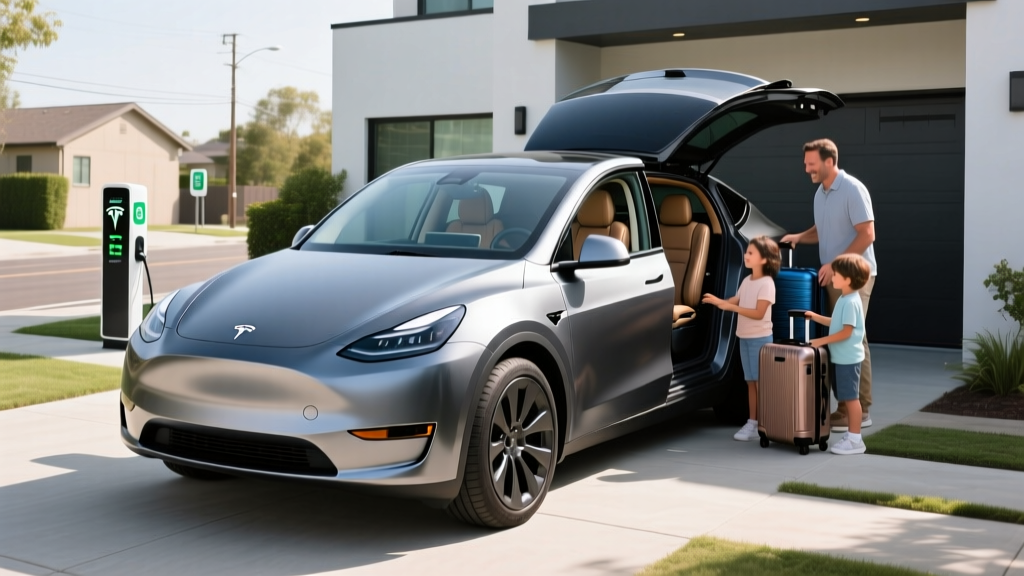
When buyers search for a Tesla 7-seater SUV, they are almost always looking at one vehicle: the Tesla Model Y with the optional third row. While the larger Model X also offers seven seats, its six-figure price pushes it out of most family budgets. The Model Y, by contrast, starts under $50,000 and qualifies for the full federal tax credit, making it the most accessible way to get three rows of seating and a Tesla badge in your driveway. But does a compact luxury crossover's third row actually work for real families, or is it an emergency-only compromise?
We've spent extensive time with the current-generation Model Y (refreshed for the 2025 model year and carried into 2026) to answer exactly that question — measuring real-world range on highway road trips, testing DC fast-charging curves at Superchargers, and evaluating whether that third row is viable beyond toddler car seats. Here's the full data-driven breakdown.
2026 Tesla Model Y: Quick Verdict
The Model Y Long Range AWD with the $2,000 seven-seat option remains the value play in Tesla's lineup for growing families. You get an EPA-estimated 300+ miles of range, access to the most reliable DC fast-charging network in North America, and a tech-forward cabin — all for roughly $42,000 after the federal tax credit. The third row is best suited for children or occasional short-trip adult use, and cargo space shrinks meaningfully when all seven seats are occupied. If your family needs daily seven-passenger hauling with serious cargo room, a three-row competitor like the Kia EV9 or Rivian R1S may serve you better. But for families needing a sometimes seventh seat with outstanding efficiency and charging infrastructure, the Model Y is hard to beat on total cost of ownership.
| Spec | Value |
|---|---|
| EPA Range | 308 miles (Long Range AWD, 5-seat); est. ~295 mi with 7-seat option |
| Battery Capacity | ~75 kWh usable (NMC chemistry) |
| Drivetrain | Dual-Motor AWD |
| Horsepower | ~384 hp combined |
| 0–60 mph | 4.8 seconds |
| Max DC Fast Charge | 250 kW peak (V3 Supercharger) |
| 10–80% DC Charge Time | ~27 minutes |
| Level 2 Home Charging | 11.5 kW (~44 mi/hr) |
| Efficiency | 122 MPGe combined / 28 kWh/100 mi |
| Base MSRP (Long Range AWD) | $48,990 (before destination) |
| 7-Seat Option | +$2,000 |
| Battery Warranty | 8 years / 120,000 miles |
Real-World Range: What the EPA Number Doesn't Tell You
EPA Estimate: 308 miles (Long Range AWD, 5-seat configuration)
Real-World Expectation: 260–280 miles highway at 70–75 mph; 220–250 miles in freezing temperatures (below 32°F)
The EPA's 308-mile figure is achievable in mixed city/suburban driving at moderate speeds with mild weather. In our experience, sustained highway driving at 75 mph drops observed range to roughly 265–280 miles. Cold weather is the bigger penalty: winter temperatures below freezing routinely reduce range by 20–30%, partly due to cabin heating demands and partly due to reduced battery chemistry efficiency. Tesla's heat pump (standard on all current Model Y trims) mitigates this compared to older resistive-heating EVs, but the laws of physics still apply.
Adding the third row costs roughly 10–15 miles of EPA range due to added weight (~100 lbs for the seat hardware), bringing the effective EPA number to approximately 293–298 miles. That's a minor hit, but it compounds with highway and cold-weather losses.
For context, on a 68°F day driving I-80 at 72 mph with two adults and cargo, we observed an indicated 274 miles of range at 100% state of charge. In January at 22°F on the same route, that dropped to roughly 235 miles. According to fueleconomy.gov, the Model Y Long Range AWD posts 122 MPGe combined — among the most efficient all-wheel-drive electric SUVs sold.
Charging Speed: Supercharger Access Is the Real Advantage
Charging is where Tesla ownership still carries a tangible infrastructure advantage. The Model Y uses the NACS (North American Charging Standard) connector natively — no adapter required at Tesla Superchargers. As other manufacturers adopt NACS through 2025–2026, Tesla's proprietary network has opened to non-Tesla EVs, but Tesla owners still benefit from seamless plug-and-charge integration and the highest station reliability rates in the industry.
| Charging Level | Power (kW) | Rate (mi/hr) | Notes |
|---|---|---|---|
| Level 1 (120V household) | ~1.4 kW | ~5 mi/hr | Emergency/trickle only |
| Level 2 (240V home, 48A) | 11.5 kW | ~44 mi/hr | Full charge in ~7 hours |
| DC Fast (V3 Supercharger) | 250 kW peak | Up to ~1,000 mi/hr at peak | 10–80% in ~27 min |
| DC Fast (V4 Supercharger) | 250+ kW | Similar to V3 for Model Y | Model Y cannot exceed ~250 kW intake |
A critical nuance many buyers miss: peak kW is not sustained kW. The Model Y hits 250 kW only at a low state of charge (roughly 5–15% SoC) and on a V3 or V4 Supercharger with a preconditioned battery. The charge curve tapers significantly above 50% SoC, and charging from 80–100% is very slow — this is why Tesla and most EV experts recommend daily charging to 80% and only charging to 100% when you need the full range for a trip.
For home charging, Tesla's Wall Connector ($420) delivers up to 11.5 kW on a 60-amp circuit (48A continuous). A typical overnight charge from 20% to 80% takes about 4–5 hours — more than adequate for daily use. Installation costs for a home Level 2 setup typically range from $500 to $2,000 depending on your electrical panel's capacity and the run length from panel to garage. Always get a quote from a licensed electrician; some homes require a panel upgrade to 200A service, which can add $1,500–$3,000.
Third-Row Space: Functional for Kids, Tight for Adults
The seven-seat Model Y adds a two-passenger third row that folds flat into the cargo floor. Here are the critical dimensions buyers need to evaluate:
- Third-row legroom: ~26.5 inches — adequate for children in booster seats or smaller teens on short trips; cramped for adults beyond 20 minutes
- Third-row headroom: ~37.0 inches — the sloping roofline cuts into head space for taller passengers
- Cargo behind third row: ~12.0 cu ft — enough for a couple of grocery bags or a stroller, but not both simultaneously with all seats up
- Cargo behind second row (third row folded): ~30.2 cu ft
- Max cargo (all rear rows folded): ~72.1 cu ft
- Front trunk (frunk): ~4.1 cu ft — useful for charging cables or a small bag
Compare this to the Kia EV9, which offers ~20.0 cu ft behind its third row and genuine adult-sized third-row legroom (~32 inches). The Model Y's third row is a utility feature, not a primary seating solution. If you regularly carry six or seven passengers, you'll feel the compromise. If you need the seventh seat for school carpools or occasional family gatherings, it works well enough.
Pricing, Trims & Federal Tax Credit Eligibility
For 2026, the Model Y is offered in three primary configurations. Here's how the pricing breaks down with the seven-seat option and federal incentive:
| Trim | Base MSRP | + 7-Seat Option | Destination | Est. Total | After §30D Credit* |
|---|---|---|---|---|---|
| Long Range RWD | $44,990 | +$2,000 | $1,390 | $48,380 | ~$40,880 |
| Long Range AWD | $48,990 | +$2,000 | $1,390 | $52,380 | ~$44,880 |
| Performance AWD | $53,490 | Not available | $1,390 | $54,880 | N/A (Performance only seats 5) |
*Federal tax credit eligibility depends on buyer income, battery sourcing, and MSRP caps. See details below.
The IRS §30D clean vehicle credit offers up to $7,500 for qualifying new EVs. For the Model Y to qualify, several conditions must be met simultaneously:
- MSRP cap: The vehicle's MSRP must not exceed $80,000 for SUVs — the Model Y clears this easily
- Buyer income cap: Modified adjusted gross income must not exceed $150,000 (single), $225,000 (head of household), or $300,000 (married filing jointly)
- Battery sourcing: At least a specified percentage of critical minerals and battery components must be sourced from the U.S. or free-trade-agreement countries. Tesla has progressively shifted Model Y battery supply chains to comply, but verify current-year eligibility on the IRS qualified vehicles list before purchasing
- Point-of-sale transfer: As of 2024, buyers can transfer the credit to the dealer at purchase, reducing the upfront cost rather than waiting for a tax refund
The Long Range RWD with the seven-seat option, at roughly $40,880 after the credit, represents one of the most affordable seven-seat electric vehicles available. The Long Range AWD at ~$44,880 adds dual-motor traction for snow-belt buyers. Always confirm your specific eligibility with a tax professional before relying on the credit.
Performance, Efficiency & Driving Impressions
The Long Range AWD's dual-motor setup delivers approximately 384 combined horsepower and a 4.8-second 0–60 mph time — quick enough for confident highway merging and passing. The instant torque delivery makes the Model Y feel faster than its numbers suggest in everyday driving, particularly from 0–40 mph around town.
Efficiency is a standout. At roughly 28 kWh per 100 miles (122 MPGe combined), the Model Y sips electrons compared to heavier three-row competitors. The Kia EV9, for comparison, consumes around 35–37 kWh/100 mi. Over 15,000 miles of annual driving at the U.S. average electricity rate of ~$0.16/kWh, that translates to roughly $672 per year in home-charging costs for the Model Y — versus over $2,000 annually for a comparable gas-powered midsize SUV at 22 MPG and $3.50/gallon.
Ride quality improved noticeably with the 2025 refresh. Tesla retuned the suspension for better compliance over rough pavement, and cabin noise isolation is meaningfully better than pre-refresh models. The steering remains quick and direct, though some drivers find it artificially weighted at low speeds.
Tech, Driver Assistance & Notable Drawbacks
The Model Y's 15.4-inch central touchscreen handles nearly all vehicle functions — climate, navigation, media, vehicle settings — with no physical buttons beyond steering-wheel stalks and scroll wheels. The interface is responsive and well-organized, though the lack of a dedicated instrument cluster means speed and navigation info are positioned to the left of the touchscreen rather than directly in front of the driver. Most owners adapt within a week, but it's a learning curve for first-time Tesla buyers.
Driver Assistance — SAE Level 2: Tesla's Autopilot (standard) and Full Self-Driving Supervised (optional, ~$8,000 or $99/month) are SAE Level 2 driver-assistance systems. The driver must remain fully engaged, hands on the wheel (or providing torque input), and eyes on the road at all times. These systems do NOT make the vehicle self-driving. Autonomy at Level 4 (no driver required) currently exists only in geofenced robotaxi services like Waymo.
Standard Autopilot includes adaptive cruise control and lane-centering, which work reliably on well-marked highways. FSD Supervised adds automatic lane changes, traffic-light and stop-sign recognition, and navigation-guided on/off-ramp handling. In practice, FSD requires frequent driver intervention in construction zones, complex intersections, and inclement weather. It's a useful highway companion, not a replacement for an attentive driver.
Notable drawbacks:
- No physical buttons for climate or volume — everything routes through the touchscreen
- No Apple CarPlay or Android Auto — Tesla uses its proprietary infotainment only
- Third-row access requires folding and sliding the second row, which is a multi-step process
- Rear visibility is limited by the sloping roofline; the backup camera is essential
- Tesla does not include a spare tire — only a tire repair kit
- Insurance premiums tend to run 15–25% higher than comparable non-Tesla SUVs due to repair costs
Warranty Coverage & Battery Longevity
Tesla covers the Model Y with a 4-year/50,000-mile basic vehicle limited warranty and an 8-year/120,000-mile battery and drive unit warranty. The battery warranty guarantees that the pack will retain at least 70% of its original capacity during the coverage period. If degradation exceeds 30% within eight years or 120,000 miles, Tesla will repair or replace the battery at no cost.
The Model Y Long Range uses NMC (nickel-manganese-cobalt) battery chemistry, which offers higher energy density than LFP (lithium iron phosphate) but is more sensitive to sustained high states of charge. Best practice for NMC longevity: charge to 80% daily, only charge to 100% when departing on a road trip, and avoid leaving the vehicle at 100% SoC for extended periods. Tesla's battery management system handles much of this automatically, but owner habits still matter for long-term health.
Real-world degradation data from high-mileage Tesla owners suggests approximately 8–12% capacity loss over the first 100,000 miles, with the degradation curve flattening significantly after the initial 20,000–30,000 miles. Out-of-warranty battery replacement currently costs between $12,000 and $16,000 depending on the pack — a figure worth knowing for second-owner or high-mileage planning.
Tesla 7-Seater SUV vs. Key Competitors
The most direct rivals for a seven-seat electric SUV include:
- Kia EV9 (3-row, ~$55,000–$75,000): Larger, more comfortable third row, CCS/NACS charging, but higher price and lower efficiency. Does not currently qualify for the full $7,500 federal credit on all trims.
- Rivian R1S (~$75,000+): True off-road capability, genuine adult-sized third row, but significantly more expensive and longer delivery wait times.
- Model X (starting ~$80,000+): Tesla's true three-row SUV with falcon-wing doors and more third-row space, but starts nearly double the Model Y price and exceeds the MSRP cap for the federal tax credit.
Choose the Model Y 7-seat if: You need a seventh seat occasionally (kids, carpools), prioritize charging network reliability and efficiency, want the lowest total cost of ownership in a 7-seat EV, and primarily drive in urban/suburban environments.
Choose a competitor if: You need daily adult-sized third-row seating (Kia EV9 or Rivian R1S), require serious off-road capability (Rivian), or want more cargo space with all three rows in use.
Pros & Cons at a Glance
Pros
- Most affordable 7-seat EV after federal tax credit (~$40,880–$44,880)
- Access to Tesla Supercharger network — best reliability in the industry
- Class-leading efficiency (122 MPGe / 28 kWh/100 mi)
- Strong performance (4.8s 0–60, dual-motor AWD)
- Over-the-air updates continuously add features
- Excellent safety ratings (NHTSA 5-star, IIHS Top Safety Pick+)
Cons
- Third row is tight — best for children only
- Minimal cargo space with all three rows upright (~12 cu ft)
- No Apple CarPlay / Android Auto
- All vehicle controls routed through touchscreen
- Insurance costs run above segment average
- No spare tire included
Frequently Asked Questions
What is the real-world range of the 7-seat Tesla Model Y?
The EPA estimates approximately 295–308 miles depending on configuration. In real-world highway driving at 70–75 mph, expect 260–280 miles in mild weather and 220–250 miles in freezing temperatures. The third-row option reduces range by roughly 10–15 miles compared to the five-seat version due to added weight.
How fast does the Model Y charge at home and on the road?
On a Level 2 home charger (240V, 48A), the Model Y charges at 11.5 kW, adding roughly 44 miles of range per hour — a full charge takes about 7 hours. At a V3 Tesla Supercharger, it peaks at 250 kW and charges from 10–80% in approximately 27 minutes, though the charge rate tapers significantly above 50% SoC.
How much does the 7-seat Model Y cost after the federal tax credit?
The Long Range RWD with the 7-seat option totals approximately $48,380 before incentives, dropping to roughly $40,880 if you qualify for the full $7,500 §30D credit. The Long Range AWD with 7 seats totals ~$52,380, or ~$44,880 after the credit. Eligibility depends on your income, the vehicle's battery sourcing, and MSRP caps. Verify current-year rules at IRS.gov and consult a tax professional.
Is the Tesla Model Y 7-seater worth buying over competitors?
If your priority is the lowest cost of ownership, best charging infrastructure access, and you only need the third row occasionally for children, the Model Y is the strongest value in the segment. If you need a genuinely comfortable third row for adults on a daily basis, the Kia EV9 or Rivian R1S are better fits despite higher prices.
Does the Tesla Model Y qualify for the $7,500 federal EV tax credit?
Yes, the Model Y qualifies for up to $7,500 under IRS §30D, provided the buyer meets income limits ($300,000 joint / $150,000 single), the vehicle's MSRP is under $80,000 (it is), and the battery meets critical-mineral and component-sourcing requirements. Tesla's U.S.-built Model Y has maintained eligibility, but sourcing rules tighten annually — always check the DOE's qualified vehicle list before purchasing. The credit can be applied at point of sale to reduce your upfront cost.
Can adults fit in the Model Y's third row?
Technically yes, but comfortably no. Third-row legroom is approximately 26.5 inches — adequate for children and smaller teens, but confining for adults on trips longer than 15–20 minutes. The sloping roofline also limits headroom. Think of it as a 5+2 seating arrangement rather than a true seven-passenger vehicle.
What is the battery warranty on the Model Y?
Tesla provides an 8-year / 120,000-mile battery and drive unit warranty, guaranteeing at least 70% capacity retention. Real-world data from high-mileage owners suggests 8–12% degradation over the first 100,000 miles with typical charging habits. Out-of-warranty replacement costs approximately $12,000–$16,000.