Quick Verdict: A Compact Third Row With Outsized Utility
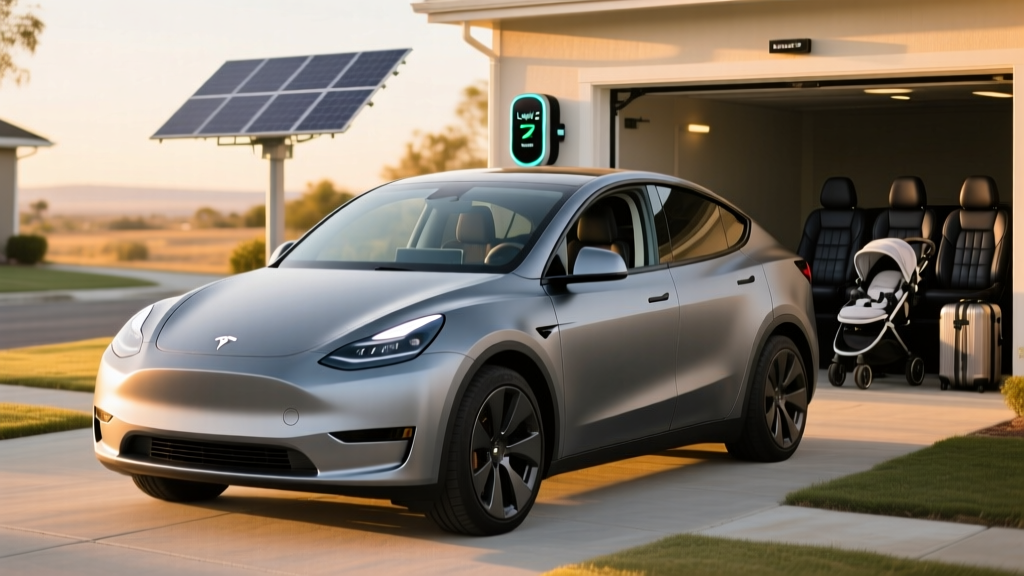
The Tesla Model Y has long dominated the electric crossover segment, but adding a third row transforms it from a five-passenger commuter into a family hauler — at least on paper. The 7 seater Model Y slots two small rear-facing seats into the cargo area, giving growing families an alternative to stepping up to the much larger (and pricier) Model X. For 2026, Tesla continues to offer the third-row option exclusively on the Long Range All-Wheel-Drive trim, and the trade-offs are real: you sacrifice cargo volume, a modest amount of range, and second-row comfort. But if your use case involves school runs, weekend sports carpools, or occasional six-person trips, the 7 seater Model Y remains one of the most accessible electric three-row vehicles on the market.
This review covers everything a prospective buyer needs: real-world range versus the EPA sticker, DC fast-charging behavior, third-row dimensions, tax credit eligibility under current IRS §30D rules, and how it stacks up against the Kia EV9, Hyundai Ioniq 9, and other electrified family movers.
Range, Efficiency, and the Real-World Reality Check
EPA Estimated Range: 300 miles (Long Range AWD, 7-seat configuration)
Real-World Expectation: Plan for 250–270 miles on sustained highway driving at 70+ mph. In cold weather (below 30°F), expect a 15–25% reduction, dropping usable range to roughly 225–255 miles depending on cabin heat usage and terrain.
The 7 seater Model Y carries a 75 kWh usable battery (approximately 82 kWh gross) using NMC (nickel manganese cobalt) cathode chemistry. Tesla does not offer the LFP (lithium iron phosphate) battery in the Long Range AWD trim — LFP is reserved for the Standard Range RWD model, which does not come with the third-row option.
On the efficiency front, the EPA rates the Long Range AWD at 122 MPGe combined, which translates to roughly 28 kWh per 100 miles. In mixed suburban driving with moderate regen braking, we've observed closer to 26 kWh/100mi. Highway-only trips at 75 mph push that to 30–32 kWh/100mi. The added weight of the third-row hardware (roughly 60–80 lbs of seat frames, belts, and hardware) has a measurable but small impact on efficiency versus the five-seat configuration.
| Spec | Value |
|---|---|
| EPA Range | 300 miles |
| Battery (usable) | 75 kWh, NMC chemistry |
| Efficiency | 122 MPGe / 28 kWh/100mi |
| 0–60 mph | 4.8 seconds |
| Horsepower | 384 hp (dual-motor AWD) |
| Drivetrain | Dual-motor all-wheel drive |
| Max DC Fast Charge | 250 kW (peak) |
| 10–80% DC Charge | ~27 minutes |
| Level 2 Home Charge | 11.5 kW (~44 mi/hr) |
| Base MSRP | $49,990 (+$2,500 third-row option) |
| Battery Warranty | 8 years / 120,000 miles |
Charging Speed: DC Fast, Home, and the Curve Reality
The Model Y Long Range supports a peak DC fast-charge rate of 250 kW at V3 and V4 Tesla Superchargers. However, peak is not sustained. The charging curve tells the real story:
- 10–30% SoC: Charges near peak (~230–250 kW)
- 30–60% SoC: Steps down to ~170–200 kW
- 60–80% SoC: Tapers further to ~100–130 kW
- 80–100% SoC: Drops sharply below 50 kW (avoid unless necessary)
The 10–80% charge takes approximately 27 minutes under ideal thermal conditions. Preconditioning the battery — which the Model Y initiates automatically when you navigate to a Supercharger — is essential. Arriving at a charger with a cold battery can add 10–15 minutes to your session as the thermal management system warms the cells before accepting peak power.
| Level | Power | Miles Added per Hour | Use Case |
|---|---|---|---|
| Level 1 (120V) | ~1.4 kW | ~4–5 mi/hr | Emergency / overnight trickle |
| Level 2 (240V, 48A) | 11.5 kW | ~44 mi/hr | Home daily charging |
| DC Fast (Supercharger V3/V4) | 250 kW peak | ~1,000+ mi/hr (peak) | Road trips, rapid top-ups |
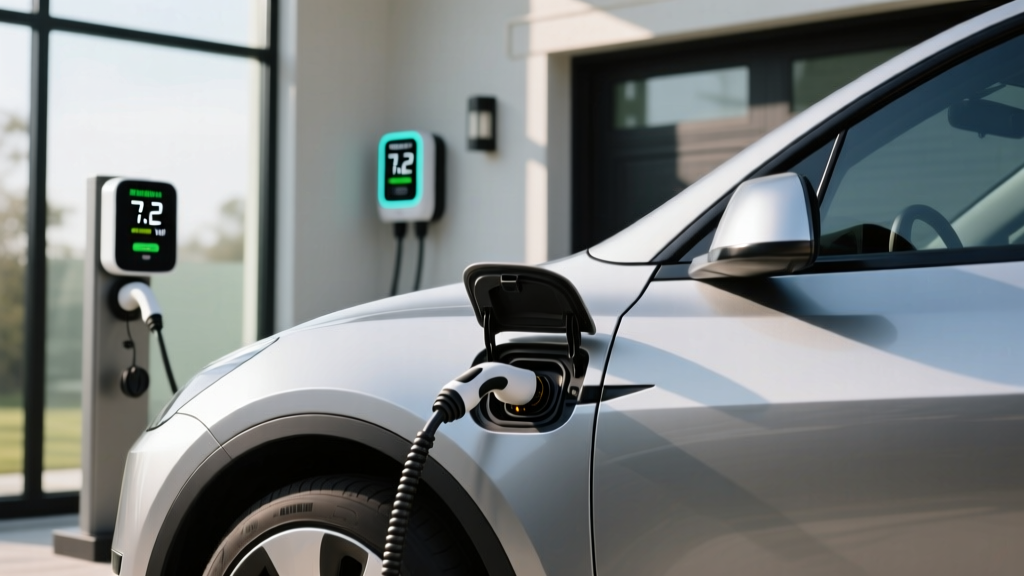
For home charging, a Level 2 wall connector on a 60-amp circuit delivers 11.5 kW, replenishing a full battery in roughly 7.5 hours. Most owners plug in nightly and wake up with a full charge. Home installation typically costs $800–$2,000 depending on panel proximity and local permitting — a 200-amp panel upgrade may be necessary in older homes and can add $1,500–$3,000.
With the 2025 adoption of the NACS connector as the industry standard, the Model Y uses the native Tesla plug. Non-Tesla Superchargers opening to other brands still use the same connector, so Model Y owners enjoy the broadest fast-charging compatibility in the U.S. without adapters.
Third-Row Space: Who Actually Fits Back There?
This is the make-or-break question for any 7 seater Model Y buyer. The honest answer: the third row is best suited for children under about 5'4" or very occasional adult use on short trips.
Key interior dimensions (7-seat configuration):
- Third-row legroom: ~26.5 inches
- Third-row headroom: ~34.5 inches (compromised by the sloping roofline)
- Second-row legroom (with third row deployed): ~36.5 inches (reduced from 40.5" in 5-seat mode)
- Cargo behind third row: ~12 cu ft (enough for a few grocery bags or a compact stroller)
- Cargo with third row folded: ~34 cu ft
- Total cargo (all rear seats folded): ~72 cu ft
The third-row seats are individually folding, which gives flexibility — you can deploy one seat for a single child while preserving half the cargo floor. The seats recline slightly and include USB-C ports, but there are no dedicated HVAC vents for the third row, which is a notable comfort gap on hot or cold days.
Access requires folding and sliding the second-row seat forward. It's manageable but not as easy as the walk-through entry you'd get in a larger SUV like the Kia EV9 or the Rivian R1S. Installing a rear-facing child seat in the second row further compresses third-row legroom to near-unusable levels.
Performance, Ride Quality, and Daily Driving
The dual-motor AWD powertrain produces 384 horsepower and launches the Model Y from 0–60 mph in 4.8 seconds. That's brisk for a family crossover and makes highway merging and passing effortless. The single-speed transmission delivers smooth, linear acceleration without the shift lag of a traditional automatic.
Ride quality has improved with Tesla's recent suspension revisions — the 2025 refresh brought revised damper tuning and additional sound insulation that carried into the 2026 model year. Road noise is noticeably lower than in pre-2025 Model Ys, though the 20-inch wheel option (standard on some trims) still transmits more impact harshness than the 19-inch setup.
Regenerative braking remains strong and predictable. In "Hold" mode, one-pedal driving is practical in stop-and-go traffic, though Tesla's recent software updates have reintroduced a low-speed creep option for drivers who prefer a more traditional feel.
Driver Assistance — SAE Level 2: The Model Y comes standard with Tesla's Autopilot, which includes adaptive cruise control, lane-keeping assist, and automatic emergency braking. The optional Full Self-Driving (Supervised) package adds automated lane changes, traffic-light recognition, and navigation-guided steering. However, both systems are SAE Level 2 — the driver must remain fully attentive, keep hands on the wheel, and be prepared to take over at any moment. This is not autonomous driving.
Pricing, Trims, and Federal Tax Credit Eligibility
The 7 seater Model Y is available exclusively on the Long Range AWD trim. Here's the pricing breakdown for 2026:
| Configuration | MSRP |
|---|---|
| Long Range AWD (5-seat) | $49,990 |
| Third-row seat option | +$2,500 |
| 7-Seat Long Range AWD (base) | $52,490 |
| Destination fee | +$1,390 |
| FSD (Supervised) add-on | +$8,000 |
| As-tested (with FSD, 20" wheels, paint) | ~$64,000–$66,000 |
Federal EV Tax Credit (§30D) — Key Requirements for 2026:
- Maximum credit: Up to $7,500 (split between $3,750 for battery components and $3,750 for critical minerals)
- MSRP cap: Vehicle must be under $80,000 for SUVs (Model Y qualifies)
- Buyer income cap: AGI must not exceed $150,000 (single), $225,000 (head of household), or $300,000 (joint filers)
- Battery sourcing: Battery components must be manufactured or assembled in North America; critical minerals must be sourced from the U.S. or a free-trade-agreement country (percentages increase annually)
- Point-of-sale transfer: Eligible buyers can apply the credit as an immediate price reduction at purchase rather than waiting for tax filing
- Final assembly: Must occur in North America (Model Y assembled in Fremont, CA and Austin, TX — qualifies)
Source: IRS §30D Clean Vehicle Credit. Eligibility rules change annually and vary by buyer. Consult a tax professional before relying on credit amounts.
With the full $7,500 credit applied, the effective starting price of the 7 seater Model Y drops to approximately $44,990 (before destination). This positions it as one of the most affordable electric three-row options available — undercutting the Kia EV9 (starting ~$56,000) by a wide margin, though the EV9 offers substantially more third-row space.
Pros, Cons, and the Competition
Pros
- Lowest entry price for any electric 3-row vehicle (with tax credit)
- Access to the Tesla Supercharger network — the most reliable DC fast-charging infrastructure in the U.S.
- Strong 300-mile EPA range and 250 kW peak charging
- Quick 4.8-second 0–60 for a family hauler
- Over-the-air updates continuously add features
- Minimal maintenance (no oil changes, long brake life with regen)
Cons
- Third row is tight — children only for anything beyond short trips
- Cargo space behind the deployed third row is minimal (~12 cu ft)
- No dedicated third-row HVAC vents
- Second-row comfort is compromised when the third row is in use
- Insurance costs tend to run 15–25% higher than comparable ICE crossovers
- Touchscreen-only controls (no physical buttons for climate, wipers, or glovebox) frustrate some drivers
Key competitors to consider:
- Kia EV9 (3-row, BEV): More spacious third row, 270-mile range, ~$56,000 starting. Better for regular 6–7 passenger use but costs significantly more.
- Hyundai Ioniq 9 (3-row, BEV): Similar size to EV9, competitive range, newer entry. Check availability in your market.
- Toyota Grand Highlander Hybrid (3-row, HEV): Not electric, but 36 MPG combined and a genuine adult-sized third row. Worth cross-shopping if home charging is unavailable.
- Rivian R1S (3-row, BEV): True off-road capability, adult-friendly third row, but starts above $80,000 and may not qualify for the full tax credit at higher trims.
Who Should Buy the 7 Seater Model Y?
Choose the 7 seater Model Y if:
- You need a third row occasionally (1–3 times per week) for children or short-trip passengers
- You have home Level 2 charging access
- Your budget is under $55,000 (after credit) and you want an all-electric three-row option
- You prioritize Supercharger network access for road trips
- You're willing to fold the third row most of the time and use the Model Y primarily as a 5-seater
Look elsewhere if:
- You need regular 6–7 adult passenger capacity (consider the EV9 or a minivan)
- You need substantial cargo space with all seats in use
- You cannot install a Level 2 charger at home and lack reliable public charging
- You prefer physical buttons and traditional control layouts
Battery Longevity and Warranty
Tesla warranties the Model Y's battery and drive unit for 8 years or 120,000 miles, whichever comes first, with a guaranteed minimum 70% capacity retention over that period. NMC chemistry in the Long Range degrades somewhat faster in the first 20,000–30,000 miles (typically 3–5% loss), then stabilizes. Long-term fleet data from sources like fueleconomy.gov and owner surveys suggest most Model Y batteries retain 85–90% capacity at 100,000 miles under normal use.
To maximize battery life: avoid routinely charging to 100% (Tesla recommends 80% daily for NMC), minimize extended periods at very low SoC, and use DC fast charging judiciously rather than as a daily routine. Battery replacement outside warranty currently runs $12,000–$16,000 at Tesla service centers — a cost worth factoring into long-term ownership plans beyond the 8-year window.
Frequently Asked Questions
What is the real-world range of the 7 seater Model Y?
The EPA rates it at 300 miles, but real-world highway driving at 70+ mph yields roughly 250–270 miles. In cold weather below 30°F, expect 225–255 miles. City driving with regen braking can actually exceed the EPA estimate due to stop-and-go energy recapture.
How fast does the Model Y charge at home and on the road?
At a 250 kW Supercharger, the 10–80% charge takes about 27 minutes with a preconditioned battery. At home on a Level 2 (11.5 kW) wall connector, you'll add roughly 44 miles per hour of charging, fully replenishing overnight in about 7.5 hours.
Does the 7 seater Model Y qualify for the $7,500 federal tax credit?
It can, but eligibility depends on your income (AGI under $300,000 for joint filers), the vehicle's MSRP (under $80,000 — it qualifies), and battery-sourcing requirements that tighten each year. The credit can be applied at the point of sale as an immediate price reduction. Always verify current-year rules on IRS.gov and consult a tax professional.
Is the 7 seater Model Y worth it versus the Kia EV9 or other 3-row EVs?
If your budget is tight and you only need a third row occasionally for children, the Model Y offers the best value — especially after the tax credit. If you regularly carry six or seven passengers and need adult-sized third-row comfort and real cargo space, the Kia EV9 or Rivian R1S are better choices despite the higher price.
Can I install a child car seat in the Model Y's third row?
The third row includes LATCH anchors on both seats, but space is very tight. A rear-facing infant seat will compromise second-row legroom significantly. Forward-facing convertible seats fit more easily. For multiple child seats, the second row is more practical.
What does it cost to own a Model Y versus a gas SUV over 5 years?
Electricity costs roughly $0.13–$0.16 per kWh nationally, translating to about 3.5–4.5 cents per mile in a Model Y. A comparable gas SUV at 25 MPG and $3.50/gallon costs about 14 cents per mile. Over 60,000 miles, that's a fuel savings of roughly $6,000–$7,000. However, factor in higher insurance premiums (typically $200–$400/year more) and potentially higher tire replacement costs due to the vehicle's weight and instant torque.
Is Tesla's Autopilot or FSD self-driving?
No. Both Autopilot and Full Self-Driving (Supervised) are SAE Level 2 driver-assistance systems. You must keep your hands on the steering wheel, eyes on the road, and be ready to intervene at all times. No consumer vehicle sold today offers Level 4 or Level 5 autonomous driving. See NHTSA's automated vehicle guidance for more context.