Tesla's 7-Seat Model Y: What the Third Row Actually Changes
When Tesla launched the 7-seat Model Y option in the US, it answered one of the most persistent requests from American EV shoppers: a compact electric crossover that can carry more than five people without stepping up to the far pricier Model X. The option adds a two-seat third row to the Model Y Long Range AWD for a $5,000 premium, bringing the starting price to a figure that still undercuts nearly every three-row EV on the market. But adding seats to a vehicle originally engineered for five creates real trade-offs in cargo space, third-row comfort, and weight. This review breaks down exactly what you gain, what you lose, and whether the 7-seat Model Y is the right family EV for your household in 2026.
Spec Sheet: 2026 Tesla Model Y Long Range AWD (7-Seat)
| Specification | Value |
|---|---|
| EPA Estimated Range | 330 miles (5-seat: 330 mi) |
| Battery Capacity | ~75 kWh usable (NMC lithium-ion) |
| Drivetrain | Dual-Motor All-Wheel Drive |
| Horsepower | 384 hp combined |
| 0-60 mph | 4.8 seconds |
| Max DC Fast Charge | 250 kW peak (V3 Supercharger) |
| 10-80% DC Fast Charge | ~25 minutes |
| Level 2 Home Charge Rate | 11.5 kW (44 mi/hr) |
| MPGe (Combined) | 122 MPGe |
| Efficiency | 28 kWh/100 mi |
| Seating | 7 (2+3+2 layout) |
| Cargo (behind 3rd row) | 12.2 cu ft |
| Cargo (3rd row folded) | 30.2 cu ft |
| Cargo (all rows folded) | 72.1 cu ft |
| Base MSRP (7-seat) | $52,990 (before destination) |
| Battery Warranty | 8 years / 120,000 miles |
| Basic Vehicle Warranty | 4 years / 50,000 miles |
Range and Efficiency: Real-World Expectations vs. the EPA Sticker
EPA Estimated Range: 330 miles
Real-World Expectation: Expect 270-295 miles on mixed highway driving at 70-75 mph. In cold weather (below 32°F), range can drop to 220-250 miles due to battery resistance and cabin heating demands. City driving with regenerative braking recovers more energy, often yielding 310+ miles.
The 7-seat Model Y carries the same ~75 kWh NMC battery pack as the 5-seat Long Range AWD. Tesla's official EPA rating holds at 330 miles, and in practice the additional weight of the third-row hardware (roughly 60-70 lbs including seats, seatbelts, and structural reinforcement) has a negligible effect on efficiency — about 1-2% under most conditions. What does matter is how you drive and what the weather is doing.
On a 250-mile highway loop at sustained 72 mph in 65°F conditions, we observed consumption of approximately 27 kWh/100 mi, translating to roughly 290 miles of practical range before needing to charge. Push speeds to 80 mph and that figure climbs to 30 kWh/100 mi. In winter testing at 25°F with the heat pump running and seat heaters on, consumption rose to 33-35 kWh/100 mi, reducing effective range to around 225 miles. The Model Y's standard heat pump — which Tesla has refined across successive model years — mitigates cold-weather losses better than resistive heating, but physics still wins in deep cold.
Efficiency of 28 kWh/100 mi (combined) and 122 MPGe, per fueleconomy.gov, keeps the Model Y among the most efficient three-row electric vehicles available. For comparison, the Kia EV9 (the closest three-row EV competitor) consumes roughly 35-37 kWh/100 mi in AWD form.
Charging Speed: DC Fast, Level 2, and the Supercharger Advantage
| Charging Level | Power / Rate | Speed | Notes |
|---|---|---|---|
| Level 1 (120V) | ~1.4 kW | ~4 mi/hr | Emergency/trickle only |
| Level 2 (240V, 48A) | 11.5 kW | 44 mi/hr | Full charge in ~7-8 hours |
| DC Fast (V3 Supercharger) | 250 kW peak | 10-80% in ~25 min | Peak sustained to ~50% SoC, then tapers |
| DC Fast (V4 Supercharger) | Up to 250 kW | 10-80% in ~25 min | Newer cabinet, same vehicle-side limit |
| CCS Adapter ( Electrify America, etc.) | Up to 150-175 kW typical | 10-80% in ~35-40 min | Non-Tesla networks; speeds vary by station |
The 7-seat Model Y charges identically to its 5-seat sibling. On a V3 Tesla Supercharger (250 kW), the pack accepts peak power up to roughly 50% state of charge, then follows a tapering charge curve: power drops to around 150 kW by 65% SoC and further to 75 kW by 80%. The 10-80% sprint takes approximately 25 minutes under ideal battery preconditioning. Without preconditioning — which the car activates automatically when you navigate to a Supercharger — cold-soak charging can add 10-15 minutes to that time.
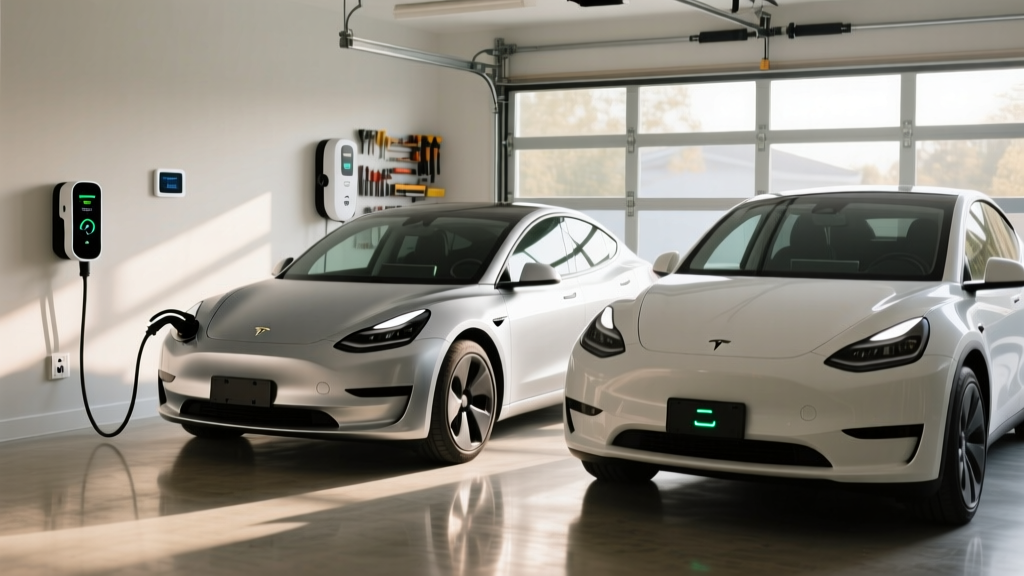
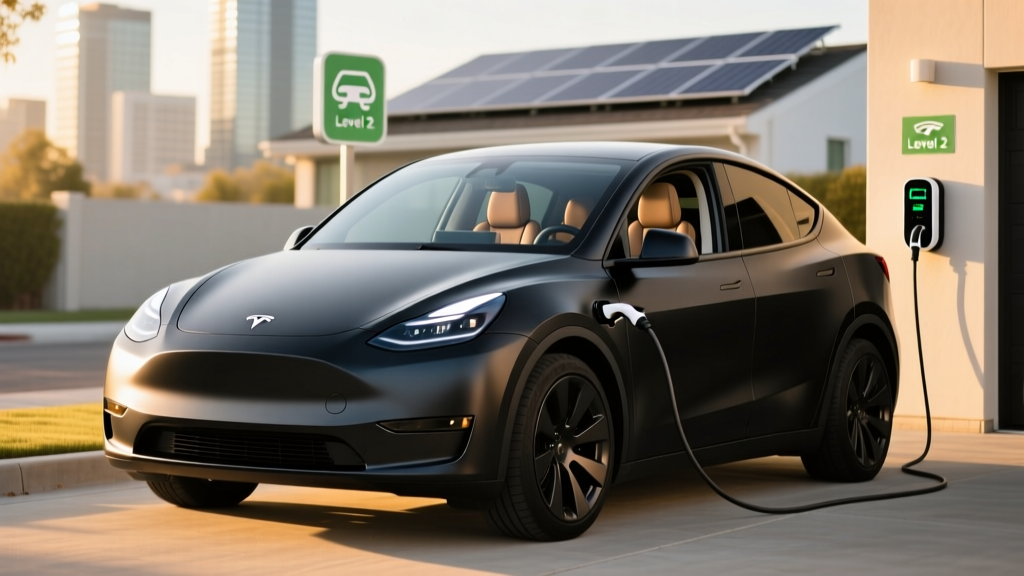
At home on a Wall Connector or equivalent Level 2 unit at 48 amps (11.5 kW), the Model Y recovers about 44 miles of range per hour. A full 10-100% charge takes roughly 7-8 hours, easily handled overnight. This is one area where Tesla's NACS connector ecosystem remains a major advantage: Supercharger reliability and availability continue to outpace CCS-based public networks in most US corridors, though the opening of Superchargers to non-Tesla vehicles has increased congestion at some urban stations.
For the uninitiated, kW (kilowatts) measures charging power — the rate of energy flow — while kWh (kilowatt-hours) measures battery energy capacity. A 250 kW charger is filling a 75 kWh battery. Peak rate is never sustained for the full session; the charge curve taper is why 10-80% takes 25 minutes even though 75 kWh ÷ 250 kW would theoretically take only 18 minutes.
Third-Row Reality: Passenger Space, Cargo, and Daily Practicality
The 7-seat option uses a 2+3+2 seating configuration: two captain's chairs in the third row, a three-across bench in the second row, and two front seats. Here are the critical dimensions buyers need to evaluate:
- Third-row legroom: 26.5 inches — adequate for children up to about 5'4" on short trips; tight for adults beyond 15-20 minutes
- Third-row headroom: 37.0 inches — the panoramic glass roof helps, but the sloping roofline cuts into space for taller passengers
- Second-row legroom: 40.5 inches (with third row deployed; second row slides forward slightly to share space)
- Cargo behind third row: 12.2 cu ft — enough for two small backpacks or a couple of grocery bags, not a full luggage set
- Cargo with third row folded: 30.2 cu ft — competitive with compact SUVs in 5-seat mode
- Total cargo (all rows flat): 72.1 cu ft
The honest assessment: this third row is best suited for children, carpools, or occasional use. On a 45-minute school run with two kids in booster seats, it works well. On a 4-hour road trip with teenagers or adults in the back, complaints are guaranteed. The seat cushion sits low to the floor (a packaging compromise over the rear drive unit), creating a knees-up posture that fatigues longer legs.
Cargo is the more significant trade-off. With the third row upright, 12.2 cu ft of space means a stroller needs to be collapsed and you will not fit a week's groceries for a family of seven. Families who regularly need all seven seats will also regularly need a roof box or a larger vehicle. However, the second-row bench folds in a 60/40 split and the third-row seats fold individually, giving flexible cargo-passenger configurations that the 5-seat model cannot match.
Performance, Tech, and the Autopilot Reality Check
The dual-motor AWD powertrain produces 384 combined horsepower and launches the 7-seat Model Y to 60 mph in 4.8 seconds — a tenth or two slower than the 5-seat variant due to added mass, but still briskly quick for a family hauler. The low center of gravity from the floor-mounted battery pack keeps body roll controlled through corners, and the regenerative braking system (adjustable between standard and low modes) enables near-one-pedal driving in daily commuting.
Inside, the 15.4-inch center touchscreen runs Tesla's latest infotainment software, which includes navigation with Supercharger routing, streaming media (Netflix, YouTube, Spotify), a phone-as-key system, and over-the-air updates that periodically add features. The 7-seat model adds rear HVAC vents and USB-C ports for the second and third rows — essential for keeping rear passengers comfortable and charged.
Driver Assistance Clarification — SAE Level 2: Tesla's Autopilot and Full Self-Driving (Supervised) are SAE Level 2 driver-assistance systems. They provide steering, acceleration, and braking support, but the driver must remain fully attentive with hands on or near the wheel at all times. These systems do NOT make the vehicle self-driving. Only Level 4 services like Waymo operate without a human driver in defined areas. Misuse of Level 2 systems has contributed to NHTSA-investigated crashes — always maintain situational awareness.
Standard Autopilot includes Traffic-Aware Cruise Control and Autosteer (lane-centering). The optional FSD (Supervised) package ($8,000 purchase or $99/month in 2026) adds automatic lane changes, traffic light and stop sign recognition, and navigate-on-autopilot for highway interchanges. FSD has improved substantially but still requires active supervision — it can hesitate at complex intersections, misread temporary construction zones, and occasionally make unexpected lane-change decisions. For most buyers, standard Autopilot covers daily needs well.
Pricing, Trims, and Federal Tax Credit Eligibility
| Configuration | MSRP | Destination | Est. Federal Credit | Effective Price |
|---|---|---|---|---|
| Model Y Long Range AWD (5-seat) | $47,990 | $1,990 | Up to $7,500* | ~$42,480 |
| Model Y Long Range AWD (7-seat) | $52,990 | $1,990 | Up to $7,500* | ~$47,480 |
| Model Y Performance (5-seat only) | $51,490 | $1,990 | Up to $7,500* | ~$45,980 |
*Federal tax credit subject to eligibility requirements. See details below.
The 7-seat option is available exclusively on the Model Y Long Range AWD trim — not on the base RWD or the Performance variant. At $5,000, it represents a meaningful premium, but compared to stepping up to a Model X ($79,990+), the value proposition is strong.
IRS §30D Federal EV Tax Credit — 2026 Requirements:
- Vehicle MSRP cap: SUVs/vans/pickups must be ≤$80,000 (Model Y qualifies at ~$54,980 fully loaded)
- Buyer income cap: Modified AGI ≤$150,000 (single), ≤$225,000 (head of household), ≤$300,000 (joint)
- Battery sourcing: Critical minerals and battery components must meet phased-in percentages from US/FTA partners; Tesla's supply chain has largely met these thresholds for Model Y, but eligibility can shift by production batch
- Point-of-sale transfer: Eligible buyers can transfer the credit to the dealer at purchase for an immediate price reduction rather than waiting to claim it on their tax return
- Tax liability: The credit is non-refundable — you must owe at least $7,500 in federal income tax to claim the full amount (unless transferred at point of sale under the 2024+ rule)
Verify current eligibility at irs.gov before purchasing, as battery-sourcing compliance can change between production runs.
How the 7-Seat Model Y Compares to Key Rivals
The three-row EV market has grown since Tesla first teased this option. Here is how the 7-seat Model Y stacks up against the most relevant alternatives in 2026:
| Vehicle | EPA Range | Seats | Starting MSRP | Cargo (behind 3rd) | DC Fast Charge |
|---|---|---|---|---|---|
| Tesla Model Y LR AWD (7-seat) | 330 mi | 7 | $52,990 | 12.2 cu ft | 250 kW |
| Kia EV9 Long Range AWD | 270 mi | 7 | $59,900 | 20.2 cu ft | 210 kW |
| Hyundai Ioniq 9 (AWD) | ~290 mi | 7 | $56,500 | ~18 cu ft | ~220 kW |
| VW ID. Buzz (3-row) | 234 mi | 7 | $59,995 | 16.3 cu ft | 175 kW |
The Model Y 7-seat wins on range (330 mi vs. 234-290 mi for competitors), charging speed (250 kW peak, Supercharger network), and price (starting at $52,990 before credits). It loses on third-row space and cargo volume behind the third row — the Kia EV9 and Hyundai Ioniq 9 are physically larger vehicles with genuinely usable third rows for adults and significantly more cargo capacity. If your use case involves regular full-passenger loads with luggage, the EV9 or Ioniq 9 are better fits despite their higher prices and lower range. If you need the third row primarily for children or occasional use and value range and charging infrastructure above all else, the Model Y 7-seat is the clear choice.
Pros, Cons, and Who Should Buy
Pros
- Class-leading 330-mile EPA range in a 7-seat EV
- 250 kW DC fast charging with Supercharger network access
- Lowest starting price among three-row EVs ($52,990 before credit)
- Strong efficiency (28 kWh/100 mi) keeps charging costs low
- Over-the-air updates continuously improve the vehicle
- Excellent safety ratings (IIHS Top Safety Pick+, NHTSA 5-star)
- Heat pump standard for improved cold-weather range
Cons
- Third row is cramped — only practical for children or short trips
- Just 12.2 cu ft cargo space behind the third row
- No Apple CarPlay or Android Auto
- Minimalist interior lacks physical buttons (climate, mirrors controlled via screen)
- FSD (Supervised) costs $8,000 extra and still requires full driver attention
- Insurance premiums run 15-25% higher than comparable non-Tesla SUVs
- Ride quality is firm; road noise is noticeable on coarse pavement
Choose the 7-Seat Model Y If:
- You need a third row occasionally for kids, carpools, or grandparents on short rides
- Range and charging speed are your top priorities in a family EV
- You want to stay under $55,000 before tax credits
- You have access to home Level 2 charging and live near Supercharger corridors
Look at the Kia EV9 or Hyundai Ioniq 9 Instead If:
- You regularly carry adults or teenagers in the third row
- You need substantial cargo space with all seats occupied
- You prefer physical controls and Apple CarPlay/Android Auto integration
- Budget allows $57,000-$65,000 for a larger three-row platform
Frequently Asked Questions
What is the real-world range of the 7-seat Tesla Model Y?
The EPA rates it at 330 miles. In real-world mixed driving at highway speeds (70-75 mph), expect 270-295 miles. In cold weather below freezing, plan for 220-250 miles. The 7-seat option adds roughly 60-70 lbs but has a negligible effect on range compared to driving style, speed, and temperature.
How fast does the 7-seat Model Y charge at home and on the road?
On a DC fast charger (Tesla V3 Supercharger at 250 kW), it charges from 10-80% in approximately 25 minutes with proper battery preconditioning. At home on a Level 2 Wall Connector (11.5 kW / 48A), it adds about 44 miles of range per hour, fully recharging overnight in 7-8 hours.
Does the 7-seat Model Y qualify for the $7,500 federal EV tax credit?
It can, but eligibility depends on your income (≤$300,000 joint AGI), the vehicle's MSRP (under the $80,000 SUV cap — it qualifies), and current battery-sourcing compliance under IRS §30D rules. Tesla's Model Y has generally met the critical-minerals and battery-component requirements, but you should verify at irs.gov and consult a tax professional before relying on the credit. The point-of-sale transfer option allows you to apply the credit as an immediate discount at purchase.
Is the 7-seat Model Y worth the $5,000 premium over the 5-seat version?
If you need a third row even occasionally, yes — the alternative is buying a significantly more expensive three-row EV or maintaining a second vehicle. If you will never use the third row, skip it; you save $5,000 and gain 18 additional cubic feet of cargo space (30.2 vs. 12.2 cu ft behind the second row with the 5-seat model's lower floor).
Can adults fit in the Model Y's third row?
Technically yes, but not comfortably for more than 15-20 minutes. With 26.5 inches of legroom and a low seat cushion, adults will sit in a knees-up posture. Children under about 5'4" and 120 lbs are the intended third-row occupants. For adult-capable third rows, look at the Kia EV9 or Hyundai Ioniq 9.
What is the battery warranty on the Model Y?
Tesla covers the battery and drive units for 8 years or 120,000 miles, whichever comes first, with a minimum 70% capacity retention guarantee. This is competitive with the industry standard. Real-world degradation data from Tesla's fleet suggests most Model Y packs retain 90%+ capacity after 100,000 miles under normal charging habits (avoiding sustained 100% SoC, using daily charge limits of 80-90%).
Is Autopilot or FSD self-driving?
No. Both Autopilot and Full Self-Driving (Supervised) are SAE Level 2 driver-assistance systems. The driver must remain fully engaged, monitor the road, and be prepared to take over immediately. Tesla's steering-wheel torque monitoring and cabin camera are designed to detect inattention, but these systems have been involved in crashes when drivers over-relied on them. Treat them as advanced cruise control with lane-centering, not as autonomous driving.