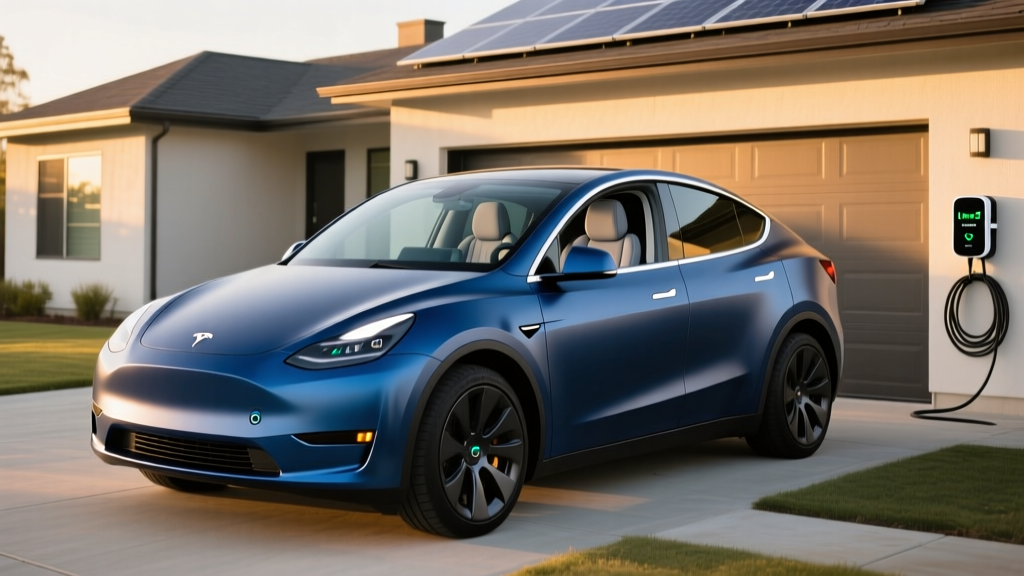
The Tesla Model Y remains the best-selling electric vehicle in the United States, and for good reason: it blends strong efficiency, access to the Supercharger network, and over-the-air updates into a crossover shape that fits most households. But for larger families, the two-row layout leaves a gap. Enter the Model Y with 7 seats — a third-row option that Tesla has offered intermittently and refreshed alongside the latest Juniper-era updates. This review examines whether that extra row is genuinely usable, how it impacts range and cargo, and whether the math still works after federal incentives.
2026 Tesla Model Y 7-Seat: Core Specifications
| Spec | Long Range AWD (7-seat) |
|---|---|
| EPA Range | 308 miles (est.) |
| Battery (usable) | ~75 kWh, NMC |
| Drivetrain | Dual-Motor AWD |
| 0-60 mph | ~5.0 sec |
| Horsepower | ~384 hp combined |
| MPGe (combined) | ~111 MPGe |
| Efficiency | ~28 kWh/100 mi |
| Max DC Charge Rate | 250 kW peak |
| 10-80% DCFC Time | ~25 min |
| Level 2 Home Charge | 11.5 kW (~44 mi/hr) |
| Third-Row Legroom | ~26.5 in |
| Cargo (behind 3rd row) | ~12 cu ft |
| Cargo (all rows folded) | ~72 cu ft |
| Base MSRP | $50,490 (before $2,000 7-seat option) |
| Warranty (Battery) | 8 yr / 120,000 mi |
Specs reflect the latest Juniper-generation Model Y Long Range AWD as configured for the 2026 model year. Always verify final figures on Tesla's configurator before ordering.
Real-World Range: What the EPA Number Doesn't Tell You
Real-World Expectation: ~240–270 miles at sustained highway speeds (70-80 mph); ~200–230 miles in sub-30°F winter driving.
The third-row option adds modest weight and slightly alters the aerodynamic profile, which is why Tesla rates the 7-seat Model Y a few miles lower than its 5-seat counterpart. On fueleconomy.gov, the Long Range AWD posts strong combined efficiency, but the real-world picture is more nuanced.
In warm-weather mixed driving, owners consistently report achieving 90–95% of the EPA sticker. Highway driving at 75+ mph, however, pushes consumption closer to 32–34 kWh/100 mi, cutting effective range to the mid-240s. Cold weather compounds this: without preconditioning, a 20°F morning can knock 20–30% off range due to battery-heating demands and cabin climate load. The Model Y's heat pump helps, but physics is physics — plan road trips around 220 miles of usable buffer in winter conditions.
For a family hauling kids to school and soccer, the daily commute is rarely an issue. It's the 400-mile holiday road trip where the 7-seat variant's slightly reduced range demands a touch more Supercharger planning.
Charging Speed: Supercharger Network Advantage
| Level | Power | Speed (Approx.) |
|---|---|---|
| Level 1 (120V) | ~1.4 kW | ~5 mi/hr |
| Level 2 (240V, 48A) | 11.5 kW | ~44 mi/hr |
| DC Fast Charge (V3 Supercharger) | 250 kW peak | 10–80% in ~25 min |
| DC Fast Charge (V4 Supercharger) | Up to 325 kW* | 10–80% in ~20 min* |
*V4 speeds depend on vehicle acceptance rate; Model Y Juniper architecture supports improved charge curves but sustained peak varies by SoC and temperature.
The Model Y's peak 250 kW DC fast-charge rate isn't class-leading on paper — competitors like the Hyundai Ioniq 5 and Kia EV6 push 350 kW on 800V architectures. But Tesla's advantage is charge-curve management. The battery preconditioning system, activated automatically when you navigate to a Supercharger, warms the pack to an optimal temperature so you hit peak kW within the first few minutes.
In practice, expect a 10–80% session to take about 25 minutes at a V3 Supercharger, adding roughly 175 miles of range. Above 80%, the charge rate tapers sharply — a trait of NMC chemistry — so plan your stops around the 80% mark to avoid sitting at the stall watching single-digit kW trickles.
At home on a Wall Connector (48A/11.5 kW), a full overnight charge from 20% to 100% takes roughly 7 hours. For most families, plugging in at night and waking up to a full battery eliminates range stress entirely.
Third-Row Reality: Who Actually Fits Back There?
This is the crux of the Model Y with 7 seats purchase decision. The third row is best understood as a kids-only zone. With roughly 26.5 inches of legroom and a low cushion height, adults will find it uncomfortable beyond short trips around town. Children under about 5'4" fit reasonably well, and the outboard positions include LATCH-compatible lower anchors for child seats — though the tight space makes rear-facing seats a squeeze against the second row.
Access is via a manual fold-and-slide second row. It works, but it's not as seamless as the power-folding third rows found in larger SUVs like the Kia EV9 or Rivian R1S. Plan for some gymnastics if you're loading car seats daily.
Cargo space behind the raised third row shrinks to approximately 12 cubic feet — enough for a couple of grocery bags or a stroller, but not both. Fold the third row flat (a 50/50 split) and you recover a deep, flat load floor. Fold everything and you get roughly 72 cubic feet, which is competitive with midsize crossovers.
The tradeoff is clear: the 7-seat option turns the Model Y from a spacious 5-seater with a massive cargo area into a compact people-mover with limited luggage room when all seats are occupied. For families who need 7 seats occasionally — carpool duty, visiting grandparents, weekend sports teams — it's a smart compromise. For daily full-capacity use, a larger vehicle is the honest answer.
Performance, Efficiency & Daily Driving
The Long Range AWD powertrain pairs dual permanent-magnet motors for a combined ~384 horsepower and a 0–60 mph time of approximately 5.0 seconds. That's brisk for a family crossover and makes highway merging and passing effortless. The dual-motor setup also provides confident all-weather traction, a key selling point for families in snow-belt states.
Efficiency is where the Model Y continues to shine. At ~28 kWh/100 mi (combined), it sips electrons compared to heavier 3-row EVs. For context, the Kia EV9 Long Range AWD consumes roughly 37 kWh/100 mi. Over 12,000 miles of annual driving at $0.15/kWh, that difference translates to roughly $160 per year in electricity savings — modest on its own, but it compounds over ownership.
Ride quality in the Juniper generation is noticeably improved over earlier Model Y variants. The adaptive damping and revised suspension tuning absorb sharp impacts better, though the low-profile tires still transmit some road harshness. Cabin noise is well-controlled, and the minimalist interior keeps distractions low — though some families will miss physical climate buttons and rear-seat HVAC controls (everything routes through the touchscreen or the rear display).
Pricing, Trims & Federal Tax Credit Eligibility
| Configuration | MSRP | Est. After §30D Credit |
|---|---|---|
| Long Range AWD (5-seat) | $50,490 | ~$42,990 |
| Long Range AWD (7-seat option) | $52,490 | ~$44,990 |
| Performance AWD (5-seat only) | $54,490 | ~$46,990 |
Pricing reflects 2026 model-year MSRPs before destination. The 7-seat option adds ~$2,000 to the Long Range AWD trim. Performance trim is not available with the third row.
The IRS §30D Clean Vehicle Credit can reduce your federal tax liability by up to $7,500 — and as of 2024, buyers can elect to transfer the credit to the dealer at point of sale, effectively reducing the purchase price at signing. However, eligibility is not universal:
- MSRP Cap: SUVs must be under $80,000. The Model Y qualifies comfortably.
- Income Cap: Modified AGI must not exceed $300,000 (joint), $225,000 (head of household), or $150,000 (individual).
- Battery Sourcing: The full $7,500 requires meeting both critical-minerals and battery-component requirements. Tesla's shifting supply chain means eligibility can change month-to-month — always confirm with your Tesla advisor and cross-reference the IRS eligible-vehicle list before purchase.
If you qualify for the full $7,500, the 7-seat Model Y Long Range AWD effectively costs around $44,990 — a compelling price for a dual-motor, 300+ mile EV with access to the most reliable DC fast-charging network in North America.
Tech, Driver Assistance & Safety
The Juniper-generation Model Y features a 15.4-inch front touchscreen, an 8-inch rear display for second-row passengers, ventilated front seats, ambient lighting, and Tesla's latest infotainment software. The UI is responsive, and the app ecosystem (Netflix, YouTube, games) keeps passengers entertained during charging stops.
On the driver-assistance front, every Model Y ships with Basic Autopilot, which includes adaptive cruise control and lane-keeping. The optional Full Self-Driving (Supervised) package ($8,000 or $99/month) adds automatic lane changes, traffic-light recognition, and city-street navigation.
Safety ratings remain strong. The Model Y has earned top marks from NHTSA (5-star overall) and the IIHS (Top Safety Pick+ in prior model years). The low center of gravity from the floor-mounted battery pack contributes to excellent rollover resistance.
Ownership Costs, Warranty & Long-Term Outlook
Tesla covers the Model Y's battery and drive units for 8 years or 120,000 miles (whichever comes first), with a warranty threshold of 70% capacity retention. Real-world degradation data from Tesla's fleet suggests most packs retain 88–92% capacity at 100,000 miles — well above the warranty floor.
The NMC chemistry in the Long Range provides higher energy density than LFP, which is why Tesla reserves it for the AWD variants. The tradeoff is slightly faster degradation and a recommendation to charge to 80% for daily use (vs. LFP packs, which tolerate regular 100% charges). For families, this means setting the charge limit in the app and occasionally topping to 100% before road trips.
Insurance costs remain a consideration. The Model Y typically runs 15–25% higher premiums than comparable ICE crossovers due to repair costs and parts pricing. Get a quote before ordering — in some states, Tesla's own insurance product offers competitive rates based on real-time driving behavior.
Model Y 7-Seat vs. The Competition
The competitive set for a 7-seat electric crossover is small but growing:
- Kia EV9 (3-row, dedicated EV): More interior space, 3rd row fits adults, ~230–300 mi range, starts ~$55,000. Trades efficiency for room.
- Rivian R1S: Genuine off-road capability, 3 usable rows, ~350+ mi range, starts ~$75,000. Premium price, premium experience.
- Hyundai Ioniq 9 (upcoming): Expected 3-row SUV on E-GMP platform, 300+ mi range, competitive pricing anticipated.
Choose the Kia EV9 or Rivian R1S if: You need adult-sized third-row seating daily, carry significant cargo with all seats up, and budget allows for a larger vehicle.
Pros & Cons at a Glance
Pros
- Best-in-class Supercharger network access
- Strong efficiency (~28 kWh/100 mi)
- Qualifies for up to $7,500 federal credit
- Quick 250 kW DC charging with good curve management
- Dual-motor AWD standard on 7-seat config
- OTA updates continuously add features
Cons
- Third row fits children only; tight for adults
- Only 12 cu ft cargo behind raised 3rd row
- Higher insurance premiums than ICE rivals
- No physical buttons; everything via touchscreen
- FSD (Supervised) is expensive and still Level 2
- 7-seat option unavailable on Performance trim
Frequently Asked Questions
What is the real-world range of the Tesla Model Y 7-seat?
Expect 240–270 miles on highway road trips at 70-80 mph, and 200–230 miles in cold weather below 30°F. Daily mixed driving in moderate temperatures can approach the 308-mile EPA estimate.
How fast does the 7-seat Model Y charge?
On a V3 Supercharger, it peaks at 250 kW and charges from 10–80% in approximately 25 minutes. At home on a 48A Level 2 Wall Connector, it adds about 44 miles of range per hour.
How much does the Model Y 7-seat cost after tax credits?
The 7-seat Long Range AWD starts at ~$52,490. If you qualify for the full $7,500 §30D credit (income, MSRP, and sourcing requirements met), the effective price drops to approximately $44,990.
Is the Model Y 7-seat worth buying vs. the Kia EV9?
If you need 7 seats only occasionally and value range, efficiency, and charging infrastructure, the Model Y wins on total cost of ownership. If you regularly carry 6-7 passengers or need cargo space with all seats up, the EV9 is the better fit.
Does the 7-seat Model Y qualify for the $7,500 federal EV tax credit?
It can, subject to IRS §30D rules: buyer income caps ($300K joint / $150K individual), SUV MSRP under $80,000, and battery critical-mineral and component sourcing requirements. Always verify current eligibility on irs.gov and with your Tesla advisor at time of purchase.
Can adults fit in the Model Y third row?
Only on very short trips. With ~26.5 inches of legroom and a low seat cushion, the third row is designed for children and smaller teens. Adults will find it cramped and uncomfortable beyond a few miles.