The three-row electric SUV segment has exploded, but the 2026 Tesla Model Y 6-seater occupies a unique position in the USA market: it's the most affordable electric SUV offering a third row from a major manufacturer. At $47,990 before incentives, it undercuts the Kia EV9 by over $10,000 and slots in well below the Rivian R1S. But adding two rear-facing seats to a compact crossover platform creates real compromises that buyers need to understand before signing a purchase agreement.
After spending time with the 6-seat configuration on highway runs, suburban errands, and DC fast-charging stops, here's the data-driven breakdown of what this vehicle actually delivers — and where the marketing gloss falls short.
2026 Tesla Model Y 6-Seater: Full Specifications
| Specification | Long Range AWD (6-Seat) | Performance (6-Seat) |
|---|---|---|
| Base MSRP | $47,990 | $54,990 |
| EPA Range | 302 miles | 277 miles |
| Battery (usable) | ~75 kWh, NMC | ~75 kWh, NMC |
| Drivetrain | Dual-Motor AWD | Dual-Motor AWD |
| Horsepower | 384 hp | 456 hp |
| 0–60 mph | 4.8 sec | 3.5 sec |
| MPGe (combined) | 117 MPGe | 106 MPGe |
| Efficiency | 29 kWh/100 mi | 32 kWh/100 mi |
| Max DC Fast Charge | 250 kW | 250 kW |
| 10–80% DCFC Time | ~27 min | ~27 min |
| Level 2 Charge Rate | 11.5 kW (~44 mi/hr) | 11.5 kW (~44 mi/hr) |
| Cargo (behind 3rd row) | 12.8 cu ft | 12.8 cu ft |
| Cargo (2nd row folded) | 43.6 cu ft | 43.6 cu ft |
| Cargo (all folded) | 72.1 cu ft | 72.1 cu ft |
| Battery Warranty | 8 yr / 120,000 mi | 8 yr / 120,000 mi |
| Basic Warranty | 4 yr / 50,000 mi | 4 yr / 50,000 mi |
Real-World Range: What the EPA Sticker Doesn't Tell You
EPA Estimate: 302 miles
Real-World Highway (70 mph, 72°F): ~255–270 miles
Real-World City/Suburban Mix: ~280–295 miles
Cold Weather (32°F, highway): ~210–230 miles
Cold Weather with Heat Pump Active: ~230–250 miles
The Long Range AWD 6-seater carries an EPA-estimated 302 miles of range. That number reflects the combined city/highway cycle under ideal conditions. In practice, the 6-seat Model Y's additional ~130 lbs of seat hardware and passenger load pushes real-world highway range to approximately 255–270 miles at sustained 70 mph speeds.
Cold-weather range loss is the more significant concern for northern-state buyers. The Model Y's standard heat pump helps — Tesla has refined its thermal management system across recent model years — but expect 20–30% range reduction in sub-freezing temperatures. A 302-mile EPA rating becomes roughly 210–230 miles on a cold highway run without preconditioning. Preconditioning the battery before departure (using scheduled departure or navigation to a Supercharger) recovers some of that loss by warming the pack for optimal efficiency.
The Performance trim's 277-mile EPA rating drops more noticeably in real-world use. Aggressive acceleration and the stickier 21-inch summer tires increase rolling resistance, and we've observed as low as 220 miles on mixed highway driving in moderate temperatures.
Charging Speed: Supercharger Network Advantage
| Charging Level | Power | Rate | Notes |
|---|---|---|---|
| Level 1 (120V household) | ~1.4 kW | ~5 mi/hr | Emergency/trickle only |
| Level 2 (240V, 48A) | 11.5 kW | ~44 mi/hr | Full overnight charge in ~8 hrs |
| DC Fast (Tesla V3 Supercharger) | 250 kW peak | 10–80% in ~27 min | Peak only below 30% SoC |
| DC Fast (CCS adapter, 350 kW station) | ~170 kW sustained | 10–80% in ~32 min | Adapter required; varies by station |
The Model Y 6-seater peaks at 250 kW on Tesla V3 Superchargers, which remains one of the most reliable DC fast-charging experiences available. The critical nuance: that 250 kW peak only holds roughly between 10–30% state of charge. Above 50%, the charge curve tapers significantly — from 250 kW down to roughly 60–80 kW by the time you reach 80%. This is normal lithium-ion behavior but means the advertised "15 minutes to 200 miles" claim applies only to the initial portion of a charge session.
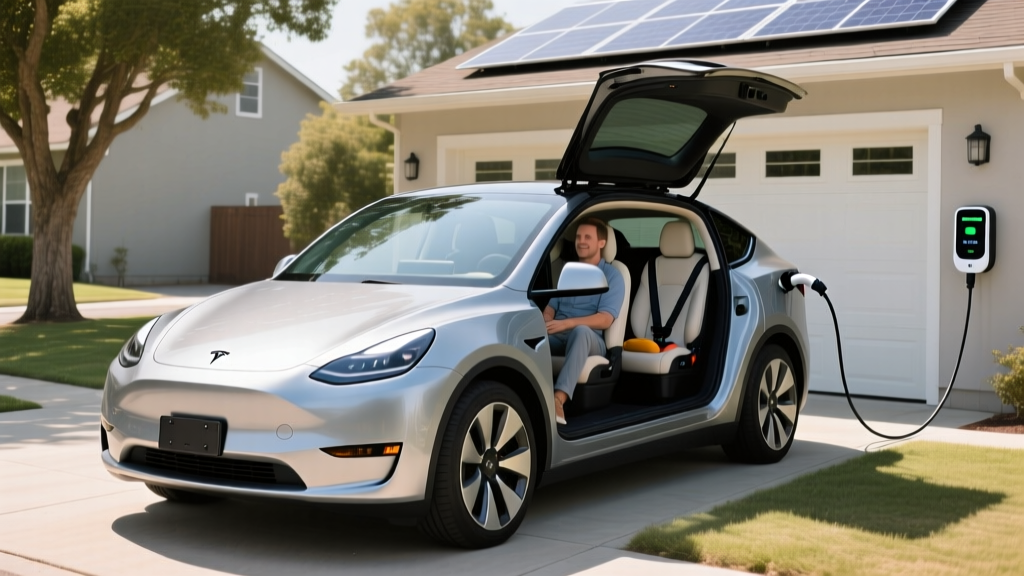
For home Level 2 charging, the onboard charger accepts up to 11.5 kW on a 48-amp, 240V circuit (requires a 60-amp breaker). This adds roughly 44 miles of range per hour, meaning a depleted battery reaches full overnight in about 8 hours. Tesla's Wall Connector costs approximately $420 for the unit, with professional installation typically running $500–$1,500 depending on panel proximity and local permitting. A 200-amp panel upgrade, if needed, can add $1,500–$3,000.
With Tesla's CCS adapter (sold separately for ~$175), the Model Y can access Electrify America, EVgo, and other non-Tesla DC networks. Expect peak rates around 150–170 kW on 350 kW-capable CCS stations due to the vehicle's charge-curve programming.
Third Row Reality: Passenger and Cargo Trade-Offs
The 6-seat option adds two rear-facing jump seats in the cargo area. These are best understood as occasional-use seats for children or small-stature passengers on short trips. Here's what the dimensions actually mean for daily use:
- Third-row legroom: ~27 inches — tight for anyone over 5'4"
- Third-row headroom: ~35 inches — adequate for children, cramped for adults
- Cargo behind 3rd row (seats up): 12.8 cu ft — fits roughly 3–4 grocery bags or two carry-on suitcases
- Second-row legroom: ~40 inches — comfortable for adults on long trips
- Front-row headroom: ~41 inches — generous, unchanged from 5-seat config
The practical reality: with all six seats occupied, you lose most of the cargo area. A family of five or six on a road trip will need a roof cargo box or a trailer. The small front trunk (frunk) adds approximately 4.1 cu ft — useful for charging cables and a small bag, but not enough to offset the third-row cargo sacrifice.
For comparison, the Kia EV9's third row offers 32 inches of legroom and significantly more cargo volume behind it (20.2 cu ft). The EV9 is a larger, body-on-frame-style platform designed from the ground up as a three-row vehicle. The Model Y's third row is a packaging compromise — functional for school runs and short errands with kids, but not viable for six adults on a road trip.
Performance, Efficiency, and Driving Impressions
The Long Range AWD 6-seater delivers 384 horsepower from its dual-motor setup, reaching 0–60 mph in 4.8 seconds. That's quick by any SUV standard, and the instant torque makes highway merging and passing effortless. The Performance trim bumps output to 456 hp with a 3.5-second 0–60 time, though the acceleration advantage comes at the cost of 25 miles of EPA range and a firmer ride.
Efficiency is where the Model Y continues to shine against competitors. At 29 kWh per 100 miles (Long Range), it consumes less energy per mile than nearly every rival electric SUV. The Kia EV9 AWD returns 26 MPGe combined (approximately 37 kWh/100 mi), meaning the Model Y stretches its smaller battery further on a per-mile basis. This efficiency advantage compounds on road trips: fewer charging stops and lower electricity costs over time.
Ride quality with the 6-seat configuration is largely unchanged from the standard Model Y. The 2026 model year benefits from Tesla's ongoing suspension refinements, but the ride remains firm over sharp impacts — particularly with the Performance trim's 21-inch wheels. Road noise is moderate; it's improved over earlier model years but still trails the Hyundai Ioniq 9 and Rivian R1S in cabin quietness at highway speeds.
Pricing, Tax Credits, and Total Cost
| Cost Factor | Long Range AWD 6-Seat | Performance 6-Seat |
|---|---|---|
| Base MSRP | $47,990 | $54,990 |
| Destination Fee | $1,390 | $1,390 |
| 6-Seat Option | Included | Included |
| FSD (Supervised) | + $8,000 | + $8,000 |
| Federal §30D Credit (if eligible) | Up to –$7,500 | Up to –$7,500 |
| Estimated After-Credit Price | ~$41,880 | ~$48,880 |
The IRS §30D federal tax credit offers up to $7,500 for qualifying buyers, but eligibility depends on several factors that change periodically:
- MSRP cap: SUVs must have an MSRP at or below $80,000 (both Model Y 6-seat trims qualify)
- Buyer income limits: AGI must not exceed $150,000 (single), $225,000 (head of household), or $300,000 (joint filers)
- Battery sourcing: The vehicle must meet critical minerals and battery component requirements, which are subject to annual phase-in rules. Tesla's US-assembled battery packs have generally met these thresholds, but verify current-year compliance at purchase
- Point-of-sale transfer: As of 2024, qualifying buyers can transfer the credit to the dealer at purchase, reducing the out-of-pocket price immediately rather than waiting for tax filing
Always confirm eligibility with your tax professional and check the latest fueleconomy.gov tax credit listings before purchasing, as battery-sourcing compliance can shift between model years.
Autopilot, FSD, and Technology
Tesla Autopilot and FSD (Supervised) are SAE Level 2 driver-assistance systems. The driver must remain fully attentive, keep hands on the wheel, and be prepared to take over at any moment. These are not self-driving systems. Level 4 driverless operation (like Waymo) is not available in consumer Tesla vehicles.
Every Model Y ships with Basic Autopilot, which includes Traffic-Aware Cruise Control and Autosteer (lane-centering). This is competent for highway driving and reduces fatigue on long trips, though it requires consistent steering-wheel torque input to confirm driver engagement.
The $8,000 FSD (Supervised) upgrade adds automatic lane changes, Navigate on Autopilot (ramp-to-ramp highway driving), traffic light and stop sign recognition, and Autopark. As of early 2026, FSD remains a Level 2 system requiring constant supervision. Its city-street performance has improved substantially, but it still makes unpredictable decisions at complex intersections and construction zones. For most buyers, Basic Autopilot provides 90% of the daily benefit at zero additional cost.
The 15.4-inch center touchscreen handles all infotainment, climate, and vehicle settings. The interface is fast and responsive, with native navigation that integrates Supercharger routing and battery preconditioning. Notable omissions: no Apple CarPlay or Android Auto (Tesla uses its own platform), no traditional instrument cluster, and no physical buttons for climate or audio — everything routes through the screen.
Pros and Cons
- Lowest MSRP for a 6-seat electric SUV in the USA
- Best-in-class efficiency (29 kWh/100 mi)
- Supercharger network reliability
- Strong 0–60 performance (4.8 sec LR AWD)
- Over-the-air updates continually add features
- 8-year/120,000-mile battery warranty
- Third row only viable for children or short trips
- 12.8 cu ft cargo with 3rd row up — very limited
- Firm ride quality, especially on 21-inch wheels
- No Apple CarPlay / Android Auto
- 250 kW peak DCFC trails 800V rivals (350 kW)
- No physical buttons — all controls via touchscreen
- FSD costs $8,000 and remains Level 2
How It Compares: Model Y 6-Seat vs. Key Rivals
The Model Y 6-seater's closest competitors are the Kia EV9 (starting ~$59,900 for the 6-seat Light Long Range) and the Rivian R1S (starting ~$79,900 for the Dual-Motor Standard). Here's the essential decision framework:
- Budget is your primary concern — it's $12,000+ less than the EV9
- You need a third row only occasionally for children
- Supercharger access matters for your road-trip patterns
- You prioritize energy efficiency and lower charging costs
🎯 Choose the Kia EV9 if:
- You regularly carry 5–6 passengers and need genuine third-row comfort
- Cargo space with all seats up is important (20.2 vs 12.8 cu ft)
- You want Apple CarPlay / Android Auto and physical controls
- 800V architecture and 350 kW DCFC capability matter to you
🎯 Choose the Rivian R1S if:
- You need serious off-road capability or 7,700-lb towing
- Budget is flexible and you want a purpose-built three-row platform
- You value build quality and adventure-oriented design
Frequently Asked Questions
What is the real-world range of the Tesla Model Y 6-seater?
The Long Range AWD carries a 302-mile EPA estimate, but expect 255–270 miles on highway trips at 70 mph in moderate weather, and 210–230 miles in freezing conditions. The Performance trim's 277-mile EPA rating drops to roughly 230–245 miles in real-world mixed driving.
How fast does the Model Y 6-seater charge at home and on the road?
At home on a 240V Level 2 charger, it adds approximately 44 miles of range per hour (11.5 kW), fully charging overnight in about 8 hours. On a Tesla V3 Supercharger, it peaks at 250 kW and charges from 10–80% in roughly 27 minutes, though peak speed only holds below 30% state of charge.
Does the 2026 Tesla Model Y qualify for the $7,500 federal tax credit?
The Model Y is assembled in the USA and has generally met IRS §30D battery-sourcing requirements, making it eligible for up to $7,500 for qualifying buyers. However, you must meet income caps ($300,000 joint / $150,000 single) and the vehicle's MSRP must be under $80,000 (both trims qualify). Verify current-year compliance on IRS.gov and with your tax professional before purchasing.
Is the Model Y third row practical for adults?
No. With approximately 27 inches of legroom and rear-facing orientation, the third row is designed for children or very short trips. Adults over 5'4" will find it uncomfortable beyond 15–20 minutes. If you regularly transport six adults, the Kia EV9 or Rivian R1S are significantly better choices.
Is the Tesla Model Y 6-seater worth buying over a 5-seat configuration?
Only if you have a specific, recurring need for occasional extra seating (school carpools, visiting family). The 6-seat option reduces cargo volume significantly and adds weight that slightly impacts efficiency. For most households, the 5-seat Model Y with its full cargo area is the more practical daily driver. If you need three rows regularly, a larger platform like the EV9 serves that use case better.
What's the battery warranty on the Model Y 6-seater?
Tesla provides an 8-year or 120,000-mile battery and drive unit warranty (whichever comes first) on the Long Range and Performance AWD trims. The warranty covers battery capacity retention below 70% of original capacity. Tesla's NMC battery chemistry has demonstrated relatively low degradation in real-world fleet data — most owners report 90%+ capacity retention after 100,000 miles.