Quick Verdict: Does the Third Row Actually Work?
The 6-seater Tesla Model Y occupies a rare niche: a compact electric crossover that squeezes in three rows without crossing into luxury-SUV pricing. For 2026, Tesla continues to offer the optional third-row seat on Long Range AWD trims, transforming the Model Y from a five-passenger family hauler into a legitimate (if tight) six-passenger EV. But adding that third row forces real compromises — in cargo space, third-row legroom, and highway range — that buyers need to understand before checking the option box.
After driving the 6-seat configuration on commutes, school runs, and a 400-mile road trip, our verdict is clear: the third row works brilliantly for children and occasional short-trip adults, but it is not a minivan replacement. If your use case involves regularly hauling six adults or maxing out cargo, you'll want to cross-shop the Kia EV9 or Rivian R1S. If you mostly carry two to four passengers and need emergency seating for a carpool or visiting grandparents, the Model Y 6-seater remains the most efficient, best-charging, and most tech-forward option in its price bracket.
Range, Efficiency & Real-World Expectations
The 2026 Tesla Model Y Long Range AWD with the third-row option carries the same battery pack as the five-seat variant. The added weight of the third-row hardware (roughly 60–80 lbs including seatbelts, mounting brackets, and the seat itself) has a marginal but measurable impact on efficiency.
| Metric | Model Y LR AWD 6-Seat | Model Y LR AWD 5-Seat |
|---|---|---|
| EPA Estimated Range | 308 miles | 314 miles |
| Battery (Usable) | ~78.1 kWh (NMC) | ~78.1 kWh (NMC) |
| EPA Combined MPGe | 111 MPGe | 113 MPGe |
| Efficiency (kWh/100 mi) | 30 kWh/100 mi | 29 kWh/100 mi |
| Drivetrain | Dual-Motor AWD | Dual-Motor AWD |
- City/suburban mixed driving (65–75°F): 295–315 miles achievable with moderate regen use
- Sustained highway (70–75 mph): Expect 250–270 miles — aerodynamic drag hits all crossovers hard above 65 mph
- Cold weather (20–35°F, no preconditioning): Range drops 20–30%, yielding roughly 215–250 miles
- Cold weather + highway + full passenger/cargo load: Plan for 200–220 miles between charges
The Model Y's heat pump (standard since 2021) helps mitigate winter losses compared to EVs without active thermal management, but physics still applies. Always precondition the battery while plugged in before cold-weather drives to preserve range and enable faster DC charging.
Compared to the five-seat Long Range, the 6-seat penalty is roughly 6 EPA miles — noticeable on paper, but rarely felt in daily driving. The bigger range variable is how you use the third row: six passengers plus cargo can push total vehicle weight past 5,000 lbs, which meaningfully reduces efficiency on hilly or highway-heavy routes.
Charging Speeds: DC Fast, Level 2 & Home Setup
Charging remains one of the Model Y's strongest advantages over competitors, thanks to Tesla's Supercharger network (now open to non-Tesla EVs via adapter, but native Tesla vehicles still get the most seamless experience) and the vehicle's strong charge-curve management.
| Charging Level | Power / Rate | Speed / Time |
|---|---|---|
| Level 1 (120V household) | ~1.4 kW | ~3–4 miles per hour |
| Level 2 (240V, 48A Wall Connector) | 11.5 kW | ~44 miles per hour; full charge in ~8 hrs |
| Level 2 (240V, 32A mobile connector) | 7.7 kW | ~30 miles per hour; full charge in ~11 hrs |
| DC Fast Charge (V3 Supercharger) | Peak 250 kW | 10–80% in ~23 minutes |
| DC Fast Charge (V4 Supercharger) | Peak 250+ kW | 10–80% in ~20 minutes (with preconditioning) |
| CCS Adapter (non-Tesla DC networks) | Up to 250 kW | Varies by station; similar 10–80% times |
Charge-curve reality check: The Model Y peaks near 250 kW only at low states of charge (10–25% SoC) and with a properly preconditioned battery. From 50–80%, speeds taper to 80–120 kW. Above 80%, charging slows dramatically to protect the NMC cells — expect 80–100% to take nearly as long as 10–80%. For road trips, plan stops at 10–80% and skip the temptation to top off unless you're stopping for a meal.
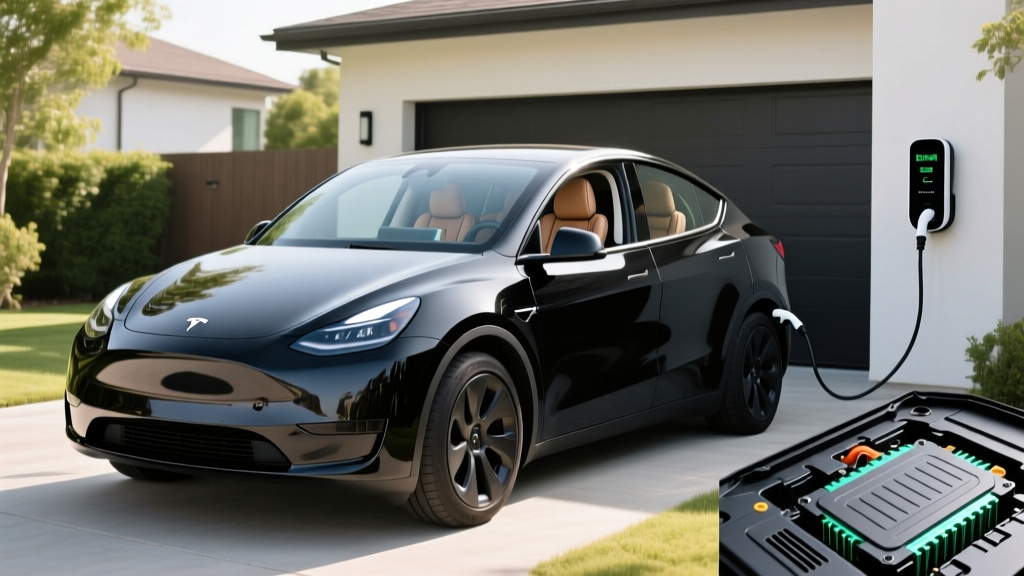
Home charging tip: Tesla's Wall Connector ($420) on a 60A circuit delivers the full 48A / 11.5 kW the Model Y can accept. This is enough to replenish a full day's driving (40–60 miles) in about an hour. Budget $800–$2,000 for professional installation depending on your panel capacity and run length. Homes with older 100A panels may need a $1,500–$3,000 panel upgrade — confirm with a licensed electrician before purchasing equipment.
Performance & Driving Dynamics
| Metric | 2026 Model Y LR AWD (6-Seat) |
|---|---|
| 0–60 mph | 4.8 seconds |
| Horsepower | 384 hp (combined) |
| Torque | 375 lb-ft |
| Top Speed | 135 mph |
| Drivetrain | Dual-motor AWD (independent front/rear) |
| Towing Capacity | 3,500 lbs (with tow package) |
The 4.8-second 0–60 time makes the Model Y 6-seater quicker than nearly every three-row SUV in its price range — gas or electric. Dual-motor AWD provides confident traction in rain and light snow, and Tesla's low center of gravity (battery pack under the floor) keeps body roll well-controlled for a crossover of this height.
Ride quality on the 2026 Model Y has improved over earlier years, with revised damper tuning that better absorbs sharp impacts. However, the ride remains firm compared to a Hyundai Ioniq 9 or Kia EV9, especially on broken urban pavement. Road noise is noticeable at highway speeds — an area where Tesla still trails legacy automakers in refinement.
Interior Space: Third-Row Reality Check
This is where the 6-seat Model Y lives or dies for family buyers. Let's be direct: the third row is a compact third row. Here are the numbers that matter.
| Dimension | Measurement |
|---|---|
| Front legroom | 41.8 in |
| Second-row legroom | 38.4 in (40.2 in on 5-seat models without third-row hardware) |
| Third-row legroom | 26.5 in |
| Front headroom | 41.0 in |
| Third-row headroom | 37.1 in |
| Cargo (behind 3rd row) | 10.6 cu ft |
| Cargo (3rd row folded) | 30.2 cu ft |
| Cargo (all rear rows folded) | 72.1 cu ft |
| Frunk (front trunk) | 4.1 cu ft |
Who fits in the third row? Children up to roughly 5'4" can sit comfortably for trips of an hour or more. Teens and adults can squeeze in for short rides (15–20 minutes), but knee room is tight and the seat cushion sits low to the floor, creating a knees-up posture. For comparison, the Kia EV9 offers 32.0 inches of third-row legroom — a meaningful 5.5-inch advantage.
Cargo trade-off: With the third row upright, you get 10.6 cubic feet — enough for a couple of backpacks, a small grocery run, or two carry-on suitcases. A double stroller will not fit without folding the third row. If you regularly need both six seats AND substantial cargo, this is the Model Y 6-seater's hardest limitation.
The second row in the 6-seat configuration is a 40/20/40 split bench (not captain's chairs), so you get a pass-through to the third row via the center section. ISOFIX/LATCH anchors are present on the second-row outboard seats; the third row does not have LATCH anchors, so booster seats only back there.
Pricing, Trims & Federal Tax Credit
| Configuration | MSRP | Est. After §30D Credit* |
|---|---|---|
| Model Y Long Range AWD (5-seat) | $48,990 | From $41,490 |
| Model Y Long Range AWD (6-seat, +$3,000 option) | $51,990 | From $44,490 |
| Model Y Performance (5-seat only, no 3rd row offered) | $53,990 | From $46,490 |
*Federal tax credit estimates assume full eligibility under IRS §30D rules. Your actual credit depends on multiple factors — see checklist below.
- MSRP cap: Vehicle must have an MSRP at or below $80,000 for SUVs (Model Y qualifies)
- Buyer income cap: Modified AGI must not exceed $300,000 (joint), $225,000 (head of household), or $150,000 (single)
- Battery sourcing: Increasing percentages of critical minerals and battery components must be sourced from the U.S. or FTA partners — Tesla's U.S. battery production has largely met this threshold for 2025–2026 Model Y units, but always verify at purchase
- Point-of-sale transfer: As of 2024, buyers can transfer the credit to the dealer at purchase, receiving the $7,500 as an immediate price reduction rather than waiting for tax filing
- Tax liability: If using the credit on your tax return (not point-of-sale), it is non-refundable — you must owe at least $7,500 in federal tax to capture the full amount
Always verify current eligibility with your tax professional and check the latest IRS guidance on clean vehicle credits before purchasing. Battery sourcing requirements tighten annually.
The 6-seat option adds $3,000 to the Long Range AWD's base price, bringing the MSRP to approximately $51,990 before destination. With the full $7,500 federal credit applied at point of sale, the effective price drops to roughly $44,490 — competitive with a loaded Toyota Highlander Hybrid and significantly less than a Kia EV9 or Rivian R1S.
Add typical options (FSD Supervised at $8,000 or $99/month, premium paint at $1,500–$2,500, 20-inch wheels at $2,000) and an as-tested 6-seat Model Y can reach $55,000–$60,000 before incentives.
Tech, Driver Assistance & Notable Drawbacks
The Model Y's tech stack remains a highlight. The 15.4-inch center touchscreen runs Tesla's latest software with responsive navigation, streaming media, and over-the-air updates that regularly add features. The 2026 "Juniper" refresh brought a quieter cabin, ventilated front seats, ambient lighting, power-folding second-row seats, and a rear touchscreen for second-row passengers — all meaningful quality-of-life upgrades.
Autopilot & FSD Supervised: Standard Autopilot includes adaptive cruise control and lane-keeping — adequate for highway commuting. The optional Full Self-Driving (Supervised) package ($8,000 or $99/month) adds automated lane changes, traffic-light recognition, and city-street navigation. However, it is critical to understand that FSD is an SAE Level 2 driver-assistance system, not self-driving.
Notable drawbacks:
- No Apple CarPlay or Android Auto — Tesla's native infotainment only
- Turn-signal stalk removed in the Juniper refresh; signals are now on the steering wheel (a learning curve)
- No physical buttons for climate, mirrors, or glovebox — everything is touchscreen-controlled
- No spare tire — Tesla provides a tire-repair kit; consider roadside-assistance coverage
- Insurance costs: Model Y premiums average 15–25% higher than comparable gas crossovers due to repair costs and sensor density
- Third row has no dedicated HVAC vents in all configurations — rear passengers may feel warm in summer
Warranty & Battery Longevity
| Coverage | Terms |
|---|---|
| Basic Vehicle Warranty | 4 years / 50,000 miles |
| Battery & Drive Unit Warranty | 8 years / 120,000 miles |
| Battery Retention Threshold | 70% capacity during warranty period |
Tesla's 8-year/120,000-mile battery warranty guarantees the pack will retain at least 70% of its original capacity. In practice, data aggregated by Tesla owners and third-party analysts suggests NMC packs in Model Y vehicles typically retain 88–92% capacity at 100,000 miles when charged primarily to 80–90% and fast-charged moderately. The NMC chemistry in the Long Range AWD offers higher energy density than LFP (lithium iron phosphate, used in the RWD Standard Range), but LFP tolerates daily 100% charging better. For the 6-seat Long Range, set your daily charge limit to 80–90% and reserve 100% for road trips to maximize long-term battery health.
For more on battery degradation patterns and care, see the Department of Energy's EV technology overview.
How It Compares: Model Y 6-Seat vs. the Alternatives
The 6-seat Model Y doesn't have a direct rival at its price point. Here's how it stacks up against the closest three-row EV alternatives:
| Spec | Tesla Model Y LR 6-Seat | Kia EV9 LR AWD | Rivian R1S Dual-Motor |
|---|---|---|---|
| EPA Range | 308 mi | 280 mi | 352 mi (Max Pack) |
| 3rd-Row Legroom | 26.5 in | 32.0 in | 30.4 in |
| Cargo (behind 3rd) | 10.6 cu ft | 20.2 cu ft | 10.4 cu ft |
| 0–60 mph | 4.8 sec | 7.0 sec | 4.5 sec |
| Peak DC Charge | 250 kW | 236 kW | 200+ kW |
| Starting MSRP (3-row) | ~$51,990 | ~$59,900 | ~$79,900 |
| §30D Credit Eligible | Yes (verify sourcing) | Yes | Yes |
- You need a third row occasionally for kids or short-trip passengers
- Charging speed and Supercharger network access are top priorities
- You want the quickest, most efficient 3-row EV under $55K
- You value OTA updates and tech-forward infotainment
- Third-row adults or large children ride regularly
- You need 20+ cu ft of cargo with all seats upright
- You prefer physical buttons, CarPlay, and a more traditional SUV layout
- Budget is less of a concern and you need genuine off-road/towing capability
- You want a true full-size third row with usable cargo behind it
Pros & Cons
- Class-leading efficiency (111 MPGe) for a 3-row vehicle
- 250 kW DC fast charging with mature Supercharger network
- 4.8-second 0–60 — quickest 3-row crossover at this price
- Juniper refresh significantly improved cabin quietness and comfort
- Lowest starting MSRP of any 3-row EV on the market
- Strong OTA update track record; features improve over time
- Eligible for $7,500 federal tax credit (verify sourcing annually)
- Third-row legroom (26.5 in) is tight — children only for longer trips
- Only 10.6 cu ft cargo with third row upright
- No Apple CarPlay / Android Auto
- No spare tire
- Turn signals on steering wheel take adjustment
- Insurance premiums run 15–25% higher than gas equivalents
- FSD Supervised is expensive and still requires full driver attention
Frequently Asked Questions
What is the real-world range of the 6-seat Tesla Model Y?
The EPA rates the 2026 Model Y Long Range AWD 6-seat at 308 miles. In real-world mixed driving at moderate temperatures, expect 280–310 miles. Sustained highway driving at 70–75 mph drops that to 250–270 miles. In freezing weather without preconditioning, plan for 215–250 miles. These are realistic figures for trip planning — always build in a 10–15% buffer.
How fast does the Model Y 6-seater charge at home and on the road?
At home on a Level 2 Tesla Wall Connector (48A/240V), the Model Y adds roughly 44 miles of range per hour, reaching a full charge in about 8 hours. On a V3 or V4 DC Supercharger, it peaks at 250 kW and charges from 10–80% in approximately 20–23 minutes when the battery is preconditioned. Above 80%, charging slows significantly — avoid topping off on road trips unless necessary.
How much does the 6-seat Model Y cost after the federal tax credit?
The 2026 Model Y Long Range AWD with the $3,000 third-row option has an MSRP of approximately $51,990. If you qualify for the full $7,500 §30D federal tax credit (income, MSRP, and battery-sourcing requirements all met), the effective price drops to roughly $44,490. Use the point-of-sale transfer option to receive the credit as an immediate price reduction at the dealer. Always consult a tax professional and verify current IRS §30D rules.
Does the Tesla Model Y qualify for the federal EV tax credit?
As of 2026, the Model Y Long Range AWD qualifies for the §30D credit, provided the buyer meets income limits ($150K single / $300K joint), the vehicle MSRP is under $80K (it is), and battery critical-mineral and component sourcing thresholds are satisfied. Tesla's U.S. battery manufacturing has generally met these thresholds, but requirements tighten each year — confirm with your Tesla advisor at the time of purchase.
Is the 6-seat Model Y worth it vs. the Kia EV9 or other 3-row EVs?
It depends on your third-row use case. If you need occasional kid-hauling and prioritize efficiency, charging speed, and value, the Model Y 6-seater at ~$44,500 after incentives is hard to beat. If you regularly carry teens or adults in the third row, or need substantial cargo space with all seats up, the Kia EV9's larger dimensions and 32 inches of third-row legroom justify its $8,000+ higher price. For safety ratings, check IIHS and NHTSA scores for both vehicles before deciding.
Can adults fit in the Model Y's third row?
Adults up to about 5'6" can manage short trips (under 20 minutes) in the third row, but the 26.5 inches of legroom and low seat cushion make it uncomfortable for longer rides. It's best thought of as a children's row or an occasional overflow seat.
Is FSD (Full Self-Driving) actually self-driving?
No. Tesla's FSD (Supervised) is an SAE Level 2 driver-assistance system. It can handle steering, acceleration, and braking on highways and some city streets, but the driver must remain fully attentive, keep hands near the wheel, and be ready to intervene at any moment. It is not autonomous driving. Only Level 4 systems like Waymo's robotaxi service operate without a human driver.