Tesla's decision to bring a third row to its best-selling SUV answered one of the most persistent requests from family buyers. The Model Y 6-seater trades a sliver of cargo flexibility for the ability to haul six passengers without stepping up to the Model X or a three-row ICE crossover. But does the physics of adding weight and reducing usable space compromise what made the Model Y a category leader in the first place?
We've tracked the latest specs, real-world efficiency data, and ordering details for the 2026 Model Y 6-seat configuration. Here's the full buyer's breakdown — range, charging, pricing, tax credits, and whether the third row actually works for daily life.
2026 Tesla Model Y 6-Seater at a Glance
| Specification | Value |
|---|---|
| EPA Estimated Range | 295 miles (6-seat Long Range AWD) |
| Battery Capacity (usable) | ~78 kWh, NMC chemistry |
| Drivetrain | Dual-motor AWD |
| Horsepower | 384 hp combined |
| 0–60 mph | 4.8 seconds |
| Max DC Fast Charge | 250 kW (V3 Supercharger) |
| 10–80% DC Charge Time | ~27 minutes |
| Level 2 Home Charging | 11.5 kW (~44 mi/hr) |
| EPA Efficiency | 117 MPGe combined / 29 kWh/100 mi |
| Passenger Capacity | 6 (2+2+2 seating) |
| Cargo (behind 3rd row) | ~12 cu ft |
| Cargo (3rd row folded) | ~40 cu ft |
| Cargo (all rear rows folded) | ~72 cu ft |
| 3rd-Row Legroom | ~27.5 inches |
| Battery/Drive Unit Warranty | 8 years / 120,000 miles |
| Base MSRP (6-seat) | $49,990 (before destination) |
| Federal Tax Credit (§30D) | Up to $7,500 — see eligibility below |
Real-World Range: What the EPA Number Doesn't Tell You
Real-World Highway (70 mph, mild weather): ~255–270 miles
Cold Weather (below 32°F, mixed driving): ~220–245 miles
City / Stop-and-Go with Regen: ~280–295 miles
The 6-seat Model Y carries a modest range penalty versus the 5-seat Long Range AWD, which posts an EPA figure of 320 miles. The third-row structure adds roughly 80–100 lbs and alters the aerodynamic profile slightly, shaving approximately 25 miles off the combined cycle. According to fueleconomy.gov, the Long Range AWD lands at 117 MPGe combined.
In practice, highway efficiency is where EVs lose the most ground. Sustained 70–75 mph cruising pushes consumption to roughly 32–34 kWh/100 mi, translating to about 230–250 miles before you'd want to stop. Cold weather compounds this: the battery's internal resistance increases, the cabin heater draws 2–5 kW continuously, and regenerative braking is limited until the pack warms up. Tesla's heat pump mitigates some of this loss, but expect a 15–25% range reduction in sustained sub-freezing conditions.
The 6-seat configuration is best understood as a 250-mile real-world vehicle for road trips, not a 295-mile one. Plan charging stops accordingly.
Charging Speed: DC Fast, Level 2, and the Curve Reality
| Charging Level | Power (kW) | Speed (mi/hr added) | Notes |
|---|---|---|---|
| Level 1 (120V household) | ~1.4 kW | ~4–5 mi/hr | Emergency/trickle only |
| Level 2 (240V, 48A Wall Connector) | 11.5 kW | ~44 mi/hr | Full charge in ~7 hours |
| Level 2 (240V, 32A Mobile Connector) | 7.7 kW | ~30 mi/hr | Standard NEMA 14-50 outlet |
| DC Fast (V3 Supercharger) | Peak 250 kW | Up to ~160 mi/hr at peak | 10–80% in ~27 min |
| DC Fast (CCS adapter, 350 kW station) | ~250 kW (vehicle-limited) | Similar to V3 | Requires CCS adapter |
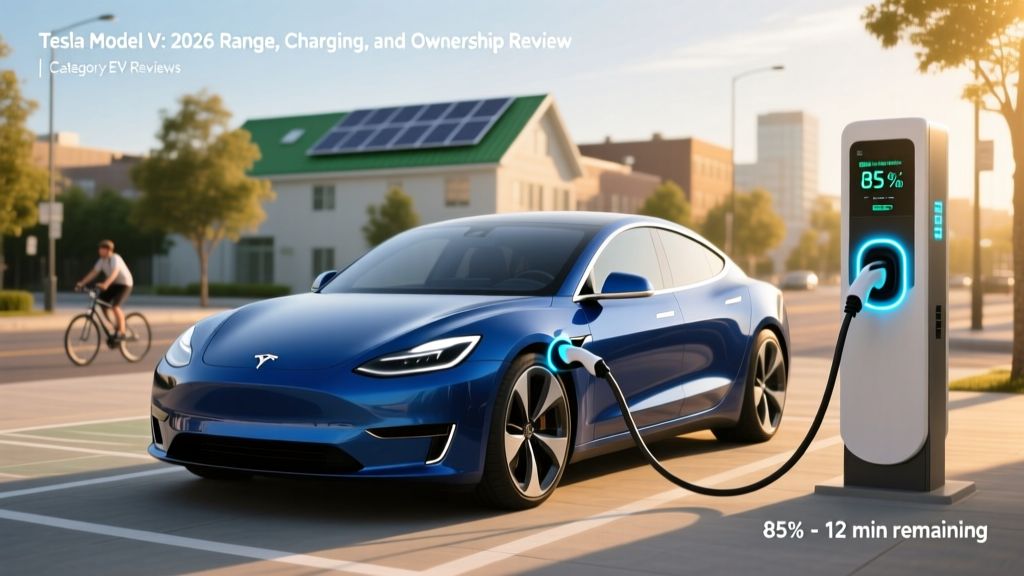
Tesla's 250 kW peak charge rate on V3 Superchargers is well-established, but the charge curve matters more than the peak number. The Model Y's NMC pack pulls close to 250 kW only between roughly 10–30% state of charge (SoC). From 30–50%, power tapers to around 175 kW. By 70% SoC, you're looking at approximately 100 kW, and above 80%, the rate drops sharply to protect battery longevity — often below 40 kW.
This means the 10–80% time of approximately 27 minutes is realistic on a V3 Supercharger with a preconditioned battery. Skip preconditioning (navigating to a Supercharger in the car triggers it automatically), and that time can stretch to 35+ minutes in cold weather.
At home, Tesla's Gen 3 Wall Connector on a 60A circuit delivers 11.5 kW (48A continuous), adding roughly 44 miles of range per hour. A full overnight charge from 20% to 90% takes about 5–6 hours. For buyers with a standard NEMA 14-50 outlet on a 40A circuit, expect 7.7 kW and about 30 mi/hr — still sufficient for most daily driving needs if you plug in nightly.
Performance, Drivetrain, and Efficiency
The 6-seat Model Y retains the dual-motor AWD powertrain: a permanent-magnet synchronous motor on the rear axle and an induction motor up front (which can freewheel to reduce drag under light loads). Combined output sits at 384 hp and 376 lb-ft of torque, pushing the heavier 6-seat variant to 60 mph in 4.8 seconds — roughly two tenths slower than the 5-seat Long Range.
That performance is more than adequate for highway merging, passing, and loaded family driving. The instant torque delivery means the car feels quicker than its 0–60 time suggests, particularly from 20–50 mph roll-on acceleration.
Efficiency remains a Tesla strength. At 29 kWh/100 mi combined (EPA), the Model Y 6-seat is slightly less efficient than the Hyundai Ioniq 5 (28 kWh/100 mi) but more efficient than the Kia EV9 (35 kWh/100 mi for the AWD variant). Tesla's thermal management system — integrating battery, motor, and cabin heating/cooling into a single octovalve heat-pump loop — is partly responsible for this advantage, especially in temperature extremes.
The Third Row: Passenger and Cargo Practicality
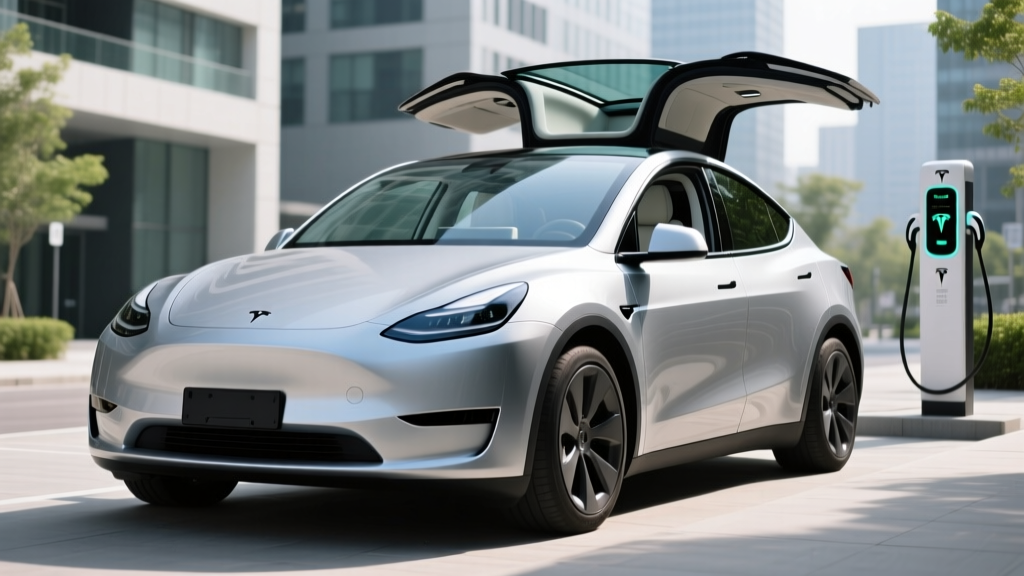
The 6-seat Model Y uses a 2+2+2 layout: two captain's chairs in the second row (with a center pass-through) and two smaller seats in the third row. This is a fundamentally different proposition from the bench-style third rows in larger SUVs.
Third-row reality: With approximately 27.5 inches of legroom, the third row fits children and smaller teens comfortably for trips up to an hour. Adults will find it cramped beyond short errands. Headroom is adequate thanks to the panoramic glass roof, but the seat cushion sits low — a common compromise in vehicles adapted from two-row platforms.
Cargo trade-offs: With all three rows in use, you get roughly 12 cu ft behind the third row — enough for a couple of backpacks or a small grocery run, but not a family road trip's worth of luggage. Fold the third row (a 50/50 split), and cargo space expands to approximately 40 cu ft, which is competitive with two-row midsize crossovers. Fold everything flat and you access roughly 72 cu ft — less than the 5-seat Model Y's 76 cu ft maximum, owing to the third-row hardware.
The front trunk (frunk) remains available and adds roughly 4 cu ft of secure, weatherproof storage for charging cables or a small bag.
Pricing, Trims, and Federal Tax Credit Eligibility
| Trim / Configuration | Base MSRP | Destination | Est. After §30D Credit |
|---|---|---|---|
| Long Range AWD (5-seat) | $47,990 | $1,390 | From $41,880* |
| Long Range AWD (6-seat) | $49,990 | $1,390 | From $43,880* |
| Performance AWD (5-seat only) | $52,490 | $1,390 | From $46,380* |
*Prices assume full $7,500 §30D credit eligibility. Actual credit depends on buyer income, vehicle MSRP cap compliance, and battery-sourcing requirements. See checklist below.
The 6-seat option adds $2,000 to the Long Range AWD base price. Notably, the Performance trim is not available in the 6-seat configuration — Tesla limits the third row to the Long Range.
- MSRP Cap: SUVs must have an MSRP at or below $80,000. The Model Y qualifies across all trims.
- Buyer Income Cap: Modified AGI must not exceed $150,000 (single), $225,000 (head of household), or $300,000 (joint filers).
- Battery Sourcing: The $7,500 credit requires meeting both critical-minerals and battery-component requirements. Tesla sources LFP cells from CATL for RWD models (which may face sourcing restrictions), but the Long Range AWD uses NMC cells from Panasonic at the Nevada Gigafactory, which has historically met domestic-content thresholds. Verify current-year compliance at IRS.gov.
- Point-of-Sale Transfer: As of 2024, eligible buyers can transfer the credit to the dealer at purchase, reducing the upfront price rather than waiting for a tax refund. Tesla supports this at checkout.
- One Credit Per VIN: The vehicle must not have been previously titled or had the credit claimed.
Tax credit rules are subject to legislative change. Consult a tax professional and the IRS Clean Vehicle Credit page before finalizing your purchase.
Technology, Driver Assistance, and Standout Features
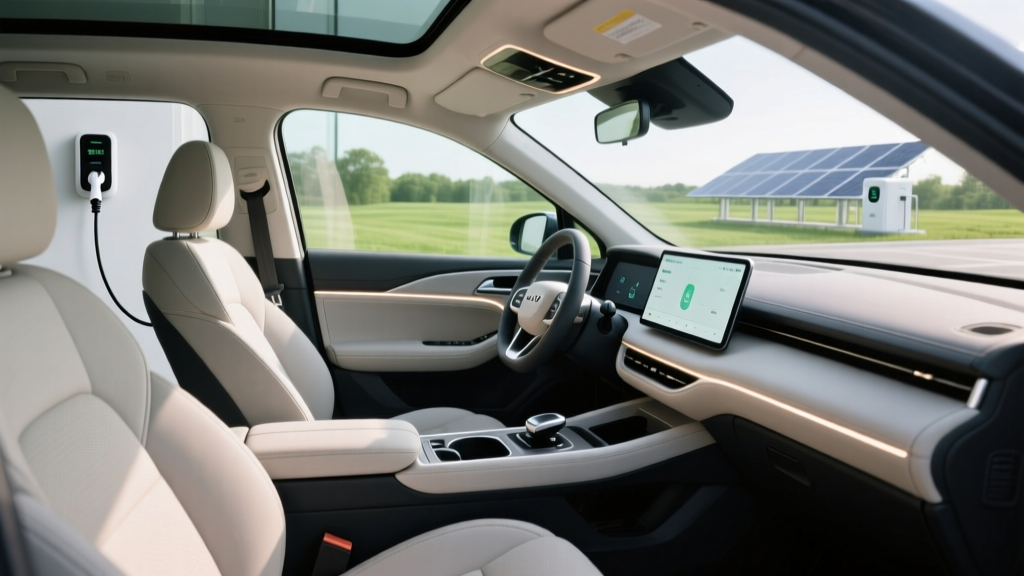
The 6-seat Model Y shares the refreshed interior introduced for the 2025 model year: ventilated front seats, ambient lighting, rear-seat entertainment screen, and acoustic glass for improved cabin quietness. The 15.4-inch center touchscreen runs Tesla's latest software, which includes native navigation with real-time Supercharger availability, trip planning with automatic preconditioning, and over-the-air updates.
Driver Assistance — SAE Level 2, Not Self-Driving:
Tesla Autopilot and Full Self-Driving (Supervised) require continuous driver engagement. You must keep your hands on the wheel and eyes on the road at all times. These systems handle lane centering, adaptive cruise, and (with FSD) traffic-light/stop-sign recognition and city-street navigation — but they are not autonomous. The driver is legally and operationally responsible at all times.
Autopilot is standard and includes Traffic-Aware Cruise Control and Autosteer. The FSD (Supervised) package remains a $8,000 add-on (or $99/month subscription as of early 2026) and adds Navigate on Autopilot, Auto Lane Change, Smart Summon, and city-street driving assist. FSD capability varies significantly by geography and road conditions and should never be treated as a substitute for an attentive driver.
Notable tech highlights:
- Sentry Mode with dashcam recording (uses ~1 mile of range per hour when parked)
- Dog Mode and Camp Mode for climate control while stationary
- Phone-as-key with Bluetooth Low Energy
- V2L (Vehicle-to-Load) not supported — Tesla has not enabled bi-directional charging on the Model Y
- HEPA air filtration with Bioweapon Defense Mode
How It Stacks Up Against 3-Row Competitors
The 6-seat Model Y occupies a narrow niche. Most three-row electric SUVs are significantly larger and more expensive, while most similarly priced EVs are two-row only. Here's how the key alternatives compare:
| Vehicle | EPA Range | Seating | Base MSRP | Max DC Charge | 0–60 mph |
|---|---|---|---|---|---|
| Tesla Model Y LR AWD (6-seat) | 295 mi | 6 | $49,990 | 250 kW | 4.8s |
| Kia EV9 GT-Line AWD | 270 mi | 6 or 7 | $63,900 | 236 kW | 5.0s |
| Hyundai Ioniq 9 (est.) | ~300 mi | 6 or 7 | ~$58,000 | ~240 kW | ~5.5s |
| VW ID.4 (2-row only) | 275 mi | 5 | $44,995 | 175 kW | 5.7s |
The Model Y's advantage is price and charging infrastructure. At roughly $50K, it undercuts the EV9 by $13,000+ while offering comparable (if tighter) third-row space and access to Tesla's Supercharger network — which, despite opening to other brands via NACS adapters in 2024–2025, still offers the most reliable plug-and-charge experience with the highest station density.
The EV9 and Ioniq 9 offer genuinely adult-sized third rows and more total cargo volume, but at a premium that pushes them outside the §30D MSRP cap for some buyers (the EV9 GT-Line exceeds $80K when optioned). If you regularly carry adults in the third row, those larger platforms are the better choice. If the third row is primarily for children or occasional use, the Model Y's price and efficiency advantages are compelling.
Pros, Cons, and Who Should Buy
✓ Pros
- Lowest entry price for a 6-seat EV in the US market
- Access to Tesla Supercharger network (17,000+ stalls in North America)
- Best-in-class efficiency at 29 kWh/100 mi for a 3-row SUV
- 250 kW DC fast charging with reliable preconditioning
- Over-the-air updates continuously add features
- Strong safety ratings (NHTSA 5-star, IIHS Top Safety Pick+)
- Heat pump standard — better cold-weather range retention
✗ Cons
- Third row fits children only — ~27.5" legroom is tight for adults
- Only 12 cu ft cargo with all seats up — impractical for loaded trips
- No Performance trim option in 6-seat layout
- FSD remains Level 2 and requires $8K add-on or subscription
- No V2L (vehicle-to-load) capability for backup power or camping
- Minimal physical controls — everything routes through the touchscreen
- Insurance costs run 15–25% above comparable ICE crossovers
- Choose the Model Y 6-seat if: You need occasional extra seating for kids or carpools, prioritize efficiency and charging infrastructure, and want the lowest-cost entry into a 6-seat EV.
- Look at the Kia EV9 or Ioniq 9 if: You regularly carry adults in the third row, need maximum cargo flexibility with all seats up, or prefer physical buttons and a more traditional interior layout.
- Stick with the 5-seat Model Y if: You rarely carry more than four passengers and want the full 320-mile EPA range and 76 cu ft of cargo space.
Warranty, Ownership Costs, and Long-Term Battery Outlook
Tesla covers the Model Y's battery and drive units for 8 years or 120,000 miles (whichever comes first), with a guaranteed minimum 70% capacity retention over that period. The NMC chemistry in the Long Range AWD has demonstrated strong longevity in fleet data — typical degradation is approximately 8–12% over the first 100,000 miles, with the curve flattening significantly after the initial break-in period.
The limited vehicle warranty is 4 years / 50,000 miles, which is competitive but not class-leading (Hyundai/Kia offer 5/60,000 and 10/100,000 powertrain coverage).
Ownership economics: At the US average electricity rate of $0.16/kWh, charging the Model Y costs roughly $4.64 per 100 miles. A comparable gasoline crossover averaging 25 MPG at $3.40/gallon costs $13.60 per 100 miles — a savings of about $9 per 100 miles, or roughly $1,350 per year at 15,000 miles driven. Over five years, fuel savings alone can offset $6,750 of the purchase price, before factoring in reduced maintenance (no oil changes, fewer brake replacements due to regenerative braking).
However, insurance premiums for the Model Y average 15–25% higher than comparable ICE crossovers, according to industry data. Get quotes before ordering — this can add $300–$600/year depending on your profile and state.
Ordering the 6-Seat Model Y: What to Know
As of early 2026, the 6-seat Model Y is available for order directly through Tesla's website in the Long Range AWD configuration only. Estimated delivery timelines typically range from 2–6 weeks depending on region and selected options. The $2,000 third-row option is selected during the configuration process under "Interior" — it is not a standalone model variant.
Key configuration decisions:
- Color: Stealth Grey and Pearl White are no-cost options. Premium colors add $1,000–$2,500.
- Wheels: 19-inch Gemini wheels maximize range; 20-inch Induction wheels reduce range by approximately 10–15 miles EPA.
- FSD: $8,000 one-time or $99/month. Most buyers are better served by the subscription model to evaluate whether the feature justifies the cost in their driving environment.
- Delivery: Tesla operates a direct-to-consumer model — there are no dealerships. Delivery occurs at a Tesla Service Center or via touchless home delivery in eligible zip codes.
Frequently Asked Questions
What is the real-world range of the Tesla Model Y 6-seater?
The EPA rates it at 295 miles combined. In real-world highway driving at 70 mph, expect 255–270 miles. In cold weather below freezing, plan for 220–245 miles. City driving with regenerative braking can approach the EPA figure.
How fast does the 6-seat Model Y charge?
On a V3 Supercharger (250 kW peak), 10–80% takes approximately 27 minutes with a preconditioned battery. At home on a 48A Level 2 Wall Connector, it adds about 44 miles per hour, reaching a full charge overnight in roughly 7 hours.
How much does the Model Y 6-seater cost after the federal tax credit?
With a base MSRP of $49,990 plus $1,390 destination, the total is $51,380 before options. If you qualify for the full $7,500 §30D credit (meeting income, sourcing, and MSRP requirements), the effective price drops to approximately $43,880. Verify eligibility on IRS.gov and with a tax professional.
Does the Model Y 6-seater qualify for the $7,500 federal EV tax credit?
The Model Y Long Range AWD qualifies under the MSRP cap ($80,000 for SUVs). Whether you receive the full $7,500 depends on your modified AGI (income caps apply), and the battery must meet critical-mineral and component-sourcing requirements. The Long Range's Panasonic NMC cells from Nevada have historically met these thresholds, but rules evolve — check the IRS Clean Vehicle Credit page for current-year specifics.
Is the third row practical for adults?
Realistically, no. At approximately 27.5 inches of legroom, the third row is best suited for children, smaller teens, or very short trips. Adults will find it uncomfortable beyond 20–30 minutes. If you need adult-capable third-row seating, consider the Kia EV9 or the upcoming Hyundai Ioniq 9.
Is the Model Y 6-seater worth buying versus competitors?
It depends on your third-row needs. If the extra seats are for kids and carpools, the Model Y offers the best combination of price, efficiency, and charging infrastructure in the segment. If you need full-size passenger and cargo flexibility, the Kia EV9 is the stronger choice — at a $13,000+ premium. For most family buyers who need occasional extra seats, the Model Y 6-seater represents the most cost-effective electric option available in 2026.
Can I tow with the 6-seat Model Y?
Yes. The Model Y Long Range AWD is rated for 3,500 lbs of towing capacity with the factory tow package ($1,000 add-on). Towing significantly impacts range — expect a 30–50% reduction depending on trailer weight and aerodynamics.
Sources: EPA fueleconomy.gov, IRS §30D Clean Vehicle Credit, Tesla Model Y specifications, NHTSA safety ratings.