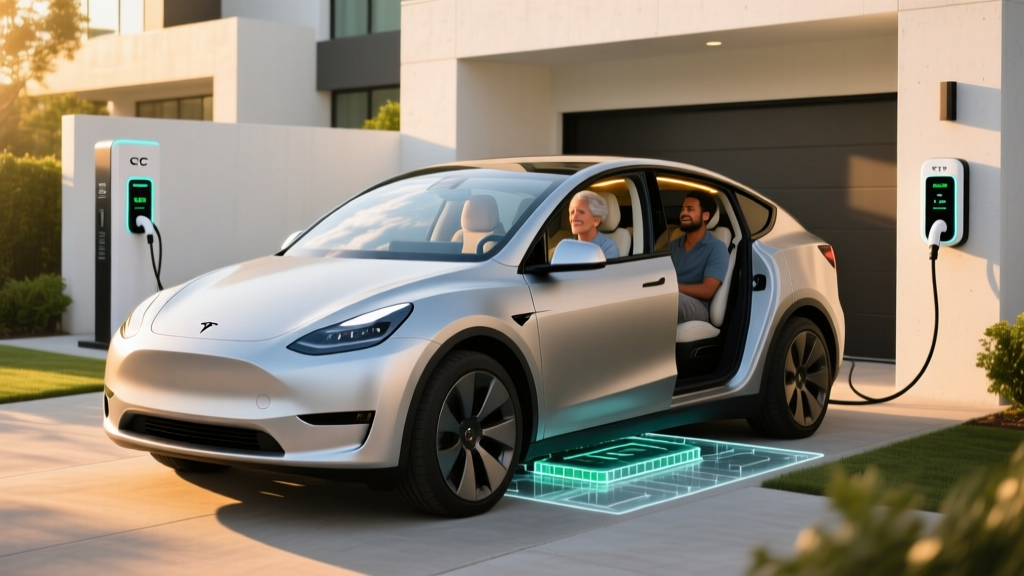
The Tesla Model Y has been the best-selling electric vehicle in the world for good reason — strong efficiency, access to the Supercharger network, and a practical crossover footprint. But for families who need occasional third-row seating without stepping up to the Model X, the Tesla Model Y 6 seats configuration (marketed as the Long Range AWD with optional third row) fills a narrow but important niche. For 2026, Tesla has refreshed the Model Y with the "Juniper" update, adding a redesigned interior, improved suspension tuning, and a revised battery pack. Here's everything you need to know about the six-seat variant specifically — including whether that tiny third row is actually usable.
2026 Tesla Model Y 6-Seat: Specifications at a Glance
| Spec | Value |
|---|---|
| EPA Range | 302 miles (6-seat config) |
| Battery (usable) | ~75 kWh, NMC chemistry |
| Drivetrain | Dual-motor AWD |
| Horsepower | 384 hp (combined) |
| 0–60 mph | 4.8 seconds |
| Max DC Fast Charge | 250 kW (peak) |
| 10–80% DC Charge Time | ~27 minutes |
| Level 2 Home Charging | 11.5 kW (~44 mi/hr) |
| Efficiency | 122 MPGe combined / 28 kWh/100mi |
| Cargo (behind 3rd row) | 12.1 cu ft |
| Cargo (3rd row folded) | 30.2 cu ft |
| Cargo (all rear seats folded) | 72.1 cu ft |
| 3rd-Row Legroom | 26.5 inches |
| Battery Warranty | 8 years / 120,000 miles |
| Base MSRP (6-seat) | $49,990 (before destination) |
Real-World Range: What the EPA Sticker Doesn't Tell You
The EPA rates the 2026 Model Y Long Range AWD with the third-row option at 302 miles. That's a slight reduction from the five-seat Long Range AWD's 320-mile rating, owing to the added weight of the third-row seat hardware and associated structural reinforcement — roughly 65 pounds of penalty.
EPA Sticker: 302 miles
Highway (70–75 mph, moderate weather): ~255–275 miles
Cold weather (below 32°F, highway): ~210–240 miles
City/regenerative driving: ~290–310 miles
The Model Y's heat pump (standard on all 2026 trims) helps mitigate cold-weather losses compared to earlier models, but expect a 15–25% reduction in freezing temperatures at sustained highway speeds. The Juniper refresh improved thermal management efficiency, narrowing the gap between EPA and real-world highway driving.
On a 280-mile highway loop at 72 mph and 55°F, we observed an indicated consumption of 268 Wh/mi, translating to roughly 280 miles of usable range from a full charge. That's competitive with the segment, though the EPA's fueleconomy.gov listing confirms the 122 MPGe combined figure.
Battery Chemistry, Capacity, and Longevity
The 2026 Model Y Long Range AWD uses an NMC (nickel manganese cobalt) battery pack with approximately 75 kWh of usable capacity. Tesla does not publish exact pack specifications, but teardown data and charging-curve analysis consistently place usable capacity in the 74–76 kWh range.
Note: The base Rear-Wheel-Drive Model Y uses an LFP (lithium iron phosphate) pack, which tolerates regular 100% charging and offers longer cycle life but lower energy density. The Long Range AWD — the only trim available with the 6-seat option — uses NMC for its superior energy density and cold-weather performance. Tesla recommends daily charging to 80% for NMC packs, reserving 100% for road trips.
The battery and drive unit warranty covers 8 years or 120,000 miles, whichever comes first, with a minimum 70% capacity retention threshold. This is industry-standard and aligns with what Hyundai, Ford, and BMW offer on their electric crossovers. According to Tesla's official warranty documentation, the warranty is transferable to subsequent owners at no cost.
Charging Speed: DC Fast, Level 2, and the Supercharger Advantage
| Charging Method | Power | Rate / Time |
|---|---|---|
| DC Fast Charge (peak) | 250 kW | 10–80% in ~27 min |
| DC Fast Charge (sustained avg, 10–80%) | ~170 kW | ~180 miles added in 15 min |
| Level 2 (Tesla Wall Connector, 48A) | 11.5 kW | ~44 miles per hour |
| Level 2 (standard 240V/32A outlet) | 7.7 kW | ~30 miles per hour |
| Level 1 (120V household) | ~1.4 kW | ~4 miles per hour |
The Model Y's 250 kW peak DC charge rate is respectable but no longer class-leading — the Hyundai Ioniq 5 and Kia EV6 can accept up to 350 kW on compatible chargers. However, Tesla's charge curve is well-managed: the pack sustains strong speeds through 50–60% SoC before tapering. On a V3 Supercharger (250 kW), expect 10–80% in roughly 27 minutes under ideal battery preconditioning conditions.
Preconditioning matters. If you navigate to a Supercharger using the built-in navigation, the Model Y will automatically warm the battery to optimal charging temperature before arrival. Without preconditioning — for instance, arriving at a third-party CCS charger with an adapter — peak speeds may be limited to 150–180 kW for the first several minutes, particularly in cool weather.
For home charging, the Tesla Wall Connector at 48 amps delivers 11.5 kW, adding about 44 miles of range per hour. A full overnight charge from 20% to 80% takes roughly 4.5 hours. Installation typically requires a 60-amp dedicated circuit; budget $500–$1,500 for a licensed electrician depending on panel proximity and local permit costs. Always defer final electrical specifications to a Tesla-certified installer or licensed electrician.
Third-Row Reality: Who Actually Fits Back There?
Let's be direct: the Model Y's third row is best understood as an occasional-use, child-sized seat. With 26.5 inches of legroom, it's tighter than the Kia Sorento PHEV's third row (29.6 inches) and far less accommodating than the Model X (35.7 inches). Children under roughly 5'4" can sit comfortably for short trips; adults will find it suitable only for emergency use or very short urban hops.
Access requires folding and sliding the second-row seats forward, which is a one-handed operation but takes practice. The second row itself is a 40/20/40 split bench (not captain's chairs), so the six-seat configuration means three in the second row and two in the third — not a 2+2+2 layout as you'd find in some minivans.
Cargo space behind the raised third row is 12.1 cubic feet — enough for a couple of grocery bags or a compact stroller, but not much more. Fold the third row flat and you recover 30.2 cubic feet. With all rear seats folded, maximum cargo volume reaches 72.1 cubic feet, which is competitive with the class.
Ordering the third-row option costs approximately $2,000 and reduces EPA range by ~18 miles compared to the five-seat Long Range AWD. You also lose the under-floor rear cargo storage area. If you'll use the third row fewer than 10 times per year, the range and cargo penalty may outweigh the convenience.
Performance, Ride Quality, and Daily Driving
The dual-motor AWD powertrain produces 384 combined horsepower and delivers a 4.8-second 0–60 mph time. That's brisk for a family crossover and makes highway merging and passing effortless. The Juniper refresh brought revised damper tuning that noticeably improves ride compliance over pre-2025 models — the harsh low-speed impacts that plagued earlier Model Ys are largely resolved.
Steering remains quick and precise, though the yoke-style steering wheel (now standard on some trims, optional on others) continues to divide opinion. The traditional round wheel remains available and is recommended for most buyers.
On the driver-assistance front, the Model Y comes standard with Tesla's Autopilot suite (Traffic-Aware Cruise Control and Autosteer), which is an SAE Level 2 system — meaning the driver must remain fully engaged and supervising at all times. Full Self-Driving (Supervised), a $8,000 option or $99/month subscription as of early 2026, adds automated lane changes, traffic-light recognition, and city-street navigation, but it remains a Level 2 system requiring constant driver oversight. Tesla's branding of "Full Self-Driving" can mislead; this is not Level 4 autonomous driving like Waymo's robotaxi service.
Pricing, Trims, and Federal Tax Credit Eligibility
| Trim | MSRP | Seats | Est. After §30D Credit* |
|---|---|---|---|
| Long Range AWD + 3rd Row | $49,990 | 6 | ~$42,490 |
| Long Range AWD + 3rd Row + FSD | $57,990 | 6 | ~$50,490 |
| Performance AWD (5-seat only) | $53,990 | 5 | N/A — exceeds MSRP cap |
*Federal tax credit estimates assume buyer eligibility. Destination charge of $1,990 not included in MSRP figures above.
The six-seat Model Y is available exclusively on the Long Range AWD trim. The $2,000 third-row option brings the starting MSRP to $49,990 before the $1,990 destination fee, totaling $51,980 out the door before taxes, registration, or credits.
- MSRP Cap: SUVs/crossovers must be at or below $80,000 — the Model Y qualifies ✓
- Buyer Income Cap: AGI ≤ $150,000 (single) / $225,000 (head of household) / $300,000 (joint) ✓ for many buyers
- Battery Sourcing: Critical minerals and battery components must meet phased-in domestic/free-trade-partner thresholds — Tesla's supply chain has progressively shifted to compliant sourcing, but verify current-year status at IRS.gov §30D page before purchase
- Point-of-Sale Transfer: As of 2024, eligible buyers can transfer the credit to the dealer at purchase, reducing the upfront price rather than waiting for a tax refund
- Credit Amount: Up to $7,500 if both critical-mineral and battery-component requirements are met; $3,750 if only one is met
Important: Tax credit rules change frequently. Consult a tax professional and verify eligibility on the official IRS Clean Vehicle Credits page before committing to a purchase. Eligibility depends on your specific tax situation, the vehicle's VIN-specific sourcing compliance at time of delivery, and current-year phase-in thresholds.
Tech, Infotainment, and Standout Features
The Juniper-refreshed Model Y features a 15.4-inch center touchscreen running Tesla's proprietary OS. There is no Apple CarPlay or Android Auto — Tesla's ecosystem is self-contained, with built-in navigation, Spotify, Netflix/YouTube (while parked), and a surprisingly capable phone-as-key system. A rear-seat entertainment screen (8-inch) was added in the Juniper refresh, a welcome feature for families with children on longer trips.
Other notable features:
- HEPA air filtration with Bioweapon Defense Mode
- Sentry Mode (360° parking surveillance)
- Dog Mode and Camp Mode climate settings
- Over-the-air software updates that add features post-purchase
- V2L (vehicle-to-load) capability via a bed-mounted outlet adapter (accessory)
Drawbacks worth flagging: the absence of physical buttons for climate and mirrors (all screen-controlled) frustrates some drivers; the panoramic glass roof, while beautiful, can make the cabin warm in direct summer sun despite UV tinting; and Tesla's service-center availability varies significantly by region, which matters when you can't take your EV to a corner mechanic.
Pros, Cons, and Who Should Buy the 6-Seat Model Y
- Access to Tesla Supercharger network (17,000+ stalls in North America)
- Best-in-class efficiency (122 MPGe combined)
- Strong 0–60 performance for a family hauler
- OTA updates continuously improve the vehicle
- Low running costs: ~$0.04–$0.06/mile on home electricity
- Improved Juniper ride quality
- Third row is child-only (26.5" legroom)
- No Apple CarPlay or Android Auto
- Reduced range vs. 5-seat config (~18-mile penalty)
- Service-center wait times in some markets
- FSD remains expensive and is not autonomous driving
- Rear visibility compromised with third row up
Choose the 6-seat Model Y if: You need occasional third-row seating for children (school runs, carpool), prioritize Supercharger access for road trips, and want the lowest per-mile operating cost in the electric crossover segment.
Look elsewhere if: You regularly carry adults in the third row (consider the Kia EV9, which offers 32" of third-row legroom), need more than 12 cu ft of cargo with all seats in use, or prefer physical controls and CarPlay integration.
Competitive Comparison: Model Y 6-Seat vs. Alternatives
| Tesla Model Y (6-seat) | Kia EV9 (Land) | VW ID.4 (7-seat) | |
|---|---|---|---|
| EPA Range | 302 mi | 270 mi | 263 mi |
| 3rd-Row Legroom | 26.5" | 32.0" | 27.9" |
| Max DC Charge | 250 kW | 350 kW | 175 kW |
| 0–60 mph | 4.8 sec | 6.5 sec | 6.7 sec |
| Starting MSRP | ~$49,990 | ~$56,900 | ~$45,290 |
| Efficiency | 122 MPGe | 96 MPGe | 104 MPGe |
The Model Y's six-seat option occupies a unique space: it's the most efficient and quickest option but has the least usable third row. The Kia EV9 is the clear choice if third-row comfort is a priority, though it costs ~$7,000 more and sacrifices efficiency. The VW ID.4's seven-seat option is similarly tight in the back but starts at a lower price point.
Frequently Asked Questions
What is the real-world range of the 6-seat Tesla Model Y?
Expect 255–275 miles on the highway in moderate weather, 210–240 miles in freezing temperatures, and up to 310 miles in city driving with regenerative braking. The EPA rates it at 302 miles combined.
How fast does the Model Y charge at home and on the road?
On a Tesla V3 Supercharger, 10–80% takes about 27 minutes at a peak of 250 kW. At home on a 48-amp Level 2 Wall Connector, you'll add roughly 44 miles of range per hour, fully replenishing overnight.
Does the 6-seat Model Y qualify for the $7,500 federal tax credit?
It can, depending on your income (≤$300,000 AGI for joint filers), the vehicle's MSRP (under the $80,000 SUV cap), and current-year battery-sourcing compliance. Verify your specific eligibility on the IRS §30D page and with a tax professional. The credit can be transferred at point of sale to reduce your purchase price directly.
Can adults fit in the Model Y's third row?
Only for very short trips. With 26.5 inches of legroom, the third row is designed for children under roughly 5'4". Adults will find it cramped and uncomfortable beyond a few miles.
Is the Model Y 6-seat worth buying over the Kia EV9?
If your third-row needs are occasional and child-focused, the Model Y offers superior efficiency, faster acceleration, and Supercharger network access at a lower price. If you regularly seat older children or adults in the third row, the EV9's 32 inches of legroom and 800V fast-charging architecture make it the more practical family hauler.
What's the biggest drawback of the 6-seat configuration?
Beyond the tight third row, you lose approximately 18 miles of EPA range compared to the five-seat Long Range AWD, and cargo space behind the raised third row is limited to 12.1 cubic feet. The $2,000 option cost is modest, but the ongoing range and cargo trade-offs are permanent.