The Tesla Model Y has dominated the U.S. EV sales charts for years, and one of its most debated options is the third-row seat. For families who need occasional extra seating but don't want to step up to the Model X or a three-row electric SUV like the Kia EV9, the Model Y's 7-seat configuration promises a compelling middle ground. But does that cramped third row actually work in practice, and what does it cost you in range, cargo flexibility, and everyday usability?
We've spent significant time with the Model Y Long Range AWD equipped with the optional third row, measuring real-world efficiency, testing DC fast-charging curves, and evaluating whether two kids (or adults) can tolerate the back seat on anything longer than a school run. Here's everything you need to know before checking that $3,000 option box.
Tesla Model Y 3rd Row at a Glance: Key Specs
| Spec | Value |
|---|---|
| EPA Range | 308 miles (est. ~303 mi with 3rd-row option) |
| Battery (usable) | ~75 kWh, NMC chemistry |
| Drivetrain | Dual-motor AWD |
| Horsepower | 384 hp combined |
| 0-60 mph | 4.8 seconds |
| Max DC Fast Charge | 250 kW peak |
| 10-80% DC Charge Time | ~27 minutes |
| Level 2 Charge Rate | 11.5 kW (~44 mi/hr) |
| MPGe (combined) | 122 MPGe (est.) |
| Efficiency | 28 kWh/100 mi |
| Base MSRP (Long Range AWD) | $48,990 |
| 3rd-Row Option | +$3,000 |
| Battery Warranty | 8 years / 120,000 miles |
Real-World Range: What the EPA Number Doesn't Tell You
The Model Y Long Range AWD carries an EPA-estimated range of approximately 308 miles. Adding the third-row option introduces a slight weight penalty — roughly 50-60 lbs of seat hardware and structural reinforcement — which Tesla estimates trims 3-5 miles off that figure in mixed driving.
- City/suburban mixed driving (65°F): ~295-310 miles — regen braking recovers energy efficiently at lower speeds
- Highway driving at 70-75 mph (65°F): ~255-275 miles — aerodynamic drag dominates, and the Model Y's crossover profile is less efficient than the Model 3 sedan
- Cold weather (20°F, highway + city mix): ~220-250 miles — expect a 20-25% reduction due to battery heating demands and cabin climate load. The heat pump helps, but physics is physics.
- Towing (with hitch, light trailer): ~180-210 miles — the 3,500-lb tow rating exists, but range drops sharply under load
Bottom line: plan your road trips around ~260 miles of usable range in warm weather highway driving, and ~220 miles in winter. Supercharger spacing along major interstates is rarely an issue, but rural routes require planning.
One nuance many owners overlook: the Model Y's battery management system reserves a top and bottom buffer (roughly 2-3 kWh combined) to protect long-term battery health. You'll never see the full 75 kWh on the dashboard — usable capacity is closer to 72-73 kWh. This is standard practice across the industry, but it means your "100%" displayed range already accounts for that buffer.
Charging Speed: Supercharger Network Advantage
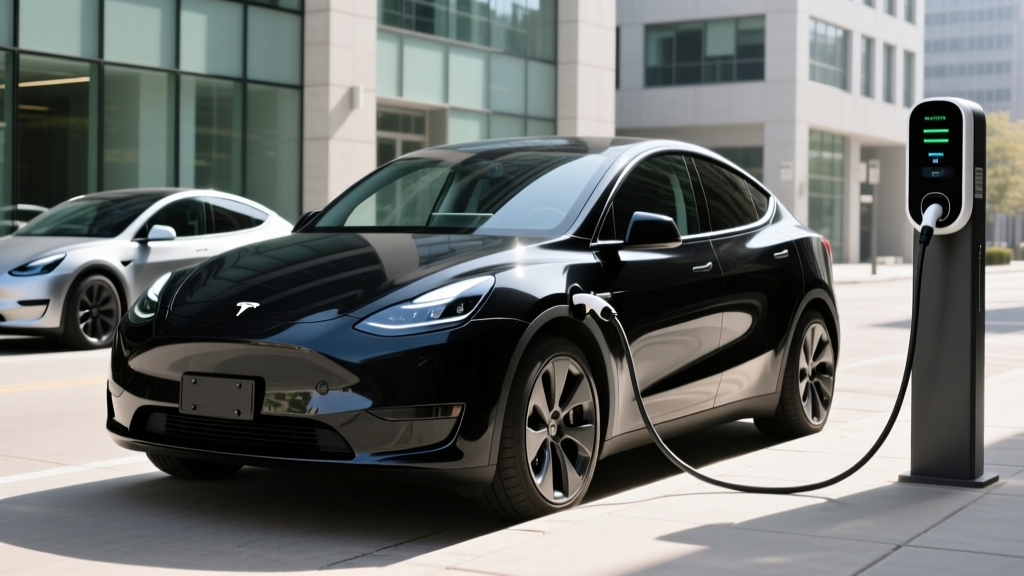
Charging is where the Model Y continues to leverage Tesla's biggest ecosystem advantage. On a V3 or V4 Supercharger, the Long Range AWD peaks at 250 kW, though — as with all lithium-ion batteries — that peak is not sustained across the entire session.
| Charging Method | Power (kW) | Speed / Time |
|---|---|---|
| Tesla Supercharger (V3/V4) | Up to 250 kW peak | 10-80% in ~27 min; ~175 mi in 15 min |
| CCS Adapter + Electrify America | Up to 250 kW peak | 10-80% in ~28-30 min (adapter required) |
| Home Level 2 (Wall Connector, 48A) | 11.5 kW | ~44 mi/hr; full charge in ~7-8 hours |
| Home Level 2 (32A mobile connector) | 7.7 kW | ~30 mi/hr; full charge in ~10 hours |
| Level 1 (120V standard outlet) | ~1.3 kW | ~3-4 mi/hr; emergency/trickle only |
The charging curve reality: The Model Y holds near-peak speed (200-250 kW) from roughly 10% to 40% SoC, then tapers progressively. From 60% to 80%, expect 80-120 kW. Above 80%, charging slows dramatically to protect cell longevity — a 90% fill can add 15+ minutes. For road trips, the optimal strategy is to charge to 80% and go; the time penalty of charging past 80% almost never justifies the extra range gained.
With Tesla's NACS connector now becoming the industry standard, third-party networks like Electrify America, EVgo, and ChargePoint are adding NACS cables. In the meantime, Tesla sells a CCS-to-NACS adapter (~$175) that unlocks non-Tesla DC fast chargers — useful if you live in an area with sparse Supercharger coverage.
Third-Row Practicality: Kids, Cargo, and Compromise
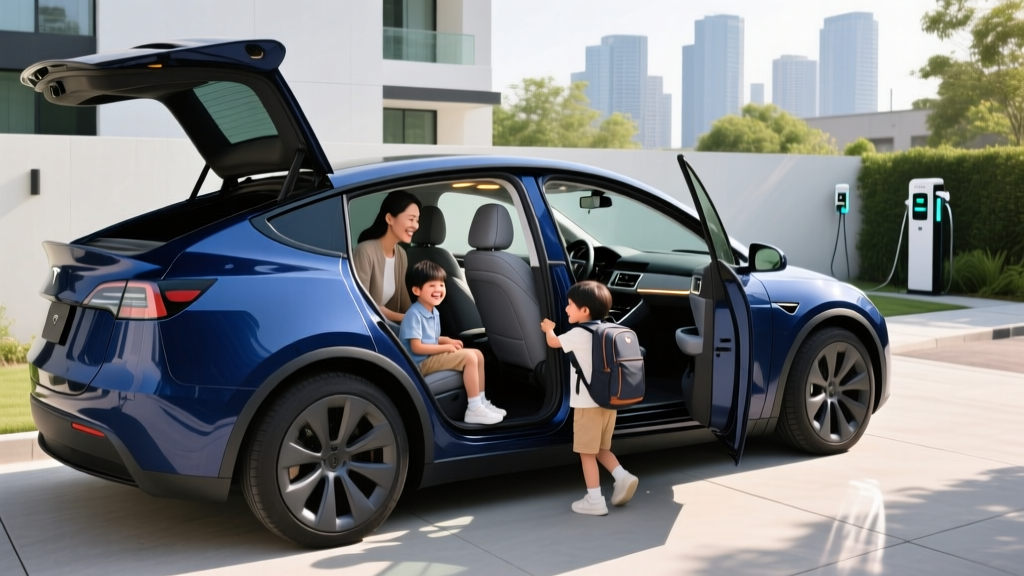
Let's address the reason you're reading this review: the third row. Tesla offers it as a $3,000 option on the Long Range trim, adding two rear-facing seats that bring total capacity to seven passengers. Here's the honest assessment after loading it with real humans and gear:
Third-row dimensions:
- Legroom (3rd row): ~26.5 inches — tight even for children over 5'2"
- Headroom (3rd row): ~34 inches — the sloping roofline cuts into space for anyone over ~4'10"
- Seat width: Suitable for two children or small teenagers; adults will not be comfortable beyond a 15-minute trip
- Access: The second-row seats tilt and slide forward, but the opening is narrow — loading a rear-facing car seat into the third row is impractical
Cargo impact:
- Behind 3rd row (all seats up): ~12 cu ft — enough for two carry-on bags or a week's groceries, but not much more
- 3rd row folded, 2nd row up: ~30 cu ft — competitive with midsize crossovers
- All rear rows folded: ~72 cu ft — a genuinely useful flat load floor
- Front trunk (frunk): ~4.1 cu ft — handy for charging cables, a backpack, or small groceries
The verdict: the third row works best for families with two younger children (roughly ages 4-10) who need occasional extra seating for carpool duty, visiting grandparents, or short neighborhood trips. If you regularly need to carry more than five people on long drives, the Kia EV9 or a used Model X will serve you better. The Model Y's third row is an occasional-use feature, not a daily-driver solution for large families.
Performance and Driving Dynamics
The Long Range AWD pairs a permanent-magnet motor on the rear axle with an induction motor up front, delivering 384 hp combined and a 0-60 mph time of 4.8 seconds. That's genuinely quick for a family crossover, and the instant torque makes highway merging and city driving feel effortless.
Ride quality has improved on the latest Model Y generation, with revised damper tuning that reduces the crashiness over sharp bumps that earlier models were known for. Road noise is still more noticeable than in a Genesis GV60 or BMW iX, but it's acceptable for the price point. The steering is precise if somewhat numb — a Tesla hallmark — and the low center of gravity (battery pack under the floor) keeps body roll well-controlled in corners.
Regenerative braking remains strong and predictable. Tesla removed the user-adjustable regen setting several years ago, so one-pedal driving is the default and only mode. Most owners adapt within a week, but if you're coming from an EV with adjustable regen (Hyundai, Ford, BMW), expect a brief adjustment period.
Pricing, Trims, and Federal Tax Credit Eligibility
The 2026 Model Y is offered in several configurations. Here's the pricing landscape:
| Trim | MSRP | 3rd Row Available? | §30D Credit Eligible? |
|---|---|---|---|
| Long Range RWD | $44,990 | No | Yes — up to $7,500 (subject to sourcing/income rules) |
| Long Range AWD | $48,990 | Yes (+$3,000) | Yes — up to $7,500 |
| Performance AWD | $52,490 | No | Yes — up to $7,500 |
Federal tax credit details (IRS §30D): The Model Y qualifies for up to $7,500 in federal tax credits, but eligibility depends on several factors that change periodically. Per current IRS rules:
- MSRP cap: The vehicle must have an MSRP at or below $80,000 (SUVs/crossovers). All Model Y trims clear this threshold comfortably.
- Buyer income cap: Modified adjusted gross income must not exceed $150,000 (single), $225,000 (head of household), or $300,000 (joint filers).
- Battery sourcing: At least a percentage of critical minerals and battery components must be sourced from the U.S. or free-trade-agreement partners. Tesla has significantly localized its supply chain, and the Model Y currently meets both the critical-mineral and battery-component requirements for the full $7,500.
- Point-of-sale transfer: Since 2024, you can transfer the credit to the dealer at purchase, effectively reducing your out-of-pocket price by $7,500 at the time of sale — no need to wait for tax filing.
A Model Y Long Range AWD with the 3rd-row option and delivery fees lands around $53,490 before incentives. With the full $7,500 federal credit applied at point of sale, the effective price drops to approximately $45,990. State incentives (California's CVRP, Colorado's Innovative Motor Vehicle Credit, etc.) may reduce the cost further — check your state's energy office for current programs.
Tech, Safety, and Driver Assistance
The Model Y's interior is dominated by a 15.4-inch central touchscreen that controls virtually every vehicle function — climate, mirrors, glovebox, navigation, media. There's no instrument cluster; all driving information appears on the main screen's left edge. This minimalist approach remains polarizing: some owners love the clean aesthetic, while others find the lack of physical buttons frustrating for simple tasks like adjusting fan speed or wipers.
Autopilot and FSD (Supervised): Every Model Y includes basic Autopilot (adaptive cruise control + lane centering). Tesla's Full Self-Driving (Supervised) package is a $8,000 add-on (or $99/month subscription) that adds automatic lane changes, traffic light/stop sign recognition, and navigate-on-autopilot highway routing.
Safety ratings are strong: the Model Y earned a 5-star overall rating from NHTSA and a Top Safety Pick+ designation from IIHS. The low center of gravity contributes to excellent rollover resistance, and the rigid battery structure provides strong crash-energy management.
Pros, Cons, and the Competition
- Access to Tesla Supercharger network — still the most reliable DC fast-charging ecosystem
- Class-leading efficiency (28 kWh/100 mi) means lower electricity costs per mile
- Strong performance (4.8s 0-60) without sacrificing range
- Over-the-air updates continuously add features
- Full $7,500 federal tax credit eligibility (as of current rules)
- Low maintenance costs — no oil changes, minimal brake wear thanks to regen
- Third row is children-only; adults will be uncomfortable beyond short trips
- Cargo space behind the third row (12 cu ft) is very limited
- No Apple CarPlay or Android Auto — Tesla's ecosystem only
- Panel gaps and interior material quality still lag premium competitors
- Ride quality improved but still firm compared to Hyundai Ioniq 5 or Kia EV6
- Insurance premiums tend to run 15-25% higher than comparable non-Tesla crossovers
Key competitors to cross-shop:
- Kia EV9 (3-row): Genuinely usable third row for adults, 304 mi range, ~$54,990 base. Larger and heavier, but a better 7-seat solution.
- Hyundai Ioniq 5 (2-row): No third row, but superior ride comfort, 800V ultra-fast charging (10-80% in 18 min), and CarPlay support.
- Ford Mustang Mach-E (2-row): Sportier driving dynamics, CarPlay, but less range and no third-row option.
- Volkswagen ID.4 (2-row, optional AWD): Lower starting price, comfortable ride, but slower charging and less range.
Who Should Buy the Model Y with the 3rd Row?
- You have two younger kids (ages 4-10) and occasionally need to carpool 2-3 extra children
- You want access to the Supercharger network for family road trips
- Your typical third-row use is short trips (school runs, sports practice, neighborhood errands)
- You prioritize efficiency and low per-mile operating cost above interior luxury
- You can charge at home (Level 2) and rarely need more than ~260 miles between stops
- You regularly carry 6-7 adults or tall teenagers
- You need substantial cargo space with all seats occupied (the EV9 or a minivan is better)
- You want Apple CarPlay, physical buttons, or a more traditional cockpit layout
- You live in an area with limited Supercharger access and need CCS-native fast charging
Frequently Asked Questions
Does the Tesla Model Y third row fit adults?
Not comfortably. With ~26.5 inches of legroom and a sloping roofline, the third row is best suited for children under about 5'2". Adults can physically fit for very short trips, but legroom and headroom are severely limited. For regular adult-capable third-row seating, look at the Kia EV9 or a three-row SUV.
How much range do you lose with the Model Y 3rd row option?
Approximately 3-5 miles of EPA-rated range, due to the added weight of the seat hardware (~50-60 lbs). In real-world driving, the impact is negligible — you're far more likely to notice range changes from weather, driving speed, and tire pressure than from the third-row option.
Can you fold the third row flat for more cargo space?
Yes. The third-row seats split 50/50 and fold nearly flat into the load floor. With the third row folded, you regain ~30 cu ft of cargo volume behind the second row, making the Model Y function like a standard 5-seat crossover for daily use.
Does the Model Y 3rd row qualify for the $7,500 federal tax credit?
Yes, as of current IRS rules. The Model Y Long Range AWD with the 3rd-row option has an MSRP well under the $80,000 SUV cap, and Tesla's battery sourcing currently meets both critical-mineral and component requirements. Buyer income caps still apply ($300,000 joint / $150,000 single). Always verify current eligibility on IRS.gov before purchasing, as sourcing rules can shift.
What is the warranty on the Model Y battery?
Tesla covers the Long Range AWD battery and drive unit for 8 years or 120,000 miles, whichever comes first, with a minimum 70% capacity retention guarantee. In practice, NMC batteries in Teslas have shown strong longevity — most owners report 5-8% degradation over the first 100,000 miles based on fleet data. The basic vehicle warranty is 4 years / 50,000 miles.
Is the Model Y a good family road-trip vehicle?
For five people or fewer, absolutely — the Supercharger network makes long-distance EV travel straightforward, with 15-25 minute charging stops every 2-3 hours. With the third row occupied and all seven seats full, cargo space shrinks to ~12 cu ft, which means packing light. Road trips with 6-7 people are doable but require more logistical planning for luggage and charging stops.