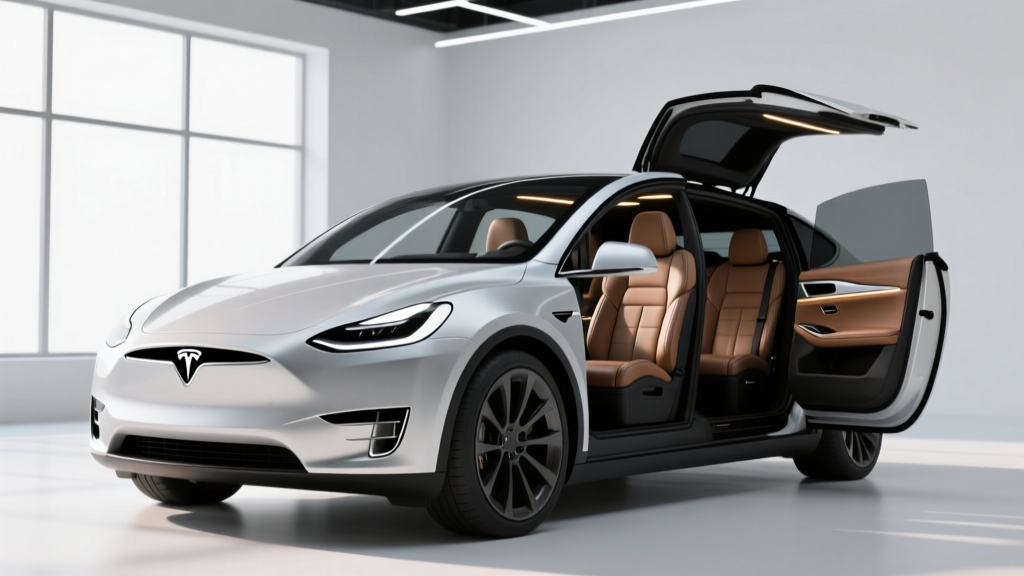
For years, the Tesla Model Y 3 rows configuration has been one of the most debated options in the EV market. Tesla introduced the optional third-row seat to make its best-selling crossover a viable seven-passenger family hauler — but shoehorning two extra seats into a midsize SUV comes with real trade-offs in legroom, cargo volume, and everyday usability. In this 2026 profile, we break down exactly what the 3-row Model Y offers in range, charging speed, interior space, and total cost — and whether the third row is a practical daily solution or a niche backup seat.
Quick Verdict: Who the 3-Row Model Y Is Actually For
The Tesla Model Y with the optional third row is best understood as a 5+2 vehicle rather than a true seven-seater. The third row works well for children, carpools, and occasional short trips, but adults will find it cramped on longer drives. If your household routinely needs to transport more than five passengers over distance, a larger SUV like the Kia EV9 or Rivian R1S will serve you better. If you need the third row a few times a month and prioritize charging infrastructure, efficiency, and software, the 3-row Model Y remains the most compelling electric option in its size class.
Range, Battery & Real-World Efficiency
The 2026 Tesla Model Y Long Range AWD — the trim that offers the 3-row option — carries a 78.1 kWh usable battery using nickel-manganese-cobalt (NMC) chemistry, which favors energy density over the LFP packs found in the base RWD trim. The EPA rates this configuration at 310 miles of range.
EPA sticker: 310 miles
Real-world highway (70-80 mph): ~250–270 miles
Cold weather (below 32°F / 0°C): ~220–240 miles
Mixed commuting (city + suburban): ~280–300 miles
The 3-row option adds roughly 40 lbs of seat hardware, which has a negligible effect on range. The bigger range reducers are sustained highway speed and cold temperatures, which affect all EVs. The Model Y's heat pump helps limit winter losses compared to older resistive-heating EVs.
Efficiency is rated at 122 MPGe combined, which translates to roughly 28 kWh per 100 miles. That is among the most efficient figures in the three-row EV segment, reflecting Tesla's industry-leading drivetrain and aero optimization.
| Spec | Value |
|---|---|
| EPA Range | 310 miles |
| Battery (usable) | 78.1 kWh, NMC |
| Efficiency | 122 MPGe / 28 kWh/100 mi |
| Peak DC Fast Charge | 250 kW (CCS via NACS adapter or native NACS) |
| 10–80% DC Charge Time | ~25 minutes |
| Level 2 Home Charge | 11.5 kW / ~44 mi/hr |
| 0–60 mph | 4.8 seconds |
| Horsepower | 384 hp (dual motor AWD) |
| Base MSRP (w/ 3-row) | ~$50,490 (incl. destination) |
| Battery Warranty | 8 yr / 120,000 mi |
Charging Speed: Home, Supercharger & Public DC Networks
Charging is where the Model Y continues to outperform most rivals, largely thanks to Tesla's Supercharger network — now open to other brands but still the most reliable and widespread DC fast-charging ecosystem in North America.
| Level | Power (kW) | Speed / Notes |
|---|---|---|
| Level 1 (120V outlet) | ~1.4 kW | ~4–5 mi/hr — emergency/trickle only |
| Level 2 (240V home) | 11.5 kW | ~44 mi/hr — full overnight recharge |
| DC Fast Charge | 250 kW peak | 10–80% in ~25 min; tapers above 80% |
Charging curve reality: The Model Y peaks at 250 kW only between roughly 10–30% state of charge. From 50–80%, the rate tapers to ~100–120 kW. This means the advertised "15 minutes to 200 miles" is accurate only when starting from a very low SoC with a preconditioned battery. On a V3 Supercharger with battery preconditioning enabled via navigation routing, 10–80% typically takes 25 minutes. At non-Tesla 150 kW chargers (Electrify America, EVgo), expect 10–80% in about 35–40 minutes.
Home charging setup: The onboard 11.5 kW charger requires a 60-amp dedicated circuit (48-amp continuous draw). A Tesla Wall Connector costs ~$400 for the unit; professional installation typically runs $500–$2,000 depending on panel proximity and whether a service upgrade is needed. Plan for a full charge from 10–100% in about 7 hours at Level 2.
Interior Space: How Usable Is the Third Row?
The third-row option replaces the standard flat cargo floor with a 50/50 split bench that folds flat into the floor when not in use. Here is how the dimensions break down:
- Third-row legroom: 26.5 inches — adequate for children up to about 12 years old; adults will have knees pressed into the second-row seatback.
- Third-row headroom: 36.1 inches — acceptable for shorter passengers but the sloping roofline cuts into space for anyone over 5'8".
- Cargo behind 3rd row: 10.6 cu ft — enough for a couple of grocery bags or a stroller, but not both simultaneously.
- Cargo with 3rd row folded: 30.2 cu ft — competitive with compact SUVs in five-seat mode.
- Total cargo (2nd & 3rd rows folded): 72.1 cu ft — near-flat load floor, excellent for large items.
- Front trunk (frunk): 4.1 cu ft — useful for charging cables and small bags.
Real-world practicality: With all three rows in use, you have seating for seven but essentially no cargo space for a family road trip. Most 3-row Model Y owners report using the third row 10–20% of the time — for carpools, school runs, or visiting grandparents — and folding it flat the rest of the time. If you need seven seats and luggage space simultaneously, the Kia EV9 (with 20.2 cu ft behind the third row) is a meaningfully better fit.
Performance, Ride & Driver Assistance
The dual-motor AWD powertrain produces 384 horsepower and propels the Model Y to 60 mph in 4.8 seconds. That is brisk for a family crossover and noticeably quicker than competitors like the Hyundai Ioniq 5 (5.2s AWD) or the VW ID.4 (5.7s AWD).
Ride quality received a meaningful improvement in Tesla's 2025 "Juniper" refresh, with revised damper tuning, additional sound deadening, and softer bushings. The 2026 model carries those improvements forward. It is still firmer than a Kia EV9 or Ford Explorer, but no longer harsh on rough pavement.
Tesla's Autopilot (standard) and Full Self-Driving Supervised (optional, ~$8,000 or $99/mo) are SAE Level 2 driver-assistance systems. The driver must remain fully engaged, hands on the wheel (or demonstrating attention via cabin camera), and ready to take over at any moment. These are not self-driving systems. Only Level 4 services like Waymo operate without a human driver in geofenced areas.
Standard Autopilot includes adaptive cruise control and lane-centering on highways. FSD Supervised adds automatic lane changes, traffic-light and stop-sign recognition, and city-street navigation. In practice, FSD handles most routine suburban and highway scenarios competently but still requires active supervision — construction zones, unusual lane markings, and complex intersections can require immediate intervention.
Pricing, Trims & Federal Tax Credit Eligibility
The 3-row option is available exclusively on the Model Y Long Range AWD trim for a $2,000 add-on. Here is the pricing landscape for 2026:
| Trim | MSRP (incl. destination) | 3-Row Option | As-Configured |
|---|---|---|---|
| Long Range AWD | $48,490 | +$2,000 | $50,490 |
| Long Range AWD + FSD | $48,490 | +$2,000 + $8,000 | $58,490 |
Federal §30D tax credit eligibility (2026 rules):
- The Model Y Long Range AWD has an MSRP under the $80,000 SUV cap, so it clears the price threshold. ✓
- Buyer income caps: Modified AGI must not exceed $300,000 (joint filers), $225,000 (head of household), or $150,000 (single). Verify via IRS §30D guidelines.
- Battery component & critical mineral sourcing: As of 2026, the full $7,500 credit requires both battery-component and critical-mineral requirements to be met. Tesla has progressively shifted Model Y battery cell production and mineral sourcing to US/FTA-partner supply chains, and the Long Range AWD has qualified for the full $7,500 in recent model years. However, sourcing rules tighten annually — confirm current-year eligibility on fueleconomy.gov before purchasing.
- Point-of-sale transfer: The credit can now be transferred to the dealer at purchase, reducing the upfront price rather than waiting for a tax refund. This effectively brings a 3-row Long Range AWD to ~$42,990 at point of sale if all eligibility criteria are met.
MSRP: $50,490 → After $7,500 credit: $42,990 (if all income, sourcing, and MSRP requirements are met). Consult a tax professional to confirm personal eligibility.
Pros, Cons & Competitor Comparison
- Best-in-class Supercharger network access
- Industry-leading efficiency (122 MPGe)
- Strong 0–60 performance (4.8s) for the segment
- Over-the-air updates continuously add features
- Low operating cost (~$0.04–0.06/mi on home charging)
- Excellent safety ratings (NHTSA 5-star, IIHS Top Safety Pick+)
- Third row fits children only — 26.5" legroom
- Only 10.6 cu ft cargo with 3rd row up
- No Apple CarPlay or Android Auto
- FSD still requires full driver attention (Level 2)
- Insurance costs above segment average
- Minimal physical controls — everything via touchscreen
Key competitors for 3-row EV buyers:
- Kia EV9 (3-row, 291 mi EPA): Larger third row (32" legroom), more cargo behind 3rd row, slower charging (210 kW peak). MSRP starts ~$56,000.
- Rivian R1S (3-row, 352 mi EPA Large Pack): Genuinely seats seven adults, superior off-road capability, starts ~$79,900 — exceeds the §30D MSRP cap.
- VW ID.4 (no 3rd row in US): Eliminated as a direct competitor since the US-spec ID.4 does not offer a third row.
Ownership Costs & Warranty
Tesla covers the Model Y battery and drive unit for 8 years / 120,000 miles (whichever comes first), with a warranty threshold of 70% capacity retention. The limited vehicle warranty is 4 years / 50,000 miles.
Real-world data from high-mileage Tesla owners and fleet operators suggests NMC packs in the Model Y typically retain 88–92% capacity at 100,000 miles, well above the warranty threshold. Degradation is fastest in the first 20,000 miles (~3–5%) and then slows significantly.
Estimated 5-year operating cost advantage: Based on 15,000 miles/year at $0.13/kWh (national average residential electricity), annual "fuel" cost is roughly $546. A comparable gas SUV at 24 MPG and $3.40/gallon costs about $2,125/year — a savings of ~$1,579 annually, or ~$7,900 over five years before accounting for any difference in maintenance (no oil changes, fewer brake replacements due to regenerative braking).
Frequently Asked Questions
What is the real-world range of the 3-row Tesla Model Y?
The EPA rates the 2026 Model Y Long Range AWD at 310 miles. Expect roughly 250–270 miles on sustained highway trips at 70–80 mph, and 220–240 miles in freezing weather. City and suburban driving with regenerative braking recovers closer to the EPA figure.
How fast does the Model Y charge at home and on the road?
At home on a 240V Level 2 charger (11.5 kW), the Model Y adds ~44 miles of range per hour, fully recharging overnight in about 7 hours. On a Tesla V3 Supercharger (250 kW peak), 10–80% takes approximately 25 minutes with a preconditioned battery.
Does the 3-row Model Y qualify for the $7,500 federal tax credit?
The Model Y Long Range AWD is under the $80,000 MSRP cap and has qualified for the full $7,500 §30D credit in recent model years based on battery sourcing. However, buyer income limits ($150K single / $300K joint) and annually tightening critical-mineral rules apply. Always verify current eligibility on fueleconomy.gov and consult a tax professional.
Is the third row practical for adults?
No. With 26.5 inches of legroom and a sloping roofline, the third row is suitable for children or very short trips for smaller adults. For regular adult passengers in the third row, the Kia EV9 or Rivian R1S are significantly more accommodating.
How does the Model Y 3-row compare to the Kia EV9?
The EV9 offers a more usable third row (32" legroom), more cargo space behind it (20.2 vs 10.6 cu ft), and a comfortable ride. The Model Y counters with better efficiency (122 vs 89 MPGe), faster charging (250 vs 210 kW), access to the Supercharger network, and a lower starting price (~$50K vs ~$56K). Choose the Model Y for efficiency and charging; choose the EV9 for passenger and cargo space.
Is FSD worth buying on the Model Y?
FSD Supervised ($8,000 or $99/month) adds city-street navigation and automatic lane changes but remains a Level 2 system requiring full driver engagement. Most owners find standard Autopilot sufficient for highway driving. FSD's value depends on your tolerance for supervising an imperfect system — test it via the monthly subscription before committing to a purchase.