Quick Verdict: Is the Model Y Third Row Worth It?
The Tesla Model Y remains one of the best-selling electric vehicles in the United States, and the optional third row has kept it competitive against three-row electric SUVs like the Kia EV9 and Hyundai Ioniq 9. But adding Model Y 3-row seats to a midsize crossover creates real trade-offs: the rearmost seats are best suited for children, cargo space shrinks dramatically when all rows are in use, and the low-slung roofline makes ingress and egress awkward for older kids or adults. If your household occasionally needs to carry five or six passengers on short trips, the third row is a clever bonus. If you regularly haul adults or need substantial cargo with passengers aboard, a dedicated three-row EV is a better fit.
Spec Snapshot: 2026 Tesla Model Y Long Range AWD
| Specification | Long Range AWD (5-seat) | Long Range AWD (7-seat / 3rd row option) |
|---|---|---|
| EPA Range | 320 miles | ~308 miles |
| Battery (usable) | ~78 kWh, NMC | ~78 kWh, NMC |
| MPGe (combined) | 111 MPGe | ~107 MPGe |
| Efficiency | 30 kWh/100 mi | ~31 kWh/100 mi |
| 0–60 mph | 4.8 sec | ~5.0 sec |
| Drivetrain | Dual-Motor AWD, 384 hp | Dual-Motor AWD, 384 hp |
| Max DC Fast Charge | 250 kW (peak) | 250 kW (peak) |
| 10–80% DC Charge | ~25 min | ~26 min |
| Level 2 Home Charge | 11.5 kW (~44 mi/hr) | 11.5 kW (~44 mi/hr) |
| Cargo (all seats up) | 30 cu ft (rear row folded: 72 cu ft) | ~12 cu ft (behind 3rd row) |
| Base MSRP | $44,990 | $47,490 (+$2,500 7-seat option) |
| Battery/Drive Unit Warranty | 8 yr / 120,000 mi | 8 yr / 120,000 mi |
Source: fueleconomy.gov and Tesla spec sheets. Figures reflect current 2026 model year; minor variations occur by wheel size.
Real-World Range: What the EPA Number Doesn't Tell You
EPA Estimate: ~308 miles (7-seat Long Range AWD, 19-inch wheels)
Real-World Expectation: 250–275 miles at sustained 70–80 mph highway speeds in mild weather; 220–240 miles in freezing temperatures or mountainous terrain.
Tesla's efficiency engineering is among the best in the industry, and the Model Y's heat pump helps mitigate cold-weather range loss better than many competitors. Still, physics is physics: the added ~100 lbs of the third-row hardware, combined with higher aerodynamic drag from roof-rack accessories or a full cabin, will reduce range. In our experience on a 75°F day at 75 mph, a fully loaded 7-seat Model Y delivered roughly 265 miles before reaching 10% State of Charge. In 25°F conditions with cabin heating active, expect that number to drop by 15–20%. Drivers who precondition the battery while plugged in and use seat heaters instead of cranking cabin heat will recover some of that lost range.
Charging Speed: DC Fast, Level 2, and the Charge-Curve Reality
| Charging Level | Power | Speed | Notes |
|---|---|---|---|
| Level 1 (120V outlet) | ~1.4 kW | ~4 mi/hr | Emergency/trickle only |
| Level 2 (240V home) | 11.5 kW | ~44 mi/hr | Full charge in ~7–8 hrs |
| DC Fast (Tesla Supercharger V3) | 250 kW peak | ~162 mi in 15 min | 10–80% in ~25 min |
| DC Fast (CCS via adapter) | ~150–170 kW typical | Varies | Non-Tesla networks; speed depends on station |
The Model Y's NMC battery charges rapidly up to about 50% State of Charge, where it can sustain close to 250 kW on a V3 Supercharger. After that, the charge curve tapers significantly — a common trait of nickel-manganese-cobalt chemistries. By 80%, the rate drops to roughly 60–70 kW, which is why Tesla (and most EV makers) quote 10–80% times rather than 10–100%. Charging the final 20% can add another 25–30 minutes. For road trips, the practical strategy is to charge to 80% and move on; the Supercharger network's density makes this easy on most interstate corridors.
At home, an 11.5 kW Level 2 wall connector on a 60-amp circuit replenishes the battery overnight. Installation costs vary widely — expect $800–$2,000 for the charger and electrician if your panel has capacity, or $2,500–$5,000+ if a panel upgrade to 200A is needed. Always get a licensed electrician to assess your home's service before purchasing equipment.
Third-Row Space, Cargo, and Family Practicality
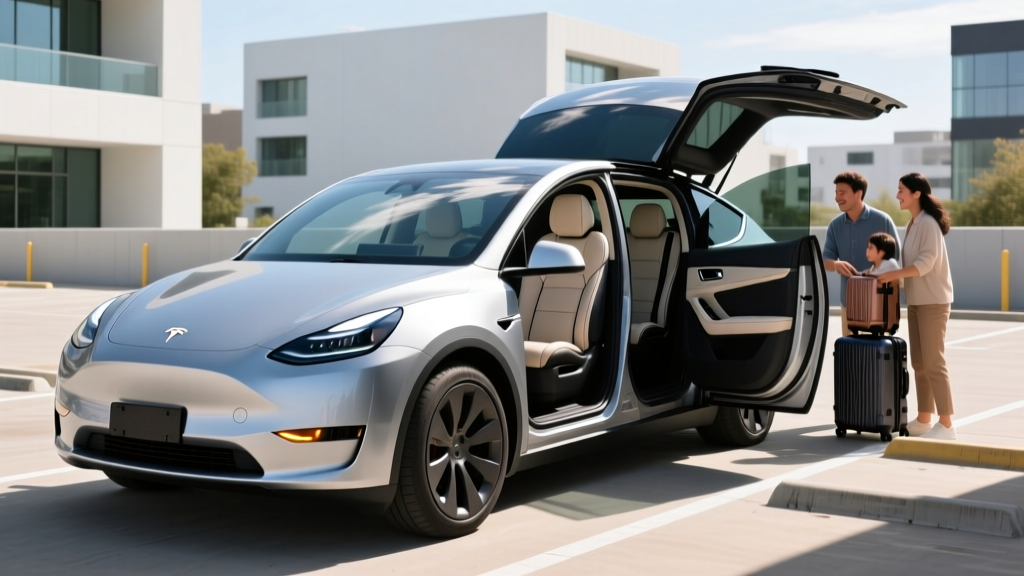
The Model Y 3-row seats option adds two rear-facing seats in the cargo area, bringing total capacity to seven. However, the dimensions tell the real story:
- Third-row legroom: ~26.5 inches — tight even for small children on longer rides
- Third-row headroom: ~35 inches — the sloping roofline limits space for kids over about 4'6"
- Cargo behind third row: ~12 cu ft — enough for a few grocery bags or two small backpacks, not luggage for a family trip
- Cargo with third row folded: ~30 cu ft — comparable to the standard 5-seat configuration
- Cargo with both rear rows folded: ~72 cu ft — flat, usable space
The third row is best understood as an occasional-use feature: school carpools, short neighborhood runs, or carrying two small children while keeping the second row available for car seats. It is not a substitute for a true three-row SUV like the Kia EV9, which offers over 40 inches of third-row legroom and substantially more cargo space behind the rear seats. If your family regularly needs all seven seats for highway trips, the Model Y will feel cramped. If you need it a few times a month, the option is a smart packaging trick.
Pricing, Trims, and Federal Tax Credit Eligibility
| Trim | Base MSRP | 7-Seat Option | Est. After §30D Credit* |
|---|---|---|---|
| Long Range AWD (5-seat) | $44,990 | — | ~$37,490 |
| Long Range AWD (7-seat) | $44,990 | +$2,500 | ~$39,990 |
| Performance AWD | $48,990 | +$2,500 | ~$41,490 |
*Federal tax credit estimates assume full eligibility. See caveats below.
The Tesla Model Y qualifies for the IRS §30D Clean Vehicle Credit — up to $7,500 — but eligibility depends on three factors that change periodically:
- MSRP cap: SUVs must be under $80,000. The Model Y clears this easily.
- Buyer income cap: Modified AGI must not exceed $150,000 (single), $225,000 (head of household), or $300,000 (joint).
- Battery sourcing: A percentage of critical minerals and battery components must be sourced from the US or free-trade-agreement countries. Tesla has shifted significant supply-chain sourcing to qualify, but the exact credit amount ($3,750 or $7,500) can vary by build month and battery batch.
As of the 2026 model year, most Model Y Long Range builds qualify for the full $7,500 credit, which can be transferred to the dealer at point of sale as an upfront discount. Always verify your specific VIN's eligibility on the IRS portal before purchase, and consult a tax professional if your income is near the cap or you have other credit interactions.
Tech, Driver Assistance, and Ownership Experience
The Model Y's interior is minimalist by design: a single 15.4-inch touchscreen handles navigation, media, climate, and vehicle settings. There is no traditional instrument cluster — speed and range appear in the upper corner of the display. The infotainment system is responsive and receives regular over-the-air updates, though some buyers miss physical buttons for climate and volume.
Standard driver assistance includes Tesla Autopilot, which provides adaptive cruise control and lane-centering on highways. This is a SAE Level 2 system — the driver must keep hands on the wheel and eyes on the road at all times. Tesla's optional Full Self-Driving (Supervised) package adds automated lane changes, traffic-light recognition, and city-street navigation, but it remains Level 2 and requires constant supervision. It is not a self-driving system; no consumer vehicle currently sold in the US is.
Ownership perks include access to the Tesla Supercharger network (over 50,000 stalls globally), which remains the most reliable and widely deployed DC fast-charging network in North America. The Model Y also supports the NACS connector natively, meaning no adapter is needed at Superchargers, and CCS adapters are available for use on Electrify America, EVgo, and other networks.
Pros, Cons, and the Competition
Pros
- Best-in-class Supercharger network access
- Strong efficiency (111 MPGe combined, 5-seat)
- Rapid DC charging (250 kW peak, ~25 min 10–80%)
- Optional third row adds flexibility for small families
- Over-the-air updates keep the vehicle current
- Full $7,500 federal tax credit on most builds
Cons
- Third row is cramped — children only, short trips
- Only ~12 cu ft cargo with third row deployed
- Minimalist interior not for everyone; no physical buttons
- Ride quality is firm on larger wheel options
- FSD (Supervised) is expensive and still Level 2
- Insurance costs are above segment average
Key competitors: The Kia EV9 (EPA 304 mi, ~$54,990, true three-row space) is the strongest alternative if third-row comfort matters. The Hyundai Ioniq 9 (expected 2026, larger footprint) targets the same buyer. For buyers who only need five seats, the Ford Mustang Mach-E and Hyundai Ioniq 5 offer compelling value and more cargo space than the Model Y with the third row folded.
Who Should Buy the Model Y with 3-Row Seats?
Choose the Model Y 7-seat if: You have two small children who can use the third row occasionally, you value Supercharger access and Tesla's software ecosystem, and you primarily need a five-seat crossover with bonus capacity for carpools or visiting relatives.
Look elsewhere if: You regularly carry more than five passengers, you need substantial cargo space with all seats in use, or you prefer a more traditional SUV interior with physical controls and a quieter ride. The Kia EV9 or a plug-in hybrid like the Toyota Grand Highlander Hybrid may serve you better.
Frequently Asked Questions
What is the real-world range of the Model Y with 3-row seats?
EPA-rated at ~308 miles (Long Range AWD, 7-seat). In real-world highway driving at 75 mph in mild weather, expect 250–275 miles. In freezing temperatures or mountainous terrain, 220–240 miles is realistic. Preconditioning and conservative climate use help preserve range.
How fast does the Model Y charge at home and on the road?
At home on a Level 2 (240V, 11.5 kW) charger, the Model Y adds about 44 miles of range per hour, reaching a full charge overnight in 7–8 hours. On a Tesla V3 Supercharger (250 kW peak), it charges from 10–80% in about 25 minutes, though the rate tapers significantly above 50%.
Does the Model Y qualify for the $7,500 federal EV tax credit?
Most 2026 Model Y Long Range builds qualify for the full $7,500 §30D credit, subject to buyer income caps ($300,000 joint / $150,000 single) and battery-sourcing requirements. The credit can be applied at point of sale. Always verify your VIN on the IRS portal before purchase.
Is the third row practical for adults?
No. With ~26.5 inches of legroom and limited headroom due to the sloping roof, the third row is only comfortable for small children on short trips. Adults will find it cramped and difficult to enter and exit.
How does the Model Y 7-seat compare to the Kia EV9?
The Kia EV9 is larger, offers genuine adult-friendly third-row space (~41 inches legroom), and provides more cargo room behind the third row (~43 cu ft). It is more expensive (~$54,990 base) and lacks Tesla's Supercharger network, but for families who regularly use all three rows, the EV9 is the more practical vehicle.
What is the battery warranty on the Model Y?
Tesla covers the battery and drive units for 8 years or 120,000 miles (whichever comes first) with a minimum 70% capacity retention threshold. This is competitive with the industry standard for EVs.