The 2026 Tesla Model Y With a Third Row: Quick Verdict
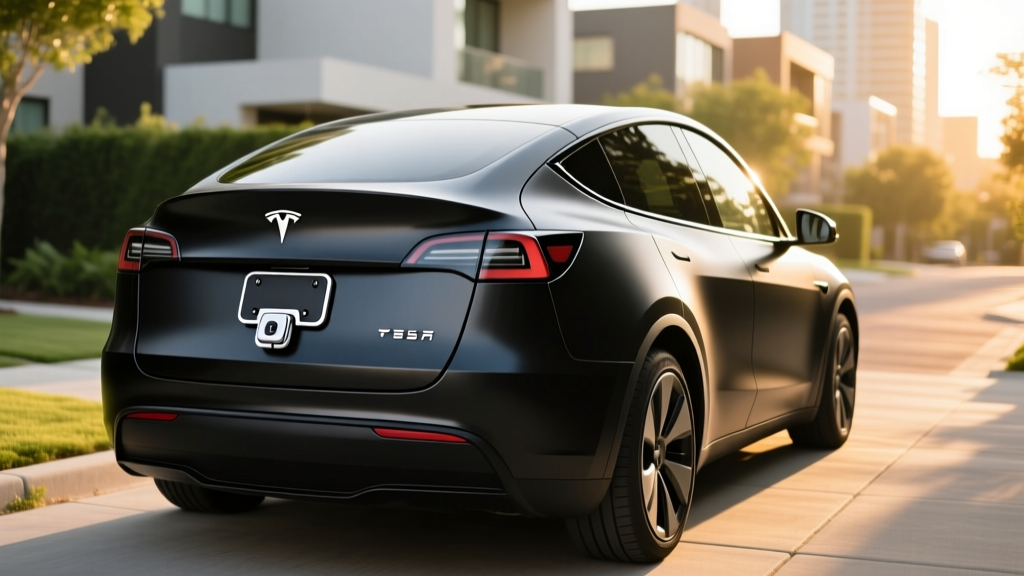
Tesla reintroduced the optional third-row seat for the refreshed Model Y (internally dubbed "Juniper") in mid-2025, and it carries over into the 2026 model year as a $2,000 add-on for the Long Range AWD trim. The pitch is compelling: a compact electric crossover that can technically haul seven passengers, access the Supercharger network, and still deliver over 300 miles of EPA range. But "technically" is doing a lot of heavy lifting here. The 3-row Model Y is best understood as a 5+2 vehicle — excellent for two kids or occasional carpools, not a minivan replacement. If your third-row needs are frequent and your passengers are over 5'4", you'll want to cross-shop the Kia EV9 or Rivian R1S instead.
Spec Table: 2026 Tesla Model Y Long Range AWD (3-Row Option)
| Spec | Value |
|---|---|
| EPA Range | 320 miles (Long Range AWD) |
| Battery Capacity | ~78 kWh usable, NMC (2170 cells) |
| Drivetrain | Dual-Motor AWD |
| Horsepower | 384 hp combined |
| 0-60 mph | 4.8 seconds |
| Max DC Fast Charge | 250 kW peak (V3 Supercharger) |
| 10-80% DC Time | ~27 minutes |
| Level 2 Home Charge | 11.5 kW (~44 mi/hr) |
| MPGe (combined) | 111 MPGe |
| Efficiency | 30 kWh/100 mi |
| Cargo (behind 3rd row) | 12.0 cu ft |
| Cargo (3rd row folded) | 34.0 cu ft |
| Cargo (all rear seats folded) | 72.0 cu ft |
| 3rd Row Legroom | 26.5 inches |
| Base MSRP | $49,990 (Long Range AWD) |
| 3-Row Option | +$2,000 |
| As-Tested (w/ option + FSD) | ~$59,990 |
| Battery Warranty | 8 yr / 120,000 mi |
| Vehicle Warranty | 4 yr / 50,000 mi |
Real-World Range: What the EPA Sticker Doesn't Tell You
The 3-row option adds roughly 75 lbs of seat hardware and structural reinforcement, which trims a negligible 2–3 miles off the EPA rating compared to the 2-row Long Range — not enough to matter in daily driving. What does matter is how you use the vehicle: a fully loaded 7-passenger Model Y with roof-rack cargo will see efficiency drop to roughly 33–35 kWh/100 mi, cutting effective range to around 235–250 miles on a highway trip.
On a fueleconomy.gov comparison, the Model Y Long Range AWD posts 111 MPGe combined — competitive with the Ford Mustang Mach-E Extended Range AWD (101 MPGe) but trailing the Hyundai Ioniq 5 AWD (110 MPGe) only slightly. Efficiency remains a Tesla strong suit thanks to the octovalve thermal management system and low drag coefficient (Cd 0.23).
Charging Speed: DC Fast and Home Level 2
Tesla's Supercharger network remains the gold standard for public DC fast charging, and the 2026 Model Y takes full advantage. On a V3 Supercharger (250 kW peak), the Model Y Long Range peaks around 250 kW at low state of charge and tapers progressively. The charge curve is the critical detail here:
| Charging Method | Power | Speed / Time |
|---|---|---|
| DC Fast (V3 Supercharger) | 250 kW peak | 10-80% in ~27 min; ~175 mi in 15 min |
| DC Fast (CCS adapter, non-Tesla) | ~170 kW typical | 10-80% in ~35 min |
| Level 2 (Tesla Wall Connector, 48A) | 11.5 kW | ~44 miles per hour; full charge in ~8 hr |
| Level 2 (generic 32A J1772 + adapter) | 7.7 kW | ~30 miles per hour; full charge in ~11 hr |
| Level 1 (120V household) | ~1.4 kW | ~4 miles per hour |
Charging curve reality: The Model Y sustains above 200 kW only between roughly 5–30% state of charge. From 30–60%, expect 120–150 kW. From 60–80%, it drops to 60–80 kW. This is typical for NMC chemistry in a mid-size pack, but it means the advertised "175 miles in 15 minutes" assumes you arrive at a near-depleted state of charge. If you plug in at 30%, that 15-minute session adds closer to 120 miles.
For home charging, Tesla's Wall Connector at 48 amps on a 60-amp circuit delivers 11.5 kW — fast enough to replenish a full day's driving (40–60 miles) in about 1–1.5 hours overnight. Installation typically runs $800–$2,000 depending on panel proximity and whether a 200-amp service upgrade is needed. Always have a licensed electrician assess your panel before committing to a 60-amp circuit.
Third-Row Space, Cargo, and Family Practicality
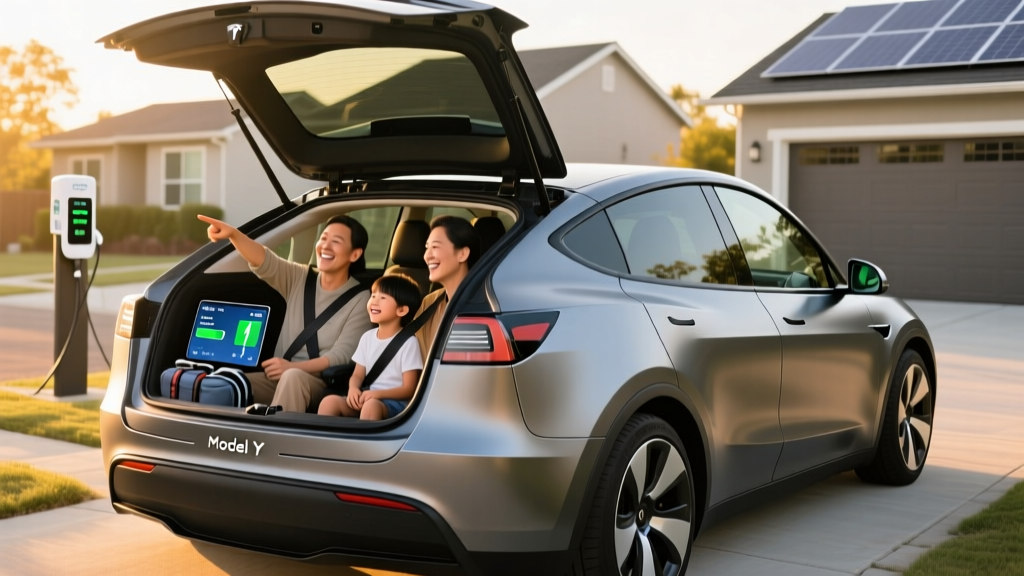
Let's be direct about the third row: it is a child-sized space. With 26.5 inches of legroom and a low cushion height, it accommodates children up to roughly 5'2" comfortably for trips up to an hour. Adults can physically fit in a pinch, but knees will be against the second-row seatback, and the low floor creates a "knees-up" posture that's fatiguing beyond 20 minutes.
Access is via a power-folding 60/40 second row that slides and tilts forward. It works, but it's slower and less graceful than the one-touch walk-in mechanisms in the Kia EV9 or Hyundai Palisade. Getting a rear-facing child seat into the second row while still using the third row is a tight squeeze.
Cargo trade-offs are significant:
- Behind the third row: 12.0 cu ft — enough for 3–4 grocery bags or two small carry-ons. No usable space for a stroller.
- Third row folded (5-seat mode): 34.0 cu ft — competitive with the 2-row Model Y and adequate for weekly family hauling.
- All rear seats folded: 72.0 cu ft — generous for a compact crossover, though the sloping roofline limits vertical space for tall items.
The front trunk (frunk) adds roughly 4.1 cu ft of secure, drainable storage — useful for charging cables, a small cooler, or wet gear. This is an advantage the EV9 and most three-row ICE crossovers don't offer.
Performance, Ride Quality, and Tech
The dual-motor AWD powertrain produces 384 hp and launches the Model Y to 60 mph in 4.8 seconds — brisk for a family vehicle and meaningfully quicker than the EV9 GT-Line (5.0 sec) or the Toyota Grand Highlander Hybrid (7.5 sec). The instant torque delivery makes highway merging effortless, even with seven occupants.
Ride quality in the Juniper refresh is notably improved over the pre-2025 Model Y. Tesla retuned the suspension, added acoustic glass, and revised the bushings. The result is a quieter, more compliant ride that still handles confidently but no longer crashes over expansion joints. It's not luxury-SUV quiet, but it's competitive with the Mach-E and Ioniq 5.
Tech and driver assistance:
- 15.4-inch center touchscreen running Tesla's latest software — responsive, minimal latency, controls virtually everything including glovebox and mirror adjustment.
- Second-row 8-inch screen for rear passengers (climate, media, gaming).
- Basic Autopilot included: adaptive cruise + lane centering (SAE Level 2).
- Full Self-Driving (Supervised) available for $8,000 or $99/month — still SAE Level 2, requires active driver supervision at all times.
- Ventilated front seats, heated rear seats, ambient lighting (all new for Juniper).
- No Apple CarPlay or Android Auto — Tesla's native ecosystem only.
Pricing, Tax Credits, and Total Cost
The 2026 Model Y Long Range AWD starts at $49,990 before destination. Adding the third-row option brings it to $51,990. A typical well-equipped build with FSD, a color upgrade, and 20-inch wheels lands around $59,990.
| Trim / Config | MSRP | §30D Credit Eligibility |
|---|---|---|
| Long Range RWD (2-row) | $46,990 | Eligible (below $55K SUV cap) |
| Long Range AWD (2-row) | $49,990 | Eligible (below $55K SUV cap) |
| Long Range AWD (3-row) | $51,990 | Eligible (below $55K SUV cap) |
| Performance AWD | $54,990 | Eligible (below $55K SUV cap) |
Federal tax credit (§30D) details for 2026: The Model Y qualifies for up to $7,500 under current IRS rules, provided you meet all requirements:
- MSRP cap: SUVs/vans must be under $80,000 — all Model Y trims qualify.
- Buyer income cap: AGI must not exceed $300,000 (joint), $225,000 (head of household), or $150,000 (single).
- Battery sourcing: A percentage of critical minerals and battery components must be sourced from the US or FTA partners. Tesla's US-built LFP and NMC packs have progressively met these thresholds, but the exact credit amount (full $7,500 vs. partial $3,750) can shift based on annual sourcing percentages. Check the fueleconomy.gov credit tracker for the current status before purchasing.
- Point-of-sale transfer: You can transfer the credit to the dealer at purchase, reducing your out-of-pocket cost immediately rather than waiting for tax filing.
With the full $7,500 credit, the 3-row Model Y Long Range AWD effectively starts at $44,490 — undercutting the Kia EV9 Air (RWD, 230-mile range) at $54,900 and competing with loaded three-row gas crossovers on a total-cost-of-ownership basis when you factor in fuel savings and lower maintenance.
Pros and Cons
Pros
- Supercharger network access — still the most reliable DC fast-charging ecosystem
- 320-mile EPA range is competitive for the class
- Strong efficiency (30 kWh/100 mi) keeps charging costs low
- Quick 4.8-sec 0-60 even with the 3-row weight penalty
- Over-the-air updates continuously add features
- Frunk adds useful sealed storage
- Improved ride quality in Juniper refresh
Cons
- Third row is child-only; 26.5" legroom is unusable for adults on longer trips
- Only 12 cu ft of cargo behind the third row
- No Apple CarPlay or Android Auto
- 250 kW peak DC charge rate trails 800V competitors (Ioniq 5: 350 kW peak)
- Visibility rearward is compromised by the sloping roofline and thick C-pillars
- FSD at $8,000 remains a Level 2 system — expensive for what it delivers
- Panel upgrade may be required for 48A home charging
Who Should Buy the 3-Row Model Y?
This vehicle is ideal for families with two small children who occasionally need to carpool one or two extra kids — think sports practice, school runs, or weekend visits with grandparents. It works as a 5-seat daily driver with generous cargo space that can flex to 6 or 7 seats a few times a month.
It is not the right choice if:
- You regularly carry more than five passengers.
- Your third-row passengers are teenagers or adults.
- You need significant cargo space while using all three rows (look at the EV9 or a minivan).
- You tow frequently — the Model Y is rated for 3,500 lbs, but towing slashes range by 30–40%.
For frequent 7-passenger use, the Kia EV9 (304-mile range, 53.5" third-row legroom, ~$60K) is a substantially more practical three-row EV, though it costs more and lacks native Supercharger access (NACS-equipped EV9 models arriving late 2026 will change this). The Rivian R1S offers genuine adult-sized third-row space but starts above $75,000.
Frequently Asked Questions
Does the 2026 Tesla Model Y 3-row qualify for the $7,500 federal tax credit?
Yes, the Model Y qualifies for up to $7,500 under IRS §30D rules, subject to buyer income caps ($300K joint / $150K single), the $80K SUV MSRP cap (all trims pass), and battery-sourcing requirements that can shift annually. Verify current eligibility at fueleconomy.gov before purchasing. You can transfer the credit at point of sale to reduce your purchase price immediately.
How fast does the 3-row Model Y charge at home and on road trips?
On a V3 Supercharger, it peaks at 250 kW and charges from 10–80% in roughly 27 minutes. At home with a Tesla Wall Connector on a 60-amp circuit (11.5 kW), you'll add about 44 miles per hour of charging — enough for a full overnight replenishment. On a standard 32A Level 2 station, expect about 30 miles per hour.
What is the real-world range of the Model Y 3-row?
The EPA rates it at 320 miles. In real-world highway driving at 70°F, expect 265–285 miles. In sub-freezing weather, plan for 220–240 miles. A fully loaded 7-passenger configuration with cargo will reduce range further, to roughly 235–250 miles on highway trips.
Is the third row practical for adults?
No. With 26.5 inches of legroom and a low seat cushion, the third row is suitable only for children under about 5'2" on short trips. Adults can fit in emergencies but will be uncomfortable beyond 15–20 minutes.
How does the Model Y 3-row compare to the Kia EV9 for families?
The EV9 offers a genuinely usable third row (53.5" legroom class-leading in some configurations), more cargo space behind all rows, and 800V fast charging. The Model Y wins on range (320 vs. 304 mi), Supercharger access, efficiency, and lower starting price after tax credits. Choose the Model Y for occasional third-row use; choose the EV9 for frequent 6–7 passenger hauling.
What's the battery warranty on the Model Y?
Tesla covers the battery and drive unit for 8 years or 120,000 miles (whichever comes first), with a minimum 70% capacity retention guarantee over that period. The vehicle limited warranty is 4 years or 50,000 miles.