Quick Verdict: A 7-Seat EV That Actually Fits a Family
The Tesla Model Y has been America's best-selling electric vehicle for years, but for families needing more than five seats, the optional third row has always been the question mark. The 2026 Tesla Model Y 3-row configuration — officially the Model Y Long Range All-Wheel Drive with the $3,000 seven-seat option — returns with Tesla's refreshed Juniper body style, improved aerodynamics, and a slightly larger battery pack. It remains one of the only mainstream electric SUVs offering a third row under $60,000, but that third row comes with real compromises buyers need to understand before checking the box.
This isn't a minivan replacement. It's a compact crossover that squeezes in two extra seats for occasional use. If your third-row needs are daily, look at the Kia EV9 or Rivian R1S. If you need those seats for school carpools, weekend sports, or the occasional family gathering — and want to keep your daily driving footprint manageable — the Model Y 3-row makes a compelling case.
Range, Battery & Real-World Efficiency
Real-World Expectation: ~260–280 miles mixed driving; ~230–250 miles sustained highway at 75 mph; ~195–220 miles in sub-30°F cold weather with cabin heat. The 7-seat option adds roughly 80 lbs and slightly reduces range versus the 5-seat Long Range AWD (320 mi EPA).
The 2026 Model Y Long Range AWD uses an estimated 82 kWh usable battery pack (approximately 85 kWh gross) with NMC (nickel manganese cobalt) chemistry. Tesla does not publish exact pack specs, but teardown data and EPA filings consistently point to this configuration. NMC offers higher energy density than LFP, which is why it's used in the Long Range and Performance trims, though it requires more careful charge management for long-term health — Tesla recommends daily charging to 80% and only charging to 100% for trips.
| Spec | Value |
|---|---|
| EPA Range | 305 miles |
| Battery (usable) | ~82 kWh (NMC) |
| Efficiency | 119 MPGe combined / 28 kWh/100 mi |
| Peak DC Fast Charge | 250 kW (V3 Supercharger) |
| 10–80% DCFC Time | ~27 minutes |
| Level 2 Home Charge Rate | 11.5 kW (~44 mi/hr) |
| 0–60 mph | 4.8 seconds |
| Horsepower | 384 hp (dual motor) |
| Drivetrain | Dual-motor AWD |
| Towing Capacity | 3,500 lbs |
| Base MSRP (7-seat) | $51,490 (incl. destination) |
| Battery Warranty | 8 years / 120,000 miles (70% retention) |
Efficiency is where the Model Y continues to shine. At roughly 28 kWh per 100 miles, it's one of the most efficient electric SUVs sold, translating to lower charging costs whether you're on a home Level 2 or paying per-kWh at public DC fast chargers. For context, the Kia EV9 (which offers a genuinely usable third row) consumes around 36 kWh/100 mi.
Charging: Speed, Connectors & Home Setup
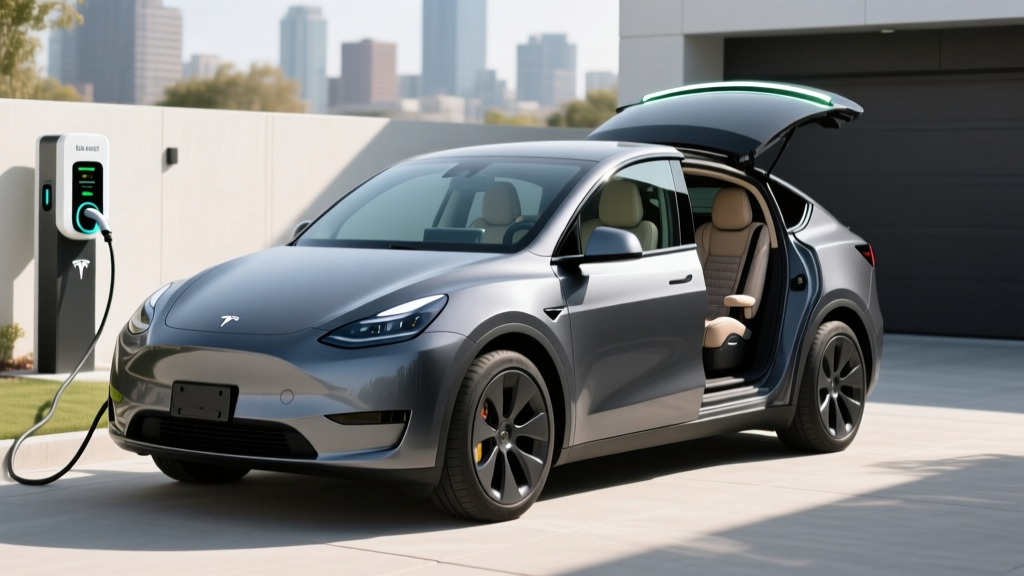
The 2026 Model Y uses the NACS (North American Charging Standard) connector natively — no adapter needed. This gives it direct access to Tesla's Supercharger network (over 25,000 stalls in North America) and, increasingly, to non-Tesla chargers adopting the NACS standard.
| Level | Power | Speed | Notes |
|---|---|---|---|
| Level 1 (120V) | ~1.4 kW | ~5 mi/hr | Emergency/trickle only |
| Level 2 (240V, 48A) | 11.5 kW | ~44 mi/hr | Full overnight charge in ~7.5 hrs |
| DC Fast (V3 Supercharger) | 250 kW peak | 10–80% in ~27 min | Peak holds to ~50% SoC, then tapers |
| DC Fast (V4 Supercharger) | ~250 kW | Similar to V3 | Newer stall design, cable management improved |
Charging curve reality check: The 250 kW peak rate applies only when the battery is preconditioned (via navigation to a Supercharger) and at a low state of charge. Expect peak rates between roughly 10–50% SoC. Above 60%, the rate drops significantly — from ~150 kW at 60% to under 50 kW past 85%. This is normal for NMC packs but means the last 20% of a charge takes disproportionately long. On road trips, the optimal strategy is charging to 80% and driving on.
For home charging, Tesla's Wall Connector ($420) or any J1772/NACS Level 2 unit on a 60-amp circuit (48A continuous) delivers the full 11.5 kW. Budget $800–$2,000 for professional installation depending on panel proximity and whether a service upgrade is needed, per Tesla's home charging guide.
Interior Space: The Third-Row Reality
Let's address the headline feature directly. The Model Y's optional third row is best described as occasional-use seating for children or compact adults on short trips. Here are the critical dimensions:
- Third-row legroom: ~26.5 inches — tight for adults, workable for kids under 5'4"
- Second-row legroom: ~38.0 inches (sliding seat, adjusted forward reduces this)
- Front-row legroom: ~41.8 inches
- Cargo behind 3rd row: ~12.0 cu ft (enough for a couple of backpacks or a stroller frame)
- Cargo behind 2nd row (3rd row folded): ~30.2 cu ft
- Total cargo (all rear seats folded): ~72.1 cu ft
- Frunk (front trunk): ~4.1 cu ft
When the third row is in use, you lose most of the rear cargo area. This is the fundamental trade-off: you get seven seats or you get cargo space, but not both simultaneously. Families who regularly haul seven people and their gear should seriously consider the Kia EV9 (77.1 cu ft max cargo, genuinely adult-sized third row) or a three-row minivan.
The 2026 Juniper refresh brought a quieter cabin (acoustic glass all around), ventilated front seats, ambient lighting, and a rear-seat entertainment screen — improvements that address prior complaints about cabin noise and rear-seat comfort.
Performance, Ride & Driver Assistance
The dual-motor AWD powertrain delivers 384 horsepower and a 4.8-second 0–60 mph time, which is quick for a 7-seat SUV. The single-speed transmission means acceleration is linear and seamless. Ride quality improved with the Juniper update — softer damping and revised bushings reduce the crashiness over sharp bumps that plagued pre-2025 Model Ys.
Standard Autopilot includes Traffic-Aware Cruise Control and Autosteer (lane centering on highways). FSD Supervised adds automatic lane changes, Navigate on Autopilot (on/off-ramp management), traffic light and stop sign recognition, and city-street autosteer. It's impressive technology, but buyer expectations should be calibrated: you are supervising a capable assistant, not a chauffeur.
Pricing, Tax Credits & Ownership Costs
| Item | Cost |
|---|---|
| Model Y Long Range AWD (base) | $48,490 |
| 7-Seat Option | +$3,000 |
| Destination Fee | Included |
| Total MSRP (7-seat) | $51,490 |
| FSD Supervised (optional) | +$8,000 |
| As-Tested (w/ FSD, Red paint) | ~$61,490 |
Federal tax credit eligibility (§30D): The Model Y is assembled in Fremont, California, and Austin, Texas. Under current IRS §30D rules, eligibility for the full $7,500 credit depends on:
- MSRP cap: SUVs must be under $80,000 — the Model Y qualifies at all trims
- Buyer income cap: AGI ≤ $150,000 (single) / $300,000 (joint) / $225,000 (head of household)
- Battery sourcing: Critical minerals and battery component requirements phase in annually — Tesla's supply chain has largely met these thresholds, but confirm at point of sale as rules tighten each year
- Point-of-sale transfer: You can apply the credit as a down-payment reduction at the dealer (Tesla) rather than waiting for a tax refund
If eligible, the effective price of the 7-seat Model Y Long Range AWD drops to approximately $43,990 — making it one of the most affordable 7-seat EVs on the market. Consult a tax professional to confirm your personal eligibility, as individual circumstances vary.
5-year ownership snapshot: At $0.13/kWh (national average residential electricity), charging 12,000 miles/year costs roughly $437 annually. A comparable gas SUV at 25 MPG and $3.50/gallon costs $1,680/year in fuel — a savings of over $1,200/year or $6,200 over five years. Insurance for the Model Y averages 15–25% higher than a comparable gas crossover, per industry data, so factor that into your budget.
Pros, Cons & Who Should Buy
Pros
- Lowest entry price for a 7-seat EV (especially after $7,500 credit)
- Best-in-class efficiency (28 kWh/100 mi) keeps charging costs minimal
- Access to Tesla Supercharger network — the most reliable DC fast-charging ecosystem
- Strong performance (4.8s 0–60) and dual-motor AWD for snow/rain
- Juniper refresh improves ride comfort, cabin quietness, and rear-seat amenities
- Over-the-air updates continue adding features post-purchase
Cons
- Third row is child-only on short trips; adults will not fit comfortably
- Near-zero cargo space when all seven seats are in use (~12 cu ft)
- No Apple CarPlay or Android Auto — Tesla's proprietary infotainment only
- FSD remains an expensive add-on ($8,000) for a Level 2 system
- NMC battery requires 80% daily charge limit for longevity
- Insurance costs run higher than segment average
Who Should Buy the Model Y 3-Row?
Choose the Model Y 7-seat if: You need a third row 1–3 times per week for kids, want the lowest operating costs in a 7-seat EV, rely on road-trip charging infrastructure, and don't need substantial cargo space with all seats up.
Look elsewhere if: You regularly transport adults in the third row, need cargo room with seven passengers (Kia EV9), want Apple CarPlay/Android Auto, or prefer a traditional dealership experience with service loaners (Rivian R1S, Volvo EX90).
Frequently Asked Questions
What is the real-world range of the Tesla Model Y 7-seat?
The EPA rates it at 305 miles. In mixed real-world driving, expect 260–280 miles. Sustained highway driving at 75 mph drops this to roughly 230–250 miles. In freezing temperatures (below 30°F), range can fall to 195–220 miles due to cabin heating demands and battery chemistry limitations. Preconditioning the battery while plugged in mitigates some cold-weather loss.
How fast does the Model Y 3-row charge?
On a Tesla V3 Supercharger (250 kW), the 10–80% charge takes approximately 27 minutes with a preconditioned battery. At home on a 48-amp Level 2 charger (11.5 kW), a full charge from empty takes about 7.5 hours, adding roughly 44 miles of range per hour. On a standard 120V outlet (Level 1), expect only about 5 miles per hour — useful only for overnight top-ups.
Does the Model Y 7-seat qualify for the federal EV tax credit?
The Model Y qualifies under the MSRP cap (under $80,000 for SUVs). Buyer eligibility depends on income (≤$300,000 AGI for joint filers, ≤$150,000 single) and battery sourcing requirements that tighten annually. As of 2026, Tesla's supply chain has largely met the critical-mineral and battery-component thresholds, but always verify at the time of purchase. The credit can be applied at point of sale as a price reduction. See IRS §30D guidelines for current rules.
Is the Model Y 3-row worth buying versus competitors?
It depends on your third-row usage. The Model Y offers the best price point and charging network access for occasional 7-seat needs. The Kia EV9 provides a genuinely adult-usable third row and more cargo space but costs $5,000–$10,000 more and charges slower on non-Tesla networks. The Rivian R1S is far more capable off-road and spacious but starts above $75,000. For budget-conscious families who need extra seats occasionally, the Model Y 3-row is hard to beat.
Can adults sit in the Model Y's third row?
Technically yes, but with only ~26.5 inches of legroom, it's uncomfortable for anyone over about 5'4" for more than 15–20 minutes. It's designed primarily for children. If adult third-row comfort is a priority, test-sit in a Kia EV9 or Rivian R1S before committing.
What's the battery warranty on the Model Y?
Tesla covers the battery and drive unit for 8 years or 120,000 miles (whichever comes first) with a minimum 70% capacity retention threshold. This is competitive with the industry standard. NMC batteries in Teslas have shown average degradation of roughly 10–12% over the first 100,000 miles based on fleet data, meaning most owners will retain well above the warranty threshold.
Does the Model Y have Apple CarPlay or Android Auto?
No. Tesla uses its proprietary infotainment system exclusively. It includes built-in navigation, Spotify, Netflix/YouTube (when parked), and Bluetooth phone integration, but there is no smartphone projection. This is a dealbreaker for some buyers accustomed to CarPlay-based interfaces.