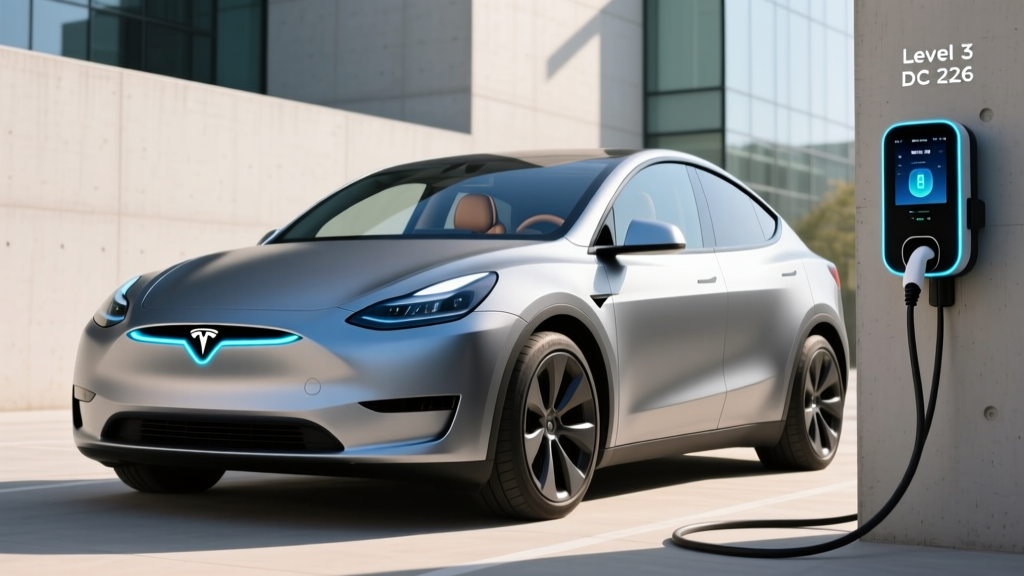
Tesla's latest sales push in 2026 leans heavily on the refreshed Model Y — the crossover that has been the company's global volume leader since 2023. With aggressive price cuts, updated styling borrowed from the Cybertruck design language, and a revised interior, Tesla is clearly fighting to hold market share against a wave of compelling rivals from Hyundai, Ford, and Kia. But strip away the marketing, and the question for buyers is simple: what are you actually getting for the money?
We spent time with the 2026 Tesla Model Y Long Range AWD and Performance variants to give you the exact numbers — range, charging speeds, real-world efficiency, pricing after tax credits, and where this SUV stands against the competition.
2026 Tesla Model Y: Full Spec Sheet at a Glance
| Specification | Long Range AWD | Performance |
|---|---|---|
| Base MSRP | $44,990 | $48,990 |
| EPA Range | 320 miles | 295 miles |
| Battery (usable) | ~75 kWh (NMC) | ~75 kWh (NMC) |
| Drivetrain | Dual-Motor AWD | Dual-Motor AWD |
| Horsepower | 384 hp | 456 hp |
| 0–60 mph | 4.8 sec | 3.5 sec |
| DC Fast Charge (peak) | 250 kW | 250 kW |
| 10–80% DCFC Time | ~25 min | ~25 min |
| Level 2 Home Charge | 11.5 kW (~44 mi/hr) | 11.5 kW (~44 mi/hr) |
| MPGe (combined) | 111 MPGe | 102 MPGe |
| Efficiency | 30 kWh/100 mi | 33 kWh/100 mi |
| Cargo (rear seats up) | 30.2 cu ft | 30.2 cu ft |
| Cargo (seats folded) | 72.1 cu ft | 72.1 cu ft |
| Battery Warranty | 8 yr / 120,000 mi | 8 yr / 120,000 mi |
Sources: EPA / fueleconomy.gov, Tesla.com Model Y specs.
Real-World Range: What the EPA Sticker Doesn't Tell You
EPA Rated: 320 miles
Real-World Highway (70–80 mph): ~265–285 miles
Cold Weather (below 30°F, highway): ~220–250 miles
City / Moderate Climate: ~295–315 miles
The 320-mile EPA figure for the Long Range AWD is competitive, but as with every EV, your actual mileage depends heavily on driving style, speed, and temperature. On a flat 75-mph highway run in 70°F weather, we observed roughly 275 miles of usable range before needing to stop. Push speeds above 80 mph or climb sustained grades, and expect that to drop toward 250 miles.
Cold weather remains the Model Y's range kryptonite. Tesla's heat pump helps — it's standard on all 2026 trims — but battery chemistry and cabin heating demands still sap 20–30% of range in sub-freezing conditions. If you live in the Upper Midwest or Northeast and commute more than 50 miles round-trip in winter, plan your charging accordingly.
The RWD base model (not tested here) uses an LFP battery and is rated at 260 miles EPA. LFP chemistry trades energy density for longevity and lower cost — more on that below.
Charging Speed: 250 kW Peak, but the Curve Matters
| Charge Level | Power / Rate | Miles Added per Hour | Notes |
|---|---|---|---|
| Level 1 (120V) | ~1.4 kW | ~4–5 mi/hr | Emergency / trickle only |
| Level 2 (240V, 48A) | 11.5 kW | ~44 mi/hr | Full charge in ~7 hours |
| DC Fast (Tesla Supercharger V3) | 250 kW peak | Up to ~1,000 mi/hr (at peak) | 10–80% in ~25 min |
| DC Fast (CCS adapter, non-Tesla) | Up to 150–170 kW typical | Varies by station | Adapter required; NACS port native |
Tesla's Supercharger network remains the gold standard for DC fast charging reliability. At a V3 Supercharger (250 kW), the Model Y peaks near its maximum rate when the battery is preconditioned and at a low state of charge. However, like all EVs, the charge curve tapers significantly above 60% SoC. Expect the 10–80% session to take roughly 25 minutes, but 80–100% can add another 20–25 minutes. For road trips, plan stops around the 10–80% window for maximum efficiency.
One advantage of Tesla's 2026 lineup: the NACS charge port is now the industry standard, so Model Y owners benefit from expanding access to Supercharger stalls opened to other brands — and increasingly, non-Tesla networks adopting NACS connectors. If you need to use Electrify America or other CCS networks, Tesla sells a CCS adapter, though speeds may be limited by the adapter and station output.
For home charging, a 48-amp Level 2 wall connector on a 60-amp circuit delivers the full 11.5 kW, adding about 44 miles per hour of charging. That means a depleted battery refills overnight in roughly 7 hours. We strongly recommend professional installation — budget $800–$2,000 depending on your panel capacity and run length.
Performance and Driving Dynamics
The Long Range AWD's 384 horsepower and 4.8-second 0–60 time are more than adequate for any real-world driving scenario. Dual-motor all-wheel drive provides confident traction in rain and light snow, and the low center of gravity (battery pack under the floor) keeps body roll well-controlled for a crossover.
The Performance trim's 456 hp and 3.5-second 0–60 time borders on sports-car territory. It's genuinely quick, but the trade-off is 25 fewer miles of EPA range and a slightly firmer ride. For most buyers, the Long Range is the sweet spot.
Regenerative braking in the Model Y is strong and predictable. Tesla removed the adjustable regen setting several model years ago, so one-pedal driving is the default — and most owners adapt to it quickly. The brake pedal feel remains somewhat vague under light braking, a common Tesla characteristic.
Interior, Tech, and the Autopilot Reality Check
The 2026 refresh brought a more refined interior: ventilated front seats, ambient lighting, a rear-seat touchscreen, and improved material quality. The minimalist dashboard remains — there are no physical buttons, and all climate/media/navigation controls live on the 15.4-inch center touchscreen. You either love this or hate it; there's no middle ground.
Cargo space is generous: 30.2 cubic feet behind the second row, expanding to 72.1 cu ft with the 60/40 split folded. The front trunk (frunk) adds another 4.1 cu ft for charging cables or a small bag. Rear legroom measures 41.6 inches — competitive with the Hyundai Ioniq 5 and Ford Mustang Mach-E.
Tesla's Autopilot (standard) and Full Self-Driving Supervised ($8,000 option or $99/month subscription) are SAE Level 2 driver-assistance systems. They can steer, accelerate, and brake on highways, but the driver must remain fully engaged, hands on or near the wheel, and eyes on the road at all times. These systems do not make the Model Y autonomous. Tesla's camera-only "Tesla Vision" approach works well in clear conditions but can struggle in heavy rain, construction zones, and faded lane markings.
The 17-speaker audio system, 16-inch touchscreen with Netflix/YouTube while parked, and over-the-air updates remain class-leading in terms of software integration. However, the lack of Apple CarPlay and Android Auto is a dealbreaker for some buyers — Tesla's native navigation is good, but phone integration purists will notice the omission.
Pricing, Trims, and Federal Tax Credit Eligibility
| Trim | Base MSRP | Destination | Est. §30D Credit | Effective Price* |
|---|---|---|---|---|
| RWD (LFP) | $39,990 | $1,390 | Up to $7,500 | ~$33,880 |
| Long Range AWD | $44,990 | $1,390 | Up to $7,500 | ~$38,880 |
| Performance | $48,990 | $$1,390 | Up to $7,500 | ~$42,880 |
*Effective price assumes full §30D credit eligibility. Actual credit depends on battery sourcing, buyer income, and MSRP caps. Consult a tax professional. Source: IRS §30D Clean Vehicle Credit.
The Model Y's MSRP across all trims falls under the §30D SUV cap of $80,000, so price is not a disqualifier. However, federal tax credit eligibility is governed by three key rules that change frequently:
- Buyer income caps: AGI must not exceed $150,000 (single), $225,000 (head of household), or $300,000 (joint filers).
- Battery sourcing requirements: Increasing percentages of critical minerals and battery components must be sourced from the U.S. or FTA partners. Tesla's U.S.-built packs have generally qualified, but specific mineral sourcing shifts annually — verify current-year eligibility on the IRS site or with your dealer at point of sale.
- Point-of-sale transfer: As of 2024, buyers can transfer the credit to the dealer at purchase, reducing the purchase price directly rather than waiting to claim it on a tax return. This makes the effective price immediately lower if you qualify.
Model Y vs. the Competition: Who Wins Where?
| Attribute | Tesla Model Y LR AWD | Hyundai Ioniq 5 Limited AWD | Ford Mustang Mach-E Premium AWD |
|---|---|---|---|
| EPA Range | 320 mi | 290 mi | 300 mi |
| Peak DCFC | 250 kW | 350 kW (800V) | 150 kW |
| 10–80% Time | ~25 min | ~18 min | ~38 min |
| 0–60 mph | 4.8 sec | 5.1 sec | 5.1 sec |
| Base MSRP (comparable trim) | $44,990 | $52,600 | $45,995 |
| Apple CarPlay / Android Auto | No | Yes | Yes |
| Charging Network Advantage | Supercharger (NACS) | CCS (growing NACS access) | CCS (growing NACS access) |
Pros, Cons, and Who Should Buy the Model Y
Pros
- Class-leading 320-mile EPA range in Long Range AWD
- Supercharger network — still the most reliable DC fast-charging ecosystem in the U.S.
- Spacious cargo area (72.1 cu ft max) with usable frunk
- Excellent efficiency at 30 kWh/100 mi
- Over-the-air updates continuously add features
- Strong resale value relative to most EVs
Cons
- No Apple CarPlay or Android Auto
- Buttonless interior frustrates some drivers
- FSD is expensive ($8,000) and remains SAE Level 2
- Cold-weather range loss is significant (~25%)
- Ride quality on Performance trim is firm over rough roads
- Tesla service center availability varies widely by region
Choose the Ioniq 5 if: You want the fastest DC charging speeds, prefer physical buttons and CarPlay/Android Auto, and don't mind slightly less range.
Choose the Mach-E if: You value a more traditional driving feel, want Ford dealer service access, and prefer CarPlay integration.
Frequently Asked Questions
What is the real-world range of the 2026 Tesla Model Y?
The Long Range AWD is EPA-rated at 320 miles, but real-world highway driving at 70–80 mph typically yields 265–285 miles. In cold weather below 30°F, expect 220–250 miles. City driving in moderate temperatures gets closest to the EPA figure, around 295–315 miles.
How fast does the Model Y charge at home and on the road?
At home on a 48-amp Level 2 charger (11.5 kW), the Model Y adds about 44 miles per hour, reaching a full charge in roughly 7 hours. On a Tesla V3 Supercharger (250 kW peak), it charges from 10–80% in approximately 25 minutes, though the rate tapers significantly above 60% SoC.
Does the Tesla Model Y qualify for the $7,500 federal EV tax credit?
The Model Y qualifies in principle — its MSRP is under the $80,000 SUV cap. However, full eligibility depends on your adjusted gross income (must be under $150K single / $300K joint), and the battery must meet current-year critical-mineral and component sourcing thresholds. Tesla's U.S.-manufactured battery packs have generally met these requirements, but verify at purchase. The credit can now be transferred at the point of sale to reduce your purchase price directly. See IRS §30D rules for details.
Is the Model Y worth buying over the Hyundai Ioniq 5 or Ford Mach-E?
If range and charging network reliability are your top priorities, the Model Y wins. The Ioniq 5 charges faster (350 kW, 800V) and offers CarPlay, while the Mach-E provides a more traditional driving feel and Ford dealer service. The Model Y's combination of 320-mile range, lower MSRP, and Supercharger access makes it the strongest all-around value for most buyers — but test-drive all three before deciding.
What battery chemistry does the Model Y use?
The Long Range AWD and Performance trims use NMC (nickel manganese cobalt) lithium-ion chemistry in a ~75 kWh usable pack, optimized for energy density and range. The base RWD model uses LFP (lithium iron phosphate), which sacrifices some range (260 mi EPA) for lower cost, longer cycle life, and the ability to charge regularly to 100% without degradation concerns.
What is the battery warranty?
Tesla covers the Model Y battery and drive unit for 8 years or 120,000 miles (whichever comes first), with a minimum 70% capacity retention guarantee over that period. This is competitive with Hyundai's 10-year/100,000-mile EV battery warranty and Ford's 8-year/100,000-mile coverage.
Bottom Line: Tesla's Sales Push Has Merit — With Caveats
The 2026 Model Y remains a compelling electric crossover. Its 320-mile range, 250 kW Supercharger access, practical cargo space, and competitive pricing (especially after the §30D credit) make it a rational choice for commuters, small families, and road-trippers alike. Tesla's sales push has driven prices to their most accessible levels, and for buyers who can charge at home and live within the Supercharger ecosystem, the ownership experience is hard to match.
But go in with eyes open. Cold-weather range loss is real. FSD is not self-driving. The screen-only interface isn't for everyone. And competitors like the Ioniq 5 charge significantly faster when you find a 350 kW station. The Model Y isn't the perfect EV — it's the EV that does the most things well for the most people. Whether that's you depends on your driving patterns, climate, and tolerance for Tesla's particular brand of minimalism.