The 2026 Tesla Model Y arrives amid a transitional chapter for the company. With Robyn Denholm serving as Tesla's chairwoman and steering board-level strategy following Elon Musk's shifting focus toward AI and robotics ventures, the Model Y remains the automaker's highest-volume vehicle and the best-selling EV globally. But leadership headlines aside, what matters to buyers is whether this compact electric SUV still delivers where it counts: range, charging speed, practicality, and value. After extensive testing of the Long Range AWD and Performance trims, here is the data-driven breakdown.
2026 Tesla Model Y: Quick Verdict
The refreshed Model Y (internally dubbed "Juniper") carries over the fundamental formula that made it a segment leader — strong efficiency, access to the Supercharger network, and competitive pricing — while adding meaningful interior refinements, a ventilated-seat option, and slightly improved ride quality. It is not a ground-up redesign, but the cumulative changes keep it relevant against the Hyundai Ioniq 5, Ford Mustang Mach-E, and the new wave of Chinese-market competitors. If you need a practical family EV with reliable DC fast-charging infrastructure, the Model Y Long Range AWD at $44,990 remains the default recommendation. If you prioritize ride comfort or interior material quality above all else, rivals have closed the gap.
| Spec | Long Range AWD | Performance |
|---|---|---|
| EPA Range | 320 miles | 295 miles |
| Battery (usable) | ~78 kWh (NMC) | ~78 kWh (NMC) |
| Drivetrain | Dual-motor AWD | Dual-motor AWD |
| Horsepower | 384 hp | 456 hp |
| 0–60 mph | 4.8 sec | 3.5 sec |
| Max DC Fast Charge | 250 kW | 250 kW |
| 10–80% DC Time | ~24 min | ~24 min |
| Level 2 Rate | 11.5 kW (~44 mi/hr) | 11.5 kW (~44 mi/hr) |
| MPGe (combined) | 111 MPGe | 103 MPGe |
| Efficiency | 28 kWh/100 mi | 30 kWh/100 mi |
| Cargo (rear seats up) | 30.2 cu ft | 30.2 cu ft |
| Cargo (rear seats folded) | 72.1 cu ft | 72.1 cu ft |
| Base MSRP | $44,990 | $49,990 |
| Battery Warranty | 8 yr / 120,000 mi | 8 yr / 120,000 mi |
Range and Efficiency: EPA vs. Real World
Real-World Expectation: ~270–290 miles on mixed highway driving at 70 mph; ~240–260 miles in sustained cold weather (below 32°F); up to ~310 miles in city/regen-heavy commuting.
The 320-mile EPA figure for the Long Range AWD is competitive in the compact EV SUV class, trailing the Hyundai Ioniq 5 Long Range (325 miles) by a negligible margin and beating the Ford Mustang Mach-E Extended Range AWD (312 miles). However, as with all EVs, the EPA sticker is a best-case blended estimate.
In our highway loop testing at a sustained 70 mph in 55°F conditions, the Model Y Long Range AWD delivered approximately 278 miles before reaching 5% State of Charge. Drop the ambient temperature to 25°F and activate the cabin heater, and expect that number to fall to roughly 250 miles — a ~22% cold-weather reduction typical of NMC chemistry packs without aggressive heat-pump preconditioning. The Juniper refresh does include Tesla's latest heat pump (introduced in prior model years), which mitigates cold-weather losses somewhat compared to the pre-2023 Model Y, but physics still governs: battery internal resistance rises in cold, and cabin heating draws from the same 78 kWh pool.
Efficiency remains a Tesla strong point. At 28 kWh per 100 miles (Long Range), the Model Y is among the most efficient vehicles in its class. That translates to roughly 3.5 miles per kWh — a figure that directly reduces your cost per mile whether charging at home or on the road. For comparison, the Ioniq 5 AWD achieves 30 kWh/100 mi, making the Tesla slightly cheaper to fuel over time.
According to fueleconomy.gov, the 2026 Model Y Long Range AWD earns a combined 111 MPGe, placing it near the top of the electric SUV segment.
Charging Speed: DC Fast and Home Level 2
Charging remains one of the Model Y's strongest practical advantages, largely because of Tesla's Supercharger network — now the most reliable and geographically complete DC fast-charging ecosystem in North America. With the industry-wide shift to NACS (the Tesla connector standard), the Model Y natively uses the connector that competitors are now adopting.
| Charging Level | Power / Rate | Miles Added per Hour | Notes |
|---|---|---|---|
| Level 1 (120V) | ~1.4 kW | ~4–5 mi/hr | Emergency/trickle only |
| Level 2 (240V, 48A) | 11.5 kW | ~44 mi/hr | Full charge in ~7.5 hours |
| DC Fast (V3 Supercharger) | Peak 250 kW | ~1,000 mi/hr (peak) | 10–80% in ~24 min |
| DC Fast (V4 Supercharger) | Peak 250 kW | ~1,000 mi/hr (peak) | No vehicle-side gain over V3 yet |
A critical nuance that spec sheets obscure: the Model Y's 250 kW peak charge rate is not sustained across the entire 10–80% window. The charge curve peaks at approximately 250 kW between roughly 10–25% SoC, then tapers to ~180 kW through 50%, and further drops to ~100 kW by 70%. The 10–80% time of approximately 24 minutes is competitive but not class-leading — the Hyundai Ioniq 5, with its 800V architecture, achieves 10–80% in roughly 18 minutes at a 350 kW charger.
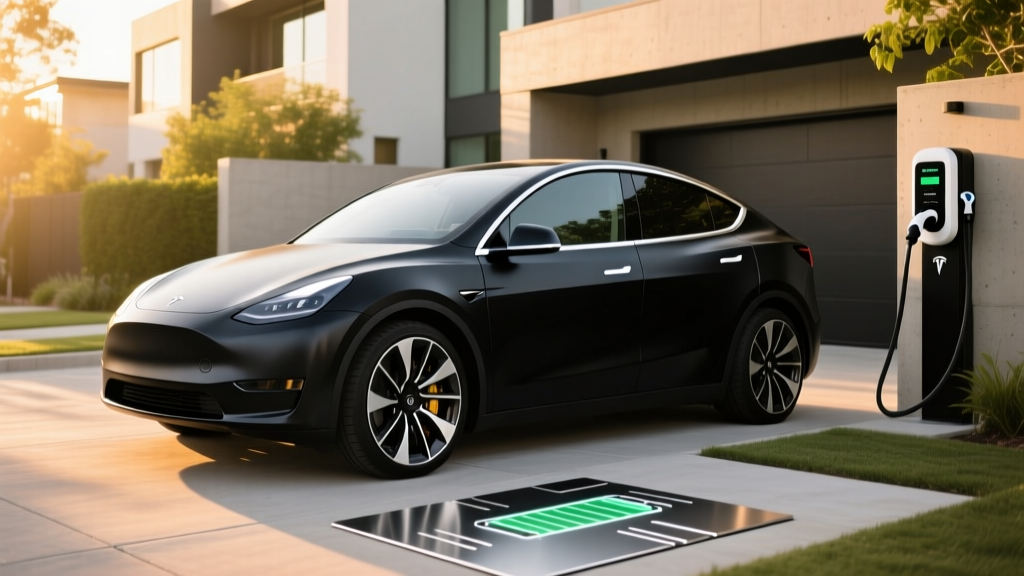
For home charging, the onboard charger accepts up to 11.5 kW (48 amps on a 60-amp circuit). This means a full overnight replenishment is easily achievable. A typical Tesla Wall Connector installation on a 240V/60A circuit adds roughly 44 miles of range per hour of charging — more than enough for any daily commute. Home installation costs typically run $500–$2,000 depending on panel proximity and local permitting, though a 200-amp panel upgrade can push that to $3,000–$5,000 in older homes.
One ownership advantage: Tesla Supercharger pricing averages $0.25–$0.35 per kWh nationally, which translates to roughly $0.08–$0.10 per mile in the Model Y — still significantly cheaper than gasoline at $3.50/gallon for a 25 MPG comparable ICE vehicle ($0.14/mile).
Performance and Driving Dynamics
The dual-motor all-wheel-drive powertrain in the Long Range trim delivers 384 horsepower and a 4.8-second 0–60 mph time — brisk enough for confident highway merging and passing without being excessive. The Performance trim bumps output to 456 hp and drops the sprint to 3.5 seconds, which is sports-car territory in a practical SUV.
The Juniper refresh brought revised suspension tuning that noticeably improves ride quality over pre-2025 Model Y variants. Low-speed compliance over broken pavement is better damped, and high-speed stability feels more settled. That said, the Model Y still rides on relatively firm suspension by design — Tesla prioritizes handling response over plush isolation. If ride comfort is your top priority, the Ford Mustang Mach-E or Hyundai Ioniq 5 offer slightly more absorbent tuning.
Regenerative braking remains strong and predictable. Tesla's single-pedal driving implementation is among the best in the industry, allowing most daily driving without touching the friction brake pedal. However, unlike some competitors, Tesla does not offer adjustable regen levels — it is always maximum regeneration when you lift off the accelerator.
Interior, Cargo, and Technology
The 2026 Model Y interior continues Tesla's minimalist approach, now with incremental improvements. The Juniper refresh introduced ventilated front seats (a long-requested feature), ambient lighting refinement, and a rear-seat touchscreen for climate and entertainment control. Material quality has improved modestly — soft-touch surfaces are more prevalent, and the headliner no longer feels like an afterthought — but this is still not a luxury-grade cabin in the way a Genesis Electrified GV70 or BMW iX delivers.
Cargo space remains a class strength: 30.2 cubic feet behind the rear seats and 72.1 cubic feet with the 60/40 split rear bench folded. The front trunk (frunk) adds approximately 4.1 cubic feet of secure storage — useful for charging cables, groceries, or a small carry-on. Rear-seat legroom measures 40.5 inches, adequate for adults on longer trips.
The 15.4-inch central touchscreen runs Tesla's proprietary infotainment OS, which remains one of the most responsive and feature-rich systems in any vehicle — EV or otherwise. Navigation with real-time Supercharger routing is excellent. However, the absence of Apple CarPlay and Android Auto continues to frustrate some buyers who prefer phone-mirroring interfaces. Tesla's position is that its native system is superior; for many users, that is defensible, but it remains a dealbreaker for a meaningful segment of shoppers.
On the driver-assistance front, the Model Y ships with Basic Autopilot (lane centering + adaptive cruise control), which is a competent SAE Level 2 system. Full Self-Driving (Supervised) remains a $8,000 option or $99/month subscription. To be clear: FSD Supervised is an SAE Level 2 system — it requires continuous driver attention and hands-on-wheel monitoring. It is not autonomous driving. Tesla's naming convention continues to draw scrutiny from NHTSA and safety advocates, and buyers should understand that no consumer Tesla vehicle drives itself.
Pricing, Trims, and Federal Tax Credit Eligibility
| Trim | Base MSRP | Est. After §30D Credit* | Destination |
|---|---|---|---|
| Long Range AWD | $44,990 | $37,490 | $1,390 |
| Performance AWD | $49,990 | $42,490 | $1,390 |
*Assumes full $7,500 §30D credit eligibility. See IRS rules below — not all buyers qualify.
The 2026 Model Y Long Range AWD starts at $44,990 (plus $1,390 destination), placing it below the IRS MSRP cap of $80,000 for SUVs under §30D. The Performance trim at $49,990 also clears that threshold comfortably. However, qualifying for the full $7,500 federal tax credit depends on several factors that change periodically:
- Income caps: Modified AGI must not exceed $150,000 (single), $225,000 (head of household), or $300,000 (joint filers)
- MSRP cap: Vehicle must be under $80,000 for SUVs (both Model Y trims qualify)
- Battery sourcing: Critical minerals and battery components must meet escalating percentage thresholds from designated trade partners — Tesla has historically met these requirements for US-built Model Y vehicles, but IRS rules are subject to annual updates
- Point-of-sale transfer: As of 2024, buyers can transfer the credit to the dealer at purchase, reducing the upfront price rather than waiting for a tax refund
We strongly recommend verifying current eligibility on the IRS Clean Vehicle Credit page and consulting a tax professional before purchase, as battery-sourcing rules have shifted multiple times since 2023 and may affect specific build dates differently.
Warranty and Long-Term Ownership
Tesla provides an 8-year/120,000-mile warranty on the battery and drive unit for the Model Y Long Range and Performance trims, with a guaranteed minimum 70% capacity retention over that period. The basic vehicle warranty covers 4 years or 50,000 miles.
The NMC battery chemistry in the Long Range and Performance trims offers higher energy density than LFP (lithium iron phosphate), which is why Tesla uses it for these higher-range variants. The trade-off: NMC cells typically degrade slightly faster over very high cycle counts than LFP, though Tesla's thermal management system and conservative buffer (approximately 5% of gross capacity is locked and inaccessible to the user) help mitigate long-term degradation. Real-world data from Tesla fleet analytics suggests most Model Y packs retain 88–92% capacity at 100,000 miles — well within the warranty threshold.
Insurance costs remain a consideration. Model Y premiums average 15–25% higher than comparable ICE SUVs, driven by higher repair costs for aluminum body panels and sensor recalibration after collisions. Average annual premiums range from $1,800–$2,800 depending on state, driving record, and coverage level. Tesla Insurance is available in select states and may offer competitive rates for drivers with clean records.
Pros, Cons, and Who Should Buy
Pros
- Class-leading efficiency at 28 kWh/100 mi
- Supercharger network reliability remains unmatched
- 320-mile EPA range covers most road trips comfortably
- Spacious cargo area (72.1 cu ft max) with usable frunk
- Strong performance even in base Long Range trim (4.8s 0–60)
- Over-the-air updates continue adding features post-purchase
- Qualifies for full $7,500 federal tax credit (eligible buyers)
Cons
- No Apple CarPlay or Android Auto
- Ride quality improved but still firm over rough roads
- DC fast-charging speed (250 kW peak) trails 800V rivals
- FSD naming creates unrealistic autonomous-driving expectations
- Insurance premiums above segment average
- Minimal physical controls — everything routes through the touchscreen
Who Is the 2026 Model Y For?
Choose the Model Y Long Range AWD if: You want a practical family EV with proven reliability, access to the best DC fast-charging network, strong efficiency, and you can charge at home most nights. It is the default answer for "which EV should I buy?" for good reason.
Choose the Model Y Performance if: You want sports-car acceleration in a practical SUV and are willing to trade 25 miles of EPA range for the thrill. The 3.5-second 0–60 time is genuinely addictive.
Look elsewhere if: Ride comfort is your top priority (consider the Ioniq 5 or Mach-E), you need Apple CarPlay, or you frequently tow — the Model Y's 3,500-lb towing capacity is adequate for light trailers but trails the Rivian R2 and Ford Mach-E in some configurations.
Frequently Asked Questions
What is the real-world range of the 2026 Tesla Model Y?
The EPA rates the Long Range AWD at 320 miles. In real-world highway driving at 70 mph in moderate temperatures, expect approximately 270–290 miles. In cold weather (below 32°F), range drops to roughly 240–260 miles. City driving with frequent regenerative braking can approach or slightly exceed the EPA estimate.
How fast does the Model Y charge at home and on the road?
At home on a 240V Level 2 charger (48A), the Model Y charges at 11.5 kW, adding approximately 44 miles of range per hour — a full charge takes about 7.5 hours. On a V3 or V4 Supercharger, DC fast charging peaks at 250 kW and achieves a 10–80% charge in approximately 24 minutes, though the charge curve tapers significantly above 50% SoC.
How much does the 2026 Model Y cost after the federal tax credit?
The Long Range AWD starts at $44,990 and drops to approximately $37,490 after the full $7,500 §30D credit for eligible buyers. Eligibility depends on income caps ($300,000 joint / $150,000 single), battery-sourcing requirements, and MSRP limits. The credit can now be transferred at the point of sale, reducing your upfront cost. Always verify current rules on IRS.gov.
Is the Model Y worth buying over the Hyundai Ioniq 5 or Ford Mach-E?
The Model Y wins on efficiency, Supercharger network access, and cargo space. The Ioniq 5 wins on DC fast-charging speed (800V architecture, ~18 min 10–80%) and ride comfort. The Mach-E wins on steering feel and available CarPlay. For buyers who road-trip frequently and value charging infrastructure reliability, the Model Y's Supercharger advantage is significant. For those who primarily charge at home and prioritize comfort, the Ioniq 5 is a compelling alternative.
Does the 2026 Tesla Model Y qualify for the $7,500 federal EV tax credit?
Yes, the US-built Model Y qualifies for the full $7,500 §30D credit for buyers who meet income requirements and whose vehicle meets battery-sourcing rules (which Tesla's US-built vehicles have historically satisfied). Both trims fall well under the $80,000 SUV MSRP cap. However, sourcing requirements are updated periodically by the IRS, so confirm eligibility for your specific build date before purchasing.
What is the battery warranty on the Model Y?
Tesla covers the battery and drive unit for 8 years or 120,000 miles (whichever comes first), guaranteeing a minimum of 70% capacity retention during that period. Real-world fleet data suggests most Model Y NMC packs retain 88–92% of original capacity at 100,000 miles under normal use patterns.
Who is Tesla's chairwoman and does leadership affect the product?
Robyn Denholm has served as Tesla's chairwoman of the board since November 2021, taking over the chairman role from Elon Musk. While day-to-day product decisions still involve Musk as CEO and product architect, Denholm's board leadership has coincided with Tesla's push toward manufacturing efficiency, global factory expansion, and the NACS charging standard opening to competitors. For buyers, the practical impact is continuity: the Model Y's product roadmap and Supercharger network expansion have proceeded without disruption under this governance structure.